Dian Darina Indah Daruis, Fatin Humaira' Mohd Naim (2026). An Illumination Study on Floating Storage and Offloading Vessel. In: Physical Ergonomics and Human Factors. AHFE Open Access, vol. 223, pp. 56–66. https://doi.org/10.54941/ahfe1007796
There are a few floating storage offshore (FSO) facilities operating in Malaysian waters. Thisstudy was executed in one of the facilities 170 km from the East Coast of PeninsularMalaysia. The objective of this study is to investigate the lighting at the workplace at the FSOand to compare it with the recommended requirements of the Department of Safety andHealth (DOSH) Malaysia. Based on the calculated room index for each compartment, a totalof fifty-four (54) points were identified for illuminance measurement. Four representative points were selected for specific tasks/activities measurements. A total of forty-eight (48) accessibleindoor locations were measured to investigate the adequacy of the lighting (illuminance)inside the accommodation section and a few of the workshops. More than 50% of themeasured locations (i.e., twenty-eight (28) out of forty-eight (48)) were found to be recordedwith illumination below the recommended levels. The general lighting at three critical areaswas found to be low, from 17 to 109 lux. However, all three places use localized light thathas more than enough lux. At the same time, it was found that all desktop activities at thestudied locations did not manage to achieve the minimum recommended illumination levels.As for activities inside the workshops, specific tasks are supplemented with task lights. Due to this, the specific activities were found to meet the minimum illumination recommendationbased on the activities performed, even though the general lighting of each workshop wasfound to be below the recommended illumination levels.
Inadequate illuminance in workplaces of various backgrounds is common, often below 300-500 lux standards and always associated with discomfort and reduced productivity (Barjoee and Grigorievich, 2024; Osemudiamen and Stanley, 2023; Zhang et al., 2023; Lu et al., 2020). An illumination study was conducted on a Floating & Storage Offshore (FSO) vessel, located approximately 170 km off the east coast of Peninsular Malaysia at the Dulang field, Terengganu, Malaysia. A total of forty-eight (48) accessible indoor locations were measured to assess the adequacy of lighting (illuminance) in the accommodation building and the workshops. This is a good initiative taken by the management to ensure good lighting at the workplace for the occupants.
An Illumination Study on Floating Storage and Offloading Vessel 57 The illumination study was conducted during normal working hour with the following objectives; to investigate the illuminance intensity (lux readings) at the workplace as well as the selected indoor locations on the FSO, to identify the potential hazards arising from the work activity under the current lighting condition in the workplace, such as insufficient illumination, glare or flicker and finally to compare the measured lighting levels with the recommended lighting requirement listed in the Guidelines on Occupational Safety and Health for Lighting at Workplace (DOSH, 2018).
WORKPLACE ILLUMINATION Effective workplace illumination is significant for productivity, and occupational safety and health. Compliance with regulations and standards is also foremost for industries. The most referenced and common regulatory standards for illumination in the literature are the Big Three standards: the International Organization for Standardization (ISO 8995-1/ CIE S 008), (ISO/CIE 2025), IES Lighting Library ANSI/IES RP-7-21 (2021) and EN 12464-1:2021 (2021). Different regions of the world approach regulations, recommended practices, and standards differently (Stefani and Cajochen, 2021). In Malaysia, with the enforcement of the Occupational Safety and Health (Amendment) Act 2022 on June 1, 2024, the prescriptive lighting requirements of the repealed Factory Machinery Act 1967 have been replaced by a risk-based approach under Section 18B (Risk Assessment) of the amended Act. OSHA provides minimum illumination values expressed in foot-candles, typically ranging from 3-30 foot-candles, depending on the task or environment, which can be converted to 32-323 lux (OSHA, 2024). ISO 8995-1/ CIE 008/E adopts a more ergonomically oriented approach, which is based not only on illuminance but also on visual comfort factors such as glare control, luminance distribution, task complexity, and colour rendering quality (ISO, 2025).
Other than that, the Department of Safety and Health, Malaysia (DOSH, 2018)’s Guidelines on Occupational Safety and Health for Lighting at Workplace 2018, emphasizes the need for employers to provide appropriate artificial lighting to prevent accidents, discomfort, and long-term health impacts caused by illumination. It is stipulated that there must be sufficient light in the workplace to ensure the safety and health of every employee. It is also said that the lighting should enable employees to comfortably see what they need to see while performing their tasks. Certain activities, such as office work, industrial tasks, and healthcare settings, require specific illuminance levels ranging commonly between 150 and 500 lux to ensure safety, comfort, and accuracy. In addition, the OSHA (2022) mentioned that compliance is no longer just about “having a lightbulb”; it’s about proving through risk assessment that your lighting is suitable and sufficient for the specific task being performed.
Comparing the three documents, DOSH aligns more with ISO principles in emphasizing worker wellbeing and appropriate illuminance levels, while OSHA serves as a regulatory baseline with minimum foot-candle thresholds for safety.
Illumination Study at Floating Storage Offshore, East Coast Malaysia The assessment for this study was carried out on a Floating Storage Offshore (FSO) that was built in 1991. She has 15 cargo tanks capable of storing at least 134,000 m3 of cargo and is equipped with facilities to tandem moor offtake tankers at her stern. Her designed loading rate is 3,300 m3 per hour. The FSO is designed to accommodate shuttle tankers with a maximum size of 85,000 deadweight tons (DWT) alongside and 150,000 DWT in tandem. She is equipped with the necessary accommodation and life support facilities for 60 persons. Due to operational constraints, the researchers were only able to conduct objective measurements in this study, as the limited time available did not permit the inclusion of subjective evaluations of the workers’ perceptions.
The Accommodation Building in the FSO places the offices, control room, radio room, sickbay, bedrooms, galley, kitchen, recreational room, as well as the prayer room. There are also workshops and equipment/chemical storage areas on the lower levels of the accommodation building. The data collection was done focusing on the indoor workplaces (i.e., control room, office, and workshops) as well as the selected indoor spaces. The illumination study was conducted in two approaches: walkthrough inspections and lighting measurement, as suggested by the Guidelines (DOSH, 2018). There were two types of lighting measurements: general lighting in the general area and specific task or activity lighting at workstations. The room index is used to determine the number of measurement points in particular work areas. Outdoor decks or open-ended corridors, or “non-enclosed areas,” were excluded, as the Room Index formula is technically only valid for enclosed rectangular spaces. Table 1 is referred to for the number of measurement points needed.
Room Index = (L+W)/(Hm (L+W) Eq. 1 Where, L : Length of room (m) W: Width of room (m) Hm: Height of lighting above the working plane (m)
From the illumination measurement, the uniformity of illuminance can be established, which is the ratio of the minimum to the average value. Depending on only the average illuminance may result in lower illuminance in certain areas and may be a threat to the safety of the employees in performing specific tasks. Hence, according to the Guidelines (DOSH, 2018), the uniformity of the illuminance should be no less than 0.5 for general lighting and no less than 0.7 for task or activity lighting. The relationship between the lighting of the work area and adjacent areas is also important. To avoid an unsafe working environment and workers’ discomfort, the maximum ratios as listed in Table 2 are used as a reference.
Illumination assessment for individual lighting requires measurement at the task position. Four (4) representative points were selected. The illuminance level at the centre of each area was measured. Lighting measurement was taken at the height of the work plane. For the task position at a computer workstation, two measurement points were taken at the keyboard position, which is 20 cm apart, and two other points on the top of the screen,
An Illumination Study on Floating Storage and Offloading Vessel 59 10 cm apart. The average of these measurements was then calculated as the average illuminance at the task position and was then compared with the recommended lighting requirement listed in the DOSH Guidelines (DOSH, 2018). The equipment used to measure the illuminance (lux levels) was a calibrated Lux Meter HD450 by Extech Instruments with a capacity of 0 – 400000 Lux and resolution of 0.1, 1, 10, and 100 Lux.
Table 1: Minimum number of measurement points for measuring average illuminance in rooms of different proportion (DOSH, 2018).
Table available in the original PDF paper.
Room Index Number of Measurement Points Below 1 4
1 and below 2 9
2 and below 3 16
Above 3 25
Table 2: Maximum ratio of illuminance (DOSH, 2018).
Table available in the original PDF paper.
Situations to Which Recommendation Applies Typical Location Maximum Ratio of Illuminance – Working Area
Local lighting in an office 5
each task is individually lit & the area around the task is lit to a lower illuminance
Localized lighting in a work store 5
two working areas are adjacent, but one is lit to a lower illuminance then the other
A storage area inside a factory & a loading bay outside 10
two working areas are lit to different illuminances & are separated by a barrier but there is frequent movement between them
RESULTS
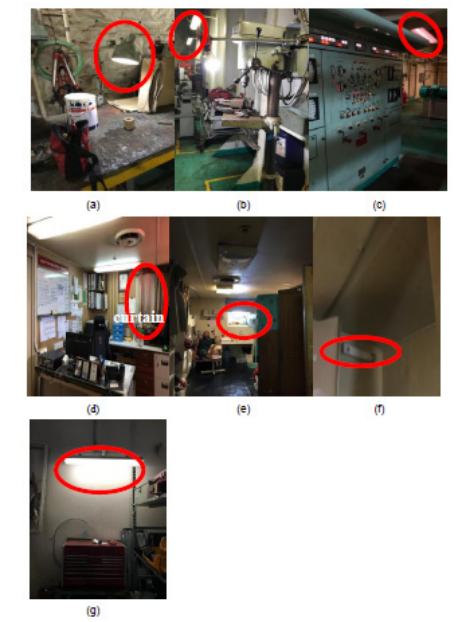
The first measurement was the general lighting carried out during the walkthrough inspection. Certain area such as in the workshops, have a combination of background lighting and localized/task lighting as shown in Figure 1(a) and (b). The task lights are adjustable and flexible, which allows for more visual comfort to the users while performing the specific detailing tasks. At several locations (i.e., near the boiler control panel as shown in Figure 1(c)), the fluorescent bulb for general lighting was removed and not replaced. Figure 1(d) showed a good practice where curtains were drawn to prevent glare. Figure 1(e) showed that one of the bedrooms (Room T) lacked general illumination due to blown bulbs. Occupants relied on natural lighting from the window for illumination. This can create a safety hazard (i.e., slip, trip, and fall, especially at nighttime). Inside certain bedrooms, as illustrated in Figure 1(f), the reading lights were not installed after being removed. At most of the storage areas, as shown in Figure 1(g), localized lightings were adopted due to the condition of the work areas.
Figure 1: Walkthrough inspection from points (a) to (g) covering the office, reception, and storage.
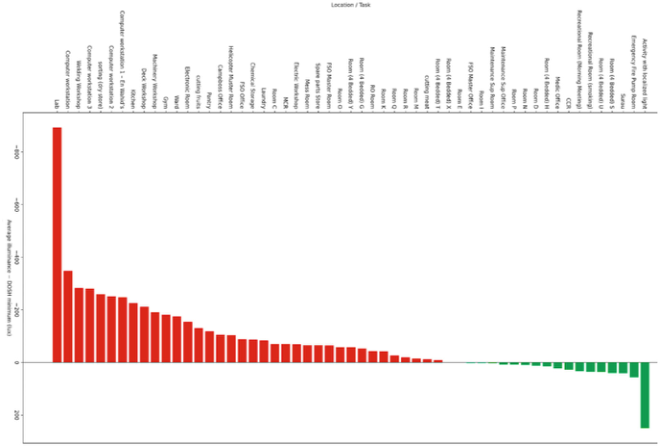
The detail result of the specific task/ activity are in the Appendix. Twenty (20) out of forty-eight (48) locations meet the average minimum recommended illumination (100 to 843 lux). All desktop activities at the studied locations did not achieve the minimum recommended illumination levels, with the lowest measurement at 51lux from Deck 1 (gaps from the Guidelines’ required lux between –70 to –349). As for activities inside the workshops, specific tasks are supplemented with task lights. Due to this, the specific activities were found to meet the minimum illumination recommendation based on the activities performed, even though the general lighting of each workshop was found to be below the recommended illumination level. The gap-to- standard, obtained by subtracting the DOSH (2018) minimum illuminance requirement from the measured average lux. As illustrated in Figure 2, the red bars indicate locations that did not meet the required lighting levels.
From 18 activities identified as critical, such as the Central Control Room, Medical office, Laboratory, Electronic, Electric, and Mechanical Workshops, were found to achieve the uniformity of illuminance as recommended by the Guidelines (DOSH, 2018), except for the computer workstation at the Camp Boss office, Ward room, and Deck workshop, as depicted in Table 3.
Figure 2: Gap- to-Standard by location/task.Table 3: Non-compliant uniformity of illuminance for critical activities.
Table available in the original PDF paper.
No. Location / Task
Recommended Ratio
Measured Illumination (Lux), Avg
Measured Illumination (Lux), Min
Uniformity of Illuminance
Compliancy Check (Yes/No)
1 Computer workstation
51 38 0.7 Not less than 0.7 No 3 Ward 124 50 0.4 Not less than 0.5 No
3 Deck Workshop
88 14 0.2 Not less than 0.5 No The relationship between the lighting of the work area/task and adjacent areas is important. For this study, there are three (3) locations applicable, which were identified during the site study as shown in Table 4.
Table 4: Illuminance ratio for locations of critical activities.
Table available in the original PDF paper.
Localized Light
Illuminance
(Lux)
General Lighting,
Avg (Lux)
Calculated
Illuminance
Ratio
Recommended
Maximum ratio
of illuminance
Compliancy
Check (Yes/No)
No
Task (Where Each Task is Individually Lit and the Area Around the Task is Lit to a Lower Illuminance)
549 17 32 5 No
1 Welding Activity with localized light (welding shop)
843 109 8 No
2 Precision machining, grinding, tool inspections etc. inside the machinery workshop
154 37 4 Yes
3 Deck workshop (workshop area vs surrounding)
Based on the results, the difference between light intensity during welding and machinery tasks using the task lights compared to the workshop’s general lighting was found to be quite significant. This can cause eye discomfort as well as the potential for accidents if the condition is not addressed. Table 5 shows the correlation between the calculated Room Index and the measured average illuminance (lux). Some locations were excluded from the analysis where a Room Index could not be accurately determined due to irregular spatial dimensions. Four locations met the threshold for medium-to-high correlation: Deck 4, Deck 1, the Main Deck, and the Machinery Deck (r values ranging from 0.6 to 0.9, the latter showing a negative correlation).
Generally, burned-out lamps in several low-illumination areas should be replaced promptly, and this should be incorporated into the standard operating or safety procedures of the FSO. Fluorescent lamps with the highest luminous flux are recommended for areas involving desktops and other critical activities. Some locations, such as the deck workshop and ward at the main deck, have poor luminance uniformity, which may indirectly make it difficult to navigate or perform tasks safely. Proper lighting positions are important to ensure optimal lighting at workstations; thoughtful planning and design of lighting layouts should be considered. In summary, the uniformity and illuminance ratio can be improved by implementing technical solutions (e.g., replacing failed lamps, installing higher intensity lighting, and optimizing luminaire spacing and layout), environmental improvements (including wall/ceiling reflectance and glare/contrast control), and systematic management practices such as regular maintenance and periodic lighting audits.
Table 5: Correlation between room index and average Lux.
Deck 1 0.67 Moderate-Strong Positive Main Deck 0.75 Strong Positive
Machinery Deck −0.95 Strong Negative Comparison of the collected data against MS EN 12464-1:2022 reveals a significant ‘performance gap.’ While areas like the Maintenance Sup Office (208 lux) meet the DOSH 2018 minimum safety requirement of 200 lux, they fall nearly 60% short of the 500 lux international benchmark (the ISO 8995-1 / CIE S 008) required for sustained clerical work and visual comfort. This suggests that while the facility may be safe by local guidelines, it is suboptimal for visual performance and worker alertness.
Traditional standards focus on visual performance, such as lux and uniformity; however, contemporary approaches include non-visual effects and higher, adjustable illuminance for well-being, especially for aging workers
An Illumination Study on Floating Storage and Offloading Vessel 63 (Barjoee and Grigorievich, 2024; Stefani and Cajohen, 2021). An empirical study by Lu et al. (2020) suggested that higher illuminance improves comfort, visual performance, some cognitive functions, and perceived productivity, although it is agreed that optimal levels vary by task type. Therefore, future investigations should incorporate workers’ perspectives and experiences. The 2024–2026 revisions for ANSI/IES RP-7-21, for example, now place a heavy emphasis on Human-Centric Lighting (HCL), which mimics natural daylight cycles to improve worker alertness and sleep quality.
CONCLUSION
Most locations were found to have low average illumination intensity, as tabulated in the Appendix, with the lowest level at 13 lux. Twenty-eight of forty-eight measured locations were below the recommended values. Based on the illuminance uniformity for the critical activities, three non- compliances were identified, namely, the workstation at Camp Boss office, Ward room, and Deck workshop, with average illumination measured at 51 lux, 124 lux, and 88 lux, respectively. Poor uniformity or bright spots next to dim areas forces the eye to continuously adjust between luminance levels, causing visual strain, reduced sustained attention, faster fatigue, and a likelihood of human error. Whilst high contrast illuminance ratios, such as at the welding shop and machinery workshop, can introduce distracting shadows over work surfaces, glare reduces visibility and veiling luminance, which masks critical visual cues.
To address the 58% non-compliance rate identified, a phased remediation strategy is proposed. Priority 1 (high) focus shall be given to the Welding Shop and Machinery Workshop; despite being critical task zones, current illuminance ratios pose an immediate safety risk through veiling luminance and shadow masking. Implementation should follow a ‘Low-Cost/High-Impact’ model: first, an immediate maintenance cycle to clean fixtures (potentially recovering 15% of lost output), followed by the installation of localized task lighting at workstations (Priority 1 (high) to bridge the gap between the measured 51–124 lux and the mandated 300+ lux. High-cost capital replacements should be reserved for the Deck Workshop, where structural shadows require a redesign of the luminaire layout to achieve the required uniformity (Uo ≥ 0.40).
ACKNOWLEDGMENT
The authors would like to acknowledge the contribution of Ms Farah Sapihie, the research assistant who collected the data on site.
and simulation analysis of illumination for workers wellbeing in the workplace”. Heliyon, 10. https://doi.org/10.1016/j.heliyon.2024.e40745.
Department of Safety and Health Malaysia (DOSH) (2018) Guidelines on Occupational Safety and Health for Lighting Workplace 2018. European Committee for Standardization. (2021). Light and lighting - Lighting of work
places - Part 1: Indoor work places (EN 12464-1:2021). Brussels, Belgium: CEN. International Organization for Standardization (2025). ISO.CIE 8995-1:2025 Light and Lighting – Lighting of Work Places Part 1: Indoor. Lu, M., Hu, S., Mao, Z., Liang, P., Xin, S., & Guan, H. (2020). “Research on work
efficiency and light comfort based on EEG evaluation method.” Building and Environment, 183, 107122. https://doi.org/10.1016/j.buildenv.2020.107122. Osemudiamen, E., & Stanley, E. (2023). “Assessment Of Illuminance and Related Health Effects in Some Departments Within a University Environment”. Dutse Journal of Pure and Applied Sciences. https://doi.org/10.4314/dujopas.v9i2b.32. Occupational Safety and Health Standards for Shipyard Employment (2011) 29 CFR
1915.82. https://www.osha.gov/laws-regs/regulations/standardnumber/1915/1915.82 Occupational Safety and Health (Amendment) Act 2022 (Act A1648). (OSHA, 2022). https://intranet.dosh.gov.my/competent-person-form/occupational-health/ regulation-2-1/acts/4777-akta-keselamatan-dan-kesihatan-pekerjaan-pindaan- 2022-akta-a1648-3?path=regulation-2-1/acts Stefani, O., & Cajochen, C. (2021). “Should We Re-think Regulations and
Standards for Lighting at Workplaces? A Practice Review on Existing Lighting Recommendations”. Frontiers in Psychiatry, 12. https://doi.org/10.3389/ fpsyt.2021.652161. Zhang, X., Qiao, Y., Wang, H., Wang, J., & Chen, D. (2023). “Lighting environmental assessment in enclosed spaces based on emotional model”. Science of The Total Environment; Volume 870, No. 161933. https://doi.org/10.1016/j. scitotenv.2023.161933.
37 Ward 1.81 9 124 300 No 38 Laundry 2.05 16 216 300 No
39 Lab 1.50 9 107 1000 No
- 16 256 200 Yes
40 Emergency Fire Pump Room
41 Deck Workshop - 16 88 300 No
Machinery Deck
42 MCR - 16 129 200 No
43 Electronic Room - 16 145 300 No
44 Electric Workshop - 16 130 200 No
45 Welding Workshop - 16 17 300 No
4 549 300 Yes
Activity with localized light
46 Machinery Workshop - 16 109 300 No
4 843 750 Yes
Activity with localized light
47 Chemical Storage - 16 13 100 No
48 Spare parts Store - 16 34 100 No
LISTED IN THE AHFE DIGITAL BOOKSTORE CATALOGUE
Explore the complete digital volume
Physical Ergonomics and Human Factors
Read this individual research paper free through the original publisher, or explore the full digital proceedings book.
ISBN 978-1-964867-99-1
Explore this ISBN in the AHFE Bookstore ↗Listed in the July 2026 bookstore catalogue; search by ISBN to confirm current availability · Digital book purchase optional