Karl Johan Klang, Rickard Lindkvist, Jörgen Karlsson, Thomas Elwinger, Carl Westin, Jonas Lundberg (2025). The Remote Support Centre – an Exploration of Technical Support and Coordination for Marine Archipelago Traffic. In: Advances in Human Factors of Transportation. AHFE Open Access, vol. 186, pp. 611–621. https://doi.org/10.54941/ahfe1006551
Three shipping companies for passenger traffic on the Swedish east and west coast took part in a participative design process generating seven scenarios during a research project from 2021-2024. The project addressed technical and operative challenges in setting up a Remote Support Centre (RSC) for marine archipelago traffic. One main technical challenge was to select among thousands of technical signals which can be transmitted from vessels, and decide which would be useful to send to a RSC. Using participative design in workshops and high-fidelity simulations, we identified needs and relevant parameters by recreating situations based on crew stories and experience. The RSC was installed in Stockholm, Sweden with three connected vessels. Our thesis - that marine archipelago traffic can be improved by making data available, processing and refining it, and delivered back to the onboard crew as decision assistance - was supported. Technical assistance from the RSC showed usefulness already in early live tests by enabling systematic checking of generators, alarms onboard, charging status of the batteries as well as initiating daily contact with the crew. The study also resulted in two tentative operative concepts for RSC services. Further development and testing of the concepts, exploration of useful information, design of RSC interfaces as well as assessment of economic aspects may be addressed in future studies.
There are several reasons and benefits with making technical and navigational data available in the maritime domain. According to Kirstein (2018), there is a huge potential to make marine logistics more efficient, reducing waiting times and delivery times into the harbour. Installation of sensors for data collection and analysis could impact the logistics process and provide new insights. The economic impact of remote analysis of technological data for larger oceanic transport is well established (OECD,
2017). The EU initiative Common Information Sharing Environment (CISE) strives to improve information sharing to enhance the maritime security among relevant stakeholders (European Commission, n.d).
In the aviation sector remote operative information service is common, for example in addition to control services smaller airports with Aerodrome Flight Information Service (Inoue, 2016; Procházka, 2013) can help airline pilots with weather and traffic information before landing and departure. Vessel Traffic Service Officers (VTSO) in the maritime domain also use voice communication to provide important and relevant traffic information in designated areas (Praetorius, 2012). Situation Awareness (SA) is a crucial component for successful decision-making and intervention (Endsley, 1995). Team Situation Awareness address the importance of verbal as well as non- verbal communications for sharing information, shared environment and screens (Endsley, 2021b), while the lack of shared environment, displays and non-verbal cues pose a risk for unclear task assignment, poor shared mental models, feedback, and individual SA. Lundberg (2015) emphasize that SA is not simply a state in the operator. It is a process of continuous information pick-up from the designed environment, and of communication and coordination with others, forming a larger SA system. As such, joint decision-making can be described for design and analysis as processes of perceiving, deciding, and acting (Lundberg and Johansson, 2021). Whilst maintaining the strengths of information mediated through voice communication, opportunities of the Internet of Things (IoT) may further improve proactivity and increase overall safety onboard (Kirstein, 2018). With 4G and 5G connection and equipment onboard ships such as RAKEL, Blueflow, Electronic Chart Display Information System (ECDIS), augmented cameras such as ABB Ability™Pilot Vision (ABB, n.d), ABB Ability™ OneBox (ABB, n,d), signals may be sent to a Remote Support Centre (RSC). Analysed and processed information can then be sent back to the crew onboard as decision support. Extracting technical signals and processing them at a remote location means opportunities – but also challenges in terms of deciding beforehand which signals to extract. Making data available may also be associated with security risks (Androjna, 2021) which need to be accounted for.
In this study we focus on potential and explore how a remote support centre (RSC) could support archipelago vessels operating on a strict timetable. Firstly, we present the seven scenarios developed in the project where a RSC could be of use, secondly, we share insights from testing four of these scenarios in a simulator environment shaping tentative operative concepts. Thirdly, we present the overarching outcome and usefulness of a RSC from a technical perspective.
The Research Project This paper describes the explorative process and results from a smaller scale Swedish research project conducted between 2021–2024. The project included a range of activities such as field visits onboard the vessels, invitation to training exercises, participative workshops and simulations, a study visit
The Remote Support Centre – An Exploration of Technical Support 613
to the SOS emergency alarm center and technical live tests with connected vessels. The strength of a smaller pilot project is that it offers the possibility to explore several aspects of remote services and assistance together with a good range of knowledge and expertise.
One main challenge was to extract information useful for time scheduled archipelago vessel crew. The idea is that marine archipelago traffic could be improved technically and operationally by making data available to a RSC and sent back to the ship as support, even if the ship is not in a VTS-area. Some examples of potential improvements are a) Navigation support - such as tracking ships to prevent collisions or grounding b) Vessel condition monitoring, maintenance and technical support c) Coordination with stakeholders c) Emergency support e) Significant weather warnings.
The expected effects of the provided services include:
Reduced costs for planned and unplanned maintenance, and avoiding breakdowns.
Reduced fuel consumption.
A coordinated and updated timetable, minimized delays, timed connections.
Balanced usage of routes during peak hours and summers to avoid overcrowded ferries.
Several stakeholders participated in the project, including three shipping companies consisting of one car ferry Tellus from Trafikverket Färjerederiet (Swedish Transport Administration Ferry Operations), and two passenger ferries, Kostervåg from Koster Marin AB on the Swedish west coast and Clara from Rederi AB Ballerina operating in Stockholm archipelago. In addition to the three shipping companies the stakeholders Carmenta Automotive, Sjöfartsverket (Swedish Maritime Administration), ABB and Linköping University took part. The participating stakeholders hold a broad range of experience in the maritime domain, as well as process industry and other industries.
The Connected Vessels The following vessels were connected to the ROC:
Tellus – car ferry, 297 passengers, 80 cars, built in 2019, 2.08 meters depth, charge hybrid.
Kostervåg – passenger ferry, 270 passengers, built in 2000, 1.48 meters depth, charge hybrid diesel with Danfoss electric engines (since 2022) with AGCO generators.
Clara – passenger ferry, 192 passengers, built in 2020, 1.85 meters depth, charge hybrid diesel with two ABB generators.
In order to select appropriate signals and parameters, we explored the kinds of services for which a RSC could be appropriate. To adress this problem, we have conducted a human factors-based approach using participatory design to create scenarios with examples of relevant information to facilitate team situation awareness and decision making in these situations. The idea was that high-level categories could guide the
selection among the thousands of signals available. The attempt has been to bridge the gap between technical detail and operational use to explore possibilities and promote safety and efficiency onboard. Hjelseth (2015) used participatory design and 3D games to simulate scenarios in the maritime sector and demonstrated the potential of high-fidelity simulations compared to traditional methods for handling safety critical operations. Participatory design (Spinuzzi, 2004) can make tacit knowledge and experiences visible by reproducing previous situations, personal experiences and predict potentially hazardous future events.
METHODS
Initially, short telephone interviews of approximately 20 minutes were held with four skippers to scope situations, based on previous events or situations which were deemed as potentially very stressful and where assistance could be of use. In addition, potential scenarios were discussed at project meetings online and in Stockholm during the spring 2022. Based on the interviews and the project meetings, seven scenarios were drafted and summarized on approximately one page per scenario. All participants could contribute with ideas on equal terms in inclusive collaborative ways. Examples of realistic situations where remote support would have been appreciated were drafted as scenarios. In this process fictive but typical times and days were selected, for example a hot summer day in good weather and many passengers, or a foggy winter day with heavy rain and strong winds. The process of collaboratively analysing parameters and signals continued throughout the project.
In the next step we conducted participatory design workshops in simulators to explore how a new role of a shore-based RSC operator, responsible for monitoring several ships, could be of assistance in relation to efficiency and safety goals. Simulator sessions were conducted in four Wärtsilä NTPRO 6.00 high-fidelity simulators with radar and ECDIS screens at Trafikverket Färjerederiets training center in Solna during the fall 2023. Scenario 2, 3, 4 and 5 of operative character were selected for the simulations. Four workshops, one for each scenario, were held in the simulators to refine the scenarios in detail and explore where and when support from ashore could be helpful onboard. The aim was to find higher level categories of signals and when they could be useful for a RSC operative working position. In each simulation the participants consisted of one domain expert crew member or ship owner with a specific experience or vision of the scenario, one skipper familiar with the simulator, one technical expert, and one research leader. During two workshops the ship owner with specific knowledge participated remotely in a hybrid online setting with access to the simulator though camera and voice communication. The simulator scenarios were saved as.nti files enabling replay in the simulator for presentation and post-exploration of details and parameters of interest, as well as replaying multiple scenarios at the same time from the instructor position.
The Remote Support Centre – An Exploration of Technical Support 615
RESULTS
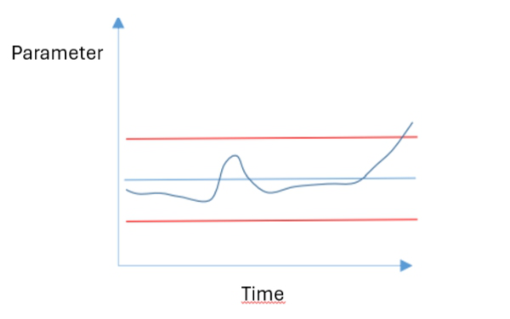
The scenarios included operational situations such as preventing collisions or grounding in poor visibility or stormy weather, but also to systematically monitor vessel status in the harbour for security reasons and technical functionality, for example the status of batteries, alarms and fluids containers. The safety of crew during peak seasons, i.e. midsummer, were discussed as well as communications between crew and a Remote Support Center (RSC). The process went from stories to scenarios and identified high level parameters of interest to monitor in a RSC. In the design process scenarios were iteratively modelled to a detailed level and relevant parameters and cues for decision making were discussed. The parameters and cues were envisioned to be monitored in the RSC according to pre-set values where a human operator would be notified if any irregular or unnormal values would occur, see Figure 1.
Figure 1: A parameter value changes over time. When it crosses a maximum, minimum value, or shows irregular patterns, the system notifies the human RSC operator.
The following seven scenarios were generated. Four scenarios (2, 3, 4, 5) were of operational character and three (1, 6, 7) focused on vessel monitoring, maintenance and passenger interaction.
1. Systematic scanning of parameters in the RSC A sudden change charging air temperature makes the operator attentive to a situation and continue to scan further parameters such as cooling water temperature and discovers an electric fault.
2. Poor visibility and heavy rain make navigation difficult Through unnormal rudder angles at the ferry Tellus the RSC operator detects the difficulty and can assist with navigation.
3. Navigation support during relocation Through sending and monitoring a route plan for the ferry Castella safe distance to shallow waters can be maintained.
4. High engine temperatures The vessel Clara is forced to stop due to high engine temperatures in between Nybroplan and Nacka, Stockholm, while a large cruise ship is passing nearby.
5. Stormy weather makes docking difficult The vessel Kostervåg is forced to anchor at a rocky position during stormy weather on the Swedish west coast. Focus is help with coordination and evacuation.
6. Surveillance of charging batteries during night Here the RSC operator follows standard monitoring procedures and systematic scan patterns during night when the vessel fleet is in the harbour. A low charging alarm triggers attention, and coordination with the night guard to check the vessel and make sure the batteries get charged is carried out.
7. Unruly passenger onboard A large group of drinking passengers enters Clara on midsummer eve. The security of passengers and crew onboard are in focus as well as subtle communication with the RSC through an alarm button.
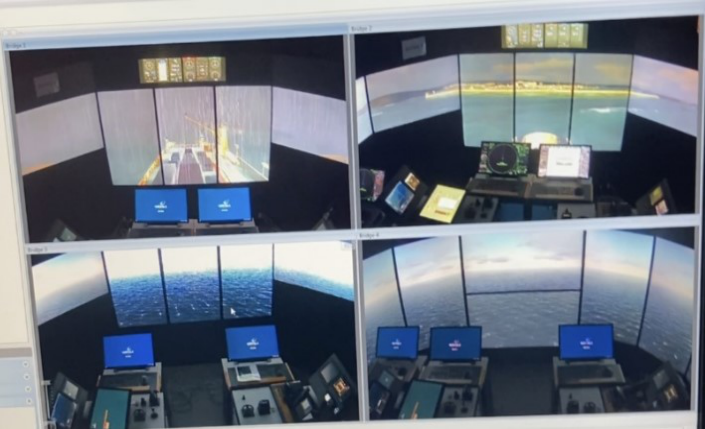
The RSC Simulations In an early version of a RSC, represented at the simulator instructors’ position, cameras were monitoring the situations on several vessels at the same time. In Figure 2 scenario 2 is displayed in the upper left corner and scenario 5 in the upper right corner.
Figure 2: Overview cameras of several ships in different scenarios from the instructor position to inspire and prepare a monitoring remote support centre on land.
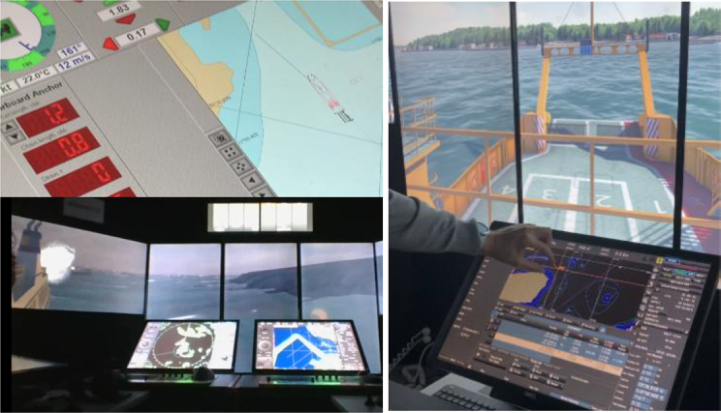
The left picture in Figure 3 shows a docking vessel in the harbour and the anchor parameters during the simulation of scenario 5. The right picture
The Remote Support Centre – An Exploration of Technical Support 617
shows scenario 3 when the skipper pointing at the rounding of the island Köpmanholm in Stockholm Archipelago where grounding has occurred as a vessel was hastily relocated from one route to another route. During the simulation workshops it was possible to interactively explore instruments and parameters of relevance for the decision making onboard, such as the water depth at the anchoring spot. The skipper in scenario 3 pointed out a critical zone and discussed with the researcher how an operative plan could be communicated through ECDIS to make sure a safe distance to land would be maintained.
Figure 3: Left: simulator views of the harbour conditions while anchored in stormy weather. Right: the skipper is pointing out a critical zone while rounding the island of Köpmanholm.
During the design process cues and parameters of relevance were brought forward which were deemed valuable to prevent potentially hazardous or risky situations. For example, non-normal rudder angles could indicate that the ship is off course and may be heading towards shallow water. Upon detection on unnormal rudder angle movements an RSC operator could be notified, thus not having to constantly monitor a single ship. One valuable insight is that if there is a system which alerts the monitoring human remote operator in case of deviations from set parameters, for example a route corridor or deviating values of an instrument, then one human could monitor several vessels at the time.
By exploring the concept together with ship owners and skippers, procedures and interactions could be sketched of how to work together on a strategic and tactical level. One outcome was the concept of “Critical Zones” where remote navigation support could be provided temporarily or “Harbour Information Service”, similar to Aerodrome Flight Information
Service from the aviation sector, for weather updates, coordination and changes in the timetables.
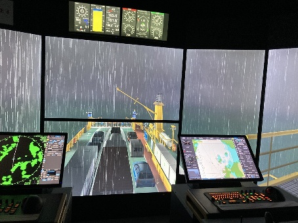
Figure 4: Left: simulation of scenario 2 with low visibility and heavy rain making navigation difficult and the radar unreliable. Right: rudder angle display onboard Tellus.
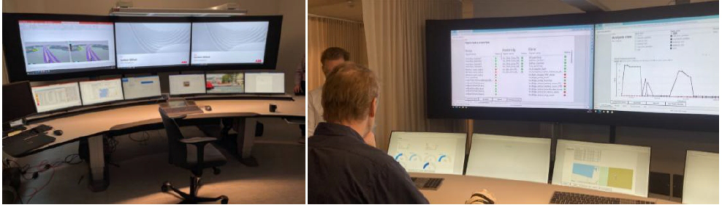
The RSC Technical Installations After a project visit to Tellus on the Swedish west coast in the spring 2023 it was further discussed how to present different signals and parameters such as rudder angles, engine temperatures, battery status, generators, alarm status, charging air temperatures, cooling water temperature, vibrations and so on to a RSC. Work was also done to continue sorting out these signals from an extensive list, which was realized to still be a huge task. In Figure 5 the connected RSC parameters such as battery charger status, pumps, rudder, generators, propeller alarms for Tellus, Kostervåg and Clara can be seen. The signals were still coded according to the signal list, such asGenSet1, Im_Bat_charger_24V_alarm_PS.
Figure 5: Left: RSC position during early prototyping. Right: the connected RSC working station in Stockholm, April 2024.
Im_Autopilot_rudder_follow_up etc under the Fleet Status Overview menu. During live tests in the summer 2024 communication with the vessel crew was initiated on a chat pad. During daily check-ins the status on alarms and batteries were reported on and patterns could be stored over time.
The Remote Support Centre – An Exploration of Technical Support 619
DISCUSSION
The results have shown the potential of information analysis and connected vessels at a Remote Support Centre (RSC). One bottleneck was the sorting of technical signals into larger categories and visualisations of the information in the RSC. Technical expertise is required to translate the exact signals from a long list into high level categories. Through an iterative participatory design processes several parameters of relevance could be mapped to extensive signal lists. The next steps could include refining the design of interfaces, standard operating procedures, timings of scanning the signals, as well as estimating economic effects of an RSC. Several operational concepts and ideas were not yet tested live. It may take time before non-routine situations occur. Shared screens, video cameras onboard and augmented systems such as Pilot Vision may contribute to a shared environment, enhancing Team Situation Awareness. Meanwhile, collecting more data, technical analysis and daily reports between crew and a RSC operator could build a bank of patterns and situations increasing awareness and preparedness, which can be very useful to the skippers and the crew onboard. Monitoring batteries, generators, and various alarms proved to be useful already in the initial tests, which support the participatory design method and creation of detailed scenarios to unveil tacit knowledge and preventive actions for the best operability of the fleet vessels. The project offers a thorough beginning of the signal sorting process alleviating this part for future work. During the project the term “Remote Support Centre” (RSC) was discussed to emphasize collaboration between shore-based staff and onboard crew, in comparison to the term Remote Operation Center (ROC) which could imply a more controlling position. Overall, this study sheds light on technological possibilities and challenges for enhanced Team Situation Awareness and explores new coordinating roles which could extend to multiple domain operations.
CONCLUSION
Our thesis - that marine archipelago traffic can be improved by making data available, processing and refining it, and deliver it back to the crew onboard as decision assistance, was confirmed through conceptual and technical tests. Participatory design workshops and simulations were followed by the installation of a Remote Support Centre (RSC) in Stockholm, Sweden with three connected vessels. Based on the overarching scenarios identified in the project, we conclude that a RSC is promising both for work of operational character as well as technical support and maintenance to strengthen team situation awareness. Taking the scenarios into the simulators for real-time exploration of human-machine interface and operational procedures, the concepts of “Critical Zones” and “Harbour Information Service” were identified. Another finding was the possibility to monitor several ships simultaneously by setting limitations in parameter values to detect irregular patterns. Regarding technical maturity, at this stage, technical signals and information can be imported, stored, analysed in the RSC and put in relation to daily reports from the ship crews. Although this is promising, further work is needed to define the concepts in-depth and test them systematically
with operators. Specifically, the concepts must be refined and tested in scenarios and settings that challenge quality and timeliness of decision- making in distributed joint human-machine control settings. Additionally, further exploration is needed to identify requirements on procedural support, equipment and connectivity as well as economic impacts of a RSC.
ACKNOWLEDGMENT
Funding was received by Trafikverket grant number TRV 2020/26025.
REFERENCES
ABB (n.d.) ABB Ability ™ Marine Pilot Vision. Available at: https:// new.abb.com/marine/systems-and-solutions/digital/abb-ability-marine-pilot/ abb-ability-marine-pilot-vision (Accessed 13 Feb. 2025). ABB (n.d.) ABB Ability™OneBox. Available at: https://new.abb.com/marine/ systems-and-solutions/digital/abb-ability-onebox—marine-signals-monitoring (Accessed 14 Feb. 2025). Androjna, A. and Perkoviˇc, M. (2021) ‘Impact of spoofing of navigation systems
on maritime situational awareness’, Transactions on Maritime Science, 10(2), pp. 361–373. Endsley, M. R. (1995) ‘Toward a theory of situation awareness in dynamic systems’, Human Factors, 37(1), pp. 32–64. https://doi.org/10.1518/ 001872095779049543 Endsley, M. R. (2021b) ‘Situation awareness in teams: Models and measures’,
in McNeese, M., Salas, E. and Endsley, M. (eds.) Handbook of distributed team cognition: Contemporary research models, methodologies, and measures in distributed team cognition. Boca Raton, FL: CRC Press, pp. 1–28. European Commission (2014) ‘Better situational awareness by enhanced cooperation across maritime surveillance authorities: Next steps within the Common Information Sharing Environment for the EU maritime domain’, (COM/ 2014/0451 final). Available at: https://eur-lex.europa.eu/legal-content/EN/TXT/ ?uri=CELEX%3A52014DC0451 (Accessed: 14 Feb. 2025). Hjelseth, S., Morrison, A. and Nordby, K. (2015) ‘Design and computer simulated
user scenarios: Exploring real-time 3D game engines and simulation in the maritime sector’, International Journal of Design, 9(3), pp. 63–75. Inoue, S., Nagashio, S. and Yamazaki, K. (2016) ‘Practical design based on user experience approach for remote aerodrome flight information services’, IFAC PapersOnLine, 49(19), pp. 325–330. https://doi.org/10.1016/ j.ifacol.2016.10.567 Kirstein, L. (2018) Information sharing for efficient maritime logistics. Available at: https://www.itf-oecd.org/information-sharing-maritime-logistics (Accessed: 14 February 2025). Lundberg, J. (2015) ‘Situation awareness systems, states and processes: A holistic
framework’, Theoretical Issues in Ergonomics Science, 16(5), pp. 447–473. https://doi.org/10.1080/1463922X.2015.1008601 Lundberg, J. and Johansson, B. J. E. (2021) ‘A framework for describing interaction between human operators and autonomous, automated, and manual control systems’, Cognition, Technology & Work, 23(3), pp. 381–401. https://doi.org/ 10.1007/s10111-020-00637-w OECD (2017), The Ocean Economy in 2030. Paris: OECD Publishing. https://
doi.org/10.1787/9789264251724-en
The Remote Support Centre – An Exploration of Technical Support 621
Praetorius, G. and Lützhöft, M. (2012) ‘Decision support for vessel traffic service (VTS): User needs for dynamic risk management in the VTS’, Work, 41(Supplement 1), pp. 4866–4872. Procházka, J., & Plos, V. (2013), ‘Aerodrome Flight Information Service’, MAD Magazine of Aviation Development, 1(1), pp. 15–18. Spinuzzi, C. (2005) ‘The methodology of participatory design’, Technical communication, 52(2), pp. 163–174. Trafikverket (2024) Remote Operation Center (ROC) för skärgårdstrafik. Internal
report. Trafikverket, TRV 2020/26025.
LISTED IN THE AHFE DIGITAL BOOKSTORE CATALOGUE
Explore the complete digital volume
Advances in Human Factors of Transportation
Read this individual research paper free through the original publisher, or explore the full digital proceedings book.
ISBN 978-1-964867-62-5
Explore this ISBN in the AHFE Bookstore ↗Listed in the July 2026 bookstore catalogue; search by ISBN to confirm current availability · Digital book purchase optional