Jonas Lundberg, Karl Johan Klang, Karljohan Lundin Palmerius, Gustaf Söderholm, Gustaf Fylkner, Björn Stavås, Magnus Bang (2025). Digital Assistant Concept for Enroute Air Traffic Management. In: Advances in Human Factors of Transportation. AHFE Open Access, vol. 186, pp. 43–51. https://doi.org/10.54941/ahfe1006492
Enroute Air Traffic Management in Sweden is facing both increasing air traffic and a predicted shortage of Air Traffic Management staff. Automation in the form of a Digital Enroute Air Traffic Management Assistant (DEMA) could support work by autonomously carrying out some tasks, while coordinating with and informing the Air Traffic Controller (ATCO), with sensitivity to current workload. This paper describes our DEMA concept, detailing how a digital assistant differs from automation in general, on a theoretical level. It also describes a set of operational concepts together with human-ai interaction and collaboration concepts. A sub-set of concepts were implemented in the UTM CITY Simulator as a high-fidelity prototype, so that the scenarios and DEMA interactions could be played out. To assess the DEMA concepts, a two-step procedure was carried out with a group of Air traffic controllers. First, a test session was carried out as a human-in-the-loop simulation, where they individually tested two situations where traffic could be delegated to DEMA. The participants then made individual reflections on DEMA, which they brought up in the subsequent workshop session on the same day as the test. During this workshop, the potential for DEMA in different settings, and alternative DEMA use cases were designed and discussed. The workshop ended with a new concept implemented as a testable prototype in the simulator.
Introducing artificial intelligence (AI) and automation in mission-critical domains requires that the whole work process of the joint human-machine system is considered, to avoid incidents. Domains such as Air Traffic Management (ATM) have several characteristics that makes this difficult. Firstly, while safety is the top priority, efficiency of the airspace is also a major concern, and there is a strive toward both goals. Secondly, the traffic is an on-going dynamic external process type – it is not self-paced. The Air Traffic Controllers (ATCOs) must both pace their own work to keep up with it and need to organize the traffic process so that their own control process becomes manageable. Further, ATM both faces increased
traffic and increased demands for efficient traffic management, as well as a predicted staff shortage. To address this, increased automation and use of artificial intelligence could be a way forward, if pitfalls (Bainbridge, 1983; Endsley, 2023) can be avoided. When adding traditional automation or AI, this constitutes yet another process type, that can either become a benefit or a hazard.
In this paper we explore digital assistant concepts (Jameel et al., 2023; Marot et al., 2022; Nebula et al., 2023; Palmerius et al., 2022; Westin et al., 2020) for enroute ATM. The approach we take here is to work with three process types in the center of our design effort: air traffic processes, ATCO control processes, and control processes by a new digital agent, the Digital Enroute Air Traffic Management Assistant (DEMA). In this paper, we take an incremental approach to automation. First, by identifying areas where the ATCO could delegate new tasks to DEMA, with improvements in the three process types. Second, to consider these processes together, by designing interaction flow concepts in a simulator environment, together with ATCOs. In a design case study, we evaluated two concepts and re-designed one DEMA concept, together with experienced ATCOs. Each concept contained one traffic situation, which is exemplified in a scenario implemented in a graphic interactive simulator. Further, each concept contained at least one interaction between an air traffic controller and DEMA.
Levels of Autonomy in Cognitive Control Versus Levels of Automation (LACC-LOA) Introducing automation or more adaptive and autonomous AI digital systems, in the form of digital assistants such as DEMA, we consider three basic notions. Firstly, what kind of cognitive work the humans and digital agents carry out individually and together. Secondly, how much work they carry out of the work that is being done. Thirdly, what characteristics the human-digital agent interactions have.
Regarding ATCO work, a central aspect is to maintain what is referred to “the picture”, the ATCO view of the situation in the air. This corresponds to the notion of “situation awareness” (Endsley, 2015; Lundberg, 2015; Stanton et al., 2017), to have up-to-date situational information at the time of making decisions. Situation Awareness is not just a state, but also a process of information-pickup and exploration, as well as a process that is mediated – information is organized in the environment both by the human and through tools, and records are made explicitly and implicitly of activities (Lundberg, 2015). To consider what kind of cognitive work is being performed, we use the Levels of Autonomy in Cognitive Control (LACC), proposed in (Lundberg et al., 2019; Lundberg and Johansson, 2021). The LACC differentiates between cognitive work that is qualitative different, in an abstraction hierarchy. Cognitive work can be described at – or as involving – one or several levels. We can describe and exemplify the LACC in enroute traffic management as follows:
Digital Assistant Concept for Enroute Air Traffic Management 45
1. Physical. Regarding traffic, the location and status (e.g. flight level, speed) of an aircraft. For the ATCO, observing the location and status of an aircraft, executing the giving of constraints such as a verbal utterance over radio. 2. Implementation. A specific route, taking constraints along it into account, as well as aircraft characteristics (e.g. weight, turn radius). For the ATCO, giving specific constraints to a specific aircraft, to e.g. implement a turn; limits on ATCO abilities to communicate with too many airspace users or co-workers at the same time. 3. Generic. A plan for a flight, that can be potentially reused, that must be adjusted to the traffic situation, as well as to changing goals. Considering the ATCO, a procedure such as assuming an aircraft from another sector can be considered. 4. Values. Performance indicators, such as the degree of safety and efficiency that is achieved, as well as trade-offs such as prioritizing safety over efficiency. Considering the ATCO, their workload can be described at this level. 5. Goals. The goals can be specific to a flight, such as reaching a particular place at a particular time, and generic to the airspace, such as safety goals and efficiency goals. The goals that the ATCO are currently concerned with in their work. 6. Frames. Airspace situations, such as an “overflight” sector, aircraft in conflict – and the situations as observed by the ATCO.
When introducing automation, ATCO work (on different LACC) could be partly or fully replaced by digital agents. As proposed by EASA (2023), in ATM, levels-of-automation (LOA) are coupled to radically different human- ai teaming concepts. Originally (Sheridan and Verplank, 1978), LOA schemes (see also Vagia et al., 2016) describe how work is divided by humans and machines, ranging from fully manual to different kinds of human- automation interaction, to fully automated. In between, work is divided between humans and digital agents. This results in new work process, of exchanges between ATCO and automation, that does not occur in fully manual or in fully automated work. In this situation, new demands on the ATCO emerges, such as understanding how the automation works, to build mental models (Endsley, 1995). The EASA LOA starts with automation functions for acquiring and presenting information (1A) and analyzing and presenting that (2B) to the human. In the EASA LOA, Human-AI Teaming is central at level 2, where humans delegate tasks (level 2A), or collaborate with more advanced AI (level 2B). Level 3 describes autonomous systems that are monitored by ATCOs (3A) or fully autonomous (3B).
In this paper, we will discuss the digital assistant concepts with regard to these two dimensions.
METHOD
A design case study was carried out, in which the main data collection was organized as a co-design workshop. The workshop had intertwined aims.
A human-in-the loop test of initial concepts was conducted both to assess these concepts, and to familiarize the ATCOs to the overarching concept of a digital assistant.
Two workshop facilitators organized the workshop. Three ATC experts participated on-site. The first ATCO had 25 years of experience, including approach and tower control. The second ATCO had 35 years of experience, primarily radar control but also approach. The third participant had ATCO training, but no operational experience, in tower and terminal area control. One additional ATCO participated on-line with more limited contributions to the workshop. Further, one additional ATCO expert joined the workshop during the co-design session.
In the study, we used a set of simulation and prototyping tools to conduct human-in-the-loop tests; to prepare, present, discuss, and co-design traffic scenarios; as well as design playable and testable DEMA workflows and interactions in a traffic simulation. The traffic situations were modelled in the UTM CITY simulator (Westberg et al., 2022). It was also used to present the scenario graphically in the workshop, by presenting a sector in an ATM-like visual display, together with simulated air traffic. Further, a rapid- prototyping system was used to design workflow prototypes of DEMA. It could react to input from UTM CITY to trigger dialogue windows to the ATCOs, react to those, and could also send output to UTM CITY.
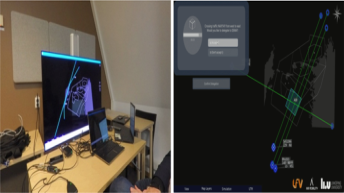
In preparation for the workshop, we designed and implemented two traffic scenarios with interactive DEMA prototypes that the ATCOs could test. In the first part of the workshop, two ATCOs tested these concepts in a human- in-the-loop simulation. The other participants could then observe and make comments. For these scenarios, we aimed for EASA Level 2 concepts, where ATCOs delegate tasks to DEMA. In the first of the initial traffic situation and concepts, DEMA was making contact from another sector to coordinate a route close to the own sector (Figure 1a). We refer to this concept as DEMA-1. In the second concept, DEMA was assigned to manage a specific flight, to solve conflicts between it and three other aircraft (Figure 1b). We refer to this concept as DEMA-2 For both concepts, we presented the routes of the aircraft (LACC L2) in conflict, and the conflict zone location (LACC L1) on the simulator screen, with textual DEMA interactions as dialogue windows. All interactions had a timer, and in the case of a non-action by the ATCO, DEMA would take a default action.
The second part of the workshop was conducted as a round-table co-design session. The UTM CITY simulator and a rapid-prototyping system were used interactively, projected on a wall-display, to design and discuss traffic situations and DEMA concepts. This session had two aims. Firstly, to understand where it could be feasible to get started with Enroute ATM digital assistants (and why), secondly to design (or at least attempt to design) at least one new concept. During this phase of the workshop, different airspace situations and processes were discussed, and then co-design work was carried out toward new DEMA concepts. Finally, during the workshop, one of these new DEMA concepts was implemented and played through in the UTM CITY simulator. We refer to this concept as DEMA-3.
Digital Assistant Concept for Enroute Air Traffic Management 47
Audio and video from the workshop were recorded, of the participants around the workshop table, and at the test station. The simulator screen was also recorded. After the workshop, audio was automatically transcribed and imported together with video into an analysis tool (JCF Editor). Using this tool, qualitative analysis was carried out, with a focus on the DEMA concepts and traffic situations.
RESULTS
We first present the results regarding the initial DEMA-1 and 2 concepts, and then the results regarding new co-designed DEMA-3 concept.
Figure 1: A) a scenario and DEMA concept with one flight going north-south, another going in the opposite direction. B) DEMA concept and scenario with three flights going south-north in proximity to each other, and one aircraft crossing from west-east.
The DEMA-1 concept (Figure 1a), coordination of traffic at the sector border, was seen as workable. However, the DEMA-2 concept (Figure 1b), delegation for conflict resolution, was seen as problematic. The participants viewed the whole control situation as dynamically coupled and uncertain. Delegating conflict resolution to DEMA-2 by assigning the resolution plan of the east-west aircraft to DEMA, as it requested, would be of limited value, as other aircraft could at any time request changes to their routes, affecting the resolution plan. They were unsure how DEMA would react in this case. They were also worried about de-skilling in the case that DEMA would handle most situations but hand some difficult situations back to the ATCO. Further, regarding the DEMA-1 concept, the ATCOs thought that it presented too much detail, and regarding DEMA-2 that it presented the wrong details. Considering DEMA-1, the ATCOs were not interested in the traffic situation details since this traffic occurred in another sector. Similarly, the details of the traffic situation (conflict resolution) that DEMA-2 presented were not seen as important to highlight. In this case, they would already be aware of the details, as it occurred in their own sector that they would work actively in. However, they thought that other details of DEMA-2 were lacking. To decide on whether DEMA-2 could manage a situation like this, they wanted details about what parameters it would consider, and DEMA flexibility versus changes to other involved aircraft.
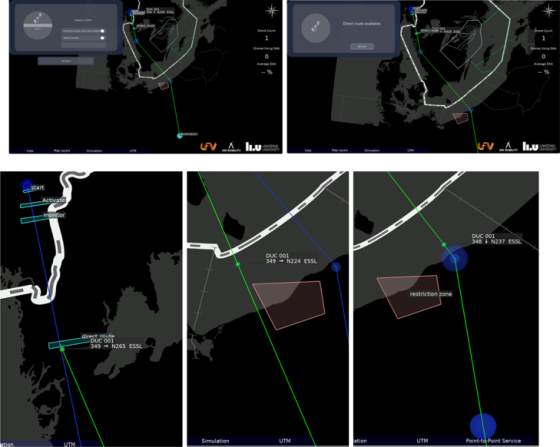
Figure 2: A) Top left first dialogue, probe direct route. B) Top right, second dialogue, direct route available. C) Lower left, close-up of the re-route position of the flight. D) Lower right, close up of the direct route. E) Lower mid, close-up of the restriction area and the detour route.
The DEMA-3 concept (Figure 2), co-designed during the workshop, targeted a new scenario, which was also co-designed. The participants placed, in UTM CITY, a desirable direct route between an airport in Norway, that then crosses over Sweden, to end in Poland. The traffic management problem in this scenario was that the aircraft cannot take this desirable direct route (Figure 2b) immediately, since they wish to go east of an area in Germany. Therefore, they go east. If following this route for too long however, the aircraft needs to avoid a restricted area, taking it more to the east (Figure 2a). In the scenario, the direct route brings the aircraft to the west of the restricted area (Figure 2d), whereas the detour takes it to the east of the restricted area (Figure 2e). The reason for taking a shorter route is lessened climate impact. It can take a long time, sometimes as long as 30 minutes before the aircraft are free to turn. In this concept, the ATCO would instruct DEMA to monitor the aircraft and notify the ATCO when a direct route is available (Figure 2b, 2c), free from restriction areas. The ATCO would delegate monitoring to DEMA soon after aircraft take-off. Two dialogues were prepared. First, “probe direct routes, report when available” (Figure 2a), was presented as the instruction to delegate to DEMA. After the delegation, DEMA would use a probing tool to check when the aircraft is clear from the restriction area. When clear, it would present another dialogue, “Direct route available” (Figure 2b). When a direct route is available, the ATCO would need about 10 seconds to also check that the route is conflict-free. At this point, DEMA would open the conflict probe tool to show the direct route so that it can be checked for conflicts. The ATCOs trusted DEMA to make the probe regarding restricted areas but not regarding conflicts. This was seen as a good “between” step,
Digital Assistant Concept for Enroute Air Traffic Management 49
to give ATCOs something that is more trustworthy than conflict probing. In sum, in this scenario, DEMA-3 targets the ATCO work process, LACC L4 workload, by moving the LACC L2 activity of probing to DEMA. DEMA also executes an LACC L1 action, activate conflict probe, on part of the ATCO.
CONCLUSION
The study resulted in three main findings regarding the two initial digital assistant (DEMA 1 and 2) concepts. Firstly it is important to consider what constitutes an independent traffic process, a “process in focus” (Lundberg et al., 2024), which was a problem with the DEMA-2 concept (conflict resolution). Secondly, the evaluation of DEMA-2 underscores the need for ATCOs for predictable DEMA activity, to build proactive situation awareness. Thus, the system needs to (at some point) present information so that ATCO can understand how it will behave, that is to build “mental models” of DEMA. Third, DEMA-1, employing a variant of the Reduced Autonomy Workspace (Nylin et al., 2022) was seen as workable, which makes it a candidate for further studies on a higher TRL.
Regarding the final concept, DEMA-3, that was co-designed with ATCOs, several interesting aspects emerged. It was not a completely “new” system. Instead, it constituted of DEMA-3 operating two tools existing in the current ATM system used by the ATCOs: aircraft conflict probe and restriction zone probe. ATCO trust in DEMA seems to be associated with these two tools, rather than to the more abstract DEMA concept per se. Considering the two tools, they both carry out one probe-action (at LACC L2), However, they relate to different goals. The first relate to the LACC L5 efficiency goal, the other to the LACC L5 safety goal. An alternative interpretation of trust would be that the actions in concern were associated with these two different goals, and that they would be more cautious with a safety-related goal. Further research is needed to study this. Regarding the impact on aircraft pilots, as airspace users affected by the final concept, any difference on their part depends on ATCO workload. If the ATCO has time to timely probe for the direct route, the result is the same regardless of what agent uses the probe tool. Therefore, from the point of view of airspace user procedures, in this case DEMA-3 makes a minor change, by taking over ATCO actions. Further research is needed to examine whether this would require procedural changes from airline pilot perspectives. ATCO work however changes to interacting with DEMA at two points in time, instead of constantly monitoring the conflict using the probe tool over a longer duration.
In conclusion, if our new hypothesis is correct that trust in DEMA-3 depended on the constituent tools, then trust in these basic functions needs to be built first and then trust in DEMA will follow. The work also underscores the need for ATCOs to be able to build mental models of tools to be able to work alongside them, to build their own situation awareness. Further work is needed to study Human-AI involving higher LACC levels on the part of an AI, and more advanced human-ai teaming concepts (EASA Level 2B) at various LACC levels.
ACKNOWLEDGMENT
This work was funded through the projects Automation Program II part A (Trafikverket, Sweden), F AUTO (Trafikverket, Sweden), and AirMobility (VINNOVA, Sweden).
REFERENCES
Bainbridge, L., 1983. Ironies of automation. Automatica 19, 775–779. EASA, 2023. Artificial Intelligence Roadmap 2.0: A human-centric approach to AI inaviation. European Union Aviation Safety Agency, EASA. Endsley, M. R., 1995. Toward a theory of situation awareness in dynamic systems.
Human Factors: The Journal of the Human Factors and Ergonomics Society 37, 32–64. Endsley, M. R., 2015. Situation Awareness Misconceptions and Misunderstandings.
Journal of Cognitive Engineering and Decision Making 9, 4–32. Endsley, M. R., 2023. Ironies of artificial intelligence. Ergonomics, 1–13. Jameel, M., Tyburzy, L., Gerdes, I., Pick, A., Hunger, R., Christoffels, L., 2023.
Enabling Digital Air Traffic Controller Assistant through Human-Autonomy Teaming Design, 2023 IEEE/AIAA 42nd Digital Avionics Systems Conference (DASC), pp. 1–9. Lundberg, J., 2015. Situation Awareness Systems, States and Processes: A holistic framework. Theoretical Issues in Ergonomics Science 16, 447–473. Lundberg, J., Bång, M., Johansson, J., Cheaitou, A., Josefsson, B., Tahboub, Z., 2019.
Human-in-the-loop AI: Requirements on future (unified) air traffic management systems, 2019 IEEE/AIAA 38th Digital Avionics Systems Conference (DASC), San Diego, CA. Lundberg, J., Johansson, B. J. E., 2021. A framework for describing interaction between human operators and autonomous, automated, and manual control systems. Cognition, Technology & Work 23, 381–401. Lundberg, J., Nylin, M., Praetorius, G., Jansson, A. A., Bång, M., 2024. Modelling
operator control work across traffic management domains: Implications for interaction design. Cognition, Technology & Work. Marot, A., Rozier, A., Dussartre, M., Crochepierre, L., Donnot, B., 2022. Towards an AI assistant for human grid operators, Hybrid Human Artificial Intelligence (HHAI), Amsterdam, France. Nebula, F., Palumbo, R., Gigante, G., Vozella, A., 2023. Digital Assistant for Arrival
Scheduling with Conflict Prevention Capabilities. Information 14, 216. Nylin, M., Johansson Westberg, J., Lundberg, J., 2022. Reduced autonomy workspace (RAW)—an interaction design approach for human-automation cooperation. Cognition, Technology & Work 24, 261–273. Palmerius, K. L., Henriksson, M., Westin, C., Lundberg, J., 2022. Digital Tower
Assistant Functionality and Design - Planning, Analysis and Operative Interfaces based on Workshops with ATCOs, 12th Sesar Innovation Days. Sesar, Budapest, Hungary. Sheridan, T. B., Verplank, W. L., 1978. Human and Computer Control of Undersea Teleoperators (No. ADA057655). Massachusetts Institute of Technology, Cambridge, MA. Stanton, N. A., Salmon, P. M., Walker, G. H., Salas, E., Hancock, P. A., 2017. State-
of-science: Situation awareness in individuals, teams and systems. Ergonomics 60, 449–466.
Digital Assistant Concept for Enroute Air Traffic Management 51
Vagia, M., Transeth, A. A., Fjerdingen, S. A., 2016. A literature review on the levels of automation during the years. What are the different taxonomies that have been proposed? Applied Ergonomics 53, 190–202. Westberg, J. J., Palmerius, K. L., Lundberg, J., 2022. UTM City—Visualization of
Unmanned Aerial Vehicles. IEEE Computer Graphics and Applications 42, 84–89. Westin, C., Boonsong, S., Josefsson, B., Lundberg, J., 2020. Building Trust in Autonomous System Competence – the DiTA Digital Tower Assistant for Multiple Remote Towers, an Early Concept Evaluation, 2020 AIAA/IEEE 39th Digital Avionics Systems Conference (DASC), pp. 1–9.
LISTED IN THE AHFE DIGITAL BOOKSTORE CATALOGUE
Explore the complete digital volume
Advances in Human Factors of Transportation
Read this individual research paper free through the original publisher, or explore the full digital proceedings book.
ISBN 978-1-964867-62-5
Explore this ISBN in the AHFE Bookstore ↗Listed in the July 2026 bookstore catalogue; search by ISBN to confirm current availability · Digital book purchase optional