Florian Haid, Thomas Schnabel, Markus Bergen, Thomas Hölzl, Gerald Bauer (2026). View2Decide: A Wearable Traffic-Light Display for Real-Time Physiological Decision Support in Military First Response. In: Cognitive Computing and Internet of Things. AHFE Open Access, vol. 205, pp. 1–11. https://doi.org/10.54941/ahfe1007356
Emerging trends in soldier systems increasingly emphasize wearable sensing and real-time physiological status monitoring to enhance operational decision-making and situational awareness. Within the “Soldier of the Future” paradigm, individual physiological data has become a key enabler for both medical support and tactical assessment. While the Austrian Armed Forces’ VitalMonitor infrastructure allows continuous monitoring of vital parameters, existing visualization tools – such as smartphones, tablets, or laptops – are often impractical for first responders under high-stress or time-critical conditions. View2Decide addresses this gap by providing a compact, wearable display module that conveys critical physiological status through an intuitive traffic-light scheme, enabling rapid assessment of multiple individuals in the field. The system integrates modular hardware, BLE-based communication, and simplified status derivation to maintain robustness, low cognitive load, and operational flexibility. The proof-of-concept prototype demonstrates that an ESP32-based display, combined with a smartphone or future embedded communication nodes, can reliably present real-time physiological status in an easily interpretable format, including sequential assessment of multiple casualties. This paper presents the system architecture, user requirements, visualization logic, and prototype implementation, highlighting how device-agnostic, low-barrier status visualization can support frontline decision-making. View2Decide represents a promising step toward scalable, sensor-supported triage solutions for future soldier systems.
Recent developments in military operations increasingly emphasize the integration of human factors, wearable sensing, and digital decision-support systems to enhance situational awareness and operational effectiveness. Within concepts such as the “Soldier of the Future” and “Soldier as a Sensor,” physiological monitoring has emerged as a key enabler for both operational command and medical support. Advances in wearable biosensor technology now allow Received March 30, 2026; Revised April 28, 2026; Accepted May 14, 2026; Available online July 20, 2026
continuous acquisition of vital parameters such as heart rate, oxygen saturation, and activity levels directly from the individual in the field (Majumder et al., 2017). In parallel, modern military research highlights the growing importance of physiological state monitoring as part of precision health strategies to assess readiness, fatigue, and injury risk in real time (Sipos et al., 2025).
Building on these developments, integrated monitoring systems have been proposed to support training and operational scenarios. For example, multisensory wearable platforms demonstrate how physiological signals can be continuously captured and processed to derive meaningful indicators of physiological strain and physical performance (Almer et al., 2021). These systems provide the technological foundation for data-driven decision support in both operational and medical contexts.
Despite these advances in sensing and data processing, a critical gap remains in how this information is presented to first responders in the field. Existing solutions typically rely on smartphones, tablets, or centralized monitoring systems, which are often impractical in high-stress, time-critical environments. First responders must operate under severe cognitive and physical constraints, requiring solutions that are robust, intuitive, and immediately interpretable without additional interaction or training.
To address this challenge, there is a growing need for visualization approaches that reduce complex physiological data to simple, actionable information. In particular, compact and device-agnostic representations – such as discrete status indicators – offer the potential to support rapid decision-making in self-aid and buddy-aid scenarios.
This paper introduces View2Decide, a system that translates wearable sensor data into a simplified, traffic-light-based representation of casualty condition for intuitive interpretation by military first responders. The main contributions of this work are as follows: (1) A device-agnostic, body-worn visualization concept that enables
immediate interpretation of physiological status without requiring interaction with conventional user interfaces. (2) A modular system architecture that decouples sensing, data processing, and visualization, allowing seamless integration with existing wearable monitoring systems and flexible deployment in different operational scenarios. (3) A proof-of-concept prototype based on BLE communication and an
ESP32-based display module, demonstrating real-time transmission and robust visualization of simplified physiological status information. (4) A user-centered design approach that explicitly addresses cognitive load constraints of first responders, translating complex physiological data into a minimal, traffic-light-based representation suitable for high-stress environments.
OBJECTIVE While recent advances in wearable biosensors and physiological monitoring systems enable continuous acquisition and processing of vital data, their
View2Decide: A Wearable Traffic-Light Display for Real-Time 3 practical use for frontline medical decision-making remains limited by the lack of suitable visualization approaches. In particular, existing solutions often depend on complex user interfaces and external devices, which are not well suited for high-stress, time-critical environments such as combat casualty care or disaster response.
The primary objective of this work is therefore to investigate and develop an intuitive, low-barrier visualization concept that translates physiological data from wearable sensors into actionable information for military first responders. The focus lies on enabling rapid assessment of an individual’s condition without requiring interaction with conventional digital devices. To achieve this, the work explores the use of simplified status representations – specifically traffic-light-based indicators (e.g., green, yellow, red) – that encode relevant physiological states in a compact and immediately interpretable form.
In addition to the visualization itself, the objective includes the integration of such a concept into a modular system architecture that can interface with existing biosensor platforms, such as multisensory wearable monitoring systems. This involves addressing key technical and operational challenges, including data acquisition and preprocessing, derivation of meaningful physiological indices, reliable data transmission, and robust, low-power display technologies suitable for field deployment.
Furthermore, the work aims to identify user-centered requirements for first responders operating under stress, including constraints related to cognitive load, usability, robustness, and deployability. Based on these requirements, the proposed system is designed to support self-aid and buddy-aid scenarios, as well as to serve as a building block for future integration into larger digital ecosystems, such as military medical support systems or battlefield management systems.
By addressing the gap between data availability and actionable visualization, this work seeks to contribute to the development of practical, sensor-supported decision aids that enhance situational awareness and improve the effectiveness of frontline medical response.
RELATED WORK
Prior work has demonstrated that continuous acquisition and wireless transmission of physiological signals from body-worn sensors is feasible and increasingly mature for both military personnel and civilian first responders. Hegarty-Craver et al. (2024) provide a broad, practical survey of commercially available heart-rate, ECG and oxygen-saturation sensors for service members and first responders, highlighting form-factor, ruggedness and low-power constraints that shape any field-usable solution. Almer et al. (2021) describe the VitalMonitor approach of integrating multiple biosensors (ECG, SpO2 and related signals) into clothing and equipment to support continuous load and readiness assessment in military training and operations, illustrating how sensor fusion and data-driven indices can be embedded in soldier systems. Sipos et al. (2025) and Majumder et al. (2017) discuss next-generation physiological monitoring (HRV, core temperature,
motion) and the baseline sensor types and signal quality issues that determine which indices can be computed reliably in the field. Work focused on first- responder needs complements these system and sensor surveys: Grothe et al. (2023) report practitioners’ preferences and perceived barriers for continuous health/environmental monitoring, and Gutiérrez et al. (2023) demonstrate how biosignals can be processed to infer cognitive load in real time – an insight that motivates low-cognitive-load visualizations for medics and buddies.
A parallel body of work has explored automated triage devices and simple, colour-coded status displays derived from physiological measurements. Early field systems and prototypes showed that light-weight tags or handheld devices can greatly speed triage and situational awareness: Killeen et al. (2006) described a wireless PDA system for rapid triage and documentation, and Gao et al. (2007) presented the AID-N electronic triage-tag architecture (mesh network of vitals tags) for disaster scenarios. More recent prototypes examine wearable triage badges and e-triage tags that stream vitals and classify patient priority: Polley et al. (2021) implemented a Bluetooth-enabled wearable triage monitor, and Park (2021) evaluated an IoT-enabled e-triage tag for disaster situations. Building on these concepts, Lemarquand et al. (2025) propose and pilot a trauma severity score computed from wearable heart rate, respiratory rate and SpO2 and mapped to a green/orange/red triage code, while Alnuaimi (2025) describe an AI-augmented, protocol-flexible platform that ingests live wearable streams and returns guideline-consistent, colour-coded casualty categories in real time.
Taken together, these studies validate the three central assumptions behind View2Decide: (1) body-worn biosensors can provide the core signals needed for rapid status estimation (Hegarty-Craver et al., 2024; Majumder et al., 2017; Almer et al., 2021), (2) low-bandwidth wearable/mesh architectures and IoT approaches can support continuous streaming and aggregation of vitals for triage (Gao et al., 2007; Polley et al., 2021; Park, 2021), and (3) both rule-based and AI-driven scoring approaches can map a small set of reliable physiologic measurements to discrete priority categories (Lemarquand et al., 2025; Alnuaimi, 2025). At the same time, practitioner surveys and cognitive-load studies (Grothe et al., 2023; Gutiérrez et al., 2023) underscore the need for visualization designs that minimize cognitive effort for the first responder – a requirement that motivates View2Decide’s focus on compact, robust, traffic-light style status displays for buddy-aid and medic decision support.
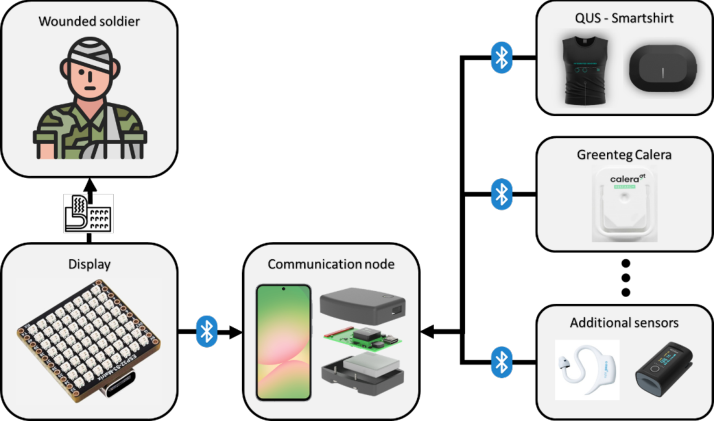
SYSTEM OVERVIEW The View2Decide system is designed as a lightweight and modular architecture that transforms physiological sensor data into an intuitive visual status representation for first responders. The system follows a clear and linear data flow, consisting of three main components: wearable sensors, a communication and processing node, and a body-worn display unit (Figure 1).
Figure 1: Overview of the View2Decide system.
Physiological data is continuously acquired by wearable biosensors attached to the individual. These sensors measure vital parameters such as heart rate, oxygen saturation, or activity-related signals and transmit the data wirelessly via Bluetooth Low Energy (BLE). The sensing layer is assumed to be part of an existing monitoring ecosystem and is therefore treated as an external input to the system.
The received data is processed by a central communication node, which acts as the core element of the system. This node aggregates incoming sensor streams, performs basic preprocessing and filtering, and derives a simplified representation of the physiological state. In particular, the node maps continuous vital parameters to a discrete status category that reflects the current condition of the individual. This abstraction step is essential to reduce complexity and enable rapid interpretation in time-critical scenarios.
The resulting status information is then transmitted via BLE to a dedicated display module. In the primary use case, the display is directly attached to the monitored individual, allowing nearby first responders to immediately perceive the current condition without interacting with any additional device. The visualization follows a traffic-light paradigm, in which a small set of discrete states (e.g., green, yellow, red) encodes the urgency or severity of the situation.
By physically coupling the display to the individual, the system ensures that the information is available exactly where it is needed – at the point of care. This enables efficient support for self-aid and buddy-aid scenarios, particularly in environments where conventional user interfaces such as smartphones or tablets are not practical.
In addition to this primary configuration, the system also supports a secondary operational mode in which a display unit can be carried by a first responder. In this case, the display dynamically connects to nearby communication nodes and retrieves the corresponding status information.
This allows a responder to sequentially assess multiple individuals, for example in situations where not every person is equipped with a dedicated display. Such a “walk-by” assessment capability enhances flexibility and ensures that the system remains usable even under constrained resource conditions.
The architecture deliberately separates sensing, processing, and visualization into independent modules connected via low-power wireless communication. This modular design allows the system to be integrated with different sensor platforms and extended toward future applications, such as integration into larger medical support or battlefield management systems.
USER REQUIREMENTS The user requirements for the View2Decide system were collected in close collaboration with potential end users from military environments to ensure operational relevance and ergonomic suitability. These requirements define the necessary characteristics for a wearable, real-time physiological monitoring system capable of supporting rapid decision-making in field conditions. The requirements can be grouped into functional, technical, and non-functional categories.
Functional Requirements The core functional requirement is the traffic-light visualization of physiological status, which enables immediate recognition of critical, warning, and non- critical conditions. The display provides three clearly distinguishable color states (green, yellow, red) and optionally a fourth state (blue) for system errors or communication failures. Rapid interpretation is essential to support both self-aid and buddy-aid scenarios, particularly under high cognitive load or time-critical conditions (Almer et al., 2021; Hegarty-Craver et al., 2024).
The display must ensure high visibility across operational environments, including direct sunlight, low-light conditions, or through supplementary illumination (e.g., flashlights or night-vision devices). Visibility should be maintained at distances of up to ten meters, allowing a first responder to monitor multiple individuals simultaneously. Status changes must be highlighted using brief blinking patterns to draw attention without increasing cognitive load.
Wireless connectivity between the communication node and the display is essential. The system should provide a documented BLE interface with automatic connection setup requiring minimal interaction, ideally a single user action. The display must clearly indicate connection status and ensure correct association with the intended communication node.
Optional functional capabilities include the ability for a single display to sequentially monitor multiple individuals, which supports efficient assessment in multi-casualty scenarios where dedicated displays are not available.
Technical Requirements The display unit must provide sufficient energy autonomy for at least one hour of continuous operation while maintaining a low-power standby mode lasting several months to years. Energy supply should be replaceable (e.g., button cell or rechargeable battery) to allow rapid maintenance in the field.
View2Decide: A Wearable Traffic-Light Display for Real-Time 7 The form factor must support flexible attachment to the body or equipment, such as via clips or Velcro, and the system should feature a modular design, allowing replacement or upgrading of individual components (battery, communication node). Production and component costs are targeted to remain in the low double-digit Euro range, enabling cost-effective scalability for military operations.
Non-Functional Requirements and Constraints The system is intentionally designed with simplicity in mind. No complex algorithms or AI-based logic are implemented for traffic-light assignment; the system relies on rule-based interpretation of physiological data. Integration with smartwatches or cloud-based real-time streaming is not planned. User IDs and timestamps are not displayed, and camouflage requirements apply only to the device in its powered-off state.
Optional enhancements for robustness and operational suitability include water and dust protection, mechanical shock and vibration resistance, and lightweight design (<50 g). A real-time display update rate of at least 1 Hz is desirable to ensure timely presentation of changes in physiological status.
SYSTEM DESIGN AND IMPLEMENTATION The View2Decide system is designed to provide a compact, wearable solution for rapid, intuitive visualization of a soldier’s physiological status in operational environments. The system architecture integrates three core components: wearable biosensors, a communication and processing node, and a display module. The sensors continuously capture vital parameters, such as heart rate and oxygen saturation, which are transmitted wirelessly to the communication node for aggregation and preprocessing. From these inputs, the node derives a simplified physiological status, which is then conveyed to the display module using a color-coded traffic-light scheme (green, yellow, red) to facilitate immediate recognition of critical, warning, or non-critical conditions. A fourth optional color (blue) indicates communication or system faults, providing a fail-safe visual cue.
Hardware and Functional Architecture The display module is an ESP32-based unit that receives periodic updates from the communication node. Its primary function is to communicate the physiological status clearly and unambiguously, minimizing cognitive load for first responders in stressful or time-critical scenarios. The communication node in the proof-of-concept demonstrator is a smartphone, which aggregates sensor data, derives the physiological status, and forwards it to the display. In future iterations, the communication node could be replaced by any BLE- enabled embedded module, enabling flexible deployment strategies while maintaining the same operational principles.
Key design considerations include visibility under diverse environmental conditions, robustness, and energy efficiency. The display uses a multi-color
LED matrix, optimized for readability in direct sunlight and low-light conditions, while the communication node performs automated data aggregation and connection management. Energy autonomy is achieved through low-power hardware and replaceable batteries, ensuring operation for at least one hour with extended standby capacity.
Automatic Connection and Sequential Assessment A central feature of the system is its automatic association mechanism. The communication node continuously scans for nearby displays and dynamically establishes connections with the closest unit. This ensures that the display attached to the monitored individual always receives the most up-to-date physiological status. In scenarios with limited hardware, a first responder can carry a single display to sequentially assess multiple individuals. The system automatically prioritizes connections based on signal strength and terminates links when the distance exceeds a defined threshold. This mechanism conserves energy and prevents outdated or incorrect status information from being displayed.
Such an approach enables flexible deployment strategies while preserving the simplicity and immediacy of the visual feedback, critical for high-stress operational contexts where rapid prioritization decisions must be made.
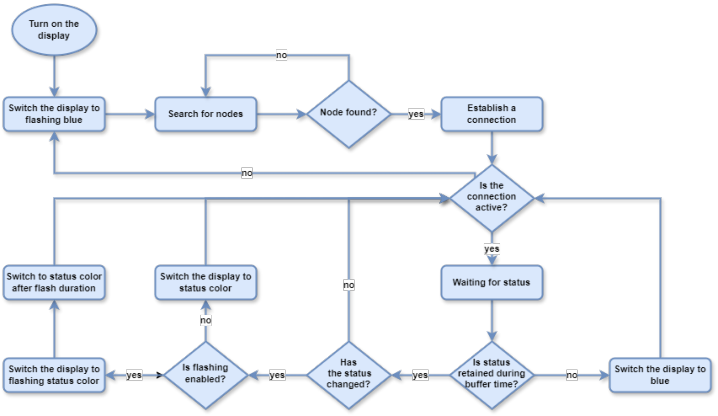
System Workflow The state-based behaviour model (Figure 2) illustrates the internal behavior of the display module in response to status updates from the communication node. Upon receiving a new physiological status, the display updates its color according to the traffic-light scheme (green, yellow, red) and optionally triggers a blinking pattern if the status indicates a worsening condition. If no update is received within a predefined timeout period, the display switches to a fail-safe state (blue) to indicate a potential communication or system fault.
Figure 2: State-based behaviour model of the display module’s status handling.
View2Decide: A Wearable Traffic-Light Display for Real-Time 9 This behavior ensures that the display provides immediate, unambiguous, and visually interpretable feedback, enabling first responders to rapidly assess a soldier’s condition even under stress or in challenging environmental conditions. The diagram also reflects the display’s handling of energy and connection monitoring, ensuring reliable operation during field deployment.
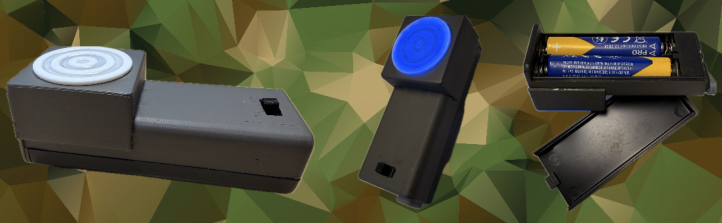
Prototype and Deployment The View2Decide proof-of-concept prototype demonstrates the feasibility of this concept, integrating a smartphone as the communication node with an ESP32-based LED display (Figure 3). The modular architecture allows for potential future enhancements, including improved energy solutions, integration with tactical networks, or additional environmental sensors. The current design emphasizes simplicity, robustness, and low-cost implementation while providing actionable information at a glance, fulfilling the operational requirements defined by the target users.
Figure 3: Prototype of the View2Decide system demonstrating the compact, wearable ESP32-based display module.
CONCLUSION
The View2Decide project demonstrates the feasibility of a compact, modular, and wearable system for rapid visualization of vital signs in military operational environments. By leveraging BLE-enabled communication, real- time sensor data, and an ESP32-based display module, the system provides intuitive, color-coded feedback that allows first responders to quickly assess the physiological status of soldiers or casualties. The traffic-light visualization minimizes cognitive load and supports immediate decision-making under time-critical and high-stress conditions.
The proof-of-concept implementation, using a smartphone as the communication and processing node, demonstrates the system’s functionality and flexibility in real-time physiological status visualization. While this setup enables rapid prototyping and validation, future work will focus on replacing the smartphone with dedicated embedded modules to improve energy efficiency, robustness, and integration into tactical communication networks. The modular architecture and open communication interface further support extensions such as enhanced power management, hardware ruggedization, and the integration of additional sensing capabilities.
This work focuses on the design and prototypical validation of the system rather than on formal user evaluation. Although the presented prototype confirms technical feasibility and practical applicability, future research will include systematic user studies and field experiments to assess usability, decision-making performance, and cognitive load reduction in realistic, time- critical, and multi-casualty scenarios.
In summary, View2Decide represents a promising approach to sensor- supported triage and physiological monitoring in military contexts. Its design combines simplicity, portability, and real-time responsiveness, laying the groundwork for future integration into comprehensive soldier health and operational decision-support systems.
REFERENCES
Almer, A., Weber, A., Paletta, L., Schneeberger, M., Ladstätter, S., Wallner, D., Grabher, G., Süss, P., Klöckl, P., Fuchshofer, P., & Hölzl, T. (2021). Multisensory wearable vital monitoring system for military training, exercise and deployment. In H. Ayaz, U. Asgher, & L. Paletta (Hrsg.), Advances in Neuroergonomics and Cognitive Engineering (Bd. 259, S. 497–505). Springer International Publishing. https://doi.org/10.1007/978-3-030-80285-1_57 Alnuaimi, M. K. (2025). Integrating wearable sensor data with an ai-based, protocol-
flexible triage platform to accelerate decision-making during the golden hour of combat casualty care. Cureus. https://doi.org/10.7759/cureus.91121 Gao, T., Massey, T., Selavo, L., Crawford, D., Chen, B., Lorincz, K., Shnayder, V., Hauenstein, L., Dabiri, F., Jeng, J., Chanmugam, A., White, D., Sarrafzadeh, M., & Welsh, M. (2007). The advanced health and disaster aid network: A light-weight wireless medical system for triage. IEEE Transactions on Biomedical Circuits and Systems, 1(3), 203–216. https://doi.org/10.1109/TBCAS.2007.910901 Grothe, J., Tucker, S., Blake, A., Achutan, C., Medcalf, S., Suwondo, T., Fruhling,
A., & Yoder, A. (2023). Exploring first responders’ use and perceptions on continuous health and environmental monitoring. International Journal of Environmental Research and Public Health, 20(6), 4787. https://doi. org/10.3390/ijerph20064787 Gutiérrez, Á., Blanco, P., Ruiz, V., Chatzigeorgiou, C., Oregui, X., Álvarez, M., Navarro, S., Feidakis, M., Azpiroz, I., Izquierdo, G., Larraga-García, B., Kasnesis, P., Olaizola, I. G., & Álvarez, F. (2023). Biosignals monitoring of first responders for cognitive load estimation in real-time operation. Applied Sciences, 13(13), 7368. https://doi.org/10.3390/app13137368 Hegarty-Craver, M., Davis-Wilson, H., Gaur, P., Walls, H., Dausch, D., &
Temple, D. (2024). Wearable sensors for service members and first responders: Considerations for using commercially available sensors in continuous monitoring. RTI Press. https://doi.org/10.3768/rtipress.2024.op.0090.2402 Killeen, J. P., Chan, T. C., Buono, C., Griswold, W. G., & Lenert, L. A. (2006).
A wireless first responder handheld device for rapid triage, patient assessment and documentation during mass casualty incidents. AMIA ... Annual Symposium Proceedings. AMIA Symposium, 2006, 429–433. Lemarquand, A., Jannot, P., Kammerlocher, L., Lissorgues, G., Behr, M., Arnoux, P.-J., & Boussen, S. (2025). A new trauma severity scoring system adapted to wearable monitoring: A pilot study. PLOS ONE, 20(3), e0318290. https://doi. org/10.1371/journal.pone.0318290
View2Decide: A Wearable Traffic-Light Display for Real-Time 11 Majumder, S., Mondal, T., & Deen, M. (2017). Wearable sensors for remote health
monitoring. Sensors, 17(1), 130. https://doi.org/10.3390/s17010130 Park, J. Y. (2021). Real-time monitoring electronic triage tag system for improving survival rate in disaster-induced mass casualty incidents. Healthcare, 9(7), 877. https://doi.org/10.3390/healthcare9070877 Polley, C., Jayarathna, T., Gunawarsdana, U., Naik, G., Hamilton, T., Andreozzi,
E., Bifulco, P., Esposito, D., Centracchio, J., & Gargiulo, G. (2021). Wearable bluetooth triage healthcare monitoring system. Sensors, 21(22), 7586. https:// doi.org/10.3390/s21227586 Sipos, D., Vészi, K., Bogár, B., Pető, D., Füredi, G., Betlehem, J., & Pandur, A. A.
(2025). Physiological state monitoring in advanced soldiers: Precision health strategies for modern military operations. Sci, 7(4), 137. https://doi.org/10.3390/ sci7040137
LISTED IN THE AHFE DIGITAL BOOKSTORE CATALOGUE
Explore the complete digital volume
Cognitive Computing and Internet of Things
Read this individual research paper free through the original publisher, or explore the full digital proceedings book.
ISBN 978-1-964867-81-6
Explore this ISBN in the AHFE Bookstore ↗Listed in the July 2026 bookstore catalogue; search by ISBN to confirm current availability · Digital book purchase optional