Florian Haid, Alexander Almer, Anna Weber, Markus Bergen, Gerald Bauer (2024). Innovative Biosensor based Aeromedical Monitoring Solution for Specific Military Medical Evacuation Scenarios. In: Cognitive Computing and Internet of Things. AHFE Open Access, vol. 124, pp. 10–20. https://doi.org/10.54941/ahfe1004699
Natural disasters, industrial accidents, or outbreaks, as evidenced by the COVID-19 pandemic, underscores the importance of preparedness in managing immediate evacuation of affected individuals. Infectious diseases pose the risk of compromising the transport environment by potentially contaminating the interior of the transport vessel. Addressing this challenge, this paper presents the DEKO-AirTrans solution introducing the development and implementation of a mobile evacuation system, tailored for use aboard the C-130 Hercules aircraft. The system features a flexible cell construction anchored to a multifunctional HCU-6 pallet, enveloped in a specifically designed protective tent material with high filtration and air permeability qualities to avoid contamination of the C-130 interior. Integrated sensor systems and wireless biosensors allow for continuous health monitoring of transported individuals, ensuring medical oversight during transport. DEKO-AirTrans represents an advancement in the air evacuation domain, offering a cost-effective, rapidly deployable, and flexible solution for the safe transport of highly infectious or contaminated persons. The system's design ensures quick setup, ease of storage, transportability, and compatibility with existing standards, highlighting its potential as a solution for emergency medical evacuation scenarios.
International crisis situations in recent years, in particular COVID-19, have shown the importance of being able to evacuate contaminated or infected soldiers or civilians by air. When dealing with life-threatening and highly contagious infectious diseases, it is essential to be able to transport individ- uals, often in time-critical situations, without compromising the transport aircraft by contaminating the interior. Currently, impermeable solutions such as MEDEVAC containers or individual containers are used for this pur- pose. These solutions provide a high level of transport security, but are very expensive and cannot be used in a flexible way. Their use requires
Innovative Biosensor Based Aeromedical Monitoring Solution 11
advance planning and the limited interior space limits the number of peo- ple that can be transported. This makes them unsuitable for dynamic situations such as evacuations, where a rapid and adaptable response is critical.
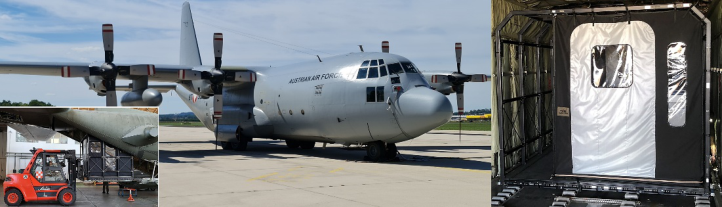
The aim of DEKO-AirTrans was therefore to develop, together with experts from the Austrian Armed Forces, a mobile, flexibly deployable system for the air transport of highly infectious or contaminated persons on board the C-130 Hercules (Figure 1). For this purpose, AUTOFLUG developed a flexible cell construction based on a multifunctional HCU- 6 pallet. It allows for a quick changeover and the combination of sev- eral cells, with only one fixation to the cargo floor. The cell is covered with a permeable tent material (ToxicShield) with high filtration capac- ity against particles and hazardous gases as well as high air permeability (Figure 2).
Figure 1: Supply and rescue chain for highly infectious and contaminated people - aeromedical evacuation from critical infection areas.
The necessary monitoring of the transport situation was realized by a sensor system integrated into the inner tent and by individual, permanent monitoring based on biosensors (PMB). Several innovative wireless biosen- sor solutions were used for the different health situations. This paper will focus on the multi-sensor medical monitoring and telemedicine system for the airborne transfer of highly infectious or contaminated patients, which was an important part of the project.
Figure 2: Evacuation tent demonstrated for the Hercules C-130 cargo aircraft.
RELATED WORK
As noted by Field et al. (1996), telemedicine can bring expert knowl- edge to the point of need. There are many different ways of implementing
telemedicine, ranging from asynchronous methods, like sharing databases or using email, to synchronous methods, such as live data sharing or tele- phone or even video calls. There is also a variety of applications, but it is very often used in disaster relief situations (Doarn et al., 2014) or in military medical centers where expert advice is needed (Tabanejad et al., 2023). Military solutions are more complex than applications for the general pub- lic because they have to meet higher security standards and operate under special conditions. In 2010, the US Defense Health Program included funding for health information technology and informatics research for the first time. This was a major step forward in the development of medicine, particularly mobile health and telemedicine (Friedl et al., 2019).
In resource-limited austere environments, telemedicine can be a great asset in optimizing care under these conditions. Although medical staff are present, they do not always have the full expertise required in some critical situations (Pamplin et al., 2019).
Relevant Research Projects VitalMonitor is an Austrian project funded within the FORTE program. Its aim was to develop a multisensory wearable vital monitoring system for mil- itary training and exercises (Almer et al., 2021). In addition to real-time monitoring of the soldiers, the focus was on developing a scenario-specific physiological stress model to help ensure the safety of the soldiers and avoid physical or cognitive fatigue (Almer et al., 2023).
SIXTHSENSE (Smart integrated extreme environment health monitor with sensory feedback for enhanced situation awareness) is a European funded project within the Horizon 2020 plan. The aim of the project was to implement a multi-sensor wearable health monitoring system for first respon- ders. This project enabled early risk detection and team leader support by providing a live monitoring solution with the ability to send tactical mes- sages via electronic stimulation to the first responders in the field (Bijelic et al., 2022).
Relevant international projects that showed important solutions were primarily the projects BATDOK1 (Battlefield Assisted Trauma Distributed Observation Kit; a mobile patient monitoring system developed by the US Air Force Research Laboratory) and AIRCARDIO (telemedicine system for the remote management of chronic patients) where the concept was described by Donati et al. (2018).
Health Monitoring Systems Thanks to technological advances, sensors are becoming cheaper, smaller and more powerful and can even be integrated into textiles or small patches. The main problem is still the flexibility and robustness of wearable sensors to
1https://techlinkcenter.org/technologies/battlefield-assisted-trauma-distributed-observation-kit-batdok-s oftware-tools/d6074edb-dde4-4a0b-8c40-c4e844917b28 (Accessed on: 2024-01-15)
Innovative Biosensor Based Aeromedical Monitoring Solution 13
provide continuous and valid monitoring of vital parameters independent of the user’s movement. Many studies and research projects deal with the development and state of the art of wearable sensor solutions. An important aspect is the personal calibration for each patient in order to avoid a mis- alignment of the sensors negatively influencing the measurements and results of the analysis methods (Guk et al., 2019).
Innovative approaches to cost-effective and non-invasive monitoring sys- tems are described by Majumder et al. (2017). In this case online capability is achieved through a two-stage communication solution (via short-range technology to a smartphone).
Dias et al. (2018) also compare several wearable health devices, focusing on the most important vital signs and the technologies behind the sensors. During their study, they identified the following five vital signs that have a major impact on health: heart rate, blood pressure, respiratory rate, blood oxygen saturation and temperature. Environmental parameters such as ambi- ent temperature, humidity and sound levels can also have a significant impact on a patient’s health.
There are also existing solutions that focus on health monitoring of mul- tiple people using wireless sensor technology. The most prominent systems currently available on the market are Equivital (Cuddy et al., 2008) and Zephyr Performance System (Claudio et al., 2015; Nazari et al., 2018) which both use a smart-textile solution to monitor the individual’s health status. VitalConnect (Santos et al., 2021) takes a different approach and uses a patch solution for health monitoring, while Cosinuss (Adams et al., 2022; Ellebrecht et al., 2022) has developed an in-ear sensor for this area of healthcare.
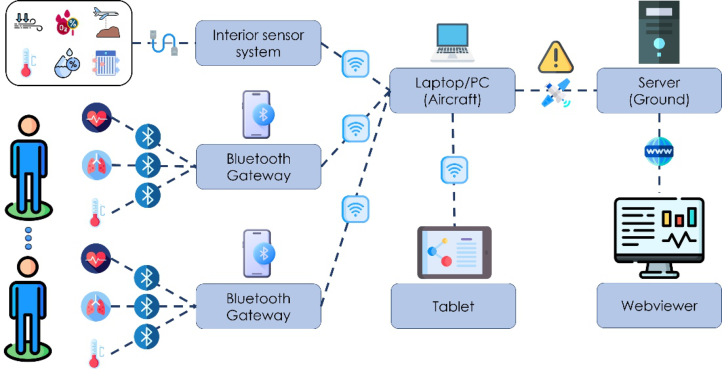
SYSTEM CONCEPT The basic concept of the whole monitoring and telemedicine system is shown in Figure 3 and consists of several different components. Each patient is fitted with one or more sensors that monitor key vital signs such as heart rate, respiratory rate and temperature. All this data is then transmitted wirelessly via BLE to a Bluetooth gateway. In the system presented, this gateway is an Android smartphone, and its role is not only to forward the recorded data, but also to merge the sensor data and analyze it directly for anomalies such as outliers or change points. The merged sensor data, including the analysis results and a patient identifier, is then transmitted via WLAN to the local server on board the aircraft.
In addition an environmental sensor is used to monitor the environmen- tal conditions (temperature, air pressure, air quality, etc.) which can have a major impact on the patient’s current state of health. In the same way as the patient’s sensor data, it is transmitted wirelessly via WLAN to the on-board server.
Figure 3: System concept of the multi-sensor medical monitoring and telemedicine system for airborne transfer of contaminated patients.
The data center is the server on board the aircraft. All received sensor data is stored and managed in a local database system. Recorded data is securely stored and can be accessed using the live Health Monitor dashboard via the local network, or by transferring all relevant data to the ground server in the event of a critical situation requiring expert support.
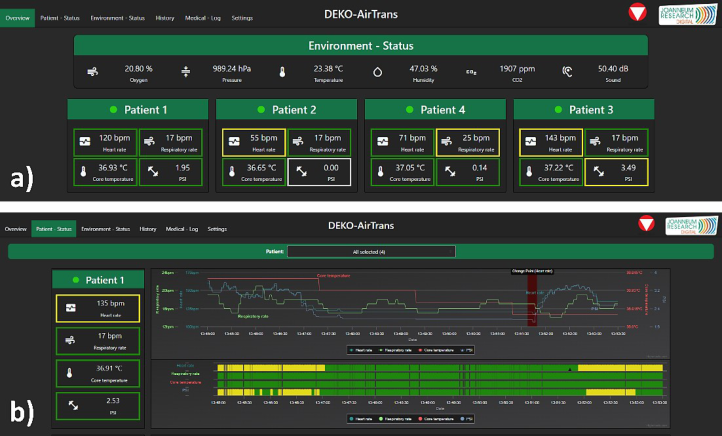
The tablet running the Health Monitor dashboard (Figure 4) receives all data from patients and environment in real-time via active WebSocket com- munication. This data is presented in an intuitive overview, including current health status, analysis results and historical data for each patient. The dash- board provides the caregiver a user-friendly interface for monitoring patients during transport.
As mentioned, another server is needed on the ground, which manages all the data and stores it anonymously in a local database. The data can be made available to anyone who is authorized to view it via the dash- board, regardless of their location. Therefore, the experts on the ground can monitor the patients in the same way as the caregivers in the air- craft. This provides an optimal opportunity for support from experts, to e.g. dispose an emergency action or define the medication. It is important to notice, that this telemedicine health monitoring approach requires an active satellite connection to the aircraft but in the end it provides a com- plete and secure system for monitoring and analysis of patients during air transport.
Innovative Biosensor Based Aeromedical Monitoring Solution 15
Figure 4: Telemedicine dashboard with an overview of the current health status of all patients, including the environmental conditions (a) and a more detailed view of all patients’ vital signs, including abnormalities detected (b).
HEALTH MONITORING Sensors
The sensor system of the developed solution consists of two different sensor groups. The environmental sensor, which is responsible for all environmental conditions and vital sensors, to measure all relevant vital parameters of the patients for an overview of their current health status.
As environmental sensor the AirQ2 air quality sensor was chosen because of the unique number of parameters it measures, the expandability/inter- changeability of the sensors, and the ease of software integration. The sensor measures 13 parameters, such as oxygen, humidity, temperature, air pressure, carbon dioxide, etc. The sensor can be expanded with special sensors and also be used in a large IoT platform for air quality monitoring in smart cities due to its low cost and live measurement capability, as presented by Choudhary et al. (2020).
The selection of the vital signs sensor was more challenging due to the specific requirements and the limitations of the application area. The goal was to integrate a patch solution that was single-use only, where the patch could be disposed of after the transport, avoiding the risk of cross-contamination.
In the end, the Biobeat’s3 chest monitor was chosen. The developed patch solution is medically certified and can be disposed after usage. It has a bat- tery life of up to five days and measures all relevant vital sings like blood pressure, blood oxygen saturation, heart rate, respiratory rate, temperature, 2https://www.air-q.com (Accessed on: 2024-01-16) 3https://www.bio-beat.com (Accessed on: 2024-01-16)
1-lead ECG and many more. The technology has also been evaluated in sev- eral studies with different research topics (systolic/diastolic blood pressure (Nachman et al., 2021), cardiac output (Dvir et al., 2022), response to a Covid mRNA vaccine (Gepner et al., 2022)), where the sensor showed quite interesting results.
Data Analysis Change Point Detection As serious changes in the patient’s vital signs could indicate a critical devel- opment in their health status, an online Bayesian change point detection algorithm is used to analyze the vital data for such change points. The first online method was published by Adams et al. (2007). The algorithm also includes some observation likelihood methods, such as Student’s t- distribution, which often require some hyperparameters that cannot be easily defined without hyperparameter tuning. To address this issue, the algorithm implemented is utilizing the approach outlined by Wang et al. (2021). By using this method, fewer parameters need to be defined in advance, and the model adapts automatically to the data collected during a warm-up phase.
Outlier Detection Outliers in data can occur due to incorrect sensor readings or other envi- ronmental influences that are abnormal. As these outliers can have a huge impact on the results and understanding of the data, it is sometimes nec- essary to identify and optionally remove them from the data. To overcome this problem, the Hampel filter from Hampel et al. (1974), which uses a slid- ing window approach and the Median Absolute Deviation (MAD) to identify outliers in given time series data, has been integrated. The algorithm is simple to implement and is considered one of the most robust and efficient methods for filtering and detecting outliers in online scenarios (Albuquerque et al., 1996).
Minimum Transmission Interval As there are several factors that can affect the maximum available data rate, it is not always possible to select the highest sample rate to obtain the most accurate data. Especially in an aircraft, the available data rate can vary greatly. For this reason, this section evaluates at which sample rate the val- ues of the three most important vital signs (heart rate, respiratory rate and temperature) where the data is still informative enough to get a picture of the patient’s health status and no important information is lost.
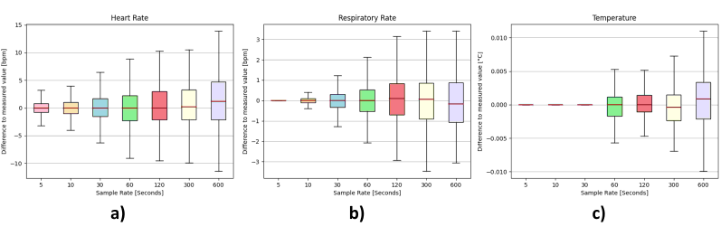
For each parameter, seven different sampling rates were compared with the original sampling interval of one second. For these cases, the mean of the difference from the exact value was calculated in addition to the standard deviation (SD) of the result. Another indicator of how well the lower sample rate data still performs is the Pearson correlation coefficient (PCC), where a high value means that the two sets of data are not correlated, and the lower the value, the more similar they are. Illustrated graphically in Figure 5, the detailed results are presented in Table 1.
Innovative Biosensor Based Aeromedical Monitoring Solution 17
Figure 5: Analysis of the minimum transmission interval for the most relevant vital signs – heart rate (a), respiratory rate (b) and temperature (c).Table 1. Results of the minimal transmission rate analysis for all three parameters.
The evaluation of the minimum transmission interval for the transmission of vital signs to still be able to make a meaningful assessment of the patient’s condition can not easily be defined. Every vital sign has different characteris- tics and therefore needs his own sample rate and should not depend on other sensors.
Following the principle of only considering data with a PCC above 0.95, a sampling rate of 30 seconds would be sufficient for the heart rate, as a PCC of 0.9574 is still achieved. Furthermore, the mean is very close to zero and there is only a standard deviation of 3 beats per minute, which should be acceptable.
If one were to follow the same principle, even the lowest sample rate of 5 seconds would not be relevant for the respiration rate, since a PCC of only 0.8650 is already achieved here. Considering the difference as the mean value and the standard deviation, an interval of 30 seconds would also be reason- able here, as the error is also very close to zero in view of the mean value and a standard deviation of less than one breath per minute is also achieved.
For the temperature, even a sample rate of only 2 minutes is sufficient, taking into account the PCC above 0.95. This is because the value does not change as rapidly as the heart rate or the respiratory rate and therefore only rises or falls relatively slowly. With an interval of 2 minutes, a PCC of 0.9653 and a standard deviation of only 0.002
C can still be achieved with a mean value close to zero. Note that this sampling rate is only acceptable under nor- mal conditions, as under other conditions, such as severe febrile seizures or heat strokes, the temperature may change rapidly, requiring a higher sampling rate.
All in all, if a combined transmission interval must be chosen for this sce- nario, a sampling rate of 30 seconds would be suitable for each vital sign, even though a higher sampling rate would be sufficient for temperature, as well. By increasing the sampling rate to 30 seconds, the transmission rate can be reduced by 1/30 of the original resolution, which in turn results in a huge reduction in the bandwidth required.
CONCLUSION AND OUTLOOK This paper described the multi-sensor medical monitoring and telemedicine system for the airborne transfer of highly infectious or contaminated patients, as part of the project DEKO-AirTrans. The aim was to develop an innovative and flexible patient monitoring system to support the caregiver during the flight. In addition to the complete setup of the system, including the internal communication in the aircraft, the sensor setup and the required dashboard, additional analyses were integrated, which are sent live to the dashboard to provide further decision support for the caregiver.
As high speed internet access is not always available in the air, the minimum data rate at which important information is not lost and an informed opinion on the patient’s condition can still be formed was also investigated. After various tests, it was concluded that at a sampling rate of 30 seconds, all important features are still present in the data set, providing a reliable basis for forming an opinion on the patient’s condition.
In summary, an operational patient monitoring system has been developed that meets all the basic requirements and can be used by medical escorts without much prior knowledge to provide additional support in monitoring contaminated patients during air transport.
The DEKO-AirTrans project represents an advancement of current MEDE- VAC solutions, providing a cost-effective, rapidly deployable and flexible solution for the safe transport of highly infectious or contaminated persons. The relevance of the topic was also confirmed by the successful submis- sion to the EDF 2023 programme. The DEKO-AirTans components will be further developed as part of the EDF project iMedCap - Development of intelligent military capabilities for monitoring, medical care and evacuation of contagious, injured and contaminated personnel.
ACKNOWLEDGMENT
The presented research activities were embedded into a project worked out within the Austrian Defense Research Programme FORTE, funded by the
Innovative Biosensor Based Aeromedical Monitoring Solution 19
Austrian Research Promotion Agency (FFG) and the Austrian Federal Min- istry of Finance. The project was carried out in close cooperation with AUT- OFLUG GmbH, Grabher Group GmbH and the Austrian Federal Ministry of Defense.
REFERENCES
Adams, R. P. & MacKay, D. J. C. (2007), ‘Bayesian Online Changepoint Detection’, Arxiv preprint arXiv:0710.3742 (www.arxiv.org). arXiv:0710.3742 [stat] version: 1. Adams, T., Wagner, S., Baldinger, M., Zellhuber, I., Weber, M., Nass, D. & Surges, R.
(2022), ‘Accurate detection of heart rate using in-ear photoplethysmography in a clinical setting’, Frontiers in Digital Health 4. Albuquerque, J. S. & Biegler, L. T. (1996), ‘Data reconciliation and gross-error detection for dynamic systems’, AIChE Journal 42(10), 2841–2856. Almer, A., Weber, A., Paletta, L., Schneeberger, M., Ladstätter, S., Wallner, D.,
Grabher, G., Süss, P., Klöckl, P., Fuchshofer, P. & Hölzl, T. (2021), Multi- sensory Wearable Vital Monitoring System for Military Training, Exercise and Deployment, ‘Advances in Neuroergonomics and Cognitive Engineering’, Springer International Publishing, Cham, pp. 497–505. Almer, A., Weber, A., Haid, F., Paletta, L., Schneeberger, M., Ladstätter, S., Wallner, D., Glanz, P., Klöckl, P., Eder, D., Bauer, G. & Hölzl, T. (2023), ‘Real-time Remote Stress Monitoring based on Specific Stress Modelling considering Load Characteristics of different Military Forces’, Cognitive Computing and Internet of Things, AHFE 73, 1–10. Bijelic, G., Iceta, N. B., Stefanovic, C., Morschhauser, A., Leyenda, A. B. C.,
Paletta, L., Falk, A., Kostic, M., Strbac, M., Jorgovanovic, N., Jobst, G., Paradiso, R., Magenes, G., Bolado, P. F., Vujic, A. & Eschenbacher, P. (2022), SixthSense: Smart Integrated Extreme Environment Health Monitor with Sensory Feedback for Enhanced Situation Awareness, in ‘2022 IEEE-EMBS International Confer- ence on Wearable and Implantable Body Sensor Networks (BSN)’, pp. 1–4. ISSN: 2376–8894. Choudhary, V., Teh, J. H., Beltran, V. & Lim, H. B. (2020), AirQ: A Smart IoT Platform for Air Quality Monitoring, in ‘2020 IEEE 17th Annual Consumer Communications & Networking Conference (CCNC)’, ISSN: 2331-9860. Claudio, D., Velzquez, M. A., Bravo-Llerena, W., Okudan, G. E. & Freivalds, A.
(2015), ‘Perceived Usefulness and Ease of Use of Wearable Sensor-Based Systems in Emergency Departments’, IIE Transactions on Occupational Ergonomics and Human Factors 3(3-4), 177–187. Cuddy, J. S., Ruby, B. C., Santee, W. R. & Karis, A. J. (2008), Hidalgo Equivital (TM) Physiological Monitor Product Review and Data Summary, Technical report, U. S. Army Research Institute of Environmental Medicine. Dias, D. & Paulo Silva Cunha, J. (2018), ‘Wearable Health Devices-Vital Sign
Monitoring, Systems and Technologies’, Sensors (Basel, Switzerland) 18(8), 2414. Doarn, C. R. & Merrell, R. C. (2014), ‘Telemedicine and e-Health in Disaster Response’, Telemedicine and e-Health 20(7), 605–606. Donati, M., Celli, A., Ruiu, A., Saponara, S. & Fanucci, L. (2018), A telemedicine
service platform exploiting BT/BLE wearable sensors for remote monitoring of chronic patients, in ‘2018 7th International Conference on Modern Circuits and Systems Technologies (MOCAST)’, pp. 1–4.
Dvir, A., Goldstein, N., Rapoport, A., Balmor, R. G., Nachman, D., Merin, R., Fons, M., Ben Ishay, A. & Eisenkraft, A. (2022), ‘Comparing Cardiac Output Measurements Using a Wearable, Wireless, Noninvasive Photoplethysmography- Based Device to Pulse Contour Cardiac Output in the General ICU: A Brief Report’, Critical Care Explorations 4(2), e0624. Ellebrecht, D. B., Gola, D. & Kaschwich, M. (2022), ‘Evaluation of a Wearable in-
Ear Sensor for Temperature and Heart Rate Monitoring: A Pilot Study’, Journal of Medical Systems 46(12), 91. Field, M. J., ed. (1996), Telemedicine: A Guide to Assessing Telecommunications for Health Care, National Academies Press, Washington, D. C. Friedl, K. E., Talbot, T. B. & Steffensen, S. (2019), Information Science and Technol-
ogy: A New Paradigm in Military Medical Research, in T. Daim, M. Dabifj, N. Baolu, J. R. Lavoie & B. J. Galli, eds, ‘R&D Management in the Knowledge Era: Challenges of Emerging Technologies’, Innovation, Technology, and Knowledge Management, Springer International Publishing, Cham, pp. 3–44. Gepner, Y., Mofaz, M., Oved, S., Yechezkel, M., Constantini, K., Goldstein, N., Eisenkraft, A., Shmueli, E. & Yamin, D. (2022), ‘Utilizing wearable sensors for continuous and highly-sensitive monitoring of reactions to the BNT162b2 mRNA COVID-19 vaccine’, Communications Medicine 2(1), 1–8. Guk, K., Han, G., Lim, J., Jeong, K., Kang, T., Lim, E.-K. & Jung, J. (2019), ‘Evo-
lution of Wearable Devices with Real-Time Disease Monitoring for Personalized Healthcare’, Nanomaterials 9(6), 813. Hampel, F. R. (1974), ‘The Influence Curve and its Role in Robust Estimation’, Journal of the American Statistical Association 69(346), 383–393. Majumder, S., Mondal, T. & Deen, M. J. (2017), ‘Wearable Sensors for Remote
Health Monitoring’, Sensors 17(1), 130. Nachman, D., Gilan, A., Goldstein, N., Constantini, K., Littman, R., Eisenkraft, A., Grossman, E. & Gepner, Y. (2021), ‘Twenty-Four-Hour Ambulatory Blood Pressure Measurement Using a Novel Noninvasive, Cuffless, Wireless Device’, American Journal of Hypertension pp. 1171–1180. Nazari, G., Bobos, P., MacDermid, J. C., Sinden, K. E., Richardson, J. & Tang, A.
(2018), ‘Psychometric properties of the Zephyr bioharness device: a systematic review’, BMC Sports Science, Medicine and Rehabilitation 10(1). Pamplin, J. C., Davis, K. L., Mbuthia, J., Cain, S., Hipp, S. J., Yourk, D. J., Colombo, C. J. & Poropatich, R. (2019), ‘Military Telehealth: A Model For Delivering Exper- tise To The Point Of Need In Austere And Operational Environments’, Health Affairs 38(8), 1386–1392. Santos, M. D., Roman, C., Pimentel, M. A. F., Vollam, S., Areia, C., Young, L.,
Watkinson, P. & Tarassenko, L. (2021), ‘A Real-Time Wearable System for Moni- toring Vital Signs of COVID-19 Patients in a Hospital Setting’, Frontiers in Digital Health 3. Tabanejad, Z., Mohajeri, H. & Hosseinpour, A. (2023), ‘Telemedicine in Selected Military Medical Centers: What and How It Is Being Done’, Journal of Archives in Military Medicine 11(1). Wang, Z., Lin, X., Mishra, A. & Sriharsha, R. (2021), Online Changepoint Detec-
tion on a Budget, in ‘2021 International Conference on Data Mining Workshops (ICDMW)’, IEEE, Auckland, New Zealand, pp. 414–420.
LISTED IN THE AHFE DIGITAL BOOKSTORE CATALOGUE
Explore the complete digital volume
Cognitive Computing and Internet of Things
Read this individual research paper free through the original publisher, or explore the full digital proceedings book.
ISBN 978-1-964867-00-7
Explore this ISBN in the AHFE Bookstore ↗Listed in the July 2026 bookstore catalogue; search by ISBN to confirm current availability · Digital book purchase optional