Florian Haid, Michael Schneeberger, Belén Carballo Leyenda, Jose A Rodríguez-marroyo, Stefan Ladstätter, Anna Weber, Alexander Almer, Jochen Mosbacher, Lucas Paletta (2024). Semantic Decision Support for Action Forces With Risk Stratification From Estimated Physiological Strain, Cognitive-Emotional Stress and Situation Awareness. In: Cognitive Computing and Internet of Things. AHFE Open Access, vol. 124, pp. 21–32. https://doi.org/10.54941/ahfe1004700
Publisher statistics will load when you open Metrics.
AHFE OPEN ACCESS OPEN ACCESS CONFERENCE PROCEEDINGS PAPER
Semantic Decision Support for Action Forces With Risk Stratification From Estimated Physiological Strain, Cognitive-Emotional Stress and Situation Awareness
In the life-threatening work of action forces, a decision support system (DSS) must provide a software application that should improve a mission decision maker's capability to make decisions. This requires analysing large amounts of data and to present and visualize the best possible options available. In case of first responders, where errors in decision-making can have fatal consequences, timely identification of increased risk of physiological collapse, insufficient cognitive readiness and lack of situation awareness is mandatory. This paper therefore introduces our Semantic Decision Support System (SDSS) that can apply intelligent analytics on data from wearable biosignal sensors, to provide feedback in terms of risk stratification. It also includes a recommender engine that identifies the best next action at team management level. Its novelty lies specifically in the combination of various multimodal data streams each being equipped with assessment modules, risk stratification and recommender engines in order to finally combine various aspects of decision support that is based on psychophysiological measurement technologies. All relevant data is systematically merged into an advanced expert dashboard, providing a comprehensive platform for the continuous real-time monitoring and visualization of critical information. This capability enables the ongoing assessment of risk levels associated with a diverse group of action forces. The centralized dashboard serves as a powerful tool, enabling careful surveillance and prompt response to emerging risks across a broad spectrum of operational scenarios.
In critical operations like those carried out by action forces, it is vital to quickly spot an increased risk of physiological collapse, insufficient cognitive readiness or lack of awareness, since mistakes in decision-making can be fatal.
This highlights the need for a Semantic Decision Support System (SDSS) designed to assist decision makers in the field by intelligently analysing data from wearable biosignal sensors in real-time. We implemented such a system that provides feedback through risk stratification and suggests the best next action at the team management level. Its uniqueness stems from combining multiple processing streams, each with assessment modules, risk stratifica- tion, and recommender engines. This unification addresses various aspects of decision support based on psychophysiological measurement technologies.
The central component of the DSS relates to the assessment of physiologi- cal risk, in particular heat strain risk. It computes the Modified Physiological Strain Index (PSI*) and applies a rule base for the classification into risk levels from PSI, heart rate, and estimated core body temperature data. Furthermore, various risk levels and duration of physiological strain are further related to recommended actions, such as, resting or rehydration. A second com- ponent provides a heuristic model of the cognitive-emotional stress that is associated with risk levels for reliable decision-making. The third com- ponent applies a mapping from cardiovascular bio-signals, such as, heart rate and heart rate variability, to quality levels of situational reporting. This Machine Learning-based estimation of various dimensions of situation awareness was developed by Paletta et al. (2022) and enables to estimate risks for increased error rates in (i) perception, (ii) understanding semantic context and (iii) projection of relevant risk-bearing developments in a scenario. A fourth component is based on the measurement of lactate concentration and provides another physiological risk stratification. Currently, these data are collected using standard lactate measurement technologies without wearable sensing capability.
The SDSS is linked to an Expert Dashboard for the monitoring and visu- alization of relevant information in real-time. It enables the tracking of risk levels for a large number of first responders, provides capabilities to switch between individual persons linked with the presentation of synchronized raw and processed data over time, as well as depicting the risk levels associated with the raw data, and recommended actions over time.
RELATED WORK
Decision support systems have become indispensable in many areas, espe- cially in life-threatening situations to which first responders are regularly exposed to. For this exact reason, there are already multiple research projects focussing on decision support systems based on biosignals. The US-based R&D project called HAZMAT developed a new system called REaCH (Fruh- ling et al., 2020). The REaCH system includes real-time health monitoring of first responders through wearable devices that capture individual health parameters and exposure to hazardous materials. The biomonitoring plat- form designed by Rodrigues et al. (2018) integrated different biomedical systems to enable the acquisition of real time Electrocardiogram (ECG), com- putation of linear Heart Rate Variability (HRV) features and collection of perceived stress levels. Tartare et al. (2018) developed a system that was com- posed of a lightweight garment integrating a number of sensors measuring
Semantic Decision Support for Action Forces With Risk Stratification 23
the wearer’s physiological state and a microcontroller permitting to gather all measured data and make data-based prediction on the wearer’s health state, stress and fatigue with the help of a local decision support system.
In comparison to all these projects, we are introducing a semantics-based DSS which, according to Jain (2020), consists of three components that are all supported by semantic technologies and integrated in such a way that they fulfil the purpose of a specific service. The three components are: (i) the knowledge base which represents and stores the domain knowledge required by the DSS, (ii) the model base, with the whole algorithmic that generates recommendations and provides the required decision support and (iii) the user interface as an information exchange between the user and the sys- tem and for the visualisation of all results from the DSS. Especially in the healthcare sector, there already exist many semantic technologies that sup- port the decision-making in different areas according to Mishra et al., 2018 and Dalal et al., 2019. A large number of decision support systems for large- scale disasters and emergency management (Hassan and Yun-He, 2016) also exists. Still, to the best of our knowledge, there does not yet exist a semantic DSS for the advising of first responders.
SEMANTIC DECISION SUPPORT SYSTEM
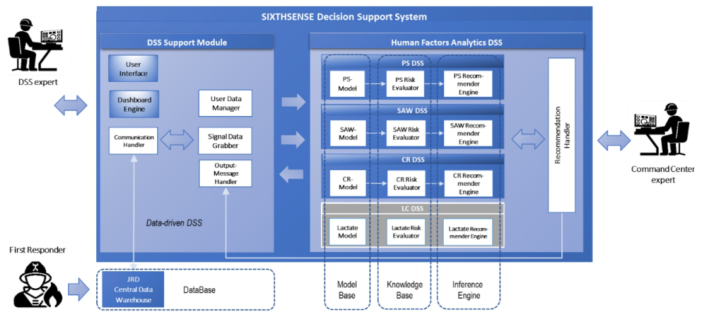
Figure 1 demonstrates in particular the implementation of the various DSS components that are modelled with respect to different types of risks that have been defined based on different psychophysiological variables of strain. These specific components of the DSS are outlined within the overall con- tainer of the “Human Factors Analytics DSS” (HFA-DSS) in the following sections. These different modules of HFA-DSS referring to (i) the physio- logical strain (PS-DSS), (ii) the situation awareness-related impact of phys- iological strain (SAW-DSS), (iii) the cognitive readiness-related impact of physiological strain (CR-DSS), and (iv) the lactate-concentration-based DSS component in the context of physiological strain (LC-DSS).
Figure 1: Schema of the semantic decision support system (SDSS) architecture.
PHYSIOLOGICAL STRAIN (PS-DSS) The proposal for the physiological strain modelling, in line with Buller et al. (2008), consists of using PSI as a starting point in the physiological strain assessment, where the classification labels were assigned based upon PSI ≥7.5 means “at risk”, and PSI < 7.5, which means “not at risk”. Given that the PSI value, presented by Buller et al. (2008) is based on core body temper- ature, and considering that our PSI* uses the skin temperature instead, we concluded after analysing experimental data that 6 is a better PSI* thresh- old for assessing physiological risk. Once an “at risk” classification has been made, additional physiological parameters could act as a second step validation of the physiological state of the first responder (i.e. hear rate thresholds, skin temperature thresholds). Yokota et al. (2005) established that, when using heart rate and skin temperature to assess physiological strain risk, a reasonable classification boundary would deal effectively with three conditions:
1. high heart rate and high skin temperature indicate “at risk”, 2. high heart rate from exercise and lower skin temperature indicate “not at risk”, 3. high skin temperature, regardless of heart rate, indicates “at risk” unless contextual information suggests otherwise.
Keeping in mind that the study of Yokota et al. (2005) focused on heat strain, it should be considered to add another boundary to account for exposure to cold environment that would be the expected scenario for mountain rescuers. For this reason, the boundary condition for cold exposure would be: 4. very low skin temperature, regardless of heart rate, indicates “at risk”.
HEART RATE THRESHOLDS Fatigue is related to sustaining a high oxygen uptake (VO2) or heart rate (HR) (Astrand and Rodahl, 1986). First responders are reported to encounter many hazardous occupational conditions, which means they must work at high exertion levels during strenuous work activities in variable work shifts (Rodríguez-Marroyo et al., 2012). Physiological limits for heavy work have been set to prevent workers from overload. These limits define the maximal sustainable workload, which should not be exceeded permanently during the working time and are usually defined as upper limits for physiological per- formance. The most frequently applied limits are prescribed as a percentage of maximal oxygen uptake (% VO2max) or maximal heart rate (% HRmax), representing the individual strain of a person.
Wu and Wang (2001) established that for high-intensity work, the maxi- mum acceptable work duration for individuals working at 60% of VO2max (∼75% HRmax) is 18.8 min, and 6.5 min when working at 70% VO2max (∼85% HRmax). In terms of heart rate, the maximum acceptable work dura- tion would be 4 min for an individual working at 90% HRmax (∼80% VO2max), 9 min at 80% HRmax (∼65% VO2max) and 18 min at 70% HRmax
Semantic Decision Support for Action Forces With Risk Stratification 25
(∼50% VO2max). These threshold values, by contrast, are based on the pop- ulation of untrained workers. First responders have to be physically fit to face up job-related tasks. This means they would have a higher cardiovascu- lar capacity than the average work population (Perroni et al., 2010), which means they could spend more time in each heart rate threshold.
Usually, a model that establishes three exercise intensity zones according to the reference heart rate values corresponding to these thresholds is used: i) low-intensity zone, below the aerobic threshold; ii) moderate intensity zone, between the aerobic and anaerobic thresholds; and iii) high-intensity zone, above the anaerobic threshold. Previous studies (Rodríguez-Marroyo et al., 2012; Callender et al., 2012) have found the aerobic and anaerobic threshold in first responders at ∼65 and ∼85% HRmax, respectively.
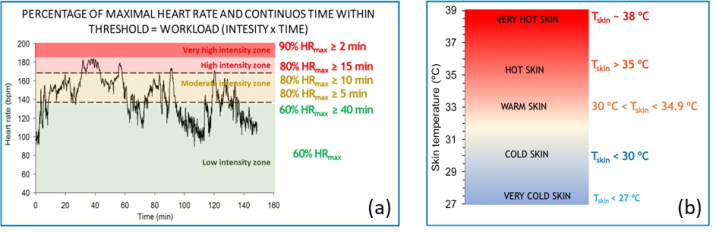
Leading to following heart rate thresholds for the physiological strain model (Figure 2a):
Figure 2: Proposed heart rate thresholds (a) and skin temperature thresholds (b) for the physiological strain model.
Very high intensity zone (danger threshold) – HR ∼100% HRmax for more than 1 minute indicates “at risk” – HR > 90% HRmax for more than 2 minutes indicates “at risk”
High intensity zone (danger threshold) – HR > 80% HRmax for more than 15 minutes indicates “at risk” – HR > 70% HRmax for more than 35 minutes indicates “not at risk” – HR > 60% HRmax for more than 40 minutes indicates “not at risk”
Moderate intensity zone (warning threshold) – HR > 80% HRmax for more than 5 minutes indicates “at risk” – HR > 70% HRmax for more than 20 minutes indicates “not at risk” – HR > 60% HRmax for more than 25 minutes indicates “not at risk”
Low intensity zone – HR ≤60% HRmax indicates “not at risk” if other parameter are “within thresholds”
SKIN TEMPERATURE THRESHOLDS The inability to regulate core body temperature during work in the heat is perhaps the most direct index of occupational thermal strain (Notley et al., 2018). Excessive rises (≥40.0
C) or drops (≤27
C) in core body tempera- ture can rapidly lead to organ failure and death if medical care is unavailable (NIOSH, 2016). As such, for heat strain, it is recommended that core body temperature should not exceed 38.0
C and 38.5
C for extended periods for unacclimatised and acclimatised workers, respectively (ACGIH, 2017). How- ever, a core body temperature limit of ∼39.5
C has been accepted in short periods for compensable conditions in acclimatised subjects (Sawka et al., 2001). Regarding cold strain, the main goal is to prevent the core body tem- perature from falling below 36
C. If the core body temperature falls below 35
C, there is a risk of hypothermia, whereas if the core body temperature reaches 27
C, unconsciousness occurs and can eventually be fatal (ACGIH, 2018). The body surface (skin) represents the medium between the body core and the external environment. As such, skin temperature is not only influenced by environmental and clothing parameters but also by metabolic heat pro- duction and autonomic heat loss responses (skin blood flow and sweating). In cooler conditions, where cutaneous vasoconstriction minimises the ther- mal gradient for dry heat exchange, regional differences in skin temperature are extensive (Notley et al., 2018). However, in hotter environments or wear- ing protective clothing, skin temperature rises and becomes more uniform as increases in cutaneous vasodilatation facilitate blood-borne heat transfer to the skin surface (Notley et al., 2018).
Based on the research the following thresholds for the skin temperature (Tskin) where used (Figure 2b):
Tskin > 38
C indicates “at risk” (danger threshold)
Tskin > 35
C and ≤38
C indicates “at risk” (warning threshold)
Tskin > 27
C and ≤35
C indicates “not at risk” if other parameter are “within thresholds”
Tskin ≤27
C indicates “at risk” (warning threshold)
DECISION RULES Based on the presented thresholds for PSI*, heart rate and skin temperature multiple decision rules have been defined together with recommendations for the first responder and are shown in Table 1.
Semantic Decision Support for Action Forces With Risk Stratification 27
Parameter Change Recommended Action PSI* ≥6 for more than 5 min take a breath (2 min) PSI* > 7 for more than 3 min take a break (5 min) PSI* > 8 for more than 3 min take a long break (>10 min) PSI* > 9 for more than 3 min Stop working + Go to recovery HR ∼100% HRmax more than 1 min take a short break (5 min) HR > 90% HRmax more than 2 min take a short break (5 min) HR > 80% HRmax more than 15 min take a long break (>10 min) HR > 80% HRmax more than 10 min slow down (the pace of work) HR > 60% HRmax more than 20 min slow down (the pace of work) HR > 60% HRmax more than 40 min take a long break (>10 min) Tskin > 38
C more than 5 min Finish service + Go to recovery Tskin > 37
C more than 5 min take a long break (>10 min) Tskin > 36
C more than 15 min take a short break (5 min) Tskin ≤27
C and HR > 50% HRmax speed up (the pace of work) Tskin ≤27
C and HR < 50% HRmax Finish service + Go to recovery
SITUATIONAL AWARENESS (SAW-DSS) This AI-based predictive model of first responders under increased stress pro- vides estimators for levels of situation awareness integrating biosignal data and predicts the performance of a situation report, which is critical at the emergency site (Paletta et al., 2022). Situational awareness and decision- making processes were first represented by a regression tree-based estimator, in the line of providing highly transparent methodology within explainable AI. A machine learning method was used to estimate biosignal-based human states and map these to situation awareness-driven risk levels, which further map to recommended actions.
In a further step, a neural network-based classifier (Support Vector Machine; SVM; Hsu et al. 2016; Chang and Lin, 2011) was deployed that predicts three levels (L1, L2, L3) of risk in the accuracy of a situation report. These levels refer to “perception”-, “understanding”-, and “projection”- specific analyses. Each of the SA levels can reach a SAW (situation awareness) degree of 1 (“low awareness”), SAW degree of 2 (“mid awareness”) or SAW degree of 3 (“high awareness”). Note that the respective AI-based signals (degrees) are slightly noisy and were smoothed by a mean filter in order to get a clearly stable behaviour.
The grades therefore obtained in terms of “situation awareness degrees” might then be assigned to “risk stages” in an essentially reciprocal manner. The final model was solely trained on HR and HRV-based data and achieved a prediction accuracy between approx. 66–69 % for situation awareness- based classification.
COGNITIVE READINESS (CR-DSS) The cognitive readiness of the first responder was estimated using a heuristi- cally defined measure called the cognitive-emotional stress (CES) score:
For the HRVfactor a value of eight was used, according to previous expe- rience. The CES parameter therefore mainly depends on the relative HRV value.
For the decision support system, the conditions for individual levels are the result of previous work and were developed empirically, as follows:
The first responder is in “Danger” status if – the CES value has been above 8 for more than 5 minutes – the CES value was above 6.5 for more than 10 minutes
The first responder is otherwise in “Warning” status if – the CES value was above 8 for more than 2.5 minutes – the CES value was above 6.5 for more than 5 minutes
and in “NoRisk” status if none of the above conditions applies within the last 20 minutes.
LACTATE COMPONENT (LC-DSS) Over the past nearly five decades, blood lactate thresholds have emerged as vital tools in assessing endurance performance. The percentage of VO2max at which individuals can sustain activity for an extended duration is associated with fatigue, partly caused by lactate accumulation in the muscles as the body increasingly relies on anaerobic pathways to support the work being done. Consequently, the accumulation of lactate in the bloodstream serves as an indicator of fatigue in humans and offers a means to assess the intensity of exercise relative to an individual’s physiological limits (Tipton et al., 2012).
In current literature, there is a widespread consensus among authors to define work intensities using a three-phase and two-threshold model (Seiler and Tønnessen, 2009). Generally, the first lactate threshold occurs at oxygen consumption levels of 65–80% of VO2max, while the exercise intensity corre- sponds to a lactate concentration of 2 mmol·L−1 (Kindermann et al., 1979). On the other hand, the second lactate threshold is defined at the workload when blood lactate concentration reaches approximately 4 mmol·L−1 (Heck et al., 1985).
Considering all the aforementioned information, the three-phase intensity zones, considering lactate can be outlined as follows:
Semantic Decision Support for Action Forces With Risk Stratification 29
Low-intensity zone: below 2 mmol·L−1 of blood lactate (∼60% of HRmax) indicates a “not at risk” level, provided that other contextual parameters are within thresholds.
Moderate intensity zone: blood lactate values above 2 mmol·L−1 and below 4 mmol·L−1 (∼60–80% of HRmax) are still considered “not at risk.”, but caution should be taken if blood lactate approaches 3 mmol·L−1.
High-intensity zone: blood lactate above 4 mmol·L−1 (∼80% of HRmax) for more than 2 minutes indicate an “at risk” danger threshold.
Leading to following decision rules for DSS (risk level and recommended actions):
> 4 mmol·L−1 more than 1 min take a short break (5 min)
> 3 mmol·L−1 more than 10 min take a breath (2 min)
> 2 mmol·L−1 more than 40 min slow down (the pace of work)
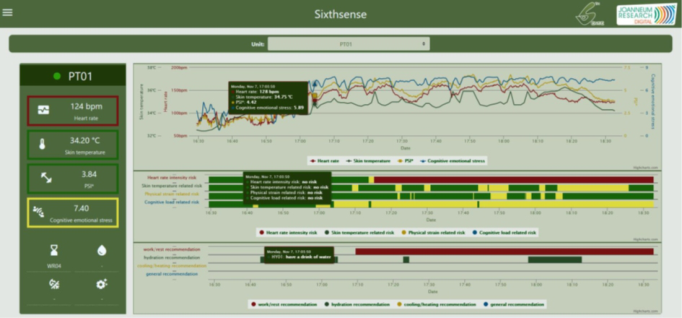
EXPERT DASHBOARD The implementation of the Decision Support System (DSS) required a specific visualisation in order to monitor and validate the application of dedicated risk levels and recommender-based information. The time sequence of the captured bio signals and the derived and calculated risks by the DSS as well as recommendations made during the field trials were visualised and analysed in real-time via a novel dashboard configuration. For this purpose, a traffic light visualisation for various risk levels and recommendations of multi-stage urgency was implemented to provide experts an intuitive presentation of selected variables. The highly flexible dashboard is suitable for focused inves- tigations of scientific experts as well as for first responders and emergency service experts. The system is configured in a modular manner and enables interfacing with the various functional components of the Decision Support System in real-time. Furthermore, this system is easily extendable towards novel data structures, e.g., to include innovative sensor data that might be gathered in the future (Figure 3).
Figure 3: Expert dashboard of the semantic decision support system (SDSS).
CONCLUSION
The Semantic Decision Support System (SDSS) presented in this work is an innovative solution for enhancing decision-making in life-threatening sce- narios, particularly for first responders. By integrating intelligent analytics on biosignals from body-worn sensors, the SDSS offers a comprehensive approach to risk stratification and decision support at team management level. Its innovative combination of multimodal processing streams, psy- chophysiological measurement technologies, and Machine Learning-based situation awareness estimation provides a holistic perspective for reliable decision-making.
The core of the SDSS focuses on estimating physiological risk, specifi- cally heat risk, through the modified physiological strain index (PSI*) and a rule base for classification. It also incorporates a heuristic model for cognitive-emotional stress and a component based on lactate concentra- tion measurement for additional physiological risk stratification. The SDSS is connected to an expert dashboard, enabling real-time monitoring and visualization of relevant information for multiple first responders.
In essence, the SDSS represents a powerful tool that minimizes errors in decision-making during critical situations, offering timely and informed support to mission leaders and first responders.
ACKNOWLEDGMENT
This work was funded from the project SIXTHSENSE under grant No 883315 of the Horizon 2020 research and innovation program of the Euro- pean Commission as well as by the project FAIRWork (grant No 101069499) of the Horizon Europe research and innovation program of the European Commission.
REFERENCES
Åstrand, A., Rodahl, I., 1986. Textbook of Work Physiology. McGraw Hill, New York, NY, 104–112. American Conference of Governmental Industrial Hygienists (ACGIH). (2017). Doc-
umentation of the Threshold Limit Values for Physical Agents: Heat Stress. Cincinnati, OH. American Conference of Governmental Industrial Hygienists (ACGIH). (2018). Documentation of the Threshold Limit Values for Physical Agents: Cold Stress. Cincinnati, OH. Buller, M. J., Latzka, W. A., Yokota, M., Tharion, W. J., & Moran, D. S. (2008). A
real-time heat strain risk classifier using heart rate and skin temperature. Physio- logical Measurement, 29(12), N85–N79. https://doi.org/10.1088/0967-3334/29/ 12/N01 Callender, N., Ellerton, J., & Macdonald, J. H. (2012). Physiological demands of mountain rescue work. Emergency Medicine Journal, 29(9), 753–757. Chang, C.-C. & Lin, C.-J. (2011). LIBSVM: a library for support vector machines.
ACM Transactions on Intelligent Systems and Technology, 2:27:1–27:27 Criteria for a recommended standard: Occupational exposure to heat and hot environments - revised criteria 2016. (2016). U. S. Department of Health and Human Services, Public Health Service, Centers for Disease Control and Prevention,
Semantic Decision Support for Action Forces With Risk Stratification 31
National Institute for Occupational Safety and Health. https://doi.org/10.26616/ NIOSHPUB2016106 Dalal, S., Jain, S., & Dave, M. (2019). A systematic review of smart mental healthcare. Fruhling, A., Hall, M., Medcalf, S., & Yoder, A. (2020). Designing a real-
time integrated first responder health and environmental monitoring dashboard. In S. Hofmann, O. Müller, & M. Rossi (Hrsg.), Designing for Digital Transfor- mation. Co-Creating Services with Citizens and Industry (Bd. 12388, S. 28–34). Springer International. Hassan, M. K. A., & Chen-Burger, Y.-H. (2016). A communication and tracking ontology for mobile systems in the event of a large scale disaster. In G. Jezic, Y.-H. J. Chen-Burger, R. J. Howlett, & L. C. Jain (Hrsg.), Agent and Multi-Agent Sys- tems: Technology and Applications (Bd. 58, S. 119–137). Springer International Publishing. Heck, H., Mader, A., Hess, G., Mücke, S., Müller, R., & Hollmann, W. (1985).
Justification of the 4-mmol/l Lactate Threshold. International Journal of Sports Medicine, 06(03). Hsu, C.-W., Chang, C.-C. & Lin, C.-J. (2016). A Practical Guide to Support Vector Classification, Technical Report, 19.5.2016. Jain, S. (2021). Understanding semantics-based decision support (1. Aufl.). Chapman
and Hall/CRC. https://doi.org/10.1201/9781003008927 Kindermann, W., Simon, G., & Keul, J. (1979). The significance of the aerobicanaerobic transition for the determination of work load intensities during endurance training. European Journal of Applied Physiology and Occupational Physiology, 42(1), 25–34. Notley, S. R., Flouris, A. D., & Kenny, G. P. (2018). On the use of wearable phys-
iological monitors to assess heat strain during occupational heat stress. Applied Physiology, Nutrition, and Metabolism, 43(9), 869–881. https://doi.org/10.1139/ apnm-2018-0173 Paletta, L., Pszeida, M., Schneeberger, M., Dini, A., Reim, L., & Kallus, K. W.
(2022). Cognitive-emotional stress and risk stratification of situational awareness in immersive first responder training. 2022 IEEE-EMBS International Conference on Biomedical and Health Informatics (BHI), 1–4. https://doi.org/10.1109/BH I56158.2022.9926805 Perroni, F., Tessitore, A., Cortis, C., Lupo, C., D’Artibale, E., Cignitti, L., & Capranica, L. (2010). Energy cost and energy sources during a simulated firefighting activity. Journal of Strength and Conditioning Research, 24(12), 3457–3463. Rodrigues, S., Paiva, J. S., Dias, D., Pimentel, G., Kaiseler, M., & Cunha, J. P. S.
(2018). Wearable biomonitoring platform for the assessment of stress and its impact on cognitive performance of firefighters: An experimental study. Clinical Practice & Epidemiology in Mental Health, 14(1), 250–262. Rodríguez-Marroyo, J. A., López-Satue, J., Pernía, R., Carballo, B., García-López, J., Foster, C., & Villa, J. G. (2012). Physiological work demands of Spanish wildland firefighters during wildfire suppression. International Archives of Occupational and Environmental Health, 85(2), 221–228. https://doi.org/10.1007/s00420-011- 0661-4 Sanju Mishra Tiwari, Sarika Jain, Ajith Abraham, & Smita Shandilya. (2018). Secure
semantic smart healthcare (S3hc). Journal of Web Engineering, 17(8). Sawka, M. N., Montain, S. J., & Latzka, W. A. (2001). Hydration effects on thermoregulation and performance in the heat. Comparative Biochemistry and Physiology Part A: Molecular & Integrative Physiology, 128(4), 679–690.
Seiler, S., & Tønnessen, E. (2009). Intervals, thresholds, and long slow distance: The role of intensity and duration in endurance training. Tartare, G., Zeng, X., & Koehl, L. (2018). Development of a wearable sys-
tem for monitoring the firefighter’s physiological state. 2018 IEEE Industrial Cyber-Physical Systems (ICPS), 561–566. https://doi.org/10.1109/ICPHYS.2018. 8390767 Tipton, M. J., Milligan, G. S., & Reilly, T. J. (2013). Physiological employment standards I. Occupational fitness standards: Objectively subjective? European Journal of Applied Physiology, 113(10), 2435–2446. https://doi.org/10.1007/ s00421-012-2569-4 Wu, H.-C., & Wang, M.-J. J. (2001). Determining the maximum acceptable
work duration for high-intensity work. European Journal of Applied Physiology, 85(3–4), 339–344. Yokota, M., Berglund, L. G., Santee, W. R., Buller, M. J., & Hoyt, R. W. (2005). Modeling physiological responses to military scenarios: Initial core temperature and downhill work. Aviation, Space, and Environmental Medicine, 76(5), 475–480.
LISTED IN THE AHFE DIGITAL BOOKSTORE CATALOGUE
Explore the complete digital volume
Cognitive Computing and Internet of Things
Read this individual research paper free through the original publisher, or explore the full digital proceedings book.
ISBN 978-1-964867-00-7
Explore this ISBN in the AHFE Bookstore ↗Listed in the July 2026 bookstore catalogue; search by ISBN to confirm current availability · Digital book purchase optional