Rita Paradiso (2024). Wearable Solutions for Smart Integrated Extreme Environments Health Monitor System. In: Cognitive Computing and Internet of Things. AHFE Open Access, vol. 124, pp. 1–9. https://doi.org/10.54941/ahfe1004698
This paper is an introduction to the design solutions implemented within the EU-funded SIXTHSENSE project; a multidisciplinary innovation and research project with the overall goal of significantly improving the effectiveness and safety of first responder deployment in hazardous environments by optimizing on-site team coordination and mission execution. The project proposes an innovative multimodal monitoring system based on biochemical and physiological sensors data that allows the detection in real time of the physical and mental status deterioration of the first responders deployed in the field. The core of the SIXTHSENSE platform is a sensing garment with a closed loop tactile biofeedback [1], that allows first responders in hazardous situations to receive recommendations related to their physical and mental status, as well as operational indications from the remote command center. The concept of the platform developed within the project focus on the applications related to the deployment of firefighters [2] and mountain rescue services in extreme conditions [3]. The system is equipped with integrated electrochemical and electrophysiological sensors embedded in a garment that ensures intimate contact with the skin to accurately detect parameters related to physiological and mental strain. System also comprises an array of electro-tactile pads providing intuitive tactile feedback in hazardous situations. The garment also combine electronics for acquisition and fusion of sensor data, a microstimulator and controller for generation of spatio-temporally distributed electrical pulses, and communication modules, all embedded in a wearable device.The development of the system is performed iteratively, advancing in parallel hardware (sensors, electronics, electrodes), software (sensor data processing, calibration algorithms, electrotactile feedback control, command center dashboard), and research (data analytics, feedback representation, new telecommunications paradigms, etc .).The overall approach of the project is envisioned through core activities that are embedded in both applications. These are complemented with specific actions, like integrating the system with a specific sensor configuration into appropriate garments and using telecommunication channels best suited for the intended environment. These activities have been performed in three consecutive iterations, following a progressive processing approach to result in two demonstrator systems related to the applications, based on three main development iterations, named Alfa, Beta and Gamma each producing a prototype platform.[1]M. Štrbac et al. , ‘Integrated and flexible multichannel interface for electrotactile stimulation’, J. Neural Eng., vol.13, no. 4, p. 046014, 2016..[2]B. Carballo-Leyenda, J. G. Villa, J. López-Satué, J. A. Rodríguez-Marroyo. “Characterizing wildland firefighters’ thermal environment during live-fire suppression.” Frontiers in Physiology, vol. 10, pp. 949. 2019.[3]D. Curone, E.L. Secco, L. Caldani, A. Lanatà, R. Paradiso, A. Tognetti, G. Magenes, “Assessment of Sensing Fire Fighters Uniforms for Physiological parameter Measurement in Harsh Environment,”IEEE Transactions on Information Technology in Biomedicine, vol. 16, no. 3, pp. 501-511, 2012
The SIXTHSENSE is a wearable health monitoring system with closed loop tactile biofeedback (Štrbac et al., 2016), that allows first responders in haz- ardous situations to sense their current health status. It is designed for early detection of risk factors that could lead to rapid deterioration of health or operation capabilities of first responders, by leveraging predictive mod- els based on multimodal biosensor data. As a team management tool, it enables real-time monitoring of all deployed operatives, helping increase team effectiveness and operational safety.
CONCEPT AND METHODOLOGY The SIXTHSENSE concept developed within the project focus on applica- tions related to deployment of firefighters (Curone et al., 2012) and mountain rescue services in extreme conditions (Carballo-Leyenda et al., 2019). The system is conceived to combine electrochemical and electrophysiological sen- sors embedded in a garment that ensures intimate contact with the skin to detect parameters related to physiological and psychological strain. System also comprises an array of electro-tactile electrodes providing intuitive tactile feedback in hazardous situations. The SIXTHSENSE garment also combine electronics for acquisition and fusion of sensor data, a microstimulator and controller for generation of spatial-temporally distributed electrical pulses,
and communication modules, all embedded in a wearable device. The devel- opment is performed iteratively, advancing in parallel hardware (sensors, electronics, electrodes), software (sensor data processing, calibration algo- rithms, electro tactile feedback control, command centre dashboard), and research (data analytics, feedback representation, new telecommunications paradigms, etc.).
The overall approach of the project is envisioned through core activi- ties that are embedded in both applications. These are complemented with application specific actions, like integrating the system with specific sensors configuration into appropriate garments and using telecommunication chan- nels best suited for the intended environment. These activities have been performed in three consecutive iterations, following a progressive elaboration approach to result in two demonstrator systems related to the applications, based on three main development iterations, named Alpha, Beta and Gamma each producing a prototype platform.
Four sets of field tests, focused respectively to mountain rescuers opera- tions in Bormio (Italy, March 2022), Postojna (Slovenia, November 2022), Kopaonik (Serbia, March 2023) and Rijeka (Slovenia, September 2023) were carried out, giving the opportunity to first responders to participate actively to the development process of the project. The activities of the last period were carried out mainly by means of questionnaires that were submitted and filled by First Responders after on-field tests, focusing on ergonomics, usability, and acceptability.
The analysis of the questionnaires provided the usability specifications for the Gamma prototype and demonstrate the good level of acceptability, usability, and ergonomics of the global architecture of the system.
DESIGN SOLUTIONS From Alpha to Gamma Prototype
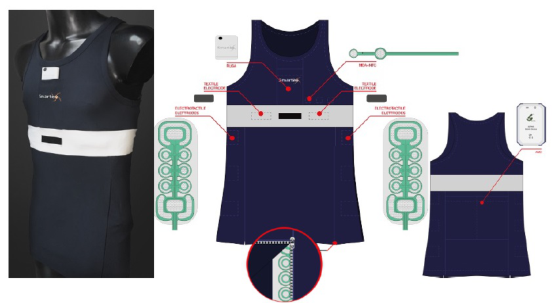
The Alpha prototype was envisioned as the test bed for the research and further development. It has been conceived as a tool to be used as a com- mon demonstration and development platform between the partners that in this multidisciplinary project come from very different backgrounds and disciplines. Based on the feedback received from the first responders while defining their requirements it was decided that the first Alpha prototype is embedded in a T shirt as shown in Figure 1, the prototype combines an elastic sensing band, in white il the photo, that is part of the WWS system produced by Smartex (www.smartex.it). This solution provides a large area for electro- chemical sensors placement and suitable positioning for electrophysiological measurements. The whole shirt is realised with a new fabric, (Sensitive, GGT5 from Eurojersey) is a 73% polyamide warp-knit and a 27% elastomeric per- centage and 250 g/m2, is used to manufacture the mostly part of the vest to guarantee the right adhesion of the electro tactile and the textile electrodes, this fabric is more contentive and heavy compared with the material used for the WWS. The design foresees two lateral zips, on the left and right side of the abdomen to facilitate the insertion of the printed tactile electrodes, to improve the quality of the contact of the electrodes with the skin, a filler
Wearable Solutions for Smart Integrated Extreme Environments Health Monitor System 3
was inserted in on the left and right area selected for the stimulation, the electrodes array is hold in placement by an internal pocket.
Figure 1: Alpha SIXTHSENSE prototype, in the middle the front, on the right the back side.
In Alpha stage of the project all the sensors and actuators were based on the exiting components, and the only developments lie on basic hardware and firmware that enables integration to the level that the system complies with defined requirements for initial research activities. However, the possibility to use the system during the focus groups with FRs and stakeholders and to distribute functional prototype to the technical developers was fundamental for the design of Beta and Gamma solutions.
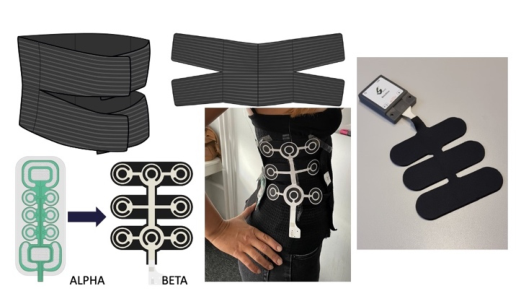
Beta demonstrator was developed to provide novel electrochemical sen- sors, complex data analytics, advanced user interfaces and additional telecommunications networks. The Beta wearable platform is conceived as a functional version designed and manufactured to validate the integration of novel electrochemical sensors and printed electrodes matrix for tactile biofeedback. It is based on an elastic stretchable solution to integrate the new sensors that require the close contact with the skin to work properly.
Figure 2: Beta functional prototype.
4 Paradiso
Beta wearable prototype is realised with 2 rectangular straps joined in the middle section to form an adjustable stretchable belt as shown Figure 2, it was conceived as a testing tool. A new 2D fabric has been used as substrate for the transferring of the Beta electro-tactile array of electrodes, the new version is more flexible and conformable to the body shape. The design of the belt with the two open and adjustable parts on the abdomen allows to maintain the positioning of the tactile electrodes and sensors on the lateral sides of the belt, this solution can be easily adjusted despite the different morphologies of the subjects.
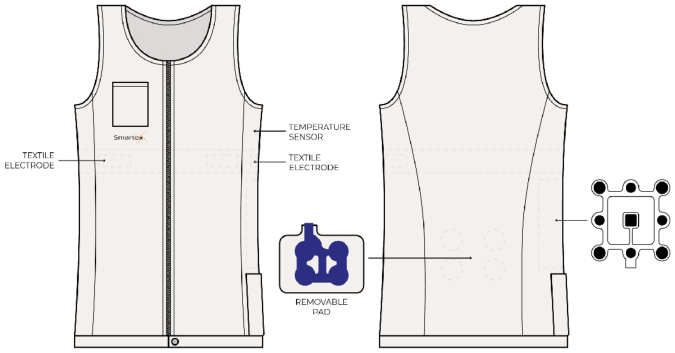
Figure 3: Gamma prototype design, inner side on the top, outer side on the bottom.
Gamma prototype is envisioned as the final version of the SixthSense sys- tem. The system was designed and implemented on the base of the experience acquired with Beta platform. In the final Gamma demonstrator, the select set
Wearable Solutions for Smart Integrated Extreme Environments Health Monitor System 5
of novels and State of the Art sensors is completely integrated, and the sys- tem is conceived for a prolonged use in harsh environment. The platform foresees printed electrodes, directly applied on the garment inner fabric, for multimodal dynamic continuous biofeedback and two Portable Electronics Devices, one for the acquisition (ACQ) and management of sensors data, and the other for the administration of the biofeedback through tactile stim- ulation (Stim). The garment is based on a multilayer structure, realised with elastic and stretchable fabric (Alpha). The use of a multi-double-layers allows to insert in the structure area that are filled with 2D or Neoprene cushions to increase the quality of the contact between the electrodes and the skin by applying a pressure on the electrodes. The garment foresees a zip in the mid- dle (Figure 3), to allow an easy access to the sensors, and to facilitate the wearing. The structure combines an inner layer with the sensors in contact with the skin (Figure 3), an interlayer for holding and protect all the cabling, and all the filled pressing areas and the external layer for protection and shap- ing and for the holding of the electrical portable devices. Both located on the front side to improve the communication efficiency and usability.
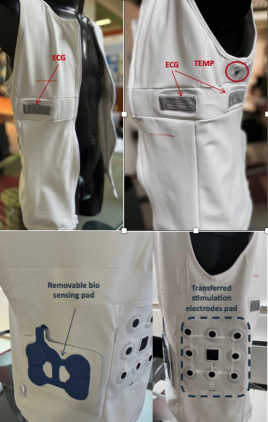
The three textile ECG electrodes are realized with conductive yarns (Bek- intex NV, Be), and fully integrated in the inner fabric layer, a new sensor for temperature (Figure 4), the Amphenol MA300 Biomedical Chip NTC was selected, for the following reasons: the device is designed for biomedical application, the thermal response time, according to data sheet is 45 seconds in still air and 2 seconds in still water (response time for assembly plunged from 25
C air to 5
C water), finally for the packaging, the stain steel case guarantees a good mechanical and chemical resistance, compliant with the users scenarios.
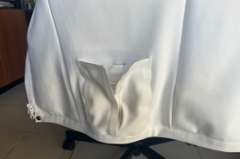
Gamma design foresees two pockets for the portable devices on the outer layer, the connectors for the two electronics, ACQ for the acquisition and Stim for the electro-tactile stimulations are integrated in the structure and available in the pocket (Figure 5).
Figure 4: Sensors integrated in the inner side of the GAMMA garment.
6 Paradiso
Figure 5: On the left: pockets for the STIM device, on the right for the ACQ device on the outer side of the GAMMA garment.
USABILITY The participation of the First Responders to the design within the project has been promoted by means of focus groups and questionaries that have been updated along with the progresses of the implementation. The final Gamma garment has been evaluated with an updated version of the question- naire designed and used during the last Postojna and Kopaonik field trials. In Kopaonik Gamma garment has been used by an operator to evaluate the ergonomic aspects. Moreover, a test with the Stim has been performed, the biofeedback has been applied without the use of the elastic band, the result was positive, the operator was able to feel the electrical stimulation from all the tactile electrodes integrated in the garment. After the validation tests, small changes on the design of the garments have been implemented and the new design was used for the sizes development (100,105,110). The size is given in term of thorax circumference, as this parameter is fundamental for the physio sensors’ functionality. Naturally, the body shape is important for the fitting, to guarantee a good contact between the skin and the sen- sors (MEA and bio), the range of available sizes must address not only the thorax length but also slim or large abdomens, as well long or short limbed physicality. The Gamma garments have been used in Rijeka for the final field trials, some of the systems were not fitting the subjects, and in this case an extra band was used to validate the biofeedback, for the subjects that used the vest with the right size, the general comfort was good, as reported in the questionnaire results.
QUESTIONNAIRE A unidimensional seven-point Likert scale has been used to collect respon- dents’ attitudes and opinions about a first series of questions; the agreement goes from point 1 Not relevant/Totally unacceptable (point 1) to point 7 (Extremely important/Fully acceptable), the selection depends on the question.
The first block of 11 questions concerns fit, time to start to use, skin contact, comfort, freedom of movements, thermal comfort, breathability, functionality of zip and pockets, use of belts on the top of the garment.
The second block is about the user experience in term of comfort for the different areas of the garment, front and back collar, armholes, abdomen, back and hips. A question follows on the type of experience, linked to linked to tingling and tightness. to the width of the garment, or nothing.
Wearable Solutions for Smart Integrated Extreme Environments Health Monitor System 7
The final block concerns the use of monitoring technology. Finally, a series of open questions about the underwear normally used, on the time taken to wear the Personal Protective Equipment, and on design suggestions.
RESULTS
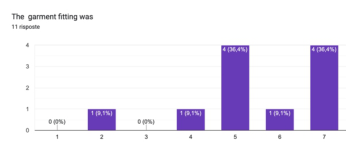
Perceived Comfort First series of responses reflects the positive feeling observed during the tri- als with the Gamma vests. Prevalence of positive responses concerned the general comfort, wearing time, skin contact, thermal comfort, freedom of movements, sensors feeling and position.
Critical comments concerned the breathability of the vest, which is under- standable given the double-layer structure interspersed with neoprene pads. For many subjects the armhole opening was too narrow, one subject reported an itchy sensation on the sensors, but overall, the system was highly appreciated.
Figure 6: Questionnaire results on fitting and comfort of the Gamma garment.
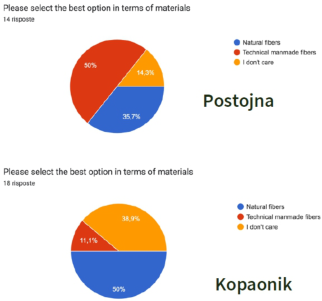
Suggestions are in line with the responses collected previously from the design questionnaire, mountain rescues are more oriented on the use of dif- ferent materials, more technical (active wear) or more natural (like merinos or other natural fibers) while the firefighter are sensitive to the position of the devices or of the sensors and the possible interferences with the standard equipment during the activity. The use of an extra elastic band was considered unacceptable.
Figure 7: Comparison of questionnaire results on materials to be used, between the fire fighter and the mountain rescue samples, acquired during Postojna and Kopaonik field trials.
8 Paradiso
Use of the Monitoring System Postojna field trials has been conducted on a sample of Fire Fighters; six subjects considered totally unacceptable the use of monitoring system.
Kopaonik field trials has been carried out on a sample of Mountain Rescue, most subjects considered the use of the monitoring system acceptable.
Rijeka field trials was conducted on a mixed sample of FFs and MRs, only three subjects considered totally acceptable the use of a monitoring system despite the low mean age and the mobile use attitude.
CONCLUSION
The Gamma prototype represents a solution in which are combined the SOTA technological tools and novel sensors, with textile electrodes for continuous electro tactile biofeedback, in compliance with the vision of SIXTHSENSE platform architecture. Design methodology and the commitment of the end users since the first implementation of the Alpha version, results in a final
Wearable Solutions for Smart Integrated Extreme Environments Health Monitor System 9
Gamma version that has been successfully evaluated by the first respon- ders. The textile solutions implemented to guarantee the functionality of the sensors have been first tested at laboratory level by simulating real field con- ditions, while the ergonomics and wearable comfort have been successfully evaluated in the field, and finally the systems have been used by 20 volunteers in real operational condition, with successful results in term of functional- ity and comfort. Questionnaires results on the use of monitoring system in the field, tells us that the workers need to be trained and informed about the potentiality of the use of the technology not only for leisure but more important for the risks prevention and the assistance in case of hazards.
ACKNOWLEDGMENT
The author would like to acknowledge all the partners involved in the project. This project has received funding from the European Union’s Horizon 2020 research and innovation programme under grant agreement No. 883315.
REFERENCES
Carballo-Leyenda, B., Villa, J. G., López-Satué, J., & Rodríguez-Marroyo, J. A.
(2019). Characterizing Wildland Firefighters’ Thermal Environment During Live- FireSuppression. Frontiers in physiology, 10, 949. https://doi.org/10.3389/fphys. 2019.00949 Curone, D., Secco, E. L., Caldani, L., Lanatà, A., Paradiso, R., Tognetti, A., & Magenes, G. (2012). Assessment of sensing fire fighters uniforms for physiological parameter measurement in harsh environment. IEEE transactions on information technology in biomedicine : a publication of the IEEE Engineering in Medicine and Biology Society, 16(3), 501–511. https://doi.org/10.1109/TITB.2011.2182615 Štrbac, M., Beli´c, M., Isakovi´c, M., Koji´c, V., Bijeli´c, G., Popovi´c, I., Radoti´c,
M., Došen, S., Markovi´c, M., Farina, D., & Keller, T. (2016). Integrated and flexible multichannel interface for electrotactile stimulation. Journal of neural engineering, 13(4), 046014. https://doi.org/10.1088/1741-2560/13/4/046014
LISTED IN THE AHFE DIGITAL BOOKSTORE CATALOGUE
Explore the complete digital volume
Cognitive Computing and Internet of Things
Read this individual research paper free through the original publisher, or explore the full digital proceedings book.
ISBN 978-1-964867-00-7
Explore this ISBN in the AHFE Bookstore ↗Listed in the July 2026 bookstore catalogue; search by ISBN to confirm current availability · Digital book purchase optional