Hannes Kern, KATJA HUTTENBRENNER, Clemens Koenczoel, Deborah Huber, Manfred Pollheimer-Stadlober, Alexander Elser, Jochen A Mosbacher, Martin Pszeida, Wolfgang Weiss, Sandra Pichler, Jasmina Schmidt, Klaus Tschabuschnig, Josef Rampitsch, Georg Schwarzott, Marie Ottilie Frenkel, Lucas Paletta, Dietrich Albert, Bettina Kubicek (2026). Decision-Making in Emergency Response Organisations: Human Factors Challenges and Implications for Digital Support Systems. In: Cognitive Computing and Internet of Things. AHFE Open Access, vol. 205, pp. 73–83. https://doi.org/10.54941/ahfe1007363
Emergency response organisations operate under conditions of extreme time pressure, uncertainty, and high stakes, where the quality of operational decisions directly affects the safety of responders and the public. Increasing technological complexity, novel hazard profiles such as alternative energy carriers and lithium-ion battery systems, and dynamic multi-actor environments significantly increase cognitive load and expose limitations of existing procedural and technological support mechanisms.Although digital Decision Support Systems (DSS) and advanced information and communication technologies are widely promoted as tools to improve operational decision-making, their practical adoption and effectiveness at the tactical level remain limited. One important reason for this gap may lie in the insufficient alignment of such systems with the Individual and contextual dynamics of real emergency response operations.This paper examines decision-making challenges in emergency response organisations from a Human Factors perspective and discusses implications for the design of digital decision support systems. The study builds on insights from the EMERDEC project, which investigates how tactical decisions are formed during the early and most critical phases of emergency response.Methodologically, EMERDEC combines participatory approaches, ethnographic field research, and controlled simulation studies in virtual and real-world environments. Advanced wearable sensor technologies and immersive simulations are used to capture psychophysiological indicators of stress, workload, and situational awareness.Based on these empirical insights, the paper identifies key Human Factors challenges for digital decision support and argues for a shift from technology-driven system development toward human-centred DSS design that aligns with the cognitive realities of emergency response operations.
Emergency response organisations operate in environments characterised by time pressure, incomplete information, and rapidly evolving hazards. These conditions create decision environments that differ significantly from the structured assumptions underlying many analytical models used in planning and command doctrine (Cohen-Hatton et al., 2015; Groenendaal & Helsloot, 2016; Kern, 2017). Decisions made during the early phases of an incident can have far-reaching consequences for the safety of responders, affected populations, and critical infrastructure (Kern, 2020; Penney et al., 2022). Incident commanders must often assess uncertain situations within minutes while coordinating personnel, interpreting fragmented information, and anticipating possible escalation.
Empirical research shows that decision-making under such conditions rarely follows systematic comparison of multiple alternatives. Instead, responders often rely on rapid interpretation of situational cues and experience-based judgement (Cohen-Hatton et al., 2015; Okoli et al., 2022). This form of decision-making is well described within the naturalistic decision-making framework, particularly through Klein’s Recognition-Primed Decision (RPD) model (Klein, 1993; Klein et al., 2010). According to this model, experts recognise familiar patterns in complex situations and evaluate the first plausible course of action through mental simulation rather than analytical comparison of alternatives. These findings align with broader theories of bounded rationality and heuristic decision-making under uncertainty (Gigerenzer & Goldstein, 1996; Gigerenzer & Selten, 2001).
In emergency response contexts, decisions are frequently made under conditions of incomplete situational awareness. Situational awareness describes the cognitive process of perceiving relevant environmental elements, understanding their meaning, and projecting their future development (Endsley, 1995). Maintaining such awareness is particularly challenging in dynamic incidents where information is fragmented and distributed across multiple actors and systems (Danielsson et al., 2014; Wolbers & Boersma, 2013).
At the same time, the operational environment of emergency services is becoming increasingly complex. Technological developments, new industrial materials, and emerging energy systems introduce novel hazard scenarios that may not yet be fully represented in training or operational doctrine (Baetzner et al., 2022; Kern, 2020). Many incidents also require coordination between multiple organisations, creating additional individual and contextual challenges for decision-makers (Penney et al., 2022).
Digital technologies are increasingly promoted as tools to improve situational awareness and support operational decision-making. Decision Support Systems (DSS), sensor networks, and advanced communication platforms promise enhanced information availability and improved coordination (Steiner et al., 2017). However, despite technological progress, their practical adoption at the tactical level remains limited. Many systems
Decision-Making in Emergency Response Organisations 75 are designed from a technological perspective and assume analytical decision processes that do not reflect the cognitive realities of emergency response work (Carvalho et al., 2018; Phillips-Wren & Adya, 2020).
Consequently, a growing body of research emphasises the importance of Human Factors perspectives in the design of Digital Support Systems (Cohen-Hatton et al., 2015; Steiner et al., 2017). Human-centred approaches acknowledge cognitive limitations, stress effects, and the role of intuitive decision strategies developed through operational experience (Beilock & Carr, 2001; Marvin et al., 2023). Rather than replacing human judgement, digital systems should support the individual processes through which responders interpret situations and select appropriate actions.
Understanding how decisions are formed actually during emergency operations is therefore a prerequisite for developing effective decision support technologies. This includes analysing how information cues are perceived, how situational understanding emerges, and how stress and organisational factors influence decision strategies (Klein et al., 1989; Penney et al., 2022).
The research presented in this paper addresses these questions within the EMERDEC project, which investigates decision-making processes during the early phases of emergency response. By combining participatory research methods, ethnographic observations, and controlled simulation studies, the project reconstructs decision processes in a simulated operational environment and identifies key human factors influencing them.
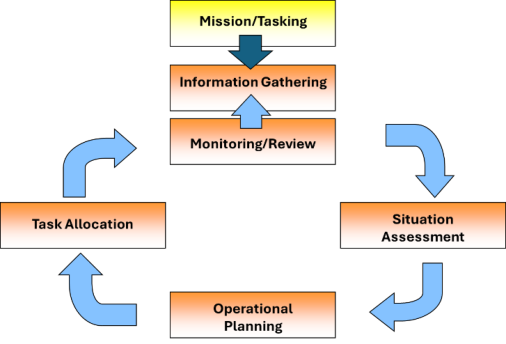
Limitations of Procedural and Analytical Decision Models Many operational doctrines and decision-support frameworks in emergency management implicitly assume that decision-makers are able to follow structured analytical procedures when assessing incidents and selecting response strategies (Figure 1).
Figure 1: Simplified representation of the operational leadership cycle used in emergency response command doctrine (Bundesministerium für Inneres, 2007; Schläfer, 1998).
Such models typically rely on a sequential process: collecting information, analysing the situation, generating alternative courses of action, evaluating these options, and selecting the most appropriate one. This logic is reflected both in formal command doctrine and in classical rational decision models such as multi-criteria evaluation and cost-benefit approaches (Bundesministerium für Inneres, 2007; Schläfer, 1998; Saaty, 1990; Dreze & Stern, 1987; Zangemeister, 1976). While these structured approaches provide an important conceptual basis for training and planning, their applicability under real operational conditions is often limited (Cohen-Hatton et al., 2015; Groenendaal & Helsloot, 2016; Kern, 2017).
Emergency incidents rarely evolve in ways that allow for systematic comparison of multiple alternatives. Information is typically incomplete, ambiguous, and continuously changing. At the same time, responders are required to act quickly in order to prevent escalation. Under such conditions, the time required to gather comprehensive information and analytically evaluate different options may simply not be available (Cohen-Hatton et al., 2015; Phillips-Wren & Adya, 2020; Penney et al., 2022). This limitation is also consistent with broader critiques of overly formal decision models in uncertain, high-pressure contexts, where simpler inferential strategies may outperform more elaborate analytical procedures (Dawes, 1979; Gigerenzer & Goldstein, 1996; Gigerenzer & Todd, 1999).
Several accident investigations in the emergency response domain illustrate how operational decision-making unfolds under these constraints. An example for this is the 2013 explosion at a fertilizer storage and distribution facility in West, Texas. When firefighters arrived on scene, they were confronted with a developing fire at the facility and initiated a conventional fire suppression approach. The responding crews were informed of large quantities of ammonium nitrate that were stored at the site, but unaware of the quick escalation pathway and the potential for creating a catastrophic explosion. As the fire progressed, the material detonated, resulting in the deaths of multiple firefighters and extensive damage to the surrounding area (Bass et al., 2013).
From a retrospective perspective, it might appear that the responders should have recognised the explosive hazard and adopted a more defensive strategy. However, such an interpretation risks oversimplifying the decision context faced by the crews on scene. At the time of the initial response, the available cues primarily indicated a structure fire, a scenario for which established operational routines strongly favour an offensive attack (Bass et al., 2013; Pulm, 2002; Scarborough, 2017). Information about the presence and quantity of ammonium nitrate was not readily available, and the responders had little time to conduct a detailed hazard assessment. In this situation, the decision to initiate fire suppression was consistent with common operational patterns and expectations, illustrating how responders often rely on rapid situational framing rather than analytical evaluation of multiple hazard scenarios (Klein et al., 2010; Okoli et al., 2022).
A similar dynamic can be observed in industrial accident environments. The explosion at the chemical company BASF in Ludwigshafen, Germany, in 2016 occurred during maintenance work on a pipeline system at the
Decision-Making in Emergency Response Organisations 77 company’s North Harbor site. Following a gas release and subsequent explosion, emergency responders were confronted with a complex and evolving industrial incident involving fire, hazardous substances, and damage to infrastructure. In the early phase of the incident, responders had to make rapid decisions regarding access routes, hazard zones, and tactical priorities while dealing with incomplete information about the underlying technical processes and the substances involved (Haselhorst & Friedrich, 2016).
Industrial incidents of this type illustrate a further limitation of procedural decision models: many hazards are not immediately visible and require specialised knowledge or additional information sources to be correctly interpreted. In such environments, responders must often make decisions before the technical details of the incident are fully understood. As a result, operational decisions are frequently based on provisional interpretations that may need to be revised as new information becomes available (Penney et al., 2022; Cordner, 2021).
Even in more typical structural fire scenarios, the dynamics of emergency operations often limit the feasibility of analytical decision-making. Interior fire attacks, for example, require firefighters to interpret rapidly changing environmental cues such as smoke characteristics, heat conditions, and ventilation patterns in order to anticipate potentially dangerous fire behaviour phenomena such as flashover (Ridder et al., 2013; Gerse et al., 2017). Experienced firefighters frequently develop intuitive responses to such cues through repeated exposure to similar situations during training and operational deployments (Klein et al., 2010; Kern, 2017). When warning signs of extreme heat or deteriorating conditions become apparent, crews may withdraw instinctively without consciously analysing the underlying thermodynamic processes. Such rapid reactions are often critical for survival but do not correspond to the step-by-step reasoning assumed in many formal decision models (Ridder et al., 2013; Gerse et al., 2017; Gigerenzer & Selten, 2001).
Similar mechanisms can be observed in technical rescue operations. During vehicle extrication scenarios, responders must quickly identify safe access points, stabilisation strategies, and cutting techniques while simultaneously considering potential hazards such as undeployed airbags, battery systems, or structural instability of the vehicle. While technical guidelines provide general procedures for such situations, the actual selection of a specific approach often depends on rapid recognition of structural patterns and situational cues rather than detailed analytical comparison of all possible rescue strategies (Pulm, 2002; Kern, 2020).
Taken together, these examples highlight a fundamental tension between formal procedural decision frameworks and the realities of operational decision- making. While structured analytical approaches remain important for planning, training, and post-incident analysis, real-time decision-making in emergency response environments is frequently shaped by rapid situational interpretation, experience-based judgement, and heuristic reasoning (Klein, 2008; Gigerenzer & Todd, 1999; Gigerenzer & Goldstein, 1996; Okoli et al., 2022).
Recognising these dynamics is essential for understanding the cognitive foundations of operational decision-making and for identifying the limitations of technology-driven support concepts that assume idealised analytical
workflows. In particular, digital decision support systems that present large amounts of raw data without supporting rapid situational interpretation may inadvertently increase cognitive load rather than improving decision quality (Steiner et al., 2017; Phillips-Wren & Adya, 2020). A more effective approach requires a deeper understanding of how responders actually perceive, interpret, and act upon information under operational conditions (Cohen-Hatton et al., 2015; Carvalho et al., 2018; Butler et al., 2023).
Human Factors and the Gap in Digital Decision Support The limitations of procedural and analytical decision models in emergency response highlight the need for a deeper understanding of the human factors shaping operational decision-making. Decisions made by emergency responders are not only influenced by the objective characteristics of an incident but also by Individual and contextual factors that affect how information is perceived, interpreted, and acted upon (Cohen-Hatton et al., 2015; Butler et al., 2023; Penney et al., 2022). Empirical studies show that real-world decisions in emergency services are strongly shaped by individual experience, contextual interpretation, and organisational practice rather than purely formal analytical reasoning (Carvalho et al., 2018; Groenendaal & Helsloot, 2016).
Emergency response environments are characterised by high uncertainty, time pressure, and operational risk. Responders must simultaneously interpret environmental cues, coordinate teams, communicate across organisational boundaries, and anticipate potential developments of the incident. These tasks compete for limited cognitive resources and are often performed under considerable psychophysiological stress (Beilock & Carr, 2001; Frenkel et al., 2021; Marvin et al., 2023). Consequently, operational decision- making is strongly influenced by bounded rationality and experience-based judgement rather than systematic analytical reasoning (Gigerenzer & Selten, 2001; Gigerenzer & Goldstein, 1996). In such contexts, responders frequently rely on pattern recognition and heuristics to interpret complex situations. Within the naturalistic decision- making tradition, Klein’s Recognition-Primed Decision (RPD) model explains how experienced responders recognise familiar patterns and evaluate the first plausible course of action through mental simulation rather than comparing multiple alternatives (Klein, 1993; Klein et al., 2010). While this strategy enables rapid responses in dynamic environments, it can also create vulnerabilities when responders encounter unfamiliar hazards or misleading cues (Okoli et al., 2022; Penney et al., 2022).
A closely related concept is situational awareness, defined as the ability to perceive relevant elements of the environment, understand their meaning, and anticipate their future development (Endsley, 1995). Maintaining situational awareness is particularly challenging in emergency response contexts where information is fragmented, dynamically evolving, and distributed across multiple actors and technical systems (Danielsson et al., 2014; Wolbers & Boersma, 2013).
Decision-Making in Emergency Response Organisations 79 At the same time, emergency response organisations face increasingly complex operational environments. Technological transformation, new industrial materials, and emerging energy systems introduce novel hazard scenarios that responders may encounter with limited operational experience (Baetzner et al., 2022; Kern, 2020; Cordner, 2021).
Digital technologies such as Decision Support Systems (DSS), communication platforms, and sensor-based information systems are therefore frequently proposed to support operational decision-making (Steiner et al., 2017). However, despite significant technological advances, their practical adoption at the tactical level remains limited (Carvalho et al., 2018; Phillips-Wren & Adya, 2020). A key reason lies in the assumptions underlying many technical systems, which focus primarily on improving information availability and assume analytical decision processes similar to formal command cycles or rational decision models.
Empirical observations suggest that this assumption is overly simplistic. Many systems provide large amounts of information without supporting the individual processes through which responders construct situational understanding and select appropriate actions (Steiner et al., 2017; Phillips- Wren & Adya, 2020). Moreover, operational decision-making is also shaped by individual and contextual factors such as experience, hierarchy, and collective norms, which influence how situations are interpreted and which actions are considered appropriate (Boyd & Richerson, 2005; Scarborough, 2017; Butler et al., 2023). These findings highlight a central challenge for digital decision support technologies: meaningful support can only be achieved if systems are aligned with the individual and contextual realities of emergency response work (Steiner et al., 2017; Penney et al., 2022).
The EMERDEC project addresses this research gap by investigating decision-making processes during the early and most critical phases of emergency response. The project focuses on the tactical level, where first- arriving officers and small operational teams must interpret rapidly evolving situations and make time-critical decisions under uncertainty (Klein et al., 1989; Klein, 2008). To study these processes, EMERDEC combines participatory methods such as expert workshops and interviews with cognitive task analysis and ethnographic observations of exercises. In addition, immersive simulation experiments using virtual reality environments are conducted to analyse decision processes under controlled but operationally realistic conditions. These simulations are implemented using the XVR On Scene platform, which is widely used for incident command training.
During these experiments, wearable biosensors and mobile eye-tracking systems capture psychophysiological indicators such as heart rate, gaze behaviour, and electrodermal activity (Hart, 1986; Beilock & Carr, 2001). This combination of qualitative field research, immersive simulations, and psychological measurements enables a detailed reconstruction of decision processes.
The resulting insights provide an empirical basis for identifying critical decision points, typical decision strategies, and potential cognitive vulnerabilities in emergency operations. Building on this understanding, the project aims to derive implications for the design of digital decision support systems that are better aligned with the individual strategies and contextual realities of emergency response organisations. In this way, EMERDEC seeks to contribute to the human-centred design of future decision support technologies.
CONCLUSION
Incidents in the emergency response context are characterised by time pressure, uncertainty, incomplete information, and rapidly evolving hazards, requiring responders to act before a comprehensive understanding of the situation is available. The examples discussed in this paper highlight the limitations of procedural decision frameworks when applied to real emergency operations. While structured models such as formal leadership cycles provide valuable guidance for training, planning, and post-incident analysis, they often fail to capture the cognitive processes that shape decisions in dynamic operational environments. In practice, experienced responders rely heavily on intuitive judgement and situational awareness to interpret ambiguous cues and select plausible actions under time pressure.
From a Human Factors perspective, these decision processes are shaped by an interaction of individual and contextual factors. Stress, workload, limited cognitive capacity, and contextual dynamics influence how information is perceived and processed into operational decisions. Digital technologies and Decision Support Systems are frequently proposed to improve operational decision-making. However, the limited adoption of many existing systems suggests a persistent mismatch between technological design assumptions and the cognitive realities of emergency response work. Systems that primarily focus on increasing information availability without supporting rapid interpretation and situational understanding may increase cognitive workload rather than improve decision quality.
These observations underline the importance of adopting a human-centred approach to the design of digital Decision Support Systems. Instead of replacing human assessment and decision making, technological solutions should support the cognitive strategies through which responders construct situational awareness and select appropriate actions. Achieving this requires a deeper empirical understanding of how decisions are formed under operational conditions.
Ultimately, improving decision support in emergency response organisations requires moving beyond purely technology-driven innovation towards a closer integration of individual, contextual and technical factors into system design (Hancock et al., 2021). Such an approach has the potential to enhance decision quality, improve responder safety, and increase the acceptance and effectiveness of digital support tools in real operational environments.
ACKNOWLEDGMENT
This research was conducted within the framework of the EMERDEC project (Fundamentals of Decision-Making Processes in Primary Emergency
Decision-Making in Emergency Response Organisations 81 Response). EMERDEC is funded by the Austrian Security Research Programme KIRAS of the Federal Ministry of Finance.
The authors would like to thank the project partners and participating emergency response organisations for their valuable contributions to the project, including their support in expert workshops, interviews, and simulation-based studies. Their operational expertise and practical insights have been essential for developing a deeper understanding of decision-making processes in emergency response environments.
Special thanks are extended to the firefighters, incident commanders, and training institutions who contributed their time and experience to the empirical studies and simulation experiments conducted within the project.
The authors also gratefully acknowledge the support of XVR Simulation for providing access to the XVR On Scene simulation environment, which enabled the development and execution of realistic emergency response scenarios for the experimental studies conducted within the EMERDEC project.
REFERENCES
Baetzner, A., Wespi, R., Hill, Y., Gyllencreutz, L., Sauter, T. C., Saveman, B.-I., Mohr, S., Regal, G., Wrzus, C., & Frenkel, M. O. (2022). Preparing medical first responders for crises: A systematic literature review of disaster training programs and their effectiveness. Scandinavian Journal of Trauma, Resuscitation and Emergency Medicine, 30(76). Bass, S., Chew, J., Crawford, B., Kistner, D., & Stephens, L. (2013). Firefighter
Fatality Investigation: Investigation FFF FY 13-06. Texas State Fire Marshal’s Office, Austin. Beilock, S. L., & Carr, T. H. (2001). On the fragility of skilled performance: What governs choking under pressure? Journal of Experimental Psychology: General, 130(4), 701–725. Boyd, R., & Richerson, P. J. (2005). The Origin and Evolution of Cultures. Oxford
University Press. Butler, P., Bowers, A., Smith, A., Cohen-Hatton, S., & Honey, R. (2023). Decision making within and outside standard operating procedures: Paradoxical use of operational discretion in firefighters. Human Factors, 65(7), 1422–1434. Carvalho, P., Righi, A., Huber, G., Lemos, C., Jatoba, A., & Gomes, J. (2018). Reflections
on work as done and work as imagined in an emergency response organisation: A study on firefighters training exercises. Applied Ergonomics, 68, 28–41. Cohen-Hatton, S., Butler, P., & Honey, R. (2015). An investigation of operational decision making in situ: Incident command in the UK Fire and Rescue Service. Human Factors, 57(5), 793–804. Cordner, A. (2021). Staring at the sun during wildfire season: Knowledge, uncertainty,
and frontline resistance in disaster preparation. Qualitative Sociology. Danielsson, E., Alvinius, A., & Larsson, G. (2014). From common operational picture to situational awareness. International Journal of Emergency Management, 10(1), 28–47. Dawes, R. M. (1979). The robust beauty of improper linear models in decision
making. American Psychologist, 34, 571–582. Dreze, J., & Stern, N. (1987). The theory of cost-benefit analysis. In A. J. Auerbach & M. Feldstein (Eds.), Handbook of Public Economics. Elsevier. Endsley, M. R. (1995). Toward a theory of situation awareness in dynamic systems.
Human Factors, 37(1), 32–64.
Federal Ministry of the Interior. (2007) Guideline s for leadership in disaster relief operations. Republik Österreich, Wien. Frenkel, M. O., Giessing, L., Egger-Lampl, S., Hutter, V., Oudejans, R. R. D.,
Kleygrewe, L., Jaspaert, E., & Plessner, H. (2021). The impact of the COVID-19 pandemic on European police officers: Stress, demands, and coping resources. Journal of Criminal Justice, 72. Gerse, A., Neuwirth, S., & Wallenstein, C. (2017). Does the flashover reaction actually help in practice? Initial results. Atemschutz.org. Gigerenzer, G., & Goldstein, D. G. (1996). Reasoning the fast and frugal way:
Models of bounded rationality. Psychological Review, 103, 650–669. Gigerenzer, G., & Selten, R. (2001). Bounded Rationality: The Adaptive Toolbox.
MIT Press. Gigerenzer, G., & Todd, P. M. (1999). Simple Heuristics That Make us Smart. Oxford University Press. Groenendaal, J., & Helsloot, I. (2016). The application of naturalistic decision making
and other research: Lessons for frontline commanders. Journal of Management & Organization, 22(2), 173–185. Hancock, P. A., Kessler, T. T., Kaplan, A. D., Brill, J. C., & Szalma, J. L. (2021).
Evolving Trust in Robots: Specification Through Sequential and Comparative Meta-Analyses. Human Factors: The Journal of the Human Factors and Ergonomics Society, 63(7), 1196-1229. Hart, S. G. (1986). NASA Task Load Index (NASA-TLX). NASA Ames Research Center. Haselhorst, R., & Friedrich, P. (2016). Explosion on October 17, 2016, at the
northern section of the BASF SE plant – operational sequence. Ludwigshafen. Kern, E.-M. (2020). How do emergency organizations work? In E.-M. Kern, G.
Richter, J.-C. Müller, & F.-H. Voß (Eds.), Einsatzorganisationen (pp. 13–39). Springer, Wiesbaden. Kern, H. (2017). Intuitive decision-making – Simple heuristics as a basis for rapid decision-making among emergency responders, using the fire department as an example. Security Research, 1. Klein, G. (1993). Decision Making in Action: Models and Methods. Ablex Publishing. Klein, G. (2008). Naturalistic decision making. Human Factors, 50(3), 456–460. Klein, G., Calderwood, R., & Clinton-Cirocco, A. (2010). Rapid decision making
on the fire ground: The original study plus a postscript. Journal of Cognitive Engineering and Decision Making, 4(3), 186–209. Klein, G., Calderwood, R., & MacGregor, D. (1989). Critical decision method for eliciting knowledge. IEEE Transactions on Systems, Man, and Cybernetics, 19(3), 462–472. Marvin, G., Schram, B., Orr, R., & Canetti, E. F. D. (2023). Occupation-induced
fatigue and impacts on emergency first responders: A systematic review. International Journal of Environmental Research and Public Health, 20(22). Okoli, J. O., Watt, J., & Weller, G. (2022). A naturalistic decision-making approach to managing non-routine fire incidents: Evidence from expert firefighters. Journal of Risk Research, 25(2), 198–217. Penney, G., Launder, D., Cuthbertson, J., & Thompson, M. (2022). Threat assessment,
sensemaking, and critical decision-making in police, military, ambulance, and fire services. Cognition, Technology & Work, 24, 423–439. Phillips-Wren, G., & Adya, M. (2020). Decision making under stress: The role of information overload, time pressure, complexity, and uncertainty. Journal of Decision Systems, 29(S1), 213–225. Pulm, M. (2002). Wrong tactic – extensive damage. Kohlhammer, Stuttgart.
Decision-Making in Emergency Response Organisations 83 Ridder, A., Cimolino, U., Fuchs, M., Südmersen, J., & Volkmar, G. (2013). Firefighting
in interior attacks – Flashover and backdraft. Ecomed Sicherheit, Heidelberg. Saaty, T. L. (1990). Multicriteria Decision Making – The Analytic Hierarchy Process.
RWS Publishing. Scarborough, R. (2017). Risk a lot to save a lot: How firefighters decide whose life matters. Sociological Forum. Schläfer, H. (1998). The tactical framework: Fundamentals of operational command.
Kohlhammer, Stuttgart. Steiner, C., Nussbaumer, A., Neville, K., & Albert, D. (2017). A psychological framework to enable effective cognitive processing in the design of emergency management information systems. Electronic Journal of Information Systems Evaluation, 20(1), 39–54. Wolbers, J., & Boersma, K. (2013). The common operational picture as collective
sensemaking. Journal of Contingencies and Crisis Management, 21(4), 186–199. Zangemeister, C. (1976). Utility analysis in systems engineering – A methodology for the multidimensional evaluation and selection of project alternatives. München: Wittemann.
LISTED IN THE AHFE DIGITAL BOOKSTORE CATALOGUE
Explore the complete digital volume
Cognitive Computing and Internet of Things
Read this individual research paper free through the original publisher, or explore the full digital proceedings book.
ISBN 978-1-964867-81-6
Explore this ISBN in the AHFE Bookstore ↗Listed in the July 2026 bookstore catalogue; search by ISBN to confirm current availability · Digital book purchase optional