Daniel Atorf, Sergius Dyck, Ehm Kannegieser (2021). Integrating System-independent Learning Content with the Benefits of Digital Game Based Learning. In: Human Systems Engineering and Design (IHSED2021): Future Trends and Applications. AHFE Open Access, vol. 21. https://doi.org/10.54941/ahfe1001149
Serious games following the ideas of Digital Game Based Learning (DGBL) by Marc Prensky mainly focus on designing a learning system which feels like a real game - while also teaching learning objectives. Descending of the enjoyment of the activity itself, serious games should provide states of optimal subjective perception of performance and peaked intrinsic motivation, influencing learning effects positively.“Lost Earth 2307” is a serious game following the ideas of Prenzky. It was developed by Fraunhofer IOSB for the knowledge domain of remote sensing. Previous studies and evaluations on the game found demand for a more modular and streamlined framework, which should support the needs of the learner without neglecting the need of authors and trainers. Such a framework should provide independence between knowledge domain (mainly content for learning objectives) and the game itself (mainly game mechanics and game loop). Implementing standards to incorporate multi-faceted knowledge domains of third party learning systems while keeping the main game mechanics in place, results in relevant learning content brought together in a serious game following the ideas of DGBL. This paper first reviews standardized state-of-the-art methods and technologies that enable a learning systems to invoke and communicate with other external learning systems. In the second step, the methods and technologies are discussed on the basis of the given objectives. Based on the discussion, a conceptual design and a system architecture is presented. The paper concludes with recommendations for future work.
Serious Games are a vital part of technology enhanced learning and the global mar- ket is continuously growing (Sonawane, 2017). When a learner is intrinsically motivated, the learning success is generally increased (Krapp et al., 1993), thus a learning system should support the learner achieving this. Serious Games leverage the natural intrinsic motivation of playing a game by incorporating learning objectives within the game. Concepts like Digital Game Based Learning (DGBL) (Prensky, 2007) and Immersive Didactics (Bopp, 2006) achieve this by creating a learning environment which feels like an entertainment game, pulling players into a state of peaked intrinsic motivation. Hence, players complete learning objectives while enjoying the activity of playing the game itself, leading to an increased learning success.
The serious game Lost Earth 2307 was developed for teaching on how to analyze aerial and satellite images and on how to formally report on identified objects by using specific terms. Previous studies and evaluations of the game identified a demand on a more modular and streamlined framework (Atorf et al., 2020). The game should not only support learners but also assist teachers and authors when creating and altering content for the game. Especially teachers are interested in adapting content for a current lesson.
When creating such a proposed modular serious game framework, it should still endorse the ideas of DGBL and Immersive Didactics. Thus, provide the possibility to create an entertaining serious game. As teachers and authors generally are not game designers, the framework should not force them to change or adjust game mechanics. Therefore, the creation of learning content is vastly independent from the engaging game loop of the framework. In addition, the framework should provide the possibility to produce a serious game for arbitrary knowledge domains. This means the serious game framework derived from Lost Earth 2307 needs to allow generating content for other knowledge domains than remote sensing. Often content is already available within other third party learning systems. Ideally this content is reutilized within the game with low integration costs for authors using the serious game framework.
These proposed features lead to demands on the overall technical architecture of the framework. This paper focuses on finding a technical concept of integrating learning content from third party learning systems into a serious game framework, using state- of-the-art methods and technologies.
Human Systems Engineering and Design (IHSED 2021) https://openaccess.cms-conferences.org/#/publications/book/978-1-7923-8987-0
STATE OF THE ART There are several organizations, e.g., IEEE, IMS, ADL and others that have been developing e-learning interoperability standards and specifications (Bakhouyi et al., 2017). The existing standards and specifications address different aspects of e- learning interoperability and can be divided into categories, for example (Abdullah and Ali, 2016): Content Communication, Metadata, Content Packaging, Learner Profile, and Learner Registration.
This chapter describes the standards and specifications that could be applied to the concept. One of the well-known standards is the Sharable Content Object Reference Model (SCORM) (Poltrack et al., 2012), which evolved into Tin Can API and eventually led to the development of Experience Application Programming Interface (xAPI).
xAPI is a data and interface standard that allows software applications implementing this standard to record and relay data about user performance along with associated contextual information. It can be used to track and store data about any conceivable activity using statements. xAPI statements are the structured data about a learning experience. A basic xAPI statement contains data about the actor (e.g., learner), verb (e.g., passed), and object (e.g., test). It can also be more complex and include contextual information such as timestamp and issuing institution, as well as additional information including results and other contextual information. The statements can be persisted in a Learning Record Store (LRS), where they can be retrieved by other applications and used for learning analytics, for example (Lim, 2015). xAPI uses the JSON data format and RESTful web-service APIs and was being formally standardized by the Institute of Electrical and Electronics Engineers (IEEE) in 2020 (IMS LTI 1.3, 2021).
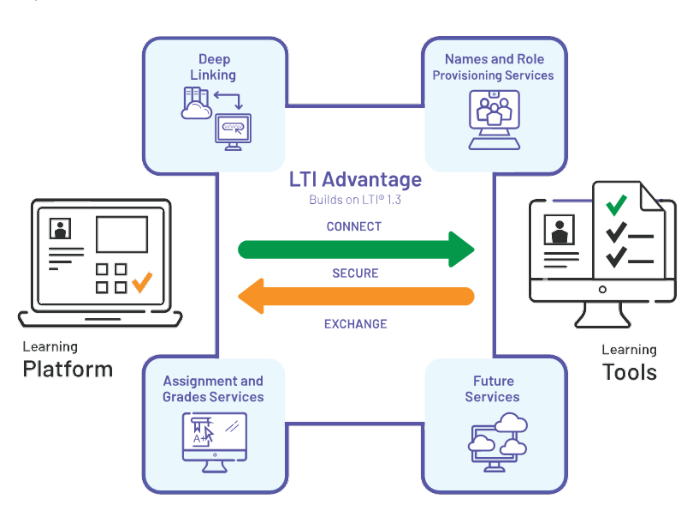
The Learning Tools Interoperability (LTI) (LTI Advantage, 2021), a IMS Global Learning Consortium standard, prescribes a way to securely connect learning applications and tools with learning platforms. The current version, called LTI Advantage, includes the core LTI (Version 1.3) and a package of three extensions that aim to enable faster setup and configuration, improve user functionality, and enhance security to protect student data. Essentially, the LTI standard enables a secure exchange of information between a learning system and an external learning tool. The information exchanged between the learning system and the external tool includes course information and user identity. It supports Single-Sign-On (SSO), thus learners can navigate seamlessly from one learning tool to the other without having to log into each one. Using deep linking, it is possible to integrate learning content from external tools directly into the corresponding learning system.
IMS Caliper Analytics (CA) (Manzoor, 2019) enables institutions to collect learning data from digital resources to better understand and visualize learning activity and product usage data. CA defines a number of metric profiles, each of which models a learning activity or a supporting activity that helps facilitate learning. Each profile provides a domain-specific set of terms and concepts that application designers and developers can draw upon to describe common user interactions in a
Human Systems Engineering and Design (IHSED 2021) https://openaccess.cms-conferences.org/#/publications/book/978-1-7923-8987-0 consistent manner using a shared vocabulary. In a way, CA solves a similar problem as xAPI. In the case of CA, however, more community cooperation is required to define the vocabulary (Experience API and Caliper Discovery, 2021), for example.
Standards such as the IMS Question and Test Interoperability (QTI) specification (Question and Test Interoperability 2021, Lay 2004) focus on the interchange and storage of assessment content. QTI enables the exchange of questions and test items between learning systems. It mainly describes a data model for the representation of questions and tests and their corresponding result reports that makes the interchange of information between systems possible. The model is defined in a standard data format (eXtensible Markup Language (XML)). QTI can describe simple to complex test structures, with any number of test parts and sections, including regulation of access or timing to each of the parts of an assessment.
Some standards combine several aspects of other standards. One such standard is IMS Common Cartridge (CC). It is based on SCORM and is a packaging standard for content that aims to simplify exchanges between learning systems, in particular to offer a standardized way (Common Cartridge, 2021):
to package and exchange digital learning materials and assessments
to import and export course materials to and from a learning system, portal, learning object repository or other learning platform
to exchange links and provide authorization to third party web-based learning tools via LTI CC uses a subset of Learning Object Metadata (LOM), known as Dublin Core Metadata (Barbone and Rifón, 2010) to manage learning objects. Learning objects (Raj and Renumol, 2019) can be digital or non-digital entities that can be described by metadata.
LOM (IEEE 1484.12.1-2020, 2020) is an IEEE standard. It describes metatags for representing metadata and specifies a conceptual data schema that defines the structure of a metadata instance for a learning object. Regardless of whether it is used for learning, education, or training; a metadata instance for a learning object describes relevant characteristics of the learning object to which it applies. A metadata instance for a learning object can be used by a learning system to manage, locate, evaluate, or exchange learning objects.
The standards and specifications described in this section are a subset of the total available standards and specifications. Some of them can be used directly in the next phase of the serious game framework development. Others may only become relevant in subsequent steps.
APPROACH The goal of this approach is to provide learning content of arbitrary sources to target groups of learning systems. A knowledge domain independent serious game framework, leveraging learning outcome in intrinsically motivating context (as explained in INTRODUCTION) conveys the learning content to the user.
Human Systems Engineering and Design (IHSED 2021) https://openaccess.cms-conferences.org/#/publications/book/978-1-7923-8987-0
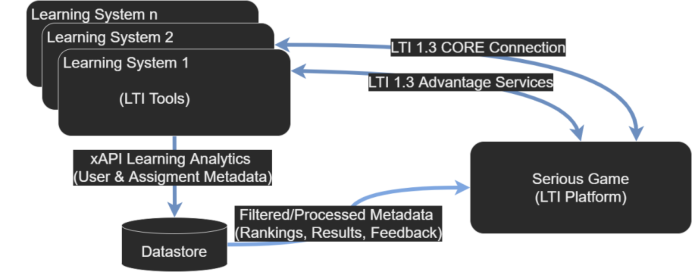
Provisioning of this content could either be achieved by content or system interoperability. Because of the inherent cost of exporting and parsing content, this approach favors system above content interoperability by implementing established standards like LTI for system interlinking and xAPI for usage tracking and learning analytics, both introduced in STATE OF THE ART.
Human Systems Engineering and Design (IHSED 2021) https://openaccess.cms-conferences.org/#/publications/book/978-1-7923-8987-0
By implementing LTI platform and tool paradigms, standard communication interfaces are used to call content on the providing system (i.e. Learning Management Systems like Moodle (LTI and Moodle, 2017) or edX (LTI Component, 2021)) to be rendered in on the receiving system (i.e. Serious Game) via deep linking, instead of being exported and reimported/parsed.
LTI consists of multiple components: the core component, providing connection and security related features and optional components, providing additional features. User and content metadata exchange (exercise results, grades) is either made feasible by using the LTI Advantage extension, which provides a minimal feature set for metadata exchange (see Figure 1) or alternatively by sending xAPI's actor-verb- activity triplets to a data store for more elaborate learning analytics, which in turn could provide higher level input to the Serious Game (see Figure 2).
Further communication between tools and platforms is facilitated either through messages (indirect, browser mediated) or services (direct, not mediated) and may consist of a number of mandatory fields, as well as optional fields for custom logic (i.e. key-value pairs, variables, properties), concluding the system architecture of the domain-independent, knowledge integrating approach.
CONCLUSIONS AND FUTURE WORK The motivation for this paper is to take the current serious game framework to the next level of development. The primary goal is to extend the framework with a fea- ture that allows learning content already available in other third-party learning systems to be included with the lowest possible integration cost for authors. For this purpose, standards and specifications are examined that can be used for the realization of the intended feature. Some of the standards and specifications described, especially LTI and xAPI, will be used directly in the next phase of serious game framework development. Others, such as QTI and CA, may not become relevant until later in development.
In future work, the approach presented in this paper will be implemented with a small number of learning systems providing learning content. This includes investigating available LRS in order to be able to implement extended activity tracking and analytics.
Human Systems Engineering and Design (IHSED 2021) https://openaccess.cms-conferences.org/#/publications/book/978-1-7923-8987-0
REFERENCES
Abdullah, M., Ali, N. A. A. (2016): E-learning standards. In Proceedings of the International Conference on Communication (ICCMIT 2016) (pp. 639-648) Atorf, D., Kannegieser, E. Dillig, M. (2020): Towards A concept for streamlining
game design of an existing serious game and preliminary evaluation: Proceedings of the 19th International Conference on WWW/INTERNET 2020, pp. 155-160, IADIS Press Bakhouyi, A., Dehbi, R., Talea, M., & Hajoui, O. (2017). Evolution of standardization and interoperability on E-learning systems: An overview. In 2017 16th International Conference on Information Technology Based Higher Education and Training (ITHET) (pp. 1-8). IEEE. Barbone, V. G., Rifón, L. A. (2010). From SCORM to Common Cartridge: A step
forward, 2009. Computers & Education, 102. Bopp, M. (2006). Immersive Didaktik und Framingprozesse in Computerspielen.
Ein handlungstheoretischer Ansatz. Common Cartridge, https://www.imsglobal.org/activity/common-cartridge (accessed on 20.04.2021) Experience API and Caliper Discovery: Moving Along Nicely!,
http://www.imsglobal.org/article/experience-api-and-caliper-discovery- moving-along-nicely IEEE 1484.12.1-2020 - IEEE Standard for Learning Object Metadata (2020) IMS LTI® 1.3 and LTI Advantage , http://www.imsglobal.org/activity/learningtools-interoperability (accessed on 20.04.2021) Krapp, A., Schiefele, U., & Schreyer, I. (1993). Metaanalyse des Zusammenhangs
von Interesse und schulischer Leistung. Zeitschrift für Entwicklungspsychologie und pädagogische Psychologie, 10(2), 120-148. Lay, S. (2004). Question and test interoperability: introducing version 2 of the IMS QTI specification. Lim, K. C. (2015). Case studies of xAPI applications to e-Learning. In The twelfth
international conference on eLearning for knowledge-based society (pp. 3-1). LTI Advantage: Learning Innovation at the Speed of Now, http://www.imsglobal.org/lti-advantage-overview LTI and Moodle – Moodle Docs (2017),
https://docs.moodle.org/310/en/LTI_and_Moodle LTI Component – Building and Running an edX Course documentation, https://edx.readthedocs.io/projects/edx-partner-course- staff/en/latest/exercises_tools/lti_component.html (accessed on 20.04.2021) Manzoor, H. (2019). Disseminating Learning Tools Interoperability Standards
(Doctoral dissertation, Virginia Tech). (accessed on 20.04.2021) Poltrack, J., Hruska, N., Johnson, A., & Haag, J. (2012). The next generation of scorm: Innovation for the global force. In The Interservice/Industry Training, Simulation & Education Conference (I/ITSEC) (Vol. 2012, No. 1). Orlando: National Training System Association. Prensky, M. (2007). Digital game-based learning: Practical ideas for the
applications of digital game-based learning. St-Paul: Paragon House. Question and Test Interoperability (QTI) Overview, Version 3, https://www.imsglobal.org/spec/qti/v3p0/oview (accessed on 20.04.2021)
Human Systems Engineering and Design (IHSED 2021) https://openaccess.cms-conferences.org/#/publications/book/978-1-7923-8987-0
Raj, N. S., Renumol, V. G. (2019). A rule-based approach for adaptive content recommendation in a personalized learning environment: An experimental analysis. In 2019 IEEE Tenth International Conference on Technology for Education (T4E) (pp. 138-141). IEEE. Sonawane, K. (2017). Serious Games Market by User Type (Enterprises and
Consumers), Application (Advertising & Marketing, Simulation Training, Research & Planning, Human resources, and Others), and Industry Vertical (Healthcare, Aerospace & Defense, Government, Education, Retail, Media & Entertainment, and Others)-Global Opportunity Analysis and Industry Forecast, 2016–2023: Allied Market Research.
Human Systems Engineering and Design (IHSED 2021) https://openaccess.cms-conferences.org/#/publications/book/978-1-7923-8987-0
LISTED IN THE AHFE DIGITAL BOOKSTORE CATALOGUE
Explore the complete digital volume
Human Systems Engineering and Design (IHSED2021): Future Trends and Applications
Read this individual research paper free through the original publisher, or explore the full digital proceedings book.
ISBN 978-1-7923-8987-0
Explore this ISBN in the AHFE Bookstore ↗Listed in the July 2026 bookstore catalogue; search by ISBN to confirm current availability · Digital book purchase optional