Sherry Palamara (2026). Optimizing human consciousness outside and inside the loop of artificial intelligence. In: Human Systems Engineering and Design (IHSED2026): Future Trends and Applications. AHFE Open Access, vol. 237, pp. 921–926. https://doi.org/10.54941/ahfe1008230
As pre-pandemic ideas become antiquated phenomena, human development in a post-pandemic era will likely rely heavily on linear momentum that constantly reconfigures continual progress (Palamara, 2021). Consciousness that subsumes collective forces greater than individuals, alleviates internal friction when solutions are guaranteed (Palamara, 2012), but unanticipated interim factors could flaw algorithms (Imanirad, 2012), producing inaccuracies from hastily forced heuristic decisions (Chaiken,1980), appearing to be derived from original guaranteed solutions lacking efficiency (Palamara, 2021). A propulsion-directionality model of human consciousness is considered to account for kinetic and non-kinetic propulsion and it is interaction with linear and nonlinear directionality that optimizes human development; especially resilience. When interactions, abide by propulsion and directionality, their forces continually reconfigure balance, while interferences require greater effort to reinstate undetected variations in the set range that qualifies as stabilized. This constitutes, in part, Newton’s third law of motion (Newton, 1846) with respect to human consciousness of interactional forces that have non-kinetic propulsion with nonlinear directionality to produce sustainable loop effects.
Post pandemic, human expansion will soon be far removed when reflecting from the pre-pandemic lenses of collective singularities that built entire fields of study ranging from art and culture to the life sciences and other worldly phenomenon, having explored the mysteries and intricacies of seemingly vast amounts of information for many millennia. As a human species, we have had the privilege of separating multiple things into their most basic parts and then gathering them together again to return them to their whole form. Imagine the possibility that in this post pandemic era, there exists the development of a collective foundation that can conceptualize a new way of considering consciousness that supports the directionality to build on ideas once thought to be inconceivable or unacceptable ways of contributing to the cognitive (Piaget, 1948; 1952) and behavioral shaping (Skinner, 1938) of foundational knowledge that humans have known about up to this point.
Received July 12, 2026 Revised July 20, 2026 Accepted August 1, 2026 Available online September 25, 2026
922 Palamara The established structure of ideological habits (James, 1890) in the pre- pandemic era was challenged during the pandemic and many of these human qualities will likely not survive the forces of the current singularities that are in motion as their potential energies prepare to take shape with instruction from individual and collective consciousnesses to direct the entirety of the human species moving forward. In this early development of post-pandemic consciousness shifts in momentum, some pre-pandemic ways of thinking may slowly start to fade away in an antiquated state of inertia, making many aspects of human perceptions irretrievable and no longer applicable to the current driving forces of the optimized human. This suggests that a post pandemic ideology takes precedence in launching a new human consciousness that has resilient sustainability and linearity to withstand uncertainty. That being said, given sufficient time and the proper resources, solutions are able to be discovered through consciousness; a metacognitive state of superior awareness of knowing. If all pre-pandemic knowledge becomes condensed on the Internet where artificial intelligence systems could access knowledge that one day contribute as an aspect to a massive quantum-computing systems, then providing a human model of consciousness to monitor these data output systems may be an insightful way for humans to alternate between two consciousnesses. One that navigates outside of the artificial intelligence (AI) data base loops and the other that navigates within the AI data base loops.
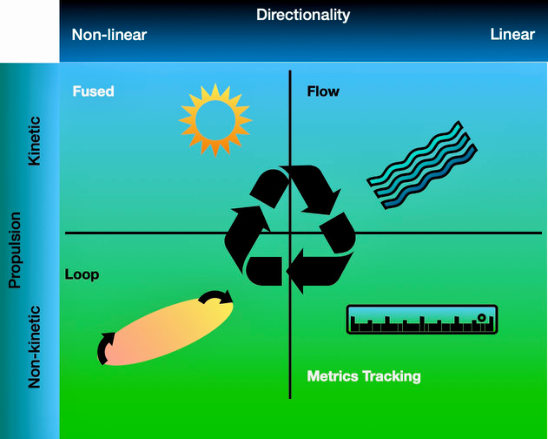
PROPULSION-DIRECTIONALITY MODEL A Propulsion-Directionality Model is proposed for consideration to delineate the interrelatedness between human consciousness and functional AI systems designed to mirror human consciousness. The first lower left quadrant of the model takes into account non-kinetic propulsion and nonlinear directionality. If a loop is subjected to the laws that interact with kinetic propulsion and directional linearity, these interactions could look something like an object exerting force on another object that receives an equal and opposite force in return from this other object, as indicated in Newton’s third law of motion (Newton, 1846). if Newton’s law is examined with respect to propulsion and directionality, and the propulsion of this force is set to be balanced, or non-kinetic, and the directionality is determined as nonlinear, a particular loop is formed that has predictability that is indicative of sustainability. If this is true, the habituated state can synchronize into a perfectly balanced experience that lacks variability, but has sustainable momentum; losing sense of time and awareness with the constancy of repeating the same consciousness choices, such as ‘binge watching’ shows or playing earlier versions of a videogames. When considering a closed system with respect to propulsion and directionality, the propulsion of the force behind the motion, balances the closed loop as the momentum glides into non-kinetic status like the constant, uninterrupted movement sustained by a pendulum and the directionality of the movement is implied to be nonlinear. The perpetual movement is designed to have an absence of propulsion that is sustainable on it is own to be considered non-kinetic motion in a closed loop system unless
Optimizing Human Consciousness Outside and Inside the Loop of Artificial Intelligence 923 this interaction is in some way interrupted. The reader can further explore various mathematical calculations for elliptical loops and their relation to interactions with propulsion and directionality which is beyond the scope of the Propulsion-Directionality Model, for now.
Moving to the lower right quadrant of the Propulsion-Directionality Model, non-kinetic propulsion is still considered an applicable factor as in the prior quadrant, but linearity changes, and is now related to linear directionality. When considering the lack of kinetic propulsion, this constitutes no movement on its own unless subjected to being moved by a force to activate motion, but when interacting with specific directional linearity that has established a highly predictable independent state, the identifiers comprised are similar to a continuous line that is determined with variable constancy proportional to measuring progress and performance variables in Metrics tracking, but gravitation towards this line is difficult to determine when the propulsion is non-kinetic. Conversions to consider may possibly include Hilbert metric formula as applied in superposition linear analysis.
Situated in the upper left quadrant of the Propulsion-Directionality Model, is a kinetic propulsion with a non-linear directionality. Sufficient propulsion to qualify as kinetic and directionality that indicates nonlinearity, suggests a type of fused state, like the gravitational forces that maintain object placement. For instance, when considering fused interactions that have kinetic propulsion with nonlinear directionality, their functions may be understood when exponential expansions in consciousness and AI interface with each other as a type of inseparable link. When kinetic propulsion with nonlinear directionality interacts with human consciousness in relation to AI systems, the interaction may be represented in terms of a labyrinth that has many layers, comprising dimensionality of indeterminate factors analogous to the behaviors that transpire when surfing online web search engines that appear to hyperlink human consciousness patterns based on the directional guidance of random human selections interpreted by the AI systems as anticipated probabilities; or in the spiraling of a consciousness vortex when gaming in an artificial world with Non-Player Characters for an indefinite amount of time, yielding to the impression of a seemingly endless surplus of kinetic propulsion. Further study may be directed to formulae that consider fused interactions.
The final quadrant of the Propulsion-Directionality Model situation in the upper right quadrant, asserts the existence of kinetic propulsion in relation to linear directionality. The interaction implies continuous flow with a prominent, kinetic propulsion and linear directionality, likened to a continuous state of non-interfering momentum. Experientially speaking, this is represented in spending hours in uninterrupted thoughts, or gliding down a flowing river, hiking up a hill or mountain with a designated open path to a fulfilling destination, indicative of an absence of discontinuity. Various types of flow can expand knowledge about the energy involved through mathematical calculations and their relation to the human experience that are personally meaningful to each human being.
Figure 1: Propulsion-directionality model. (Palamara, 2026) a) A loop constituting non-kinetic propulsion with nonlinear directionality; b) Metric tracking that qualifies as having non-kinetic propulsion yet linear directionality; c) Fused states that imply kinetic propulsion with non-linear directionality; and d) Flow impermanence indicative of kinetic propulsion with linear directionality.
CONSCIOUSNESS FREQUENCY FORMULA FOR RESILIENCE Consciousness may be experienced as a catalyst that accelerates kinetic energy to produce individual and collective effects. A computational model described by Palamara (1966) considers small variations in momentum inclined towards precession flow in an orbiting trajectory. The following proposed consciousness frequency formula for resilience suggests the potential factors involved in reaching the sustainable interactive flow state as indicated in the Propulsion-Directionality Model previously described, which constitutes kinetic propulsion that interacts with linear directionality.
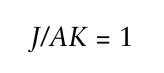
Consider the aspects of a Joule that represents energy input and output, divided by acceleration multiplied by Boltzmann’s constant that equals one and is written in the following way:
Equation reproduced from the original PDF.
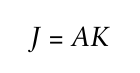
The processed conversion and expenditure of energy is also presumed to be equal to acceleration multiplied by Boltzmann’s constant and is written as:
Equation reproduced from the original PDF.
An insightful concept indicative of acceleration, such as the speed of a thought or intuitive detection as measured with a monitoring device and considered in this formula to be multiplied by Boltzmann’s constant such as a resonant frequency from the planet or cosmos, is held constant,
Optimizing Human Consciousness Outside and Inside the Loop of Artificial Intelligence 925 but could occupy resilient constancy, a factor that AI inputs without the human experience and does not slow down movement even when mistakes are made. AI systems do not encounter the experience of blissful states, humans, on the other hand, have known bliss as an anecdotal experience of timelessness, complete relaxation and an uninterrupted momentum or flow state that can increase with frequency. With respect to human consciousness, exposure to multiple compiled binaural frequencies configured at a very high prestissimo rate, with hundreds of frequency sounds that are tuned to 432 Hz and 440 Hz (Palamara, 2026), may be a possible congruency model to explore for supporting human consciousness resiliency in rapidly changing circumstances.
Table 1: Propulsion-directionality model and resiliency formula (Palamara, 2026).
Table available in the original PDF paper.
Kinetic propulsion and linear directionality Flow state J = AK Non-kinetic propulsion and nonlinear directionality Loop J = AK
Kinetic/non-kinetic propulsion and nonlinear and linear directionality
Fused State J ≠ AK Metrics Tracking J ≠ AK
CONCLUSION
If striving towards balance of internal discordance with the abundant external changes that are happening on this planet and those entering into the atmosphere, this accelerated motion is likely to continue. Uncertainty of where potential energies direct kinetic propulsion will also likely continue as major decisions are made particularly with the profound understanding of consciousness as an emerging daily practice that is reflected in continual intellectual development of whole brain functioning. Extrapolating the human interlude from artificial intelligence to advance societal optimization and individuality, is more essential now to maintain contact with the vast changes that are currently happening and will likely accelerate exponentially as grouped singularity collectives than isolated individuals without renouncing moral integrity. Attuning human consciousness to become a type of quantum consciousness with intuitive integrity that interfaces with AI systems, may occupy a broader conceptualization for humans than AI, to the extent that human consciousness advances insights, knowledge and understanding much further than ever known to be anticipated and at a faster rate than ever experienced.
ACKNOWLEDGMENT
The author would like to acknowledge her family for being a prominent support and her late father Ronald D. Palamara, Ph.D., for being a profound inspiration. The author would like to acknowledge that no portion of this paper was generated by artificial intelligence.
REFERENCES
Chaiken, S. (1980). Heuristic Versus Systemic Information Processing and the Use of Source Versus Message Cues in Persuasion. J. Pers. Soc. Psychol., Vol. 39(5), pp. 752–766. (1980) Einstein, A. (1961). Relativity: The Special and the General Theory: 15th Rev. Ed.:
N.Y.: Three Rivers Press. Imanirad, R., Yang, X-S, & Yeomans, J.S. (2012). A Co-evolutionary, Nature-inspired Algorithm for the Concurrent Generation of Alternatives. GSTF. J. on Comput., vol. 2(3), pp. 101–106. James, W. (1890). The Prin of Psychol: vol. I., Habit, pp. 104–127. N.Y.: Dov. Pub.,
Inc. Newton, I. (1846). Newton’s Principia: The Mathematical Principles of Natural Philosophy: 1st Ed.: (A. Mott Trans.). N. Y. Daniel Adee. Palamara, R. D. (1966). Some considerations for a simplified orbiting general
relativity experiment. AIAA Journal, Volume 4, No. 6. pp. 1036–1043. Palamara, S. (2021). Optimizing the human psyche in a pandemic. In R. Provinciali & T. Ahram (Eds.), Advances in human factors and ergonomics in healthcare and medical devices (pp. 377–382). Springer. Palamara, S. (2026). Frequency Shower: Mana Breeze Experience # 2. Self-Published.
https://drsherrypalamara.bandcamp.com/album/frequency-shower-mana-breeze- experience-2-2 Piaget, J. (1952). The Origins of Intelligence in Children: N.Y.: International Universities Press, Inc. Piaget, J. (1948). The Origins of Intelligence in Children: France: Delachaux &
Niestlé, Neuchâtel (Switzerland). Planck, M. (1901). On the Law of Distribution of Energy in the Normal Spectrum.
Annalen Der Physic, vol. 4. p. 553 ff. Planck, M. (1900). On the theory of the Energy Distribution Law of the Normal Spectrum. Read at the meeting of 14 December 1900. p. 235. Skinner, B. F. (1938). The behavior of organisms: An experimental analysis.
Appleton- Century. Tesla, N. (1900). The Problem of Increasing Human Energy. Cen. Il. Mo. Mag, pp. 183–226.
FIND THE COMPLETE VOLUME IN THE AHFE DIGITAL BOOKSTORE
Explore the complete digital volume
Human Systems Engineering and Design (IHSED2026): Future Trends and Applications
Read this individual research paper free through the original publisher, or explore the full digital proceedings book.