Farhad Mazareinezhad, Firdaous Sekkay, Daniel Imbeau (2024). Evaluating the Accuracy of the MOST Predetermined Motion Time System through Lab Experiments. In: Human Aspects of Advanced Manufacturing, Production Management and Process Control. AHFE Open Access, vol. 146, pp. 116–122. https://doi.org/10.54941/ahfe1005157
Ensuring the reliability of time estimations is vital for industries, as it establishes the basis for effective planning, resource allocation, and performance assessment, ultimately improving operational efficiency and optimizing workflows. This study, designed to evaluate the accuracy of the MOST predetermined motion time system (PMTS) through comprehensive laboratory experiments, involved twenty participants performing 300 various simple motions. Our focus was on motions characterized by specific features, such as those at higher levels (shoulder height), motions involving objects with varying weights, and motions occurring within the reach distance zone (between 5 cm and 60 cm from the workers). These motion characteristics are often overlooked in MOST data cards. Task durations were initially measured using an accelerometer and then estimated using both the MOST and Fitts' Law (a widely recognized method for estimating the duration of simple motions). The results unveiled a 22% underestimation of MOST estimations by Fitts’ Law. These findings underscore the need to revise MOST data cards for accuracy enhancement and to mitigate potential risks to workers. Future research endeavors should incorporate real-world scenarios and a broader array of motions to further validate and refine these outcomes, ensuring a more comprehensive understanding of the capabilities and limitations of the MOST predetermined motion time system.
In manufacturing, accurate estimation of work times is vital for ensuring suc- cessful production by effectively managing resources such as workforce and materials. Predetermined Motion Time Systems (PMTS) play a crucial role in enhancing efficiency and resource allocation in industrial settings (Genaidy et al., 1989; Neumann et al., 2002). These systems use techniques to estimate operation time, providing a standardized framework for evaluating product costs, comparing workstations or tasks, and identifying improvement areas (Heap, 2015).
PMTSs commonly used in industries include Method Time Measurement (MTM), which is known for analyzing motions in detail, and the Maynard
Evaluating the Accuracy of the MOST Predetermined Motion Time System 117
Operation Sequence Technique (MOST), which is a simplified adaptation of MTM (Genaidy et al., 1989; Zandin, 2002).
MOST utilizes data cards with standardized codes and descriptions for specific motions, enabling quantification of parameters like walking time, machine usage time, and tool usage (Zandin, 2002). Fitts’ law, introduced by Paul Fitts in 1954, serves as a well-established predictive model for movement time, considering both target distance and object size, as demonstrated in various studies, ranging from earlier works such as Crossman & Goodeve (1983) to more recent research conducted by Clark et al. (2020) and Xie et al. (2023).
This study explores the application of both MOST and Fitts’ law in time estimation. While MOST excels in estimating complex movements, Fitts’ law is more suitable for simpler ones. For simple movements, it is anticipated that Fitts’ law and MOST will provide comparable time estimates.
Given technological advancements and organizational changes, regu- lar validation of PMTS accuracy is essential for precise time estimations (Genaidy et al., 1989; Neumann et al., 2002). Despite its importance, schol- arly attention to PMTS validation is relatively low. Previous studies, such as those conducted by Kurkin & Bures (2011), Bahcivancilar (2012), and Bures and Picvodova (2015), have demonstrated variations between PMTS esti- mates (including MTM-1, MOST, and MTM-UAS) and empirically measured actual times. As a result of these investigations, deviations of up to 17 percent were discovered between the estimated times of PMTSs and measured actual times.
The tendency of PMTSs to predict unrealistically short completion times can lead to errors in productivity estimation and inaccuracies in risk assess- ments. These overly optimistic time predictions, often used to set worker productivity expectations, can lead to overexertion, and increase the risk of injury among workers (Harari et al., 2018).
This study aimed to assess the accuracy of the MOST (Maynard Oper- ation Sequence Technique) predetermined motion time system through a laboratory experiment. The research focused on comparing established time standardization methods, including direct measurement, MOST, and Fitts’ law.
METHODS
Twenty participants, aged between 27 and 59 years (mean ± SD: 43 ± 10.9 years, range: 27–52 years), volunteered for the study after confirming their ability to handle objects weighing up to 5 kg and providing informed consent. The study received ethics certificate number CER-2223-38-D.
The study consisted of three experiments designed to assess the preci- sion of MOST data cards in diverse motion scenarios, inspired by research paradigms such as Kurkin & Bures (2011) and Bahcivancilar (2012). MOST data cards often overlook specific movement characteristics, including higher-level shoulder movements, object weight, and action distances within the worker’s reaching zone. Consequently, our focus was on evaluating the
alignment between MOST estimations and actual time measurements in these specific movements.
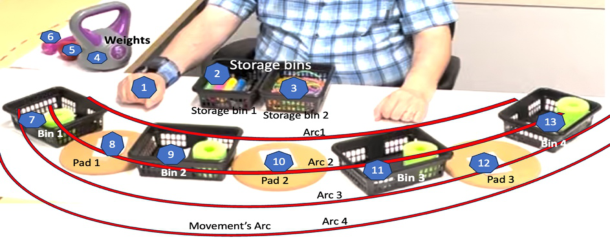
The experiments were centered on seated “Get and Place” movements, requiring participants to manipulate objects accurately over specified dis- tances. Various objects, including markers, rubber bands, and weights, were moved across different tasks based on the experimental layout (Figure 1).
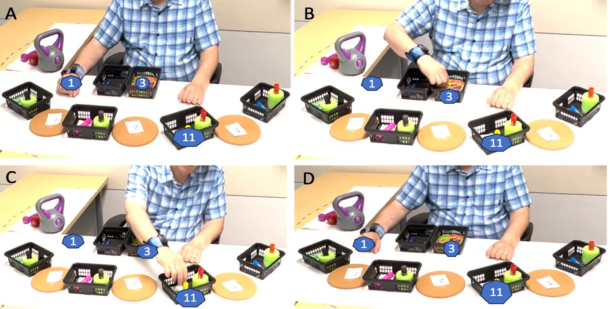
In these experiments, participants performed tasks assessing motion char- acteristics, such as action distances, object weight, and movement precision, in diverse scenarios. In Experiment 1, the distances between these points were individually customized for each participant based on their unique maximum reach capacity. In Experiment 2, all participants were given the same distance, irrespective of their reach capacity. In Experiment 3, the table height was adjusted according to the individual’s maximum reach capacity, and movements were replicated at higher levels. In total, participants com- pleted various tasks across various scenarios in all experiments. These tasks included motions such as precisely placing markers in bins, grasping inter- locked rubber bands, and moving various weights. This diversity aimed to assess the accuracy of MOST data cards across various scenarios and under- stand whether specific motion characteristics impact motion times. Figure 2 illustrates a participant carrying out a task in Experiment 1.
Figure 1: Experimental layout.Figure 2: Participant performing a task in experiment 1.
Evaluating the Accuracy of the MOST Predetermined Motion Time System 119
MOST and Fitts’ Law Time Estimations Movements were selected from “MOST Work Measurement Systems” by Zandin (2002), providing detailed time estimations and reducing reliance on subjective judgments to minimize unintentional bias. The MOST time estimations, initially expressed in TMUs, were converted to seconds (1 TMU = 0.036 seconds) for consistency.
For estimating each motion time, Fitts’ law was also employed, utilizing the formula MT = a + b * log2(D/W + 1) (Fitts, 1954). Coefficients a and b, set to 100 ms and 150 bits/ms, respectively, are task-specific and were determined through regression analysis. D represents distance, easily calculated based on spatial distance, and W signifies target width, measured as the effective diameter.
The dataset encompasses measured times, MOST, and Fitts’ law estima- tions for each of the 6,000 movements from three experiments involving 20 participants (300 movements per participant).
Experimental Procedure Participants were equipped with a wrist-mounted accelerometer that recorded motion data at 50 Hz, aligning with the axes of the forearm and trunk. The peaks and valleys in the acceleration data were identified to cor- respond to specific motion intervals. Through manual identification of these points, and considering the sampling rate and resolution, we determined the duration of each motion in seconds.
To complement this data, video recordings of participants’ movements dur- ing the experiments were captured using an iPhone 13 Pro camera. These recordings played a crucial role in identifying and addressing outliers in the dataset.
Data Analysis In each experiment, we replicated every motion and then computed the aver- age value for each. Manual inspection ensured data quality by identifying and eliminating 11 outliers, which were prolonged movements caused by distractions.
Means and standard deviations were calculated for both estimation meth- ods for N = 6000 motions. The Bland-Altman agreement test, following the methodology by Bland and Altman (1999), was also applied to assess agreement between estimated times of MOST and Fitts’ Law. This involved computing the 95% Limits of Agreement (LoA) using differences between Estimated times, supplemented by ± 2 times the standard deviation of dif- ferences (SDdiff). These limits determined the upper and lower bounds of agreement, contributing to the evaluation of method accord. All statistical analyses were conducted with Microsoft Excel.
RESULTS
Due to space constraints, the results section will primarily focus on high- lighting the disparity between MOST and Fitts’ Law. A comparison between
Fitts’ Law and MOST estimations was conducted to evaluate MOST’s per- formance in estimating task times. The results revealed that the mean time estimated by MOST (2.33 ± 0.32 seconds) was lower than that estimated by Fitts’ Law (3.09 ± 0.59 seconds), indicating a discrepancy in estimation methods.
Despite variations in tasks, the MOST time for different tasks remains consistent because MOST data cards do not account for variations in mov- ing object weight, motion height levels, or distance covered during motions, particularly within workers’ reach zones. Consequently, the time values for these motions remain consistent when estimated according to MOST rules.
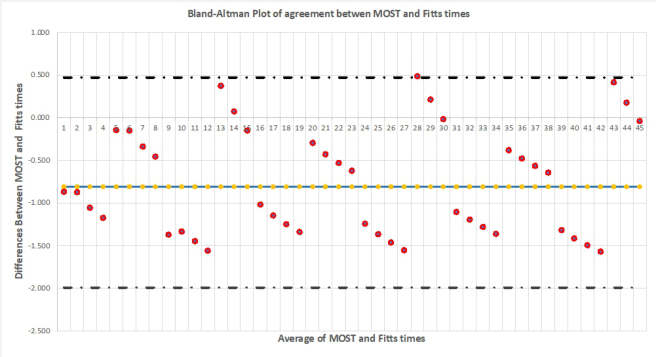
The Bland-Altman method demonstrated the level of agreement between MOST and Fitts’ Law, with a mean difference of −0.76 seconds (95% LoA: −1.99 to 0.47 seconds) and a standard deviation of differences at 0.63 seconds, indicating substantial variation and low agreement between the methods. Figure 3 displays the Bland-Altman plot illustrating the agreement between MOST and Fitts’ Law, with the solid line representing the mean bias and dashed lines indicating the limits of agreement.
Figure 3: Bland-Altman plot, the differences between the MOST and Fitts’ law in 45 tasks performed.
DISCUSSION
Considerable variability in time estimation was observed when comparing MOST and Fitts’ Law, with MOST consistently underestimating Fitts’ Law times by 22%. This discrepancy raises concerns, as Fitts’ Law serves as the foundation for estimating basic movement times.
One of the key factors contributing to this discrepancy is our intentional focus on selecting specific types of motions that exhibit unique characteristics. These include elevated-level motions (at shoulder level), motions involving varying object weights, and motions with different reach distance zones (typ- ically occurring between 5 cm to 60 cm from the workers). While Fitts’ Law
Evaluating the Accuracy of the MOST Predetermined Motion Time System 121
accounts for some of these aspects, such as motions with different reach dis- tance zones, none of them are considered by the MOST system in its data cards, which could explain part of the observed difference. It underscores the significant impact of these unaccounted motion characteristics on the pre- cision of time estimations made by MOST, suggesting the need for a more comprehensive investigation into its predictive capabilities, especially in the presence of these neglected factors.
CONCLUSION
This research assessed the accuracy of MOST data cards in estimating basic movements, revealing a notable disparity with the estimations provided by Fitts’ Law, indicating a consistent underestimation of the Fitts’ time for motions investigated in this study. While PMTS, including MOST, are widely employed for rough estimates during the planning phase, understanding the reasons behind these discrepancies is crucial. This study underscores the potential for enhancing the accuracy and efficiency of MOST by address- ing gaps and unexplored aspects within this time system. Such improvements would contribute to better decision-making and organizational productivity for industries utilizing the MOST time system.
Future research can draw inspiration from the findings of this study, par- ticularly focusing on the detailed analyses of factors influencing movement times across various scenarios; these analyses should aim to determine the sig- nificance of these factors, which explain the variation in MOST estimations and actual measurements. By identifying and incorporating these missing fac- tors into MOST data cards, future research endeavors could significantly enhance MOST accuracy.
ACKNOWLEDGMENT
The authors would like to gratefully acknowledge the funding provided by Mitacs Canada for this project. Additionally, we extend our apprecia- tion to our industry partner, Dassault Systèmes Canada, for their invaluable collaboration and guidance throughout the project.
REFERENCES
Bahçıvancılar, U. (2012). Validation of methods time measurement data (master’s thesis, Middle East Technical University). Bland, J. M., & Altman, D. G. (1999). Measuring agreement in method comparison
studies. Statistical methods in medical research, 8(2), 135–160. Bures, M., & Pivodova, P. (2015). Comparison of time standardization methods on the basis of real experiment. Procedia Engineering, 100, 466–474. Clark, L. D., Bhagat, A. B., & Riggs, S. L. (2020). Extending Fitts’ law in three-
dimensional virtual environments with current low-cost virtual reality technology. International Journal of Human-Computer Studies, 139, 102413. Crossman, E. R. F., & Goodeve, P. J. (1983). Feedback control of hand-movement and Fitts’ Law. The Quarterly Journal of Experimental Psychology Section A, 35(2), 251–278.
Fitts, P. M. (1954). The information capacity of the human motor system in controlling the amplitude of movement. Journal of experimental psychology, 47(6), 381. Genaidy, A. M., Mital, A., & Obeidat, M. (1989). The validity of predeter-
mined motion time systems in setting production standards for industrial tasks. International Journal of Industrial Ergonomics, 3(3), 249–263. Harari, Y., Riemer, R., & Bechar, A. (2018). Factors determining workers’ pace while conducting continuous sequential lifting, carrying, and lowering tasks. Applied ergonomics, 67, 61–70. Kurkin, O., & Bures, M. (2011, January). Evaluation of operational times by
MTM methods in the digital factory environment. In Proceedings of the 22th International DAAAM Symposium. Vienna, Austria (pp. 671–672). Neumann, W. P., Kihlberg, S., Medbo, P., Mathiassen, S. E., & Winkel, J. (2002). A case study evaluating the ergonomic and productivity impacts of partial automa- tion strategies in the electronics industry. International journal of production research, 40(16), 4059–4075. Xie, Y., Zhou, R., & Qu, J. (2023). Fitts’ law on the flight deck: Evaluating
touchscreens for aircraft tasks in actual flight scenarios. Ergonomics, 66(4), 506–523. Zandin, K. B. (2002). MOST work measurement systems. CRC press.
LISTED IN THE AHFE DIGITAL BOOKSTORE CATALOGUE
Explore the complete digital volume
Human Aspects of Advanced Manufacturing, Production Management and Process Control
Read this individual research paper free through the original publisher, or explore the full digital proceedings book.
ISBN 978-1-964867-22-9
Explore this ISBN in the AHFE Bookstore ↗Listed in the July 2026 bookstore catalogue; search by ISBN to confirm current availability · Digital book purchase optional