Chun-Yang Chiu, Chien-Hsiung Chen (2026). Effects of Different Grip Postures on the Usability of Portrait-Mode Mobile Action Games. In: Usability and User Experience. AHFE Open Access, vol. 232, pp. 270–278. https://doi.org/10.54941/ahfe1008055
The impact of different grip postures on the usability of mobile games is critical. From the perspective of Fitts’ law, this study investigates how different grip postures (one-handed use with the right thumb on the screen, cradling with the thumb on the screen, and two-handed use) affect the usability of a portrait‑mode mobile action game. Thirty participants were recruited through convenience sampling, and a one-way between-subjects design was adopted to measure task completion time for button-clicking tasks, the number of coins collected, and overall subjective usability using the System Usability Scale (SUS). The results showed that: (1) For the bottom-right button, the right thumb was close to the target in all grip postures, whereas for the top-right button the thumbs were far from the target in all grip postures; the lack of significant differences in completion time between these two buttons is consistent with Fitts’ law. (2) For the top-left button, the left thumb in the cradling posture was closer to the target, and its completion time was significantly shorter than in the one-handed use with the right thumb posture, which is consistent with Fitts’ law. (3) The lack of a clear correspondence between the bottom-left button and the theoretical predictions of Fitts’ law may be due to participants being more accustomed to horizontal movements in the lower part of the screen (regardless of grip posture), which is related to device size, interface layout, and human factors. (4) When the tappable area was extended to the entire screen, no significant differences were observed among the three grip postures, again in line with Fitts’ law. (5) SUS scores did not differ significantly among the three grip postures. These findings provide useful implications and reference for related research fields.
INTRODUCTION AND RELATED WORK The high convenience of mobile devices has made mobile gaming the most profitable segment of the game industry (Newzoo, 2024). Gesture-based interaction on mobile devices is one of the ways in which humans achieve more natural and intuitive interactions. Different interaction gestures and grip postures, combined with different button locations (i.e., interface layout and design), can lead to varying performance outcomes (Karlson et al., 2008; Park & Han, 2010; Trudeau et al., 2016), and device size and hand size may further influence these results (Choi et al., 2020) which are critical for the
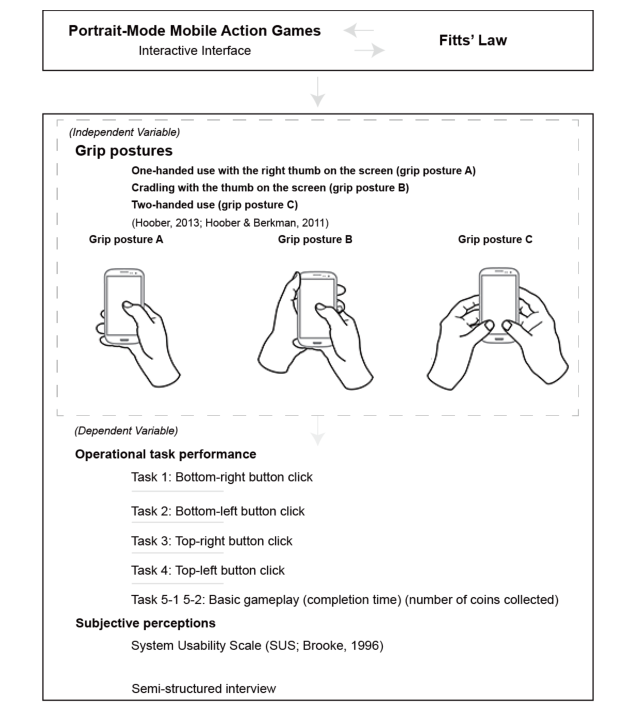
Effects of Different Grip Postures on the Usability of Portrait-Mode Mobile 271 user experience of game applications. Building on the grip postures proposed by Hoober and Berkman (2013; 2011), this study treats grip posture as an independent factor and distinguishes three conditions: one-handed use with the thumb of the same hand (grip posture A), cradling with the thumb on the screen (grip posture B), and two-handed use (grip posture C). We examine how these three grip postures affect usability in a mobile gaming context under different button locations and interaction designs.
Fitts’ law plays an important role in this context, and numerous studies have examined target acquisition on mobile touchscreens (Chakraborty & Yadav, 2023; Hayes et al., 2016; Murata, 1999). Fitts’ law describes how movement time is influenced by target distance and target size: movement time decreases as the distance to the target is shortened and the target size is increased (Fitts, 1954; MacKenzie, 1992). Over time, several variants of Fitts’ law have been developed; in human–computer interaction research, the most commonly adopted formulation of the index of difficulty is 𝐼𝐷 = log2(𝐴/𝑊+1), where some authors denote the distance term by 𝐷 instead of 𝐴. This formulation indicates that the index of difficulty depends on the target distance 𝐴 (from the starting point to the target center) and the target width 𝑊 (MacKenzie, 1992; Wright & Lee, 2013). In addition to comparing performance across different grip postures and button locations, this study also seeks to interpret whether and how the empirical results align with Fitts’ law, and to explore the underlying reasons for any consistencies or deviations.
The present study integrates prior work and the theoretical framework of Fitts’ law to examine how different grip postures affect usability in a portrait-mode action game on mobile devices, and to derive corresponding design implications. The specific research objectives are as follows:
1. Under the framework of Fitts’ law, to evaluate the performance of different grip postures in a portraitmode mobile action game. 2. Under the framework of Fitts’ law, to examine the effects of different grip postures on subjective usability perceptions in a portraitmode mobile action game.
METHOD
This study examines, within the theoretical framework of Fitts’ law, how different grip postures affect target acquisition performance and interface usability in a portrait-mode mobile action game. A single-factor between- subjects experimental design was employed, with grip posture as the independent variable at three levels: one-handed use with the right thumb on the screen (grip posture A), cradling with the thumb on the screen (grip posture B), and two-handed use with both thumbs (grip posture C). The dependent variables were task performance and subjective usability as measured by the System Usability Scale (SUS).
The experimental tasks consisted of button-clicking at different screen locations (near the bottom-right, bottom-left, top-right, and top-left) and basic gameplay operations, during which participants’ grip postures and interaction behaviors were observed. Subjective evaluations were collected using the SUS to assess perceived interface usability, followed by a semi-structured interview
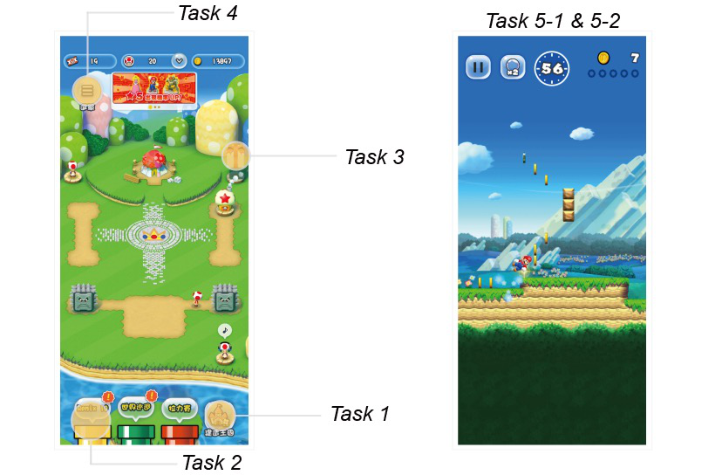
272 Chiu and Chen after completion of the questionnaire. The experiment was conducted on a Samsung Galaxy S24 smartphone. The independent variable and overall research framework are illustrated in Figure 1, and screenshots of the task interfaces are shown in Figure 2.
Participants and Procedure This study recruited 30 participants using convenience sampling, and all were confirmed to be right-handed. Participants were 19–23 years old, currently enrolled as undergraduate students, and all had sufficient ability to perform the tasks and understand the questionnaires; the sample comprised 11 males and 19 females. Participants did not include hardcore mobile gamers. All participants were randomly assigned to one of three experimental groups and completed the experiment individually in a quiet laboratory environment. Each session lasted approximately 15 minutes. Task completion time was recorded using a professional stopwatch, and the number of collected coins (Task 5-2) was recorded according to the values displayed by the system. Task completion time, number of coins collected, and SUS scores were then entered into SPSS for storage and subsequent statistical analysis.
Figure 1: Research framework.
Effects of Different Grip Postures on the Usability of Portrait-Mode Mobile 273 Before the experiment, participants were informed about the study background and objectives and then completed a demographic questionnaire and an informed consent form. The experimental procedure and task operations were subsequently explained. After finishing all tasks, participants completed a subjective usability questionnaire (SUS) and took part in a semi- structured interview to elaborate on their interface usage experiences.
Figure 2: Screenshots of the task interfaces.
Experimental Design and Sample Given the diversity of mobile games and their associated interaction strategies and conventions, this study focused on a portraitmode action game. The task scenarios were initially planned and designed, followed by a survey and testing of existing game products; one product that best matched the experimental and task requirements was selected as the sample. The task design was then refined to align with the product’s interface layout while meeting the standards of the experimental design. In total, five operation tasks were defined, as summarized in Table 1.
Table 1: Task descriptions and main objectives.
Table available in the original PDF paper.
Task ID and Descriptions Main Objective Task 1: Bottom-right button click To measure completion time for different grip postures at a bottom-right button location.
Task 2: Bottom-left button click Main objective: To measure completion time for different grip postures at a bottom-left button location.
Task 3: Top-right button click Main objective: To measure completion time for different grip postures at a top-right button location.
(Continued)
Table 1: Continued.
Table available in the original PDF paper.
Task ID and Descriptions Main Objective Task 4: Top-left button click Main objective: To measure completion time for different grip postures at a top-left button location.
Task 5-1: Basic gameplay (completion time)
To measure completion time for basic gameplay under different grip postures.
Task 5-2: Basic gameplay (number of coins collected)
To measure number of collected coins for basic gameplay under different grip postures.
RESULTS
A one-way between-subjects analysis of variance (ANOVA) was conducted with grip posture as the independent variable with three levels. Task completion time, number of collected coins, and subjective usability ratings were analyzed using SPSS, with the significance level (alpha) set at 0.05.
Task 1 Task 1 required participants to click the bottom-right button (Figure 2). A one-way ANOVA (Table 2) showed no significant effect of grip posture on completion time (F = 0.17, p = 0.85 > 0.05), indicating no significant differences among the three grip postures.
Task 2 Task 2 required participants to click the bottom-left button (Figure 2). A one- way ANOVA (Table 2) again revealed no significant effect of grip posture (F = 0.40, p = 0.96 > 0.05), suggesting no significant differences among the three grip postures.
Task 3 Task 3 required participants to click the top-right button (Figure 2). A one- way ANOVA (Table 2) showed no significant effect of grip posture (F = 0.89, p = 0.42 > 0.05), indicating that completion times did not differ significantly across the three grip postures.
Task 4 Task 4 required participants to click the top-left button (Figure 2). A one-way ANOVA (Table 2) revealed a significant effect of grip posture on completion time (F = 4.59, p = 0.02 < 0.05). Scheffé post hoc comparisons showed that grip posture B (M = 0.82, SD = 0.42) differed significantly from grip posture A (M = 1.45, SD = 0.55), whereas grip posture C (M = 1.20, SD = 0.41) did not differ significantly from either grip posture A or grip posture B. These results indicate that Task 4 was completed in a shorter time with grip posture B than with grip posture A.
Task 5 Task 5 involved basic gameplay (Figure 2), during which both completion time and the number of coins collected were recorded. A one-way ANOVA
Effects of Different Grip Postures on the Usability of Portrait-Mode Mobile 275 (Table 2) showed no significant effect of grip posture on completion time (F = 0.74, p = 0.49 > 0.05), and no significant effect on the number of coins collected (F = 0.30, p = 0.74 > 0.05). Thus, for Task 5, there were no significant differences among the three grip postures in either completion time or coin collection performance.
Table 2: One-way ANOVA results for task completion time (in seconds), except for Task 5-2, which reports the number of coins collected.
Table available in the original PDF paper.
Grip Posture A - M (SD)
Grip Posture B - M (SD)
Grip Posture C - M (SD)
F p Post Hoc (Scheffé) Task 1 0.33 (0.20) 0.28 (0.15) 0.31 (0.18) 0.17 0.85
SUS Subjective Ratings A one-way between-subjects ANOVA was conducted on SUS scores (Table 3). The results indicated no significant effect of grip posture on overall usability (F = 0.24, p = 0.79 > 0.05), suggesting that SUS ratings did not differ significantly among the three grip conditions.
Table 3: One-way ANOVA of System Usability Scale (SUS) scores.
Table available in the original PDF paper.
Grip Posture A – M (SD)
Grip Posture B – M (SD)
Grip Posture C – M (SD)
F p Post Hoc (Scheffé) SUS 72.00 (13.58) 67.75 (12.77) 69.00 (15.99) 0.24 0.79
DISCUSSION
The performance results for Tasks 1, 3, and 4 (bottom-right, top-right, and top-left buttons) are largely consistent with Fitts’ law (Fitts, 1954; MacKenzie, 1992; Wright & Lee, 2013). Across the three grip postures, thumb positions corresponded either to targets located nearby (e.g., in Task 1, all thumbs were close to the bottom-right button) or to targets located farther away (e.g., in Task 3, all thumbs were relatively far from the top-right button), yielding no significant differences among postures. In contrast, Task 4 produced a significant effect: grip posture B yielded shorter completion times than grip posture A. Combining the experimental results with observations made during the study and Fitts’ law, this can be attributed to the left hand in grip posture B supporting the phone near the upper-left area, enabling many participants to tap the top-left button directly with the left thumb, while some participants used the left hand primarily as support to facilitate faster movements by the right thumb toward the top-left target. Thus, for
276 Chiu and Chen the top-left button, grip posture B benefited either from reduced movement distance or from more effective physical support by the left hand, which facilitated task execution.
In Task 2 (bottom-left button), however, the results did not fully align with Fitts’ law. Although the left thumb in grip posture C was closest to the button, no significant differences emerged among the three grip postures. A possible reason is that this button location involved predominantly horizontal movements across all three postures (especially grip postures A and B), and on a relatively small-screen smartphone, participants—who were all right-handed—were already highly accustomed to performing horizontal thumb movements along the lower part of the screen, thereby attenuating differences among postures. Wobbrock et al. (2008) reported that many hand postures exhibit higher success rates for horizontal than for vertical movements, which echoes this finding.
Semi-structured interview data further revealed that many participants perceived the upper buttons (top-right and top-left) as harder to reach and tap accurately, which may be related to the specific grip posture adopted and individual interaction preferences.
No significant differences were observed in completion time or coin collection for basic game operations (Task 5). When the tappable area was expanded to the entire screen, allowing the protagonist to jump in response to taps anywhere, this design effectively minimized the impact of different grip postures on basic gameplay. This finding aligns with Fitts’ law and suggests that, in real-world scenarios, users can select their preferred and context-appropriate grip posture for basic gameplay without substantially affecting performance.
In summary, the findings that different button placements correspond to different operational grip postures are not only closely linked to Fitts’ Law but also influenced by interface configuration and design, device size, and ergonomic factors (Choi et al., 2020; Karlson et al., 2008; Park & Han, 2010; Trudeau et al., 2016)right side: R, top: T, bottom: B, front: F, back: K. Regarding the System Usability Scale (SUS), participants reported no significant differences in overall task experience across the different grip postures. Participants’ usability evaluations of the three distinct grip postures remained near marginal or marginal levels (Bangor et al., 2009).
CONCLUSION
Using a single-factor between-subjects experimental design, this study examined how different grip postures influence usability in a portraitmode mobile action game. The main findings are summarized as follows: (1) For the bottom-right button, the right thumb was close to the target in all grip postures, whereas for the top-right button the thumbs were far from the target in all grip postures; the lack of significant differences in completion time between these two buttons is consistent with Fitts’ law. (2) For the top-left button, the cradling posture (left thumb on the button) yielded significantly shorter completion times than the one-handed posture with the right thumb on the screen, reflecting the advantage of a shorter movement
Effects of Different Grip Postures on the Usability of Portrait-Mode Mobile 277 distance in line with Fitts’ law. (3) The bottom-left button did not fully align with the theoretical predictions of Fitts’ law. A plausible explanation is that participants, regardless of grip posture, were more accustomed to performing horizontal movements along the lower part of the screen, in combination with the effects of device size, interface layout, and human factors. (4) When the tappable area was expanded to the entire screen, no significant differences emerged among the three grip postures, again consistent with Fitts’ law, as enlarging the effective target area reduces the influence of distance and reachability. (5) SUS scores did not differ significantly across the three grip postures, indicating similar overall perceived usability.
Overall, the effects of different button locations under different grip postures are closely related not only to Fitts’ law but also to interface layout and design, device size, and human factors such as hand size and posture. The findings of this study provide useful implications and reference for related research and for the design of grip posture-based interaction in mobile games.
REFERENCES
Bangor, A., Kortum, P., & Miller, J. (2009). Determining what individual SUS scores mean: Adding an adjective rating scale. J. Usability Studies, 4(3), 114–123. Chakraborty, P., & Yadav, S. (2023). Applicability of Fitts’ law to interaction with
touchscreen: Review of experimental results. Theoretical Issues in Ergonomics Science, 24(5), 532–546. https://doi.org/10.1080/1463922X.2022.2114034 Choi, Y., Yang, X., Park, J., Lee, W., & You, H. (2020). Effects of smartphone size and hand size on grip posture in one-handed hard key operations. Applied Sciences, 10(23), Article 23. https://doi.org/10.3390/app10238374 Fitts, P. M. (1954). The information capacity of the human motor system in
controlling the amplitude of movement. Journal of Experimental Psychology, 47(6), 381–391. https://doi.org/10.1037/h0055392 Hayes, S. T., Steiger, J. H., & Adams, J. A. (2016). Modelling touch-interaction time on smartphones. Behaviour & Information Technology, 35(12), 1022–1043. https://doi.org/10.1080/0144929X.2016.1221460 Hoober, S. (2013, February 18). How Do Users Really Hold Mobile Devices?
UXmatters. https://www.uxmatters.com/mt/archives/2013/02/how-do-users- really-hold-mobile-devices.php Hoober, S., & Berkman, E. (2011). Designing Mobile Interfaces. O’Reilly Media.
https://www.amazon.com/Designing-Mobile-Interfaces-Patterns-Interaction/ dp/1449394639 Karlson, A. K., Bederson, B. B., & Contreras-Vidal, J. L. (2008). Understanding one-handed use of mobile devices. In Handbook of Research on User Interface Design and Evaluation for Mobile Technology (pp. 86–101). IGI Global. https:// doi.org/10.4018/978-1-59904-871-0.ch006 MacKenzie, I. S. (1992). Fitts’ Law as a Research and Design Tool in Human-
Computer Interaction. Human–Computer Interaction, 7(1), 91–139. https://doi. org/10.1207/s15327051hci0701_3 Murata, A. (1999). Extending Effective Target Width in Fitts’ Law to a Two- Dimensional Pointing Task. International Journal of Human–Computer Interaction, 11(2), 137–152. https://doi.org/10.1207/S153275901102_4 Newzoo. (2024). Newzoo global games market report 2024. Newzoo. https://
278 Chiu and Chen Park, Y. S., & Han, S. H. (2010). Touch key design for one-handed thumb interaction
with a mobile phone: Effects of touch key size and touch key location. International Journal of Industrial Ergonomics, 40(1), 68–76. https://doi.org/10.1016/j. ergon.2009.08.002 Trudeau, M. B., Asakawa, D. S., Jindrich, D. L., & Dennerlein, J. T. (2016). Twohanded grip on a mobile phone affords greater thumb motor performance, decreased variability, and a more extended thumb posture than a one-handed grip. Applied Ergonomics, 52, 24–28. https://doi.org/10.1016/j.apergo.2015.06.025 Wobbrock, J. O., Myers, B. A., & Aung, H. H. (2008). The performance of hand
postures in front- and back-of-device interaction for mobile computing. International Journal of Human-Computer Studies, Mobile Human-Computer Interaction, 66(12), 857–875. https://doi.org/10.1016/j.ijhcs.2008.03.004 Wright, C. E., & Lee, F. (2013). Issues Related to HCI Application of Fitts’s Law.
Read this individual research paper free through the original publisher, or explore the full digital proceedings book.
ISBN 979-8-950676-08-6
Explore this ISBN in the AHFE Bookstore ↗Listed in the July 2026 bookstore catalogue; search by ISBN to confirm current availability · Digital book purchase optional