Perini Matteo, Bacchetta Paolo, Khamaisi Riccardo, Melloni Riccardo, Morganti Alessio, Peruzzini Margherita, Botti Lucia (2024). Exoskeletons in action: The impact of exoskeletons on human factors during manual material handling. In: Human Aspects of Advanced Manufacturing, Production Management and Process Control. AHFE Open Access, vol. 146, pp. 11–21. https://doi.org/10.54941/ahfe1005146
1 European Interdisciplinary Applied Research Center for Safety (EURSAFE), Parma Strada della Repubblica, 41, 43121, Italy ↗
2 Department of Engineering Enzo Ferrari (DIEF), University of Modena and Reggio Emilia, Via P. Vivarelli, 10, 41125 Modena, Italy; INTERMECH MO.RE., University of Modena and Reggio Emilia, Modena, Italy ↗
3 Department of Industrial Engineering, University of Bologna, viale Risorgimento 2, Bologna, 40132, Italy ↗
4 Department of Engineering Enzo Ferrari (DIEF), University of Modena and Reggio Emilia, Via P. Vivarelli, 10, 41125 Modena, Italy; Interdepartment Research Center on Security and Safety (CRIS), University of Modena and Reggio Emilia, Via P. Vivarelli, 10, 41125 Modena, Italy ↗
In the last years, both industrial and academic researchers have been trying to explore the effectiveness of exoskeletons in supporting human workers during the execution of various tasks to highlight the benefits and opportunities but also the limitations of this technology. Today multiple types of exoskeletons have been developed to supply support to different body districts. The purpose of the study in this paper is to analyze the impact of an occupational passive back support exoskeleton during manual material handling. Specifically, the study evaluated the influence of the exoskeleton on physiological parameters and human factors, such as the pressure of the feet to the ground, the heart rate and the blood oxygen saturation, and the user perceptions about comfort and usability. The results show variations in the distribution patterns of the pressure of the feet to the ground and in the heart rate when the task is performed with and without the exoskeleton. This experimental study lays the foundations for an in-depth future study in which the findings can be investigated contributing to the growing body of knowledge in the field of human factors and ergonomics at work.
Recently, the interest in the study of the effects of exoskeletons on human health has increased considerably, as confirmed by the exponential growth in the number of scientific publications on exoskeletons published in the last ten years (Botti et al., 2023; De Bock et al., 2022; Young & Ferris, 2017). While the use and benefits of exoskeletons in medicine and rehabilitation are well known, the interest of both academic and industrial researchers has
grown toward their applications in previously unexplored fields, such as the use of exoskeletons to support workers who are required to perform mul- tiple tasks. Exoskeletons used in the workplace may be, however, both an opportunity and a risk to workers’ health (Botti & Melloni, 2023). On the one hand, exoskeletons can provide physical support and assistance, reducing the risk of stress injuries on the body during repetitive or strenuous activities. This can lead to increased productivity, satisfaction, and reduction of worker fatigue (Madinei et al., 2020a; Steinhilber et al., 2020). On the other hand, exoskeletons can also pose risks, especially if not properly used (Cardoso et al., 2020; Spada et al., 2019). Exoskeletons can be divided into two macro- categories. Active exoskeletons use actuators and external power sources to increase human strength, while passive exoskeletons are non-motorized exoskeletons made of different elastic materials that store the energy pro- duced by human movements and return it to support the muscles in other movements (de Looze et al., 2016). The latter, mainly because of their light- ness, cost, and reduced maintenance, compared to active exoskeletons, are being adopted and tested by a growing number of companies belonging to different sectors, and lately, also the number of companies that produce and distribute passive exoskeletons increased. This is confirmed by the high num- ber of different models on the market and now available (Ashta et al., 2023). Passive exoskeletons, particularly those designed for lumbar support, are among the most extensively researched and developed types. These exoskele- tons reduce the strain on the back muscles during manual handling of loads, particularly during lifting and lowering, which are major contributors to the development of musculoskeletal disorders. (HSE: Work-Related Muscu- loskeletal Disorders Statistics in Great Britain, 2023, 2023). Some of the most studied aspects in the academic literature on exoskeletons are perceptions of comfort and usability in addition to muscle fatigue, with electromyography (Madinei et al., 2020b; von Glinski et al., 2019; Wang et al., 2021), kinemat- ics of movements (Madinei et al., 2020b; Wang et al., 2021), and metabolic consumption (Madinei et al., 2020). Other aspects studied in the literature are heart frequency (von Glinski et al., 2019) and the distribution of the pressure of the feet to the ground (Botti, Melloni, et al., 2023). Among the methodolo- gies used to obtain subjective opinions, there are interviews, questionnaires, the Borg scale and Local Perceived Pressure evaluation (LPP) (Wang et al., 2021) and, finally, the system usability scale to evaluate usability and the Likert’s scale (Pacifico et al., 2022).
This paper, which shows our research in progress, investigates the impacts of a passive occupational exoskeleton for lumbar support while performing a manual palletizing task. Specifically, the study evaluated the influence of the exoskeleton on various parameters and human factors, such as the pressure of the feet to the ground, changes in physiological parameters such as heart rate and blood oxygen saturation, and user perceptions about comfort and usability. The participants involved in the study performed the task with and without the assistance of the exoskeleton and subsequently the resulting data were compared and analysed.
The article is structured as follows: Section 2 describes the materials and the methodology used in the study; Section 3 presents and discusses the results
Exoskeletons in Action: The Impact of Exoskeletons on Human Factors 13
obtained; then, the presentation of opportunities for future developments are in Sections 4.
MATERIALS AND METHODS
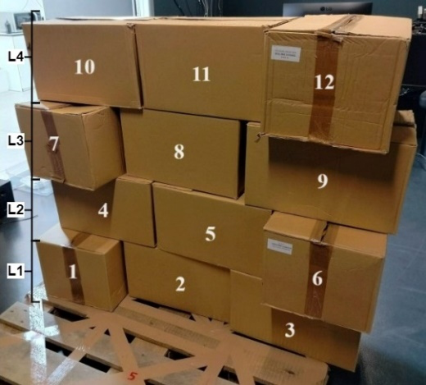
This preliminary study was intended to analyse the impact of a passive exoskeleton for lumbar support (Laevo V2), on different subjects, specifi- cally the variation of physiological parameters and the pressure of the feet to the ground, during the execution of a lifting task. To do this, a task was created to simulate a palletizing activity that consisted of the lifting of 12 cardboard boxes (dimensions 44 × 31.5 x 28.5 cm) each weighing 15 kg grabbing them from the bottom. The boxes that were originally placed on a Euro pallet (at a height of 14.4 cm) have been lifted and carried for 2 m from the pick-up point until the deposit point on another Euro pallet. The boxes are deposited to form 4 levels, of 3 boxes each, following a specific deposition scheme, aimed at simulating a typical palletizing mode, then going to deposit the carton first in position 1, then 2 and 3, and in the next level reverse the arrangement of the last box (Figure 1). The height of the hands of the users at the deposition was 14.4 cm (first level, L1), 42.9 cm (second level, L2), 71.4 cm (third level, L3) and 99.9 cm (fourth level, L4).
Figure 1: Scheme and sequence of deposit of the boxes on the four levels (L1, L2, L3, L4) on the pallet.
FlexInFit sensor baropodometric insoles were used to collect the data on the distribution patterns of the pressure of the feet to the ground (FlexInFit, 2023). Each insole contains 214 sensors. The insoles were placed inside the subjects’ shoes and connected via Bluetooth to a personal computer. Data from the insoles were then processed with the FreeStep software developed by Sensor Medica for biomechanical analysis of posture, movement, and foot support (FreeStep, 2023). In addition, a pulse oximeter (Karaeas, Model: YK011) was used to measure blood oxygen and heart rate.
Table 1. Demographic and anthropometric data.
Table available in the original PDF paper.
Data collected Mean (SD) Min Max Age [years] 26.7 (1.5) 25.0 29.0 Weight [kg] 74.8 (6.0) 70.0 86.0 Foot size [EU] 42.8 (1.5) 41.0 45.0 Height [cm] 179.3 (5.3) 171.0 184.0
The study involved a panel of 6 participants (all males), who took part voluntarily in the experiment. The subjects were mainly researchers and PhD students from the Department of Engineering “Enzo Ferrari” of the Univer- sity of Modena and Reggio Emilia, in Italy. Table 1 shows the average values and Standard Deviation (SD) of age, weight, height, and foot size of the sub- jects involved in the study. After an exhaustive initial explanation of the task and the purpose of the study to the subjects, a numeric code was assigned to every one of them to ensure the data anonymity, and anthropometric data, heart rate, and blood oxygen saturation values were collected in resting and sitting conditions. Next, the subjects wore the FlexInFit insoles Bluetooth connected to the PC running the software, and after the execution of an off- set to reset the residual pressures, the task started running. After wearing the exoskeleton and fitting it on his body, each user was asked to perform simple actions to familiarize himself with the exoskeleton such as walking, bending the knees, leaning forward from the hip by pointing the hands towards the feet and tilting forward obliquely by stretching the arms forward. All the sub- jects were trained to the correct execution of the task, that was maintaining the box as close as possible to the body and avoiding rotations of the trunk during the lifting movement. After depositing 3 boxes, i.e., when a level is completed, the user must return to the starting position, the pressure record- ing is interrupted and the analysis of the pressure of the feet to the ground is collected. Then, the user picked a box and started a new level on the pallet. Four levels (L1, L2, L3 and L4) were completed during each task. At the end of the task, the heart rate and blood oxygen saturation values were collected again, and the subjects were asked to fill in a questionnaire. The question- naire consisted of three sections. The first section aimed to collect data on the variation of the effort perceived during the execution of the task, using the Borg’s scale (Borg, 1998). The second section used the Likert scale (Albert & Tullis, 2023) to collect the judgements of the users on the usability of the exoskeleton. Finally, the third section investigated the pressure perceived by the subjects in different body districts, i.e., shoulders, chest, pelvis, thighs, back, using the Locally Perceived Pressures (LPP) proposed in (Grinten & Smitt, 1992).
Each subject performed the task twice, i.e., the first time without and the second time with exoskeleton support. The panel was divided into two equal groups: one group performed the task first without and after with exoskeleton aid, other group performed the task first with and after without exoskeleton aid. The time between the two tasks was variable. Indeed, each subject started the second task when the heart rate and blood oxygen satu- ration returned to the values observed during the resting condition. Before
Exoskeletons in Action: The Impact of Exoskeletons on Human Factors 15
performing the task with the exoskeleton, the subjects were assisted in wear- ing and adjusting the device, based on the indications in the manufacturer’s manual, adjusting the angle of inclination to the position most appropriate for the individual user. The same exoskeleton torso structure size was used for all the subjects (size M, Laevo).
RESULTS AND DISCUSSION
The parameters investigated in this study are the pressure of the feet to the ground, differences in two physiological parameters such as blood oxygen level and heart rate. In addition, general perceptions of comfort and usability were evaluated.
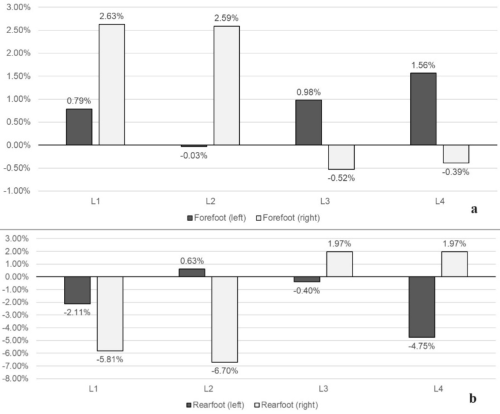
Figure 2 shows the average values of the percentage changes in the distri- butions of the pressures on both the forefoot (Figure 2a) and on the rear foot (Figure 2b) between the tasks performed with and without the exoskeleton aid. The values were calculated separately for each level of boxes on the pallet (L1-L4). Figure 2 positive values refer to the condition in which, on average, the percentage of distribution in an area in the test carried out wearing the exoskeleton is higher than the values collected during the test without the exoskeleton. The average pressure on the forefoot increased during the task with the exoskeleton when the users deposited the boxes on L1 and L2. The maximum percentage variation was 2.63% on the right foot in L1. Also, the average pressure on the right forefoot decreased when the subjects deposited the boxes on L3 and L4. The average pressure on the rearfoot decreased in L1 and L2 during the task with the exoskeleton. Specifically, the minimum decrease was -6.70% on the right rearfoot in L2. Generally, for both forefoot and rearfoot, there have been increments or decrements of bigger percentage variations for L1 and L2.
Figure 2: Variation of the pressures of the forefoot (top, a) and rearfoot (bottom, b), for different deposition levels (L1, L2, L3, L4).
This could be caused by the low height of deposition for L1 and L2 since users tend to move their centre of gravity forward by loading more on the forefoot to deposit boxes in L1 and L2. The presence of the exoskeleton would seem to lead to a slight increase in this trend in lifting mode. Data on the physiological parameters show no significant variation in the blood oxygen saturation of subjects after the execution of the task manually and with the exoskeleton (Table 2). On the other hand, significant variations were recorded in the heart rate.
Table 2. Oxygen blood saturation for the six users at rest condition, after the test without exoskeleton and after the test with exoskeleton.
Table available in the original PDF paper.
Oxygen blood saturation User ID At rest Without exoskeleton With exoskeleton
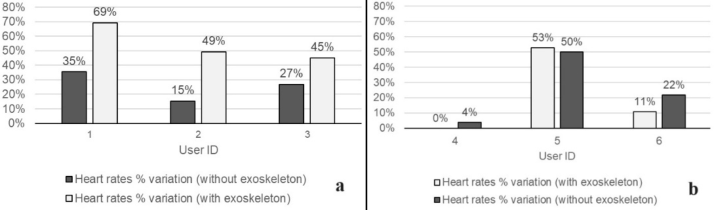
Figure 3 shows the percentage differences in heart rate observed concern- ing the resting condition for the six test participants under the conditions wearing or not the exoskeleton. Figure 3a represents the heart rate percent- age variation for the three users who performed the first of the two tests without wearing the exoskeleton. Vice versa, Figure 3b shows the heart rate percentage variation for the three users who performed the first test wearing the exoskeleton.
Figure 3: Heart rates percentage variation compared with the rest condition. (a) Heart rates percentage variation for users who performed the first of the two tests with- out wearing the exoskeleton, (b) the heart rates percentage variation for users who performed the first test wearing the exoskeleton.
Exoskeletons in Action: The Impact of Exoskeletons on Human Factors 17
For the first three subjects (Figure 3a) there was a maximum increasing variation of 35% during the test without wearing the exoskeleton and a max- imum variation of 69% wearing it. All results regarding the three tests show a major variation in the condition of wearing the exoskeleton. For the other subjects, the maximum variation recorded was 50% during the test not wear- ing the exoskeleton and 53% for the test with exoskeleton aid (Figure 3b). These data suggest an increase in heart rate in the tests carried out with the use of the exoskeleton occurred in 67% of the subjects however the order of execution of the two tests, with and without exoskeleton aid, seems to affect the results. Moreover, the lifting frequency rate, which has not been measured, may have affected the test results in the tests with and without exoskeleton and affected the variation in the heart rate.
Finally, questionnaires revealed that all users already knew the exoskeleton technology, but only 33% of them had declared used it before.
Table 3. Average values of perceived effort scores in different actions.
Table available in the original PDF paper.
Question Indicate on a scale from 0 to 10 (in 0 “zero stress” and 10 “extremely heavy stress”) the perceived value in each of the following situations WITHOUT the aid of the exoskeleton.
Situation Upright position Walking Squat Lifting load Mean 0.2 3.5 4.5 5.0 Question Indicate on a scale from 0 to 10 (in 0 “zero stress” and 10 “extremely heavy stress”) the perceived value in each of the following situations WITH the aid of the exoskeleton.
Situation Upright position Walking Squat Lifting load Mean 1.3 3.7 3.2 3.2
Table 3 shows the scores recorded by a Borg scale of the effort perceived during the execution of different actions wearing or not the exoskeleton. In maintaining the upright position, the subjects expressed an average score of 0.2 for the condition of not wearing the exoskeleton, while an average score of 1.3 wearing the exoskeleton. The effort in the walking action was given an average score of 3.5 not wearing the exoskeleton and 3.7 while wearing it. The squat actions were evaluated on average with a score of 4.5 not wear- ing the exoskeleton and 3.2 while wearing it. Finally, the load-lifting action stress perceived was evaluated with a value of 5.0 not wearing the exoskele- ton and 3.2 while wearing it. These data show that the perceived effort to perform squats and load lifting actions decreases wearing the exoskeleton, while the effort felt during the walk remained essentially the same and the effort in the upright position increased slightly. Subjects found the device to be sufficiently comfortable and easy to use on average with Likert’s scores of 2.7 and 3.7 although they found, with an average score of 3.3, that the device was an obstacle in some movements during the performance of the tasks.
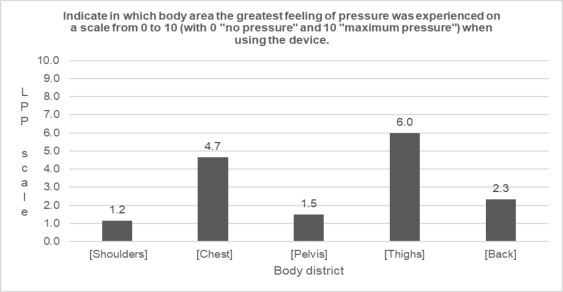
Figure 4: Means values of LPP scale for the different body district.
Figure 4 shows the results of the evaluation of local pressures perceived on the LPP scale. In particular, the highest average perceived pressure was detected on the thighs, this is due to the presence of the leg bearings, with the value of 6.0. Furthermore, the perceived pressure was higher on the chest, where there was the presence of chest support in the sternal area, with an average value of 4.7. The other areas of contact such as the back, pelvis, and shoulders have recorded lower perceived pressures, with values of 2.3, 1.5, and 1.2, respectively. From these values, it is possible to assume that the body areas on which this exoskeleton (Laevo V2), acts most during use are the thighs and the chest.
CONCLUSION
This paper discussed our studies regarding the effects of a passive exoskele- ton for back support while performing manual material handling. The study involved six participants who were asked to perform a manual palletizing task, wearing and not an occupational exoskeleton. The parameters investi- gated in this study were: the pressure of the forefoot and the rearfoot to the ground, and the variation of the users’ physiological parameters, such as the blood oxygen saturation and the heart rate. In addition, perceptions about the exoskeleton’s comfort and usability and the perceptions of the pressure exerted by the exoskeleton on different body districts were collected. Results suggest that the exoskeleton impacts the pressure of the feet to the ground when performing manual material handling. However, further research is needed to understand this phenomenon, also expanding the sample of users. The results from the analysis of the physiological parameters suggest that task execution wearing the exoskeleton determines an increase in the heart rate. However, these data may also have been influenced by the different lifting frequency rates, which have not been measured, wearing or not the exoskele- ton, and could be partly related to the sequence of execution of the two tests (with and without wearing the exoskeleton). Finally, user perceptions obtained from the questionnaires, show that they perceived useful exoskele- ton aid during the execution of the lifting movements. However, although
Exoskeletons in Action: The Impact of Exoskeletons on Human Factors 19
easy to use, users also highlighted that they felt limited during some move- ments, such as squatting, walking, and bending. Data on the perceptions of the contact pressures of the exoskeleton on the body show that the two areas most involved are the thighs and chest in the sternal area. Future develop- ments of this study will further investigate the benefits and limitations of wearing exoskeletons at work. By expanding the sample of users, it will be possible to obtain a more representative data set and to further investigate the interaction of the exoskeleton with the body, it will be possible to mea- sure the pressures exerted by the exoskeleton in the two areas that have been indicated as the most critical. Finally, the postures adopted by users during the task execution will be investigated to evaluate any changes induced by the exoskeleton in both the static and the dynamic postures.
ACKNOWLEDGMENT
Partial support for this research was provided by: the Department of Indus- trial Engineering “Enzo Ferrari” (DIEF) of the University of Modena and Reggio Emilia, through the following fund “FAR2022DIP_DIEF - Fondo di Ateneo per la Ricerca 2022 per il finanziamento di piani di sviluppo dipartimentale nell’ambito della ricerca” Prot. n. 2985 del 27/07/2022; the University of Modena and Reggio Emilia, through the fund “FAR2022ATTR - Fondo di Ateneo per la Ricerca 2022 per il finanziamento di attrezza- ture”, Decreto rettorale n. 835/2022 Prot. 193214 del 25/07/2022; the Fondazione di Modena and the University of Modena and Reggio Emilia through the fund “Finanziamento FAR2023 FOMO per progetti di ricerca interdisciplinari_FAR PROGETTI con codice FAR2023_FOMO_FAR PRO- GETTI”, CUP E93C23002110007, which supports the project “ERGOEXO - Investigating occupational exoskeletons and supporting the adoption of the ergonomic approach in the design of workplaces and work activities”. The authors are grateful for this support.
REFERENCES
Albert, W. (Bill), & Tullis, T. S. (Tom). (2023). Self-Reported Metrics. Measuring the User Experience, 109–151. https://doi.org/10.1016/B978-0-12-818080- 8.00005-4 Ashta, G., Finco, S., Battini, D., & Persona, A. (2023). Passive Exoskeletons
to Enhance Workforce Sustainability: Literature Review and Future Research Agenda. In Sustainability (Switzerland) (Vol. 15, Issue 9). MDPI. https://doi.or g/10.3390/su15097339 Borg, G. (1998). Borg’s Perceived Exertion And Pain Scales. In Human Kinetics. Botti, L., & Melloni, R. (2023). Occupational Exoskeletons: Understand- ing the Impact on Workers and Suggesting Guidelines for Practitioners and Future Research Needs. Applied Sciences, 14(1), 84. https://doi.org/10.3390/ap p14010084 Botti, L., Melloni, R., Oliva, M., Perini, M., & Bacchetta, A. P. (2023). Exoskeletons to Support Manual Material Handling at Work: A Preliminary Study. Lecture Notes in Mechanical Engineering, 833–841. https://doi.org/10.1007/978-3-031- 34821-1_91
Botti, L., Paolo Bacchetta, A., Oliva, M., & Melloni, R. (2023). Exoskeletons at work: opportunities, suggestions for implementation and future research needs. Human Aspects of Advanced Manufacturing, 80. https://doi.org/10.54941/ahfe 1003510 Cardoso, A., Colim, A., & Sousa, N. (2020). The Effects of a Passive Exoskeleton
on Muscle Activity and Discomfort in Industrial Tasks. In P. M. Arezes, J. S. Bap- tista, M. P. Barroso, P. Carneiro, P. Cordeiro, N. Costa, R. B. Melo, A. S. Miguel, & G. Perestrelo (Eds.), Occupational and Environmental Safety and Health II (pp. 237–245). Springer International Publishing. https://doi.org/10.1007/978-3- 030-41486-3_26 De Bock, S., Ghillebert, J., Govaerts, R., Tassignon, B., Rodriguez-Guerrero, C., Crea, S., Veneman, J., Geeroms, J., Meeusen, R., & De Pauw, K. (2022). Bench- marking occupational exoskeletons: An evidence mapping systematic review. In Applied Ergonomics (Vol. 98). Elsevier Ltd. https://doi.org/10.1016/j.apergo .2021.103582 de Looze, M. P., Bosch, T., Krause, F., Stadler, K. S., & O’Sullivan, L. W. (2016).
Exoskeletons for industrial application and their potential effects on physical work load. In Ergonomics (Vol. 59, Issue 5, pp. 671–681). Taylor and Francis Ltd. https://doi.org/10.1080/00140139.2015.1081988 FlexInFit. (2023). https://www.sensormedica.com/it/flexinfit/ FreeStep. (2023). https://www.sensormedica.com/it/freestep/ Grinten, M. P. vd, & Smitt, P. (1992). Development of a practical method for measuring body part discomfort. Advances in Industrial Egonomics and Safety IV, 318–331. HSE: Work-related musculoskeletal disorders statistics in Great Britain, 2023.
(2023). https://www.hse.gov.uk/statistics/assets/docs/msd.pdf Madinei, S., Alemi, M. M., Kim, S., Srinivasan, D., & Nussbaum, M. A.
(2020a). Biomechanical assessment of two back-support exoskeletons in symmet- ric and asymmetric repetitive lifting with moderate postural demands. Applied Ergonomics, 88. https://doi.org/10.1016/j.apergo.2020.103156 Madinei, S., Alemi, M. M., Kim, S., Srinivasan, D., & Nussbaum, M. A.
(2020b). Biomechanical assessment of two back-support exoskeletons in symmet- ric and asymmetric repetitive lifting with moderate postural demands. Applied Ergonomics, 88. https://doi.org/10.1016/j.apergo.2020.103156 Pacifico, I., Parri, A., Taglione, S., Sabatini, A. M., Violante, F. S., Molteni, F., Giovacchini, F., Vitiello, N., & Crea, S. (2022). Exoskeletons for workers: A case series study in an enclosures production line. Applied Ergonomics, 101. https://doi.org/10.1016/j.apergo.2022.103679 Spada, S., Ghibaudo, L., Carnazzo, C., Gastaldi, L., & Cavatorta, M. P. (2019).
Passive Upper Limb Exoskeletons: An Experimental Campaign with Workers. In S. Bagnara, R. Tartaglia, S. Albolino, T. Alexander, & Y. Fujita (Eds.), Proceedings of the 20th Congress of the International Ergonomics Association (IEA 2018) (pp. 230–239). Springer International Publishing. Steinhilber, B., Seibt, R., Rieger, M. A., & Luger, T. (2020). Postural Control When Using an Industrial Lower Limb Exoskeleton: Impact of Reaching for a Working Tool and External Perturbation. von Glinski, A., Yilmaz, E., Mrotzek, S., Marek, E., Jettkant, B., Brinkemper, A.,
Fisahn, C., Schildhauer, T. A., & Geßmann, J. (2019). Effectiveness of an on-body lifting aid (HAL® for care support) to reduce lower back muscle activity during repetitive lifting tasks. Journal of Clinical Neuroscience, 63, 249–255. https://do i.org/10.1016/j.jocn.2019.01.038
Exoskeletons in Action: The Impact of Exoskeletons on Human Factors 21
Wang, H. M., Le, D. K. L., & Lin, W. C. (2021). Evaluation of a passive upper-limb exoskeleton applied to assist farming activities in fruit orchards. Applied Sciences (Switzerland), 11(2), 1–14. https://doi.org/10.3390/app11020757 Young, A. J., & Ferris, D. P. (2017). State of the art and future directions for
lower limb robotic exoskeletons. IEEE Transactions on Neural Systems and Reha- bilitation Engineering, 25(2), 171–182. https://doi.org/10.1109/TNSRE.2016. 2521160
LISTED IN THE AHFE DIGITAL BOOKSTORE CATALOGUE
Explore the complete digital volume
Human Aspects of Advanced Manufacturing, Production Management and Process Control
Read this individual research paper free through the original publisher, or explore the full digital proceedings book.
ISBN 978-1-964867-22-9
Explore this ISBN in the AHFE Bookstore ↗Listed in the July 2026 bookstore catalogue; search by ISBN to confirm current availability · Digital book purchase optional