Fatemeh Davoudi Kakhki, Armin Moghadam (2024). Comparative user feedback on the efficacy of a back-support exoskeleton in industrial settings. In: Human Factors in Design, Engineering, and Computing. AHFE Open Access, vol. 159, pp. 805–813. https://doi.org/10.54941/ahfe1005647
Work-related musculoskeletal disorders (WMSDs) are prevalent in industrial settings, particularly affecting the lower back, shoulders, and knees. Exoskeletons show promise in reducing WMSDs, though their effectiveness varies by user demographics. This study investigates the impact of a passive back-support exoskeleton on perceived physical exertion (PPE) during lifting and carrying tasks, with a focus on gender-specific responses. Twenty-two participants rated their PPE under two conditions: with and without the exoskeleton. Results indicate that exoskeleton use significantly reduces perceived exertion, especially for female participants. These findings highlight the importance of gender-specific considerations in the design and optimization of exoskeletons for improving ergonomic outcomes across diverse user groups.
In industrial settings, Work-related musculoskeletal disorders (WMSDs) are associate with 27.8% of occupational injuries, often leading to injuries in the lower back, shoulders, and knees (Reyes, Shuo and Yu, 2023). Occupational injuries affect employees’ well-being(Kakhki, Freeman and Mosher, 2019; Yang, Park and Jeong, 2020), and place heavy financial pressures on workers, businesses, insurance companies and healthcare systems (Davoudi Kakhki, Freeman and Mosher, 2019). WMSDs, especially back issues from biomechanical overload and strain, impact personal health and have major economic and social burdens (Lazzaroni et al., 2020).
Regarding manual material handling tasks such as lifting and carrying, previous studies have shown that back-supporting exoskeletons (BSEs) are effective in reducing rate of perceived physical exertion (Alemi et al., 2020; Madinei et al., 2020a, 2020b; Golabchi, Chao and Tavakoli, 2022; Golabchi et al., 2023; Davoudi Kakhki et al., 2024). Despite the usefulness of the exoskeletons, they are not yet fully incorporated in occupational settings due to several challenges. Research on BSEs identified that the acceptance of industrial exoskeletons is dependent on factors such as wearing comfort and
perceived usefulness (Elprama, Vanderborght and Jacobs, 2022). In addition, studies suggest that customizable exoskeletons, tailored to individual users, may be more effective than standardized models (Farris et al., 2023). While assistive technologies like exoskeletons hold promise in mitigating the high incidence of WMSDs, there is lack of research focusing on the thorough evaluation of exoskeletons, which is essential to ensure their successful and effective implementation in industrial occupational settings (Antwi-Afari et al., 2021; Golabchi et al., 2022).
To address this, focused research is needed to investigate challenges and benefits of passive exoskeletons, particularly from the perspective of end users. Integrating insights gained from users perspectives into the design improvement of exoskeletons can result in better alignment with the needs of users, their tasks, and work environments (Kozinc et al., 2020, 2021; Elprama, Vanderborght and Jacobs, 2022). This alignment has the potential to drive widespread adoption of exoskeletons in industrial settings.
This study aims to evaluate the gender-specific effects of a back-supporting exoskeleton on perceived physical exertion (PPE) during lifting and carrying tasks in industrial settings. The study also assesses users’ experience with the exoskeleton’s features. By examining PPE differences between males and females and their interaction with the exoskeleton, the study seeks to offer insights that could be used for optimizing exoskeleton design to improve safety, comfort and effectiveness. Ultimately, this could help reduce WMSDs and enhance occupational ergonomics.
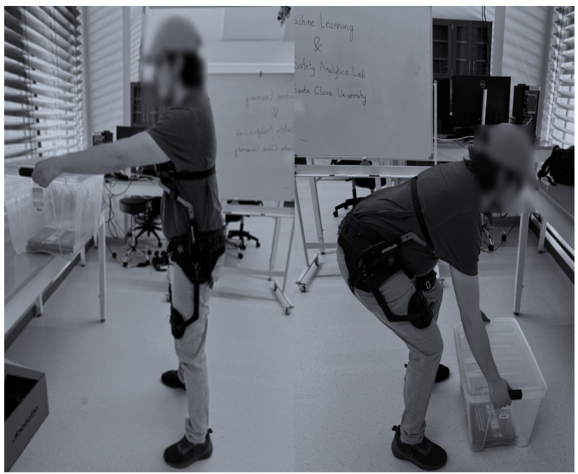
EXPERIMENTAL APPROACH The study was conducted in accordance with the Declaration of Helsinki and received approval from the Institutional Review Board and the Office of Research Compliance and Integrity at Santa Clara University (Approval No: 23-11-2076). Informed consent was obtained from all participants before they participated in the research. The goal of this study is to assess the impact of an occupational passive back-supporting exoskeleton on perceived physical exertion (PPE) during lifting and carrying tasks. To that end, twenty-two healthy college students (12 females and 10 males) with no musculoskeletal disorders participated in our experiment. The participants completed tasks such as lifting, and carrying a 7 kg box in two sessions: one with the exoskeleton and one without. An overview of a participant wearing the BSE while completing the lifting and carrying the box task is illustrated in Figure 1.
PPE was measured using the Borg CR10 scale (Williams, 2017; Frasie et al., 2024) where 0 represents no exertion and 10 shows maximum exertion rated by participants describing their experience with the exoskeleton. The participants also completed a survey questionnaire on various features of the exoskeleton, as described in (Maurice et al., 2020). The Ottobock BackX exoskeleton, suitable for industrial applications, was used. It was customized to fit each participant, who also received an orientation session. Descriptive statistical methods were used to analyze the data, providing critical insights for ergonomic improvements and enhancing occupational health and safety.
Comparative User Feedback on the Efficacy of a Back-Support Exoskeleton 807
Figure 1: Participant wearing the BSE during lifting and carrying tasks.
RESULTS AND DISCUSSION
To to ensure maximum effectiveness and user satisfaction across all demographics, the BORG scores and survey results were analysed. The purpose was to provide insights on gender-specific variations in user evaluation of the BSE. The results can provide insights on the importance of considering gender-specific needs in the design and training programs for exoskeletons.
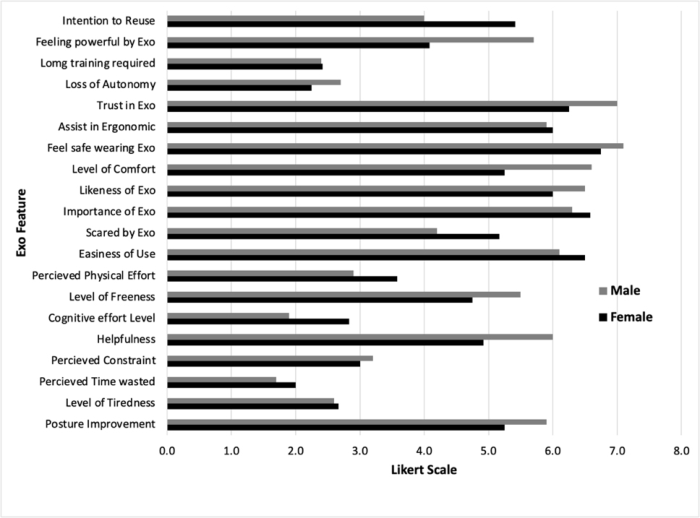
Gender-Specific User Experience With BSE The comparative results of ratings of user experience during interaction with the BSE in the lifting and carrying tasks are shown in Figure 2. Both genders reported similar levels for certain features. For instance, the level of comfort was rated 5.3 by males and 5.25 by females, and the perceived time wasted was 1.7 for males and 2.0 for females. Both genders also rated perceived constraint similarly, with males at 2.9 and females at 3.0, and the level of tiredness with males at 2.6 and females at 2.67. These similarities suggest that the basic functionality and usability of the exoskeleton are universally perceived regardless of gender.
Differences were observed in several features. Females rated the helpfulness of the exoskeleton higher (4.92) compared to males (4.10). Females also reported higher levels of perceived physical effort (3.58) and cognitive effort (2.83) compared to males, who rated these at 3.10 and 2.10, respectively. Trust in the exoskeleton was higher among females (6.25) compared to males (5.30), as was feeling safe while wearing it, with females rating it at 6.75 and males at 6.10. Conversely, males felt more powerful wearing the exoskeleton
808 Kakhki and Moghadam
(5.70) compared to females (4.08) and believed less in the necessity of long training to use it effectively, with males scoring this feature at 3.20 and females at 2.42. The most notable patterns include the significantly higher ratings by females for features like trust in the exoskeleton (6.25 for females vs. 5.30 for males), helpfulness (4.92 for females vs. 4.10 for males), and safety (6.75 for females vs. 6.10 for males). This indicates that while females might find the exoskeleton more demanding in terms of physical (3.58 for females vs. 3.10 for males), they also perceive greater overall benefits and reliability. Males, on the other hand, show a tendency to feel more empowered (5.70 for males vs. 4.08 for females) by the exoskeleton and less constrained by its usage (2.90 for males vs. 3.00 for females), highlighting a difference in how each gender interacts with and benefits from the technology.
Figure 2: Gender-specific evaluation of interaction with the BSE.
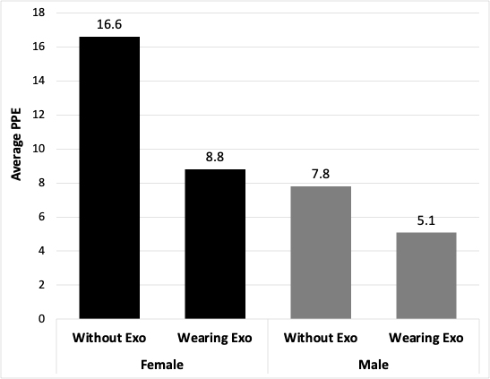
Perceived Physical Exertion With and Without BSE In the lifting task (Figure 3), the average PPE scores for male and female participants were measured both with and without a back-supporting exoskeleton. Female participants showed a significant reduction in exertion, with an average PPE of 16.6 without the exoskeleton dropping to 8.8 with it. Male participants also experienced a decrease, with their average PPE reducing from 7.8 without the exoskeleton to 5.1 when wearing it. The greater reduction in females suggests that the exoskeleton has a more substantial impact on reducing physical exertion for female participants compared to males. The results of the t-test, as shown in Table 1, indicate
Comparative User Feedback on the Efficacy of a Back-Support Exoskeleton 809
a statistically significant difference for females (t = 2.98, p = 0.010) when comparing the PPE scores with and without the exoskeleton. However, for males, the difference was not statistically significant (t = 1.10, p = 0.29).
Figure 3: PPE comparison between male and female participants for lifting the box.Table 1. T-Test for lifting based on gender and Exo condition.
Table available in the original PDF paper.
Comparison t-statistic p-value Female (Without Exo vs Wearing Exo) 2.98 0.010 Male (Without Exo vs Wearing Exo) 1.10 0.29
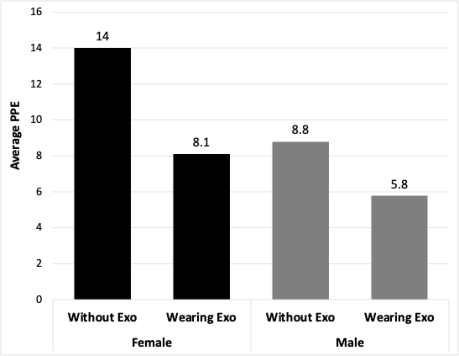
The comparison of average PPE during this task based on BSE reveals significant differences, particularly in certain body parts. For females, the most impacted areas included the lower back, where the average PPE reduced from 29.0 (Without Exo) to 15.0 (Exo), the knees from 16.5 to 10.0, and the wrist from 12.0 to 6.5. Similarly, for males, the lower back showed a reduction in PPE from 11.0 (Without Exo) to 5.5 (Exo), the knees from 8.5 to 4.5, and the wrist from 5.0 to 2.5. These reductions indicate that the exoskeleton is particularly effective in alleviating exertion in these key areas, with females experiencing a more pronounced benefit due to generally higher initial exertion levels without the exoskeleton. In contrast, the least impacted body parts for females included the ankle, with PPE reducing from 7.0 (Without Exo) to 3.5 (Exo), the feet from 5.5 to 2.5, and the elbow from 7.0 to 3.0. For males, the ankle showed a reduction from 3.5 (Without Exo) to 1.5 (Exo), the feet from 5.0 to 2.5, and the elbow from 4.5 to 2.0. While these reductions are still significant, they are less pronounced compared to the more heavily impacted areas. The results demonstrate that while the exoskeleton effectively reduces perceived exertion across all body parts, its impact varies, with some regions experiencing greater relief than others. Male participants showed a reduction from an average PPE of 8.8 without the exoskeleton
810 Kakhki and Moghadam
to 5.8 with it. Both genders experienced a notable decrease in perceived exertion with the exoskeleton, with the reduction being more pronounced in females. This indicates that the back-supporting exoskeleton effectively lowers physical exertion for both male and female participants, with a more significant impact observed in females during the carrying task. The results of the t-test, as shown in Table 2, indicate a statistically significant difference for females (t = 2.38, p = 0.032) when comparing the PPE scores with and without the exoskeleton. However, for males, the difference was not statistically significant (t = 1.12, p = 0.28).
For the carrying task (Figure 4), female participants reported an average PPE of 14 without the exoskeleton, which significantly decreased to 8.1 when wearing it. For the carrying tasks for female participants, the most impacted areas included the knees, where the average PPE reduced from 17.0 (without Exo) to 10.0 (Exo), the shoulder from 22.0 to 8.0, and the neck from 12.0 to 3.0. Similarly, for males, the neck showed a reduction in PPE from 11.0 (without Exo) to 1.0 (Exo), the shoulder from 12.0 to 4.0, and the lower back from 13.0 to 14.0 (indicating an unusual increase in PPE with the exoskeleton). These reductions indicate that the exoskeleton is particularly effective in alleviating exertion in these key areas, with females experiencing a more pronounced benefit due to generally higher initial exertion levels without the exoskeleton.
Figure 4: PPE comparison between male and female participants for carrying the box.Table 2. T-Test for carrying based on gender and exo condition.
Table available in the original PDF paper.
Comparison t-statistic p-value Female (Without Exo vs Wearing Exo) 2.38 0.032 Male (Without Exo vs Wearing Exo) 1.12 0.28
In contrast, the least impacted body parts for females included the lower back, with PPE remaining relatively stable at 27.0 (without Exo) to 26.0 (Exo), the feet from 7.0 to 5.0, and the elbow from 8.0 to 3.0. For males,
Comparative User Feedback on the Efficacy of a Back-Support Exoskeleton 811
the ankle showed an unusual increase in PPE from 2.0 (without Exo) to 5.0 (Exo), the feet remained stable at 4.0, and the elbow decreased from 6.0 to 2.0. While these reductions are still significant, they are less pronounced compared to the more heavily impacted areas. The results demonstrate that while the exoskeleton effectively reduces perceived exertion across all body parts, its impact varies, with some regions experiencing greater relief than others.
Applications in Occupational Ergonomics The results highlight the critical role of gender-specific user experience and ergonomic evaluation in the design and implementation of BSEs in industrial settings. Given the significant differences observed in PPE between males and females during lifting and carrying tasks, it is clear that a one-size-fits-all approach to exoskeleton design is insufficient. This research demonstrates that females generally benefit more from the use of exoskeletons, experiencing greater reductions in PPE across various body parts. The implementation of gender-specific ergonomic evaluations can lead to substantial improvements in safety practices and occupational ergonomics, particularly in industries where lifting and carrying are crucial tasks. By tailoring exoskeleton designs to meet the distinct needs of male and female workers, companies can enhance the overall effectiveness of these devices, thereby reducing the incidence of WMSDs.
The significant reduction in PPE for females (from 16.6 without Exo to 8.8 with Exo) compared to males (from 7.8 without Exo to 5.1 with Exo) underscores the necessity for gender-specific design enhancements. Females experienced pronounced benefits in the lower back, knees, and wrists, areas which are critical for lifting tasks. Ensuring that exoskeletons provide targeted support in these regions can help in mitigating the higher initial exertion levels reported by females.
For carrying tasks, the PPE reduction was also more significant for females (from 14 without Exo to 8.1 with Exo) than for males (from 8.8 without Exo to 5.8 with Exo). The t-test results confirmed significant differences for females in both lifting (t = 2.98, p = 0.010) and carrying (t = 2.38, p = 0.032) tasks, while males did not show statistically significant differences. This highlights the need for BSEs to be designed with a focus on reducing exertion in the knees, shoulders, and neck for female workers during carrying tasks.
Customized exoskeleton designs should be considered by manufacturers, with adjustable features that cater to the specific anatomical and physiological differences between genders. For instance, adjustable support mechanisms for the lower back, knees, and wrists for females can enhance comfort and reduce exertion more effectively. Implementing training programs that educate workers on the optimal use of exoskeletons can ensure that both males and females maximize the benefits of these devices. Training should include guidance on adjusting the exoskeleton to fit different body types and tasks. Regular ergonomic assessments should be conducted to evaluate the impact of exoskeletons on worker safety and comfort. These
812 Kakhki and Moghadam
assessments can help identify any gender-specific issues and guide further improvements in exoskeleton design and usage. Companies should develop policies that mandate the use of ergonomically evaluated exoskeletons, especially for tasks that involve heavy loads.
CONCLUSION
The study found that back-supporting exoskeletons significantly reduced perceived physical exertion for both males and females during lifting and carrying tasks, with a more pronounced effect observed in females. Specifically, females experienced greater reductions in perceived physical exertion for across key body parts such as the lower back, knees, and wrists during lifting tasks, and the knees, shoulders, and neck during carrying tasks. These results emphasize the importance of gender-specific ergonomic evaluations in optimizing exoskeleton designs to enhance occupational safety and comfort.
REFERENCES
Alemi, M. M. et al. (2020) ‘Effects of Two Passive Back-Support Exoskeletons on Muscle Activity, Energy Expenditure, and Subjective Assessments During Repetitive Lifting’, Human Factors, 62(3), pp. 458–474. Available at: https: //doi.org/10.1177/0018720819897669. Antwi-Afari, M. F. et al. (2021) ‘Assessment of a passive exoskeleton system on spinal
biomechanics and subjective responses during manual repetitive handling tasks among construction workers’, Safety Science, 142. Available at: https://doi.org/ 10.1016/j.ssci.2021.105382. Davoudi Kakhki, F. et al. (2024) ‘Evaluating the Efficacy of a Passive Exoskeleton for Enhancing Ergonomics in Manufacturing’, Applied Sciences, 14(13), p. 5810. Available at: https://doi.org/10.3390/app14135810. Davoudi Kakhki, F., Freeman, S. A. and Mosher, G. A. (2019) ‘Evaluating machine
learning performance in predicting injury severity in agribusiness industries’, Safety Science, 117, pp. 257–262. Available at: https://doi.org/10.1016/j.ssci .2019.04.026. Elprama, S. A., Vanderborght, B. and Jacobs, A. (2022) ‘An industrial exoskeleton user acceptance framework based on a literature review of empirical studies’, Applied Ergonomics, 100. Available at: https://doi.org/10.1016/j.apergo.2021. 103615. Farris, D. J. et al. (2023) ‘A systematic literature review of evidence for the use of
assistive exoskeletons in defence and security use cases’, Ergonomics. Taylor and Francis Ltd., pp. 61–87. Available at: https://doi.org/10.1080/00140139.2022. 2059106. Frasie, A. et al. (2024) ‘Validation of the Borg CR10 Scale for the evaluation of shoulder perceived fatigue during work-related tasks’, Applied Ergonomics, 116. Available at: https://doi.org/10.1016/j.apergo.2023.104200. Golabchi, A. et al. (2022) ‘Impact of Passive Back-Support Exoskeletons on
Manual Material Handling Postures in Construction’, in Proceedings of the International Symposium on Automation and Robotics in Construction. International Association for Automation and Robotics in Construction (IAARC), pp. 359–366. Available at: https://doi.org/10.22260/isarc2022/0050.
Comparative User Feedback on the Efficacy of a Back-Support Exoskeleton 813
Golabchi, A. et al. (2023) ‘Performance and effectiveness of a passive back-support exoskeleton in manual material handling tasks in the construction industry’, Construction Robotics, 7(1), pp. 77–88. Available at: https://doi.org/10.1007/ s41693-023-00097-4. Golabchi, A., Chao, A. and Tavakoli, M. (2022) ‘A Systematic Review of Industrial
Exoskeletons for Injury Prevention: Efficacy Evaluation Metrics, Target Tasks, and Supported Body Postures’, Sensors. MDPI. Available at: https://doi.org/10. 3390/s22072714. Kakhki, F. D., Freeman, S. A. and Mosher, G. A. (2019) ‘Use of neural networks to identify safety prevention priorities in agro-manufacturing operations within commercial grain elevators’, Applied Sciences (Switzerland), 9(21). Available at: https://doi.org/10.3390/app9214690. Kozinc, Ž. et al. (2020) ‘Reliability of a battery of tests for functional evaluation
of trunk exoskeletons’, Applied Ergonomics, 86. Available at: https://doi.org/10. 1016/j.apergo.2020.103117. Kozinc, Ž. et al. (2021) ‘Short-Term Effects of a Passive Spinal Exoskeleton on Functional Performance, Discomfort and User Satisfaction in Patients with Low Back Pain’, Journal of Occupational Rehabilitation, 31(1), pp. 142–152. Available at: https://doi.org/10.1007/s10926-020-09899-7. Lazzaroni, M. et al. (2020) ‘Evaluation of an acceleration-based assistive strategy
to control a back-support exoskeleton for manual material handling’, Wearable Technologies, 1. Available at: https://doi.org/10.1017/wtc.2020.8. Madinei, S. et al. (2020a) ‘Biomechanical assessment of two back-support exoskeletons in symmetric and asymmetric repetitive lifting with moderate postural demands’, Applied Ergonomics, 88. Available at: https://doi.org/10. 1016/j.apergo.2020.103156. Madinei, S. et al. (2020b) ‘Biomechanical Evaluation of Passive Back-Support Exoskeletons in a Precision Manual Assembly Task: “Expected” Effects on Trunk Muscle Activity, Perceived Exertion, and Task Performance’, Human Factors, 62(3), pp. 441–457. Available at: https://doi.org/10.1177/0018720819890966. Maurice, P. et al. (2020) ‘Objective and Subjective Effects of a Passive Exoskeleton
on Overhead Work’, IEEE Transactions on Neural Systems and Rehabilitation Engineering, 28(1), pp. 152–164. Available at: https://doi.org/10.1109/TNSRE. 2019.2945368. Reyes, F. A., Shuo, D. and Yu, H. (2023) ‘Shoulder-Support Exoskeletons for Overhead Work: Current State, Challenges and Future Directions’, IEEE Transactions on Medical Robotics and Bionics, 5(3), pp. 516–527. Available at: https://doi.org/10.1109/TMRB.2023.3275761. Williams, N. (2017) ‘The Borg Rating of Perceived Exertion (RPE) scale’, Occupational Medicine. Oxford University Press, pp. 404–405. Available at: https://doi.org/10.1093/occmed/kqx063. Yang, S. T., Park, M. H. and Jeong, B. Y. (2020) ‘Types of manual materials handling
(MMH) and occupational incidents and musculoskeletal disorders (MSDs) in motor vehicle parts manufacturing (MVPM) industry’, International Journal of Industrial Ergonomics, 77. Available at: https://doi.org/10.1016/j.ergon.2020. 102954.
LISTED IN THE AHFE DIGITAL BOOKSTORE CATALOGUE
Explore the complete digital volume
Human Factors in Design, Engineering, and Computing
Read this individual research paper free through the original publisher, or explore the full digital proceedings book.
ISBN 978-1-964867-35-9
Explore this ISBN in the AHFE Bookstore ↗Listed in the July 2026 bookstore catalogue; search by ISBN to confirm current availability · Digital book purchase optional