Sara Falcone (2025). Embodiment at Work: A Framework for Human–Technology Interaction in the Future Workplace. In: Human Factors in Design, Engineering, and Computing. AHFE Open Access, vol. 199, pp. 1809–1819. https://doi.org/10.54941/ahfe1006992
Emerging technologies are reshaping the future of work, where tasks are increasingly mediated by remote, robotic, and immersive systems. As teleoperation, exoskeletons, and hybrid collaboration tools become more widespread, a central but underexamined question arises: what does it mean for humans to feel embodied in these systems? The sense of embodiment - the cognitive experience of ownership, agency, and self-location - has been shown to affect performance, learning, and well-being. Yet, its role in shaping the future of work has not been systematically theorized. Without a clear framework, human–technology systems risk being designed around efficiency rather than human experience, potentially undermining usability, ergonomics, and inclusivity.This paper offers a conceptual contribution by positioning embodiment as a key factor in understanding and guiding the evolution of work in teleoperated and hybrid environments. Three literatures provide the foundation. First, perceptual studies of embodiment in virtual environments highlight the importance of multisensory congruence but rarely address real-world labor or applied ergonomics. Second, kinesthetic learning research underscores how haptic and proprioceptive channels support skill acquisition, yet these insights remain underutilized in teleoperation and future-of-work design. Third, human factors and ergonomics research has traditionally focused on workload, fatigue, and safety, but has not integrated embodiment as a mediating construct. Together, these literatures reveal both a gap and an opportunity: embodiment can serve as a bridge linking psychological experience with organizational outcomes.The framework proposed here conceptualizes embodiment in future work settings as a multi-layered construct: (1) Perceptual embodiment, emphasizing the sensory congruence necessary for users to feel present and effective in remote or hybrid tasks; (2) Motor embodiment, focusing on the kinesthetic alignment between human operators and robotic or wearable systems, which shapes both productivity and skill transfer; and (3) Social embodiment, which extends to collaboration, trust, and presence in distributed teams. These dimensions provide a roadmap for theorizing embodiment not only as an individual experience, but also as a structural factor shaping the organization of work itself.These dimensions provide a roadmap for theorizing embodiment not only as an individual experience but also as a structural factor shaping the organization of work itself. For instance, in remote surgery, perceptual and motor embodiment influence accuracy and safety; in industrial teleoperation, they affect workload and adaptability; in hybrid conferencing and education, social embodiment determines whether remote participants feel included and empowered.This paper contributes to human factors theory and practice in three ways. First, it provides a unifying lens to connect fragmented strands of research across ergonomics, immersive systems, and the learning sciences. Second, it outlines testable hypotheses and methodological pathways - such as cross-modal congruency tasks, motion analysis, and presence measures - for empirically validating embodiment in applied contexts. Third, it highlights design implications, suggesting how adaptive control systems, wearable interfaces, and immersive platforms can be intentionally shaped to support inclusive, human-centered, and ergonomically sustainable workplaces.
Across industries, the future of work is being reshaped by emerging technologies such as robotic teleoperation, wearable exoskeletons, and immersive collaboration platforms. These systems promise efficiency, safety, and scalability in fields ranging from remote surgery to industrial maintenance and hybrid education. Yet, as the locus of work increasingly shifts from direct physical engagement to technologically mediated interaction, a critical question arises: how do humans experience embodiment when working through these systems?
The sense of embodiment refers to the cognitive and perceptual experience of ownership, agency, and self-location with respect to one’s body or a surrogate (Falcone et al., 2023). Research in cognitive science and virtual
reality has demonstrated that embodiment can enhance presence, task performance, and learning outcomes (Kilteni et al., 2012, Sanchez-Vives and Slater, 2010, Slater, 2009, Falcone et al., 2024, Van Erp et al., 2022). However, most of this work remains situated in laboratory studies or entertainment applications. By contrast, the integration of embodiment into ergonomics and human factors research has been limited, often focusing on metrics such as workload, fatigue, and safety (Hart and Staveland, 1988, Maravita and Iriki, 2003) without explicitly considering how embodied experience mediates human-technology interaction (Falcone et al., 2022, 2024). This gap is consequential. If work systems are designed solely around efficiency and output, without attention to the quality of human experience, they risk producing environments that undermine usability, inclusivity, and well-being. A surgeon teleoperating robotic instruments, for instance, may experience misalignment between motor intention and visual feedback, increasing cognitive load and error potential (Pratt and Williamson, 1995). Similarly, a remote worker participating in a hybrid meeting may lack social embodiment cues - such as gaze and turn-taking - that signal inclusion and trust within a team (de Vignemont, 2018). In both cases, performance and organizational outcomes hinge on more than technical specifications; they depend on how workers embody the systems they use.
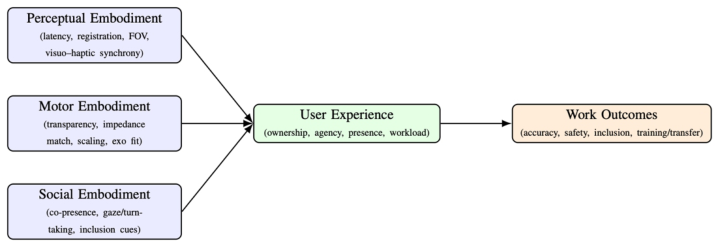
This paper argues that embodiment should be treated as a structural factor in the future of work, alongside traditional ergonomic concerns. We propose a multi-layered conceptual framework of embodiment in work settings that includes (1) perceptual embodiment, or the sensory congruence that supports presence and effectiveness; (2) motor embodiment, or the kinesthetic alignment that enables skill transfer and reduces physical strain; and (3) social embodiment, or the collaborative dimension that fosters trust and inclusion in distributed teams. By situating embodiment at the intersection of human factors, kinesthetic learning, and immersive systems research, we provide a roadmap for both theorizing and empirically testing its role in shaping the future workplace.
We begin by surveying related work across embodiment, kinesthetic learning, and human factors, then propose a unified framework with perceptual, motor, and social layers. We translate the framework into hypotheses and design guidance for teleoperation, exoskeletons, and hybrid collaboration, and conclude with implications, limitations, and avenues for future research.
BACKGROUND AND RELATED WORKS Embodiment in Virtual and Immersive Systems
Research on embodiment in cognitive science and virtual reality has established ownership, agency, and selflocation as core components of the embodied self (Kilteni et al., 2012, de Vignemont, 2018, Falcone et al., 2022). Classic illusions demonstrate that temporal and spatial congruence between seen and felt events can re-map body representation (e.g., the rubber- hand paradigm), while contemporary VR studies show that synchrony, low
Embodiment at Work: A Framework for Human–Technology Interaction 1811
latency, and coherent multisensory cues strengthen presence and influence behavior (Maravita and Iriki, 2003, Slater, 2009, Sanchez-Vives and Slater, 2010). Within immersive systems, embodiment is not merely an epiphenomenon of display fidelity; it depends on cross-modal alignment, visuomotor contingency, and stable sensorimotor predictions that jointly support a sense of being able to act through a surrogate body or viewpoint.
Despite this progress, much of the literature remains oriented toward laboratory demonstrations, therapeutic applications, or entertainment contexts, with comparatively fewer treatments of applied work settings. For example, presence and ownership are seldom linked to task-critical outcomes such as precision, error recovery, or training transfer in safety and time critical environments. Moreover, widely used measures of presence and embodiment (Sanchez-Vives and Slater, 2010, Kilteni et al., 2012) are rarely integrated with ergonomics metrics or organizational key performance indicators (KPIs), limiting actionable guidance for engineering and operations.
Kinesthetic Learning and Motor Control Parallel lines of work in motor control and kinesthetic learning highlight the importance of proprioceptive and haptic channels for skill acquisition and performance. Internal models and efference-copy mechanisms underpin predictive control, enabling humans to estimate dynamics and compensate for delays or disturbances; such mechanisms are central when interacting with tools, robots, or wearables that alter the operator–world coupling Boaventura and Buchli (2016). In human–robot systems, controller transparency (the degree to which the device allows the user’s intended motion and forces to pass unimpeded) is a key determinant of precision, effort, and learning. Design levers include impedance/admittance tuning, motion scaling, and gravity compensation (Pratt and Williamson, 1995, Yang et al., 2011, Dos Santos et al., 2022).
Kinesthetic guidance and haptic augmentation can accelerate early learning, shape movement trajectories, and reduce corrective submovements, but benefits may depend on matching assistance to task phase and user proficiency. In exoskeleton contexts, anthropometric fit and load-sharing influence both performance and fatigue, underscoring the need to jointly consider biomechanics and control (Just et al., 2018, Dos Santos et al., 2022). Yet, connections between these kinesthetic constructs and higher-level constructs like agency or body ownership are still under-specified in applied domains, leaving open questions about how motor alignment translates into perceived control and durable skill transfer.
Human Factors and Ergonomics for Teleoperation and Hybrid Work Human factors research offers mature tools for assessing workload, fatigue, safety, and usability (e.g., NASA–TLX) and has a long history in teleoperation and supervisory control (Hart and Staveland, 1988, Roth and Latoschik, 2020, Hoffmann et al., 2018). Traditional evaluations, however, seldom treat embodiment as a mediating construct that links interface properties to outcomes such as accuracy, error recovery, inclusion, and training efficiency.
1812 Falcone
In telemanipulation, for instance, latency, registration error, and controller impedance affect both cognitive load and precision (Almeida et al., 2020), but their effects on ownership, agency, or presence are rarely measured alongside performance. Similarly, in hybrid collaboration, social presence and participation equity are central to team effectiveness, yet many systems under-provide gaze, deictic pointing, or floor-control cues that scaffold coordination (Slater, 2009).
Bridging these perspectives suggests a more complete account: perceptual congruence (timing, registration, crossmodal redundancy) and motor alignment (transparency, scaling, fit) condition the operator’s embodied experience, which in turn shapes workload, precision, and safety (Nostadt et al., 2020, Toet et al., 2020, Falcone et al., 2023); social embodiment affordances (visibility parity, legible gaze/turn-taking, identity cues) condition trust, inclusion, and coordination. The literature to date provides the building blocks - presence and embodiment in VR (Sanchez-Vives and Slater, 2010, Kilteni et al., 2012, Slater, 2009, Falcone et al., 2022), tool/body-schema extension (Maravita and Iriki, 2003, Nostadt et al., 2020), workload and ergonomics (Hart and Staveland, 1988, Almeida et al., 2020), and transparency in robot control (Pratt and Williamson, 1995, Van Erp et al., 2022) - but lacks an integrative framework that treats embodiment as a first- class variable connecting interface design to organizational outcomes. This paper addresses that gap by articulating a multi-layered model (perceptual, motor, social) and outlining testable pathways to validate it in applied future-of-work scenarios.
IMPLICATIONS FOR RESEARCH AND PRACTICE Testable Hypotheses and Measures
Building on the proposed framework, we articulate three hypotheses that render embodiment falsifiable in applied work settings and specify corresponding measurement strategies.
H1 (Perceptual—Cross-modal congruency). When multisensory signals are temporally and spatially congruent, participants should exhibit a larger cross-modal congruency effect (CCE) — the difference in reaction times and errors between incongruent and congruent visuo–tactile trials—which is expected to covary with presence and with objective task performance (Verhagen et al., 2020, Falcone et al., 2024, Falcone and Taylor, 2024). Operationally, congruence can be manipulated via motion-to-photon latency (low vs. high), visual–haptic registration (aligned vs. offset), and field of view (restricted vs. wide). Dependent variables include CCE magnitude (RTincongruent–RTcongruent) and error rate, along with task key performance indicators (time-to-completion, precision, count of slips/misses).
H2 (Motor transparency—Impedance matching). In telemanipulation and exoskeleton use, lower impedance mismatch and higher controller transparency should improve spatial accuracy and movement efficiency while reducing perceived workload (Karavas et al., 2015, Parsa et al., 2022, Forouhar et al., 2024, Lieftink et al., 2024). Transparency can be tuned through admittance/impedance parameters, motion scaling, and
Embodiment at Work: A Framework for Human–Technology Interaction 1813
gravity compensation. Outcomes include endpoint RMS error, path length, normalized jerk (smoothness), correction count, and peak interaction forces; subjective workload can be captured with validated surveys, such as the NASA–TLX. Short calibration blocks can stabilize performance before data collection.
H3 (Social presence—Participation and recovery). Affording social embodiment cues (e.g., gaze indicators, turn-taking scaffolds, and visibility parity between remote and co-located participants) should yield more equitable participation and faster recovery from coordination errors (Xu et al., 2017, Jing et al., 2021). Independent variables include availability of gaze/pointing cues, presence of lightweight floor control (e.g., speaking queue), and parity of views/audio. Dependent variables include talk-time balance (e.g., Gini coefficient), interruption rate, timeto-recover after slips, and perceived inclusion/co-presence. Nevertheless, telepresence remains an active area of inquiry, and current solutions do not consistently achieve high-fidelity co-presence (Van Dijk et al., 2011, Biehl et al., 2015).
Measures and analysis. Perceptual embodiment is probed with standard CCE paradigms and presence/agency questionnaires (de Vignemont, 2018, Peck and Gonzalez-Franco, 2021); motor embodiment with motion-capture kinematics (path length, smoothness), controller logs, and NASA–TLX (Hart and Staveland, 1988); social embodiment with audio/video analytics of turn- taking and inclusion scales. Mixed-effects models with random intercepts for participant (and task item, where applicable) are appropriate for repeated- measures designs, report effect sizes, confidence intervals, and pre-register primary contrasts (Peck and Good, 2023, Wu and Chen, 2024). Where design changes target inclusivity, non-inferiority tests can verify that performance remains within acceptable margins relative to baselines.
Figure 1: Conceptual framework: perceptual, motor, and social embodiment feed into user experience, which in turn shapes organizational/work outcomes.
DESIGN GUIDELINES The framework suggests concrete levers for designing embodied work systems. For perceptual embodiment, interfaces should minimize end-to- end latency and visual–haptic misregistration, expose quick calibration to prevent drift, and provide multimodal redundancy so that salient events are
1814 Falcone
co-signaled visually, haptically, and/or acoustically (Lieftink et al., 2024). Adjustable field of view and motion gain can help sustain presence without overloading vestibular cues (Falcone et al., 2022; 2024).
For motor embodiment, controllers should adapt transparency to task phase, such as higher assistance and damping during coarse transport, and lighter impedance with motion scaling during fine manipulation (Agarwal and Deshpande, 2019). Exoskeletons require anthropometric fit and load- sharing that limit peak forces and cumulative strain; ergonomics indicators (e.g., path inefficiency, grip-force spikes) should be surfaced to operators and supervisors. Routine assessment of workload can trigger micro-breaks or automatic controller retuning when fatigue rises (Mauri et al., 2019, Chung et al., 2025).
For social embodiment in hybrid teams, systems should enforce visibility parity (remote participants see what in-room participants see and vice versa), make gaze and pointing cues legible to support joint attention, and provide lightweight turn-taking scaffolds that discourage interruption cascades while preserving spontaneity (Xu et al., 2017, Altmann et al., 2025). Stable identity and status cues (e.g., role, speaking queue position) improve attribution and trust.
Taken together, these practices operationalize embodiment as a first- class design target. By instrumenting perceptual congruence, motor transparency, and social presence alongside conventional human-factors metrics, organizations can link interface choices to safety, performance, training transfer, and inclusion, and iterate toward ergonomically sustainable, human-centered workplaces.
Table 1: Embodiment layers, example design levers, and expected outcomes in work settings.
Trust, team cohesion, equitable participation, reduced isolation
DISCUSSION
This paper positions embodiment as a structural factor in the design and evaluation of technology-mediated work. By articulating perceptual, motor, and social embodiment as interdependent layers, we link concrete interface properties (e.g., latency, registration, controller impedance, visibility parity) to experiential states (ownership, agency, presence) and, ultimately, to organizational outcomes (accuracy, safety, inclusion, training transfer). In
Embodiment at Work: A Framework for Human–Technology Interaction 1815
doing so, we synthesize strands of research that have often progressed in parallel—embodiment and presence in immersive systems, tool-induced body schema extension, transparency and impedance in telemanipulation, workload and safety in ergonomics, and advance a mechanism-centered account that is amenable to empirical testing.
Conceptualizing embodiment as a mediator clarifies how interface manipulations propagate to performance and well-being. Perceptual congruence supports stable sensorimotor predictions that ground ownership and presence; motor alignment reduces error-corrective submovements and cognitive load by harmonizing human and device dynamics; social embodiment affords mutual intelligibility (e.g., gaze, turn-taking), which underwrites trust and equitable participation. The framework also suggests moderators: task phase (transport vs. fine manipulation), user proficiency, environmental complexity, and organizational norms (e.g., meeting etiquette) likely shape the strength of embodiment–outcome links. Importantly, the layers can trade off or interact—for example, aggressive motion scaling may aid precision (motor layer) while degrading visuo-proprioceptive consistency (perceptual layer); conversely, rich social cues can mitigate minor perceptual imperfections by stabilizing coordination.
Operationalizing embodiment requires jointly sampling subjective and objective measures. We advocate batteries that pair (i) CCE-based indices and presence/agency questionnaires for perceptual embodiment, (ii) kinematic and force metrics plus cognitive workload tests for motor embodiment, and (iii) participation analytics (talk-time balance, interruptions, recovery time) for social embodiment. Two validity concerns warrant attention. First, manipulation checks: record motion-to-photon latency and visual–haptic registration, log controller impedance/assistance, and verify availability of gaze/turn-taking cues; embodiment inferences are weak without such checks. Second, ecological linkage: triangulate lab tasks (e.g., CCE, path-following) with in-situ KPIs to ensure transfer to operational contexts. Mixed-effects models accommodate repeated measures and heterogeneous tasks, while non-inferiority tests are useful when inclusive designs must meet safety or productivity thresholds. Pre-registration and sharing of stimulus code, controller settings, and analysis scripts will improve reproducibility.
Treating embodiment as a design target yields practical levers for how systems are procured, configured, and taught in everyday use. On the perceptual side, teams should plan explicitly for latency and registration budgets, offer rapid calibration to prevent drift, and pair visual events with haptic and auditory confirmations so cross-modal cues reinforce one another. For motor embodiment, controller settings should adapt to task phase— providing more assistance and damping during gross transport, then easing impedance and enabling motion scaling for fine manipulation. Exoskeleton deployments also benefit from anthropometry-aware fitting and load- sharing policies, with simple ergonomics indicators tracking peak forces and cumulative strain; routine workload checks can then trigger short breaks or automatic retuning before fatigue accumulates. Social embodiment in hybrid teams calls for visibility parity between remote and in-room participants, legible gaze and pointing to anchor joint attention, and lightweight floor
1816 Falcone
control to keep turn-taking orderly without throttling spontaneity. At the organizational level, acceptance testing should evaluate embodiment alongside traditional usability and safety criteria, and training curricula should scaffold operators from low- to high-embodiment conditions so that ramp-up time shortens and errors fall as proficiency grows.
Embedding embodiment metrics into workplace systems raises normative questions. Instrumentation that logs gaze, speech turns, or kinematics must respect privacy and avoid punitive surveillance. Inclusion-oriented features (e.g., turn-taking scaffolds) should not inadvertently disadvantage spontaneity or cultural communication styles. Exoskeleton and teleoperation deployments should consider accessibility and differing physical abilities, ensuring that embodiment benefits are not reserved for a narrow subset of workers.
CONCLUSION AND FUTURE WORKS Embodiment is a structural determinant of safety, performance, inclusion, and learning in technology-mediated work. We proposed a three-layer framework—perceptual, motor, and social—that links interface properties (e.g., latency, registration, controller transparency, visibility parity) to experiential states (ownership, agency, presence) and, through them, to organizational outcomes. We also translated this framework into testable hypotheses and a measurement toolkit that pairs subjective indices (presence, agency, inclusion, workload) with objective signals (kinematics, controller logs, cross-modal congruency, and team-process analytics), enabling embodiment to be treated as an explicit design target. As a conceptual account, our approach has limits: thresholds for “sufficient” congruence or transparency are task- and population-dependent, and interactions among layers may entail trade-offs (e.g., motion scaling improving precision while degrading visuoproprioceptive consistency). Priorities for future work include quantifying inter-layer interactions (for example, whether social cues buffer moderate perceptual misalignment); establishing benchmark tasks and open datasets that link embodiment metrics to operational KPIs; studying longitudinal adaptation and skill transfer in real workplaces; and broadening participant populations and contexts. At the organizational level, procurement and certification should incorporate embodiment thresholds alongside usability and safety criteria to align incentives for human-centered, ergonomically sustainable systems.
REFERENCES
Agarwal, P. and Deshpande, A. D. (2019). A framework for adaptation of training task, assistance and feedback for optimizing motor (re)-learning with a robotic exoskeleton. IEEE Robotics and Automation Letters, 4(2):808– 815. Almeida, L., Menezes, P., and Dias, J. (2020). Interface transparency issues in
teleoperation. Applied Sciences, 10(18):6232. Altmann, M., Hegemann, K., Askari, A., Rallabandi, V., Pascher, M., and Gerken, J. (2025). Noticelight: Embracing socio-technical asymmetry through tangible peripheral robotic embodiment in hybrid collaboration. arXiv preprint arXiv:2506.22125.
Embodiment at Work: A Framework for Human–Technology Interaction 1817
Biehl, J. T., Avrahami, D., and Dunnigan, A. (2015). Not really there: Understanding embodied communication affordances in team perception and participation. In Proceedings of the 18th ACM Conference on Computer Supported Cooperative Work & Social Computing, pages 1567–1575. Boaventura, T. and Buchli, J. (2016). Acceleration-based transparency control
framework for wearable robots. In 2016 IEEE/RSJ International Conference on Intelligent Robots and Systems (IROS), pages 5683–5688. IEEE. Chung, J., Quirk, D. A., Cherin, J. M., Friedrich, D., Kim, D., and Walsh, C. J. (2025).
The perceptual and biomechanical effects of scaling back exosuit assistance to changing task demands. Scientific Reports, 15(1):1– 17. de Vignemont, F. (2018). Bodily ownership and bodily awareness. Analysis and Metaphysics, 17:20–45. Dos Santos, L. F., Escalante, F. M., Siqueira, A. A., and Boaventura, T. (2022). Imubased transparency control of exoskeletons driven by series elastic actuator. In 2022 IEEE 61st Conference on Decision and Control (CDC), pages 2594–2599. IEEE. Falcone, S., Brouwer, A.-M., Cocu, I., Gijsbertse, K., Heylen, D. K., and van Erp, J. B.
(2022). The relative contribution of five key perceptual cues and their interaction to the sense of embodiment. Technology, Mind, and Behavior, 3(1). Falcone, S., Englebienne, G., Van Erp, J., and Heylen, D. (2023). Toward standard guidelines to design the sense of embodiment in teleoperation applications: A review and toolbox. Human–Computer Interaction, 38(5-6):322– 351. Falcone, S., Lieftink, R., Brouwer, A.-M., Dresscher, D., Heylen, D., and Erp, J.
V. (2024). Sense of embodiment supports motor learning and adaptation in tele- robotics. ACM Transactions on Human-Robot Interaction, 14(1):1–17. Falcone, S.and Taylor, J.(2024). The impact of spatiotemporal calibration on sense of embodiment and task performance in teleoperation. In Proceedings of the Annual Meeting of the Cognitive Science Society, volume 46. Forouhar, M., Sadeghian, H., Suay, D. P., Naceri, A., and Haddadin, S. (2024). A
tactile lightweight exoskeleton for teleoperation: Design and control performance. In 2024 IEEE/RSJ International Conference on Intelligent Robots and Systems (IROS), pages 178–183. IEEE. Hart, S. G. and Staveland, L. E. (1988). Development of nasa-tlx: Results of empirical and theoretical research. Advances in Psychology, 52:139–183. Hoffmann, L., Bock, N., and Rosenthal vd Putten, A. M. (2018). The peculiarities of
robot embodiment (emcorp-¨scale) development, validation and initial test of the embodiment and corporeality of artificial agents scale. In Proceedings of the 2018 ACM/IEEE international conference on human-robot interaction, pages 370–378. Jing, A., May, K. W., Naeem, M., Lee, G., and Billinghurst, M. (2021). Eyemrvis: Using bi-directional gaze behavioural cues to improve mixed reality remote collaboration. In Extended Abstracts of the 2021 CHI Conference on Human Factors in Computing Systems, pages 1–7. Just, F., Ozen, Ö., Bösch, P., Bobrovsky, H., Klamroth-Marganska, V., Riener, R.,
and Rauter, G. (2018). Ex-öskeleton transparency: Feed-forward compensation vs. disturbance observer. at-Automatisierungstechnik, 66(12):1014–1026. Karavas, N., Ajoudani, A., Tsagarakis, N., Saglia, J., Bicchi, A., and Caldwell, D.
(2015). Tele-impedance based assistive control for a compliant knee exoskeleton. Robotics and Autonomous Systems, 73:78–90. Kilteni, K., Groten, R., and Slater, M. (2012). The sense of embodiment in virtual reality. Presence: Teleoperators and Virtual Environments, 21(4):373–387. Lieftink, R., Falcone, S., Van Der Walt, C., Van Erp, J., and Dresscher, D. (2024).
A pragmatic approach to bi-directional impedance reflection telemanipulation control: Design and user study. IEEE Robotics and Automation Letters, 9(4):3617–3624.
1818 Falcone
Maravita, A. and Iriki, A. (2003). Tools for the body (schema). Trends in Cognitive Sciences, 7(2):79–84. Mauri, A., Lettori, J., Fusi, G., Fausti, D., Mor, M., Braghin, F., Legnani, G., and
Roveda, L. (2019). Mechanical and control design of an industrial exoskeleton for advanced human empowering in heavy parts manipulation tasks. Robotics, 8(3):65. Nostadt, N., Abbink, D. A., Christ, O., and Beckerle, P. (2020). Embodiment, presence, and their intersections: Teleoperation and beyond. ACM Transactions on Human-Robot Interaction (THRI), 9(4):1–19. Parsa, S., Maior, H. A., Thumwood, A. R. E., Wilson, M. L., Hanheide, M., and
Esfahani, A. G. (2022). The impact of motion scaling and haptic guidance on operators’ workload and performance in teleoperation. In CHI Conference on Human Factors in Computing Systems Extended Abstracts, pages 1–7. Peck, T. C. and Gonzalez-Franco, M. (2021). Avatar embodiment. A standardized questionnaire. Frontiers in Virtual Reality, 1:575943. Peck, T. C. and Good, J. J. (2023). Measuring embodiment: Movement complexity
and the impact of personal characteristics. IEEE Transactions on Visualization and Computer Graphics, 30(8):4588–4600. Pratt, G. A. and Williamson, M. M. (1995). Series elastic actuators. In IEEE/RSJ IROS, pages 399–406. Roth, D. and Latoschik, M. E. (2020). Construction of the virtual embodiment
questionnaire (veq). IEEE Transactions on Visualization and Computer Graphics, 26(12):3546–3556. Sanchez-Vives, M. V. and Slater, M. (2010). From presence to consciousness through VR. Nature Reviews Neuroscience, 6:332–339. Slater, M. (2009). Place illusion and plausibility can lead to realistic behaviour
in immersive VR. Philosophical Transactions of the Royal Society B, 364(1535):3549–3557. Toet, A., Kuling, I. A., Krom, B. N., and Van Erp, J. B. (2020). Toward enhanced teleoperation through embodiment. Frontiers in Robotics and AI, 7:14. Van Dijk, B., Zwiers, J., op den Akker, R., Kulyk, O., Hondorp, H., Hofs,
D., and Nijholt, A. (2011). Conveying directional gaze cues to support remote participation in hybrid meetings. In Toward Autonomous, Adaptive, and Context- Aware Multimodal Interfaces. Theoretical and Practical Issues: Third COST 2102 International Training School, Caserta, Italy, March 15–19, 2010, Revised Selected Papers, pages 412–428. Springer. Van Erp, J. B., Sallaberry, C., Brekelmans, C., Dresscher, D., Ter Haar, F., Englebienne, G., Van Bruggen, J., De Greeff, J., Pereira, L. F. S., Toet, A., et al. (2022). What comes after telepresence? Embodiment, social presence and transporting one’s functional and social self. In 2022 IEEE International Conference on Systems, Man, and Cybernetics (SMC), pages 2067–2072. IEEE. Verhagen, P., Kuling, I., Gijsbertse, K., Stuldreher, I. V., Overvliet, K., Falcone, S.,
Van Erp, J., and Brouwer, A.-M. (2020). The cross-modal congruency effect as an objective measure of embodiment. In Companion Publication of the 2020 International Conference on Multimodal Interaction, pages 107–111. Wu, L. and Chen, K. B. (2024). Embodiment of virtual body and extremities with movement control in reaching tasks using virtual reality. In Proceedings of the Human Factors and Ergonomics Society Annual Meeting, volume 68, pages 1227– 1228. SAGE Publications Sage CA: Los Angeles, CA.
Embodiment at Work: A Framework for Human–Technology Interaction 1819
Xu, B., Ellis, J., and Erickson, T. (2017). Attention from afar: simulating the gazes of remote participants in hybrid meetings. In Proceedings of the 2017 Conference on Designing Interactive Systems, pages 101–113. Yang, C., Ganesh, G., Haddadin, S., Parusel, S., Albu-Schaeffer, A., and Burdet, E.
(2011). Human-like adaptation of force and impedance in stable and unstable interactions. IEEE Transactions on Robotics, 27(5):918–930.
LISTED IN THE AHFE DIGITAL BOOKSTORE CATALOGUE
Explore the complete digital volume
Human Factors in Design, Engineering, and Computing
Read this individual research paper free through the original publisher, or explore the full digital proceedings book.
ISBN 978-1-964867-75-5
Explore this ISBN in the AHFE Bookstore ↗Listed in the July 2026 bookstore catalogue; search by ISBN to confirm current availability · Digital book purchase optional