Ashraf Alhujailli (2024). Assessing the Effects of Fatigue on Cognitive Performance for Shift Workers in the Petrochemical Industry: A Scoping Review. In: Neuroergonomics and Cognitive Engineering. AHFE Open Access, vol. 126, pp. 180–187. https://doi.org/10.54941/ahfe1004751
Each industry has its challenges and risk factors for workplace fatigue, shaped by the nature of the work, the work environment, and regulatory frameworks. The petrochemical industry requires shift systems to keep their productions operational continuously. These systems pose significant risks associated with worker fatigue. Workers are frequently exposed to hazardous chemicals, posing a risk to their health and further exacerbating fatigue. It might lead to decreased safety and productivity. To investigate this issue, we conducted a scoping review of literature published according to PRISMA guidelines in the past two decades using Scopus, Web of Science, and Embase databases. The objective is to investigate the question: "What does the current literature indicate about the effects of fatigue during shift work in the petrochemical industry?". Our review highlights the complex relationship between shift work patterns and their physiological and psychological impact on workers in this industry. Our paper aims to provide industry-specific recommendations and interventions that effectively reduce the adverse effects of shift fatigue in the petrochemical sector.
Shift work is commonly adopted globally among both part-time and full- time employees. It usually involves hours extending beyond the standard 07:00 to 18:00 timeframe. It impacts nearly 20% of the global labor force (Rivera et al., 2020, Wright et al., 2013). Fatigue, although lacking a univer- sally accepted definition, is described by The Oxford Dictionary as “extreme tiredness resulting from mental or physical exertion” distinct from sleepiness or tiredness. Sleep might mitigate sleepiness but does not necessarily relieve fatigue, which can occur without sleepiness (Phillips, 2015, Shen et al., 2006). This distinction is crucial as Shen et al. (2006) noted the significant effect of shift work on subjective fatigue, unlike sleepiness, suggesting the need for different assessment and management approaches. Gander et al. (2011) highlighted fatigue as a critical issue in workplace risk management.
Heidari et al. (2017) identified job satisfaction, mental disorders, and sleepiness as critical factors affecting fatigue, employing the Seemingly
Assessing the Effects of Fatigue on Cognitive Performance in Shift Workers 181
Unrelated Regression (SUR) method. Moradifar et al. (2014) demonstrated that rotating-shift workers exhibit higher fatigue levels and greater insomnia severity than their fixed-dayshift counterparts.
The petrochemical industry, which converts petroleum and natural gas into various chemical products, had experienced significant growth since the first petrochemical product was produced in 1920 at the Standard Oil plant in Bayway, New Jersey, when isopropyl alcohol was successfully pro- duced (AFPM_Communications, 2020). Since then, continuous production schedules have necessitated shift work, leading to irregular sleep patterns and chronic fatigue. The complexity of manufacturing processes, the need for constant vigilance, and exposure to hazardous chemicals exacerbate workers’ mental and physical exhaustion.
However, different industries face unique challenges and risks associated with workplace fatigue, influenced by the nature of the job, the environ- ment, and the regulations. This scoping review aims to evaluate the current research on fatigue’s effects on cognitive functions among shift workers in the petrochemical industry.
METHODOLOGY
The methodology for this research was structured to ensure a comprehen- sive review of relevant literature. In conducting this scoping review, the 2020 Preferred Reporting Items for Systematic Reviews and Meta-analyses (PRISMA) guidelines (Page et al., 2021) was followed. This approach ensured a rigorous and transparent review process, facilitating a comprehensive understanding of the impacts of work shifts and fatigue in the petrochemical sector.
The initial phase involved setting specific parameters for database searches: a focus on the petrochemical sector and published research between January 1990 to December 2023, utilizing prominent databases of Scopus, Web of Science, and Embase.
This review focused on the relationship between work shifts and fatigue within the petrochemical industry. A strategic combination of keywords were employed to capture the breadth of relevant literature, including both MESH and non-MESH terms: ‘Petrochemical,’ ‘work shift,’ and ‘fatigue’.
Two reviewers independently assessed the titles and abstracts of citations gathered from all sources. Disagreements between the two reviewers were resolved through consultation with additional authors. The synthesis of the findings from these studies is presented in Table 1.
RESULTS
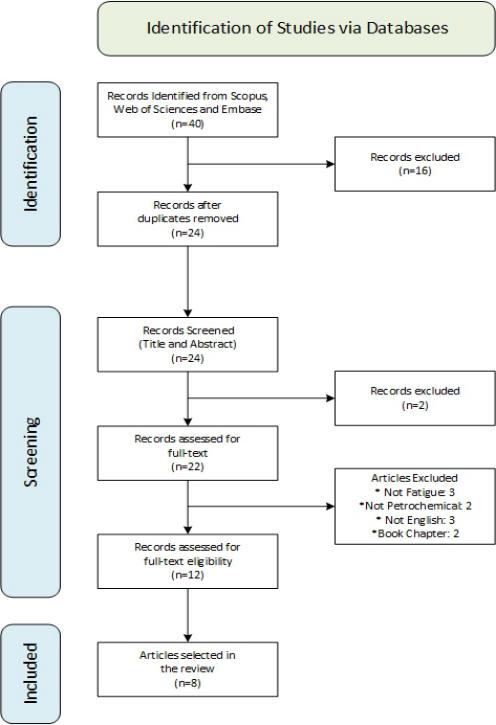
A comprehensive search yielded 40 relevant papers. After removing duplicates, the remaining articles underwent a careful selection process. Adhering to predefined inclusion and exclusion criteria, 8 articles were ultimately deemed suitable for inclusion in the final analysis (refer to Figure 1).
182 Alhujailli
Figure 1: Detailed flowchart illustrating the study selection process for the scoping review.
DISCUSSION AND CONCLUSION The scoping review conducted recently has brought to light some significant findings regarding the impact of fatigue on cognitive performance of shift workers in the petrochemical industry. It highlights the complex occupa- tional health challenges faced by these workers. The collected studies present a comprehensive picture of how shift work can adversely affect both men- tal and physical health, leading to decreased cognitive performance and an increased risk of human errors in high-stakes environments. The studies provided understanding of how shift work can adversely affect mental and physical health, leading to decreased cognitive performance and increased risk of human errors.
The investigation made by researchers like Bazazan et al. (2019), Choobineh et al. (2018), and Fischer et al. (2000) had conducted investiga- tion on the complex dynamics between shift work schedules, sleep quality,
Assessing the Effects of Fatigue on Cognitive Performance in Shift Workers 183
and worker fatigue. For instance, Bazazan et al. (2019) found a signifi- cant correlation between physical and mental fatigue, suggesting that mental health could significantly contribute to increased fatigue among workers. This aligns with Choobineh et al. (2018), who emphasized increased levels of fatigue and sleepiness in employees with sleep disorders, particularly those on irregular or night shifts. Adding to the complexity of this issue, research conducted by Fischer et al. (2000), (Kazemi et al., 2016) and Kazemi et al. (2018) demonstrated the adverse effects of inadequate sleep and long work- ing hours on shift workers’ circadian rhythms and cognitive functions. These consequences are not only limited to decreased alertness and cognitive perfor- mance but also include psychological discomfort and increased risk of human errors (Mariana et al., 2018, Rasoulzadeh et al., 2015).
Ultimately, the reviewed body of research suggests a new approach to address the issues triggered by shift work in the petrochemical industry. Based on the collected evidence, interventions must not only focus on adjusting shift schedules and work hours to align with the human biological clock alone but also stress the importance of regular health assessments, mental health support, and strategies to improve sleep quality among workers. Kang et al. (2021) analyzed various studies to categorize and compare fatigue assessment methods in the industry.
The scoping review has revealed a significant gap in our understanding of how shift work affects the mental health and overall performance of work- ers in the petrochemical industry. Although the research reviewed has drawn connections between shift patterns, fatigue, sleep quality, and cognitive per- formance, it seems we still missing in-depth research to explain the causes of the marked decline in cognitive performance and increased fatigue related to different shift patterns. Additionally, there is a marked gap in the lack of literature exploring individual differences, such as age, cultural background, and worker experiences.
The impact of shift work has been studied across various industries, and fatigue is a widespread issue. In the Malaysian electronics manufacturing industry, Shahril Abu Hanifah and Ismail (2020) noted a high prevalence of fatigue. Boogaard and Caubo (1994) examined the relationship between physical workload, shift work, and health and suggested that changes in circadian rhythms due to shift work, rather than chemical exposure, were responsible for increased albuminuria in industrial workers. Parody et al. (2020) highlighted the different types of fatigue (physical, mental, and gen- eral) and their influence on worker performance in an energy accumulator assembly line.
The authors Richter et al. (2016) have reviewed non-pharmacological mea- sures to combat fatigue and suggested several coping strategies for workplace health promotion programs, including napping, exposure to bright light, and cognitive-behavioral measures. Dawson and Reid (1997) have compared the performance impairment caused by fatigue with that of alcohol intoxication, thus highlighting the significant risks associated with fatigue in workplace safety assessments.
184 Alhujailli
(Continued)
workers of petrochemical industries in Iran. The results showed a strong
positive correlation between physical and mental fatigue in shift workers,
suggesting that higher levels of mental health issues were associated with
higher levels of fatigue.
Petrochemical employees reported moderate levels of fatigue, with
significant differences in fatigue dimensions between individuals with and
without sleep disorders. Positive relationships between sleepiness and
fatigue among petrochemical workers. Shift workers had higher fatigue
scores compared to day workers. Employees with sleep disorders had
significantly higher levels of fatigue and sleepiness compared to those
without sleep disorders. Rest, plays a role in the occurrence of fatigue
among these workers
Sleep quality was perceived to be worse after night shifts compared to day
shifts. Perceived alertness was higher during the early hours of the shift and
decreased in the later hours.
causes irregularities in the circadian rhythm and the cycle of sleep. This
fatigue induced a decline in cognitive performance at the end of both day
and night shifts. Fatigue associated with shift work, especially during long
shifts, is a critical factor contributing to the observed decrease in cognitive
functions among petrochemical control room operators.
501 The prevalence of fatigue, sleepiness, and sleep disorders among
Population Summary of Findings
Questionnaire
survey 287 Occupational fatigue and mental health complaints among 8 - hour shift
Cross-sectional
design-
Questionnaire
survey
Questionnaire 218 Sleep duration decreased during night shifts and increased after off days.
questionnaire
survey 60 Long working hours per shift result in significant fatigue, which in turn
sleepiness, and sleep disorders
among petrochemical employees
in Iran, and to investigate the
relationship between these factors.
implementing 12 -hour shifts in a
Brazilian petrochemical plant on
workers’ sleep duration, sleep
quality, and alertness.
on cognitive performance, sleep
quality, and sleepiness among
petrochemical control room
operators
mental health concerns and
fatigue among 8 -hour rotating
shift workers in petrochemical
industries in Iran.
Choobineh et
al. (2018) Iran Assessed the prevalence of fatigue,
Fischer et al.
(2000) Brazil Evaluated the impact of
Kazemi et al.
(2016) Iran Examined the effects of shift work
Table 1. Summary of the selected papers.
Table available in the original PDF paper.
Authors, Year Country Purpose of the Study Study Design Study
Bazazan et al.
(2019) Iran Evaluated the prevalence of
Assessing the Effects of Fatigue on Cognitive Performance in Shift Workers 185
compared to the 4 -night shift. Melatonin levels and sleepiness were not
significantly different between the two shift types, but there were significant
effects of time and shift duration on these factors.
operation found that there are association between fatigue and human
errors among shift workers in petrochemical, oil, and gas plant operations.
especially among those working 12-hour shifts.
sleep quality, with workers on fixed night shifts having the highest scores on
Sleep Quality. Factors such as age, job satisfaction, and shift schedule were
associated with impaired sleep quality.
Population Summary of Findings
290 The were an association between fatigue and psychological discomfort,
192 More than half of offshore workers in the petroleum industry had poor
questionnaire
survey 60 Cognitive performance was better among workers in the 7 -night shift
survey 37 Fatigue and human errors analysis in petrochemical and oil and gas plant’s
cross-sectional
study-
Questionnaire
survey
cross-sectional
study-
Questionnaire
survey
on human errors in the workplace questionnaire
psychological distress and fatigue
among petrochemical workers on
12-hour shift schedules.
offshore workers in the petroleum
industry, specifically focusing on
factors such as shift schedule, job
satisfaction, and age.
shifts on cognitive performance,
salivary melatonin levels, and
sleep among control room
operators in a petrochemical
complex.
Iran evaluate the sleep quality of
Mariana et
al. (2018) Indonesia Investigated the impact of fatigue
Rasoulzadeh
et al. (2015) Iran Examined the levels of
Sadeghniiat
Haghighi et
al. (2018)
Table 1. Continued
Table available in the original PDF paper.
Authors, Year Country Purpose of the Study Study Design Study
Kazemi et al.
(2018) Iran Investigated the effects of night
186 Alhujailli
Fathi et al. (2013) have discussed the challenges of shift work in Iran, such as stress and job dissatisfaction, and have emphasized the need for ergonomic measures to mitigate these adverse effects.
Finally, Bourdouxhe et al. (1999) conducted a study on the long-term effects of shift work, specifically rotating 12-hour shifts. The study warns of future concerns, especially for aging workforces, in managing the com- pounded effects of shift work.
In conclusion, the findings from this scoping review necessitates develop- ing a new approach to investigating the health and safety of shift workers in the petrochemical industry. It is essential to optimize the design of work activ- ities for shift workers by considering their cognitive load and capacity. This includes rethinking shift designs and implementing health and wellness pro- grams to mitigate the risks of shift work. By prioritizing employees’ health, petrochemical industries can enhance productivity and overall workplace satisfaction.
REFERENCES
AFPM_Communications. 2020. The refining and petrochemical industries: 170 years of innovation [Online]. Available: https://www.afpm.org/newsroom/blog/refinin g-and-petrochemical-industries-170-years-innovation [Accessed 2024]. Bazazan, A., Rasoulzadeh, Y., Dianat, I., Safaiyan, A. & Mombeini, Z. 2019. Occu-
pational fatigue and mental health complaints among 8-hour shift workers of petrochemical industries in Iran. Work, 62, 309–317. Boogaard, P.J. & Caubo, M. E.1994. Increased albumin excretion in industrial workers due to shift work rather than to prolonged exposure to low concentrations of chlorinated hydrocarbons. Occup Environ Med, 51, 638–41. Bourdouxhe, M. A., Queinnec, Y., Granger, D., Baril, R. H., Guertin, S. C.,
Massicotte, P. R., Levy, M. & Lemay, F. L. 1999. Aging and shiftwork: The effects of 20 years of rotating 12-hour shifts among petroleum refinery operators. Experimental Aging Research, 25, 323–329. Choobineh, A., Javadpour, F., Azmoon, H., Keshavarzi, S. & Daneshmandi, H. 2018.
The prevalence of fatigue, sleepiness, and sleep disorders among petrochemical employees in Iran. Fatigue: Biomedicine, Health and Behavior, 6, 153–162. Dawson, D. & Reid, K. 1997. Fatigue, alcohol and performance impairment. Nature, 388, 235–235. Fathi, R., Farzan, F. & Asadi, S. 2013. Investigating problems’ and providing solu-
tions to generate motivation among shift work staff of Gachsaran Oil and Gas exploitation company. Life Science Journal, 10, 88–91. Fischer, F. M., Moreno, C. R. D., Borges, F. N. D. & Louzada, F. M. 2000. Implementation of 12-hour shifts in a Brazilian petrochemical plant: Impact on sleep and alertness. Chronobiology International, 17, 521–537. Gander, P., Hartley, L., Powell, D., Cabon, P., Hitchcock, E., Mills, A. & Popkin,
S. 2011. Fatigue risk management: Organizational factors at the regulatory and industry/company level. Accident Analysis & Prevention, 43, 573–590. Heidari, S., Keshavarz, S. & Mirahmadizadeh, A. 2017. Application of seemingly unrelated regression (SUR) in determination of risk factors of fatigue and gen- eral health among the employees of petrochemical companies. Journal of Health Sciences & Surveillance System, 5, 180–187.
Assessing the Effects of Fatigue on Cognitive Performance in Shift Workers 187
Kang, J., Sasangohar, F. & Mehta, R. K. Current state of worker fatigue assessment and associated recommendations in oil and gas and petrochemical industries. Proceedings of the Human Factors and Ergonomics Society, 2021. 1593–1597. Kazemi, R., Haidarimoghadam, R., Motamedzadeh, M., Golmohamadi, R., Solta-
nian, A. & Zoghipaydar, M. R. 2016. Effects of shift work on cognitive perfor- mance, sleep quality, and sleepiness among petrochemical control room operators. Journal of Circadian Rhythms, 14, 1–8. Kazemi, R., Motamedzade, M., Golmohammadi, R., Mokarami, H., Hemmatjo, R.
& Heidarimoghadam, R. 2018. Field Study of Effects of Night Shifts on Cogni- tive Performance, Salivary Melatonin, and Sleep. Safety and Health at Work, 9, 203–209. Mariana, M., Sahroni, T. R. & Gustiyana, T. Fatigue and human errors analysis in petrochemical and oil and gas plant’s operation. Proceedings of the Interna- tional Conference on Industrial Engineering and Operations Management, 2018. 2611–2619. Moradifar, R., Hoveidi, H., Givehchi, S. & Talebi, F. 2014. Examining fatigue
and insomnia symptoms among workers of a gas transmission industry in 2013. Electron Physician, 6, 827–31. Page, M. J., Mckenzie, J. E., Bossuyt, P. M., Boutron, I., Hoffmann, T. C., Mulrow, C.
D., Shamseer, L., Tetzlaff, J. M., AKL, E. A., Brennan, S. E., Chou, R., Glanville, J., Grimshaw, J. M., Hróbjartsson, A., Lalu, M. M., LI, T., Loder, E. W., Mayo- Wilson, E., Mcdonald, S., Mcguinness, L. A., Stewart, L. A., Thomas, J., Tricco, A. C., Welch, V. A., Whiting, P. & Moher, D. 2021. The PRISMA 2020 statement: an updated guideline for reporting systematic reviews. Bmj, 372, n71. Parody, A., Viloria, A., Hernandez, M., Niño, A. & Cervera, J. Integration of Statistical Techniques to Evaluate the Fatigue of Operators on the Productivity of a Company. In: Pandian, A. P., Ntalianis, K. & Palanisamy, R., eds. Intelli- gent Computing, Information and Control Systems, 2020// 2020 Cham. Springer International Publishing, 53–62. Phillips, R. O. 2015. A review of definitions of fatigue – And a step towards a whole
definition. Transportation Research Part F: Traffic Psychology and Behaviour, 29, 48–56. Rasoulzadeh, Y., Bazazan, A., Safaiyan, A. & Dianat, I. 2015. Fatigue and Psychological Distress: A Case Study Among Shift Workers of an Iranian Petrochemical Plant, During 2013, in Bushehr. Iran Red Crescent Med J, 17, e28021. Richter, K., Acker, J., Adam, S. & Niklewski, G. 2016. Prevention of fatigue and
insomnia in shift workers—a review of non-pharmacological measures. EPMA Journal, 7, 16. Rivera, A. S., Akanbi, M., O’Dwyer, L. C. & Mchugh, M. 2020. Shift work and long work hours and their association with chronic health conditions: A systematic review of systematic reviews with meta-analyses. PLOS ONE, 15, e0231037. Sadeghniiat Haghighi, K., Aminian, O., Zahabi, A., Najafi, A. & Rahimi-
Golkhandan, A. 2018. Sleep quality in shift workers of offshore petroleum industry. Journal of Sleep Research, 27, 293. Shahril Abu Hanifah, M. & Ismail, N. 2020. Fatigue and its associated risk factors: A survey of electronics manufacturing shift workers in Malaysia. Fatigue: Biomedicine, Health & Behavior, 8, 49–59. Shen, J., Barbera, J. & Shapiro, C. M. 2006. Distinguishing sleepiness and fatigue:
focus on definition and measurement. Sleep Medicine Reviews, 10, 63–76. Wright, K. P., JR., Bogan, R. K. & Wyatt, J. K. 2013. Shift work and the assessment and management of shift work disorder (SWD). Sleep Med Rev, 17, 41–54.
LISTED IN THE AHFE DIGITAL BOOKSTORE CATALOGUE
Explore the complete digital volume
Neuroergonomics and Cognitive Engineering
Read this individual research paper free through the original publisher, or explore the full digital proceedings book.
ISBN 978-1-964867-02-1
Explore this ISBN in the AHFE Bookstore ↗Listed in the July 2026 bookstore catalogue; search by ISBN to confirm current availability · Digital book purchase optional