Hao Liu, Calvin Or, Vivian Lou, Yong Hu, Ning Xi (2023). Perceptions of and intention to use wearable and assistive devices among older adults. In: Human Factors and Wearable Technologies. AHFE Open Access, vol. 85, pp. 101–110. https://doi.org/10.54941/ahfe1003631
This study examined older adults’ perceptions of wearable and assistive devices and the influences of these perceptions on the intention to use (ITU) these devices. Fourteen perception variables related to device usage were assessed: perceived usefulness (PU), perceived ease of use (PEOU), attitudes (ATT), ease of maintenance (EOM), weight (WEI), portability (POR), perceived comfort (PCOM), perceived convenience (PCON), appearance (APP), anxiety (ANX), image (IMA), perceived need (PN), perceived cost-effectiveness (PCE), and trust (TRU). Eighty-one older adults aged 65 years or older tried out any three of seven wearable and assistive devices and then responded to a questionnaire containing items pertaining to each variable. Descriptive statistics were used to describe the participants’ demographic characteristics and perception responses. Partial least-squares path modeling was used to examine the impacts of the variables on the participants’ ITU. We found that the participants generally had positive perceptions of wearable and assistive devices. Specifically, we found that PU, PEOU, ATT, APP, PN, IMA, and TRU positively influenced the participants’ ITU, whereas EOM negatively influenced their ITU. In summary, practitioners should understand the needs of older adults, reduce their investment in promoting EOM, optimize the appearance and usability of the devices, and provide opportunities to try out the devices, all of which should be useful in improving older adults’ perceptions of and ITU for wearable and assistive devices.
Increases in life expectancy have been accompanied by increases in the pre- valence of low mobility among older adults (Yong, Saito and Chan, 2009), which can significantly reduce quality of life (Musich et al., 2018) and social engagement (Rosso et al., 2013). Among older adults, reduction in mobility mainly occur due to the physical challenges caused by progressive increases in body fat or loss of muscle mass (Gallagher et al., 1996). Technologies such as wearable and assistive devices can support rehabilitation training to restore motor functionality (Tefertiller et al., 2011; Chen, Or and Chen, 2021) or
provide active assistance to limbs (Herr and Kornbluh, 2004); thus, these devices can be used to improve mobility in older adults (Grimmer et al., 2019; Cianchetti et al., 2018).
Many wearable and assistive devices have remained in the concept stage despite proven feasibility in technical studies, and questions about whether and why users would adopt such devices have been less clear. Understanding users’ perceptions of and intention to use (ITU) such devices represents an important step toward the application of such devices in real-world settings, and the knowledge gained can be used to determine the further development of wearable and assistive devices and the marketing strategies to be used (Chen et al., 2022; Xie and Kalun Or, 2020; Holden and Karsh, 2010; Liu et al., 2022; Or et al., 2011).
To date, little research has been conducted on the opinions and percepti- ons of wearable and assistive devices among older adults, who comprise a major contingent of device users. The current study therefore examined the perceptions of wearable and assistive devices held by older adults and the influences of these perceptions on their ITU.
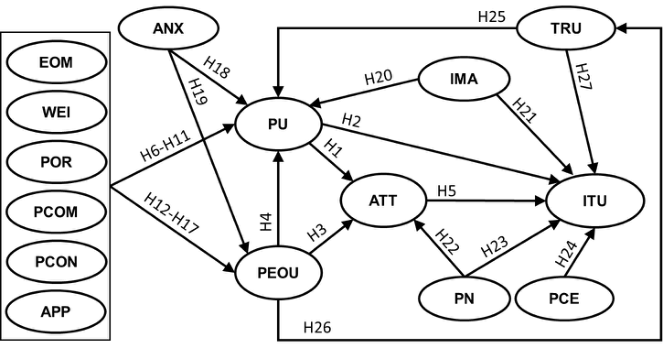
PERCEPTIONS AND INTENTION TO USE Following previous studies (Or et al., 2011; Or and Karsh, 2009; Yan and Or, 2018, 2019; Karsh, Holden and Or, 2011), we examined 14 variables related to perceptions of wearable and assistive devices and the influences of these perceptions on the ITU. The variables and their hypothesized relationships with ITU are presented in Table 1 and Figure 1.
APPARATUS AND METHODS Wearable and Assistive Devices Used in the Study
Seven commercially available, wearable and assistive devices designed to sup- port motor function rehabilitation, provide assistance with daily activity, and promote knee care were used. Table 2 presents the details of the devices.
Study Design At the start of the study, a questionnaire was used to collect information about the participants’ sex, age, and education level. A researcher then explained to the participants the purpose, usage, features, and price of seven wearable and assistive devices. Participants were instructed to choose any three of the devices and try them out. Participants were required to perform three tasks with each device chosen, including using, carrying, and maintai- ning the device, as if they were regular users. After the participants had tried out the three devices, we assessed their perceptions of and ITU the devices. Each perception variable was measured using a measurement scale with mul- tiple items adapted from previous studies. The participants were asked to rate each item using a 7-point Likert scale (0, strongly disagree to 6, strongly agree), with higher scores denoting more favorable perceptions.
Perceptions of and Intention to Use Wearable and Assistive Devices Among Older Adults 103
Table 1. Definitions of the 14 perception variables and ITU, and their hypothesized relationships (→denotes a significantly positive influence).
Table available in the original PDF paper.
Definition Hypothesis Perception variable
H1: PU →ATT H2: PU →ITU
Perceived usefulness (PU)
The extent to which older adults believe that the devices are useful for their intended purposes Perceived ease of use (PEOU) The degree of ease felt by older adults when using the devices
H5: ATT →ITU
H3: PEOU →ATT H4: PEOU →PU Attitude (ATT) Positive or negative feelings regarding device use The degree of ease felt by older adults when maintaining the devices H6: EOM →PU H12: EOM →PEOU Ease of maintenance (EOM)
Weight (WEI) The extent to which older adults consider the device weights to be acceptable
H7: WEI →PU H13: WEI →PEOU Portability (POR) The degree of ease felt by older adults when carrying the devices
H8: POR →PU H14: POR →PEOU Perceived comfort (PCOM)
The degree of comfort felt by older adults when using the devices The degree of convenience felt by older adults when using the devices
H10: PCON →PU H16: PCON →PEOU
H9: PCOM →PU H15: PCOM →PEOU Perceived convenience (PCON) Appearance (APP) The extent to which the appearance of the devices is considered attractive by older adults H11: APP →PU H17: APP →PEOU Anxiety (ANX) The degree of anxiety felt by older adults when using the devices
H20: IMA →PU H21: IMA →ITU
H18: ANX →PU H19: ANX →PEOU Image (IMA) The extent to which older adults believe that using the devices makes them appear dependent Perceived need (PN) The extent to which older adults believe that they need to use the devices
H24: PCE →ITU The extent to which older adults believe that the devices are cost-effective
H22: PN →ATT H23: PN →ITU Perceived cost-effectiveness (PCE) Trust (TRU) The degree of trust felt by older adults when using the devices
N/A
H25: TRU →PU H26: TRU →PEOU H27: TRU →ITU Intention to use (ITU)
The strength of older adults’ intention to use the devices in the near future
Participants The participants were recruited using posters displayed on the campus of the University of Hong Kong and at a local senior service center. A researcher contacted all the interested individuals and determined their eligibility based on the following criteria: age of 65 years or older; ability to communicate in Chinese; ability to complete the experiment independently; and a lack of injury to or impairment of the spine, hip, knee, or any other joint. Finally, eligible individuals were invited to the experimental site at the University of Hong Kong to participate in the study.
Figure 1: Examined perception variables and their hypothesized relationships with the intention to use the wearable and assistive devices.Table 2. Wearable and assistive devices used in the study.
Table available in the original PDF paper.
Device Specifications Hand function rehabilitation device The device provides resistance for hand functional rehabilitation training. Knee assist device The device provides resistance when the knee is flexed and assistance when it is extended. Heating knee pads The device warms the knee area. Walking assist device The device provides traction to help lift the legs while walking. Knee joint massage device
The device applies pressure and vibration to different acupoints on the knee and helps relax the muscles. Wearable chair device The device provides a wearable seat to enable the user to sit and rest anywhere and at any time. Sitting assist device The device provides resistance when sitting and assistance when leaving the seat.
Data Analysis Descriptive statistics were used to describe the characteristics of the sam- ple and the participants’ self-rated measurements of the perception variables and ITU. The scores for all of the items in each measurement scale were aggregated to obtain the mean, median, mode, and standard deviation (SD) for the corresponding variable. Cronbach’s alpha (α) and composite reliabi- lity (CR) were calculated to assess internal consistency; the average variance extracted value (AVE) was calculated to assess convergent validity; and the Fornell–Larcker criterion was used to assess discriminant validity. Partial least squares path analysis was performed to examine the relationships betw- een the perception variables and their influences on ITU. The P values and
Perceptions of and Intention to Use Wearable and Assistive Devices Among Older Adults 105
95% confidence intervals of the path coefficients were obtained using a boot- strapping procedure with 5,000 subsamples randomly extracted from the original dataset.
RESULTS
Characteristics of Participants Eight-one participants (mean age = 70.1 years, SD = 4.1) were examined. The sample characteristics are presented in Table 3.
Table 3. Sample characteristics (N = 81).
Table available in the original PDF paper.
Characteristics Frequency (%) Sex
Female 54 (66.7) Male 27 (33.3) Age group (years) 65–74 73 (90.1) 75–84 7 (8.7) ≥85 1 (1.2) Education
Primary school or below 26 (32.1 Some or completed secondary school 10 (12.4) Diploma, advanced diploma, associate degree, or equivalent 15 (18.5) Bachelor’s degree or above 30 (37.0)
Measurement Validation The reliability and validity of the measurements were acceptable, with Cron- bach’s α values of 0.75–0.97, CR of 0.89–0.99, and AVE 0.78–0.97. The square root of the AVE for each variable was greater than the correlation of each variable with other variables, thus meeting the Fornell–Larcker criterion of discriminant validity.
Measurements of Variables
Table 4 presents the participants’ self-rated measurements of the 14 perce- ption variables and their ITU wearable and assistive devices.
Partial Least Squares Path Analysis
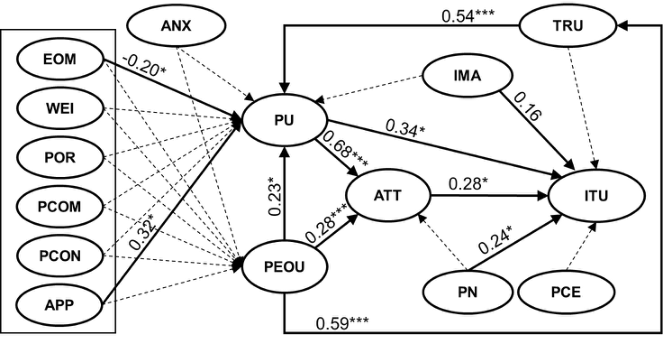
Table 5 and Figure 2 present the results of the partial least squares path analy- sis. Significant path coefficients are indicated in Figure 2. Based on the R2 values, the variables explained 72% of the total variance in ITU.
DISCUSSION
Main Findings Nearly half of the older adults who participated in our study expressed an ITU for the wearable and assistive devices after trying them. We found that,
Table 4. Self-rated measurements of perception variables and ITU (range of possible scores: 0–6, higher scores denote more favorable perceptions).
Figure 2: Path coefficients of the statistically significant influential relationships betw- een perception variables and ITU.
overall, the older adults had positive perceptions of the wearable and assistive devices. We observed the following: first, a high PU was associated with an improved ATT (H1) and enhanced ITU (H2). Second, improving the EOU was associated with an improved ATT (H3) and PU (H4). Third, a positive ATT was associated with a high ITU (H5). Fourth, IMA (H21) and PN (H23) positively influenced the participants’ ITU.
TRU was found to mediate the effect of PEOU on PU (H25, H26). Two antecedent variables of PU were identified in our study, namely EOM (H6) and APP (H11). Contrary to our hypothesis, a higher EOM score was associa- ted with lower PU (H6 was not supported). This outcome may have occurred
Perceptions of and Intention to Use Wearable and Assistive Devices Among Older Adults 107
Table 5. Path coefficients and significance of the hypothesized relationships between variables (P value: * < 0.05, ** < 0.01, *** < 0.001).
because devices that are simple to maintain generally have simpler structures and relatively fewer functions and thus, have a low PU. In contrast, a high APP score was associated with high PU. This may have occurred because an attractive appearance can encourage the user to explore the features of the device and thus, gain awareness of its usefulness. Older adults reported a reduced ITU when they believed that using the devices would make them appear less independent, indicating that such stigma could present barriers to device implementation. In contrast, older adults reported an increased ITU when they believed that the devices were required to perform daily activities.
Implications To improve the PU of wearable and assistive devices, developers should understand the needs of older adults; this will enable the developers to find and focus on target audiences. For example, hand rehabilitation devices can be provided for older adults with impaired hand functionality and walking aids could be provided for those with gait difficulties. Improving APP would also be beneficial as it would encourage older adults’ interest in learning
about and using the devices and increase their awareness of the devices’ bene- fits. To increase PEOU, practitioners should conduct usability tests during development, reduce the probability of user errors, and increase device effe- ctiveness and user satisfaction (Or, Holden and Valdez, 2023; Cheung et al., 2018; Or and Tao, 2012; Cheung et al., 2016; Tao and Or, 2012). The use of large, clearly visible, and easy-to-read operation panels and adjustable wearable designs, simplification of the operation process, and correction of common errors are feasible measures toward this goal. Practitioners should also consider providing detailed user manuals that can enable older adults to learn how to use the devices. Furthermore, the devices should be evalu- ated to ensure reliable quality and functional stability. These measures will increase TRU among users and thus, improve PU. Older adults can benefit from assistance to overcome psychological barriers hindering the use of wea- rable and assistive devices, as such efforts would improve IMA. One possible way to overcome such barriers is to increase the prevalence of device use; this would reduce the shame felt by older adults when using the devices as many of their peers would be using the same devices. As a related measure, healthcare institutions could provide mental health counseling to older adults who would benefit from using wearable and assistive devices with the aim of overcoming stigma. Finally, as older adults increase their use of wearable and assistive devices, their knowledge of the benefits of the devices will increase, they will likely become proficient in device usage and thus, have high PN. Therefore, the distributors of wearable and assistive devices should provide more opportunities to test the devices and thus, increase PN. Advertising the devices through television, newspapers, and other media outlets can also help improve PN.
Limitations Some of the participants recruited from the university campus were active or retired university faculty and had a higher average education level than the general public. In addition, the participants recruited for this study were healthy older adults who generally did not have deficits in motor ability and therefore, may have had less need for motor assistance. These two approaches of participant recruitment may have affected our results. In future studies, participants can be recruited from the general public.
CONCLUSIONS
This study examined the perceptions of and ITU for seven wearable and assi- stive devices among older adults. We found that the participants generally had positive perceptions of the devices and that the perception variables of APP, PN, IMA, and TRU positively influenced ITU, whereas EOM negatively influenced ITU. Practitioners should understand the needs of older adults, reduce their investment in promoting EOM, optimize the appearance and usability of the devices, and provide opportunities to try out the devices, all of which should be useful in improving older adults’ perceptions of and ITU for wearable and assistive devices.
Perceptions of and Intention to Use Wearable and Assistive Devices Among Older Adults 109
ACKNOWLEDGMENT
The authors would like to acknowledge a matching fund from the Depar- tment of Industrial and Manufacturing Systems Engineering at the University of Hong Kong (principal investigator: Calvin Or) and the Theme-based Rese- arch Scheme (TRS) fund (principal investigator: Ning Xi; project number: T42-717/20-R).
REFERENCES
Chen, T., Chen, J., Or, C. K. and Lo, F. P. (2022) “Path Analysis of the Roles of Age, Self-Efficacy, and TAM Constructs in the Acceptance of Performing Upper Limb Exercises through Immersive Virtual Reality Games”. International Journal of Industrial Ergonomics. 91, 103360. Chen, T., Or, C. K. and Chen, J. (2021) “Effects of Technology-Supported Exercise
Programs on the Knee Pain, Physical Function, and Quality of Life of Indivi- duals with Knee Osteoarthritis and/or Chronic Knee Pain: A Systematic Review and Meta-Analysis of Randomized Controlled Trials”. Journal of the American Medical Informatics Association. 28 (2), 414–423. Cheung, D. S. T., Or, C. K. L., So, M. K. P. and Tiwari, A. (2018) “Usability Testing of a Smartphone Application for Delivering Qigong Training”. Journal of Medical Systems. 42 (10), 191. Cheung, S. T., Tiwari, A. F. Y., Hui, V., Or, K. L. and So, M. (2016) “Usabi-
lity Testing of a Smartphone Application for Delivering Qigong Training”. In: Academy on Violence and Abuse 2016 Global Health Summit on Violence and Abuse. Spartanburg, South Carolina. 20–21 October 2016. Cianchetti, M., Laschi, C., Menciassi, A. and Dario, P. (2018) “Biomedical Applications of Soft Robotics”. Nature Reviews Materials. 3 (6), 143–153. Gallagher, D., Visser, M., Sepúlveda, D., Pierson, R. N., Harris, T. and Heymsfield,
S. B. (1996) “How Useful Is Body Mass Index for Comparison of Body Fatness across Age, Sex, and Ethnic Groups?”. American journal of epidemiology. 143 (3), 228–239. Grimmer, M., Riener, R., Walsh, C. J. and Seyfarth, A. (2019) “Mobility Related Physical and Functional Losses Due to Aging and Disease-a Motivation for Lower Limb Exoskeletons”. Journal of NeuroEngineering and Rehabilitation. 16 (1), article 2. Herr, H. M. and Kornbluh, R. D. (2004) “New Horizons for Orthotic and Pros-
thetic Technology: Artificial Muscle for Ambulation”. In: Proceedings of the International Society for Optical Engineering. 27 July 2004. 1–9. Holden, R. J. and Karsh, B.-T. (2010) “The Technology Acceptance Model: Its Past and Its Future in Health Care”. Journal of Biomedical Informatics. 43 (1), 159– 172. Karsh, B., Holden, R. J. and Or, C. K. L. (2011) “Human Factors and Ergonomics of
Health Information Technology Implementation”. In: P. Carayon (ed.). Handbook of Human Factors and Ergonomics in Health Care and Patient Safety. 2nd edition. Boca Raton, Florida, CRC Press. 249–264. Liu, K., Or, C. K., So, M., Cheung, B., Chan, B., Tiwari, A. and Tan, J. (2022) “A Longitudinal Examination of Tablet Self-Management Technology Acceptance by Patients with Chronic Diseases: Integrating Perceived Hand Function, Perceived Visual Function, and Perceived Home Space Adequacy with the TAM and TPB”. Applied Ergonomics. 100, article 103667.
Musich, S., Wang, S. S., Ruiz, J., Hawkins, K. and Wicker, E. (2018) “The Impact of Mobility Limitations on Health Outcomes among Older Adults”. Geriatric Nursing. 39 (2), 162–169. Or, C. and Tao, D. (2012) “Usability Study of a Computer-Based Self-Management
System for Older Adults with Chronic Diseases”. Journal of Medical Internet Research (JMIR)-Research Protocols. 1 (2), e2184. Or, C. K., Holden, R. J. and Valdez, R. S. (2023) “Human Factors Engineering and User-Centered Design for Mobile Health Technology: Enhancing Effective- ness, Efficiency, and Satisfaction”. In: V. G. Duffy, M. Ziefle, P.-L. P. Rau, and M. M. Tseng (eds.). Human-Automation Interaction: Mobile Computing. Cham, Springer International Publishing. 97–118. Or, C. K. L. and Karsh, B.-T. (2009) “A Systematic Review of Patient Acceptance
of Consumer Health Information Technology”. Journal of the American Medical Informatics Association. 16 (4), 550–560. Or, C. K. L., Karsh, B.-T., Severtson, D. J., Burke, L. J., Brown, R. L. and Brennan, P. F. (2011) “Factors Affecting Home Care Patients’ Acceptance of a Web-Based Interactive Self-Management Technology”. Journal of the American Medical Informatics Association. 18 (1), 51–59. Rosso, A. L., Taylor, J. A., Tabb, L. P. and Michael, Y. L. (2013) “Mobility, Disability,
and Social Engagement in Older Adults”. Journal of Aging and Health. 25 (4), 617–637. Tao, D. and Or, C. (2012) “A Paper Prototype Usability Study of a Chronic Disease Self-Management System for Older Adults”. In: 2012 IEEE International Confere- nce on Industrial Engineering and Engineering Management. Hong Kong, China, IEEE. 1262–1266. Tefertiller, C., Pharo, B., Evans, N. and Winchester, P. (2011) “Efficacy of Reha-
bilitation Robotics for Walking Training in Neurological Disorders: A Review”. Journal of Rehabilitation Research and Development. 48 (4), 387–416. Xie, Z. and Or, C. (2020) “Acceptance of MHealth by Elderly Adults: A Path Analysis”. Proceedings of the Human Factors and Ergonomics Society Annual Meeting. 64 (1), 755–759. Yan, M. and Or, C. (2019) “A 12-Week Pilot Study of Acceptance of a Computer-
Based Chronic Disease Self-Monitoring System among Patients with Type 2 Diabetes Mellitus and/or Hypertension”. Health Informatics Journal. 25 (3), 828–843. Yan, M. and Or, C. (2018) “Factors in the 4-Week Acceptance of a Computer-Based, Chronic Disease Self-Monitoring System in Patients with Type 2 Diabetes Mellitus and/or Hypertension”. Telemedicine and e-Health. 24 (2), 121–129. Yong, V., Saito, Y. and Chan, A. (2009) “Changes in the Prevalence of Mobility
Limitations and Mobile Life Expectancy of Older Adults in Singapore, 1995– 2005”. Journal of Aging and Health. 22 (1), 120–140.
LISTED IN THE AHFE DIGITAL BOOKSTORE CATALOGUE
Explore the complete digital volume
Human Factors and Wearable Technologies
Read this individual research paper free through the original publisher, or explore the full digital proceedings book.
ISBN 978-1-958651-61-2
Explore this ISBN in the AHFE Bookstore ↗Listed in the July 2026 bookstore catalogue; search by ISBN to confirm current availability · Digital book purchase optional