Vivian Lou, Yuen Man Cheng, Ning Xi (2024). Advancing the Development of Intelligent Wearable Robots for Elderly Assistance: An Innovative User-Centric Co-Creation (UC3) Framework. In: Human Factors and Wearable Technologies. AHFE Open Access, vol. 141, pp. 37–47. https://doi.org/10.54941/ahfe1005053
Department of Social Work and Social Administration, The University of Hong Kong Hong Kong, China; Sau Po Centre on Ageing, The University of Hong Kong, Hong Kong, China ↗
Sarcopenia is an involuntary loss of muscle mass along with age, bringing pressure and challenges to older adults who demand independence. Wearable robots are promising solutions to address the adversities brought by sarcopenia. Using an innovative User-Centric Co-Creation (UC3) Framework, we conducted an iterative, transdisciplinary, multistage study in Hong Kong, to develop intelligent wearable robots to assist older adults in performing daily living tasks. A multimethod approach combining participatory workshops, quantitative assessments, and laboratory experiments was adopted. A total of 16 participants joined six sessions of participatory workshops to provide user requirements. 91 healthy older adults joined an experiment to provide reference data, and 55 older adults with sarcopenia potential joined an experiment to provide user data. User requirements provide insights for robotic design, reference group data informed the robotic team on system design, and user experiments in turn provided evidence for the robotic group to further improve robotic systems and identify outcome indicators at three levels, including physiological level, functional level, and behavioral level. Following the UC3 Framework, we involved users as equal partners in the development process and collected insightful data to develop wearable robots in iterative cycles.
Population aging is gaining prominence as a significant policy concern. This is primarily due to the simultaneous increase in both the absolute number and proportion of older individuals within populations worldwide (World Health Organization, 2021). In Asia and the Pacific, the number of people aged 60 years or over is increasing at an unprecedented rate and is projected to account for around 63 percent of the global population by 2050 (United Nations, 2022). Notably, China currently has the largest number of older
adults in the world (265 million) and this number is expected to reach 509 million by 2050 (United Nations, 2022). While the majority of countries have established measures to promote active and healthy aging, involuntary loss of muscle mass, strength, and function, termed sarcopenia, is one of the most striking effects of aging (Papadopoulou, 2020). Sarcopenia increases the risk of functional decline that brings negative impacts on independent living living (e.g., transfer to toilet, locomotion, climbing stairs; Bertschi et al., 2022), physical activity (Ohtsubo et al., 2022), and quality of life (Umegaki et al., 2020). As the global population continues to age, innovative solutions are needed to address the consequences of sarcopenia. Wearable robots, also known as exoskeletons, have emerged as a promising technology with the potential to assist individuals with sarcopenia in overcoming physical limitations (Goher and Fadlallah, 2020). According to the ASTM F48, wearable robots “aug- ments, enables, assists, and/or enhances physical activity through mechanical interaction with the body”, and “may include rigid or soft components, or both” (Lowe et al., 2019). Rigid systems utilize parallel link mechanisms aligned with the limbs to facilitate load transmission and provide assistance to the joints, however, they are criticized for being bulky and non-optimal human-machine coordination (Goher and Fadlallah, 2020). In light of these, soft wearable systems have flourished in recent years. Soft wearable robots simulate the working principles of human muscles and tendons, providing greater performance in terms of comfort, convenience, and coordination (Morris et al., 2023).
With a growing interest in developing soft wearable robots (Cakmak et al., 2022), researchers from multiple disciplines collaborate on wearable robots’ development that follows user-centered design (UCD), to improve acceptance and adoption (Baltrusch et al., 2020). Despite this trend, a recent integrative review shows three major gaps: (1) inadequate transdis- ciplinary collaboration, (2) insufficient user engagement, and (3) ineffective data curation (Cheng et al., 2022). To fill these gaps, we unfolded an inno- vative User-Centric Co-Creation (UC3) framework to develop intelligent soft wearable robots, to actualize “intelligent robotic elderly assistant to create hope” (i-REACH). The UC3 framework is exceptional in that unlike previ- ous approaches, it highlights the importance of treating potential users as peer researchers and involving them in each of the development cycle. This paper outlines the processes of applying the UC3 framework in i-REACH to obtain user requirements and experiment data.
METHODS
Study Design To meet the objectives, a multistage, multimodal design was adopted for this study. Instead of a study that included the users in the prototype testing stage, we decided to include users in the idea generation and conceptualization stage. Following the UC3 framework, described in detail below, we devel- oped two wearable robot prototypes (i.e., hand robots and knee robots) to assist older adults in daily living, between June 2021 and December 2022.
Advancing the Development of Intelligent Wearable Robots 39
The first phase was designed primarily to understand the user require- ments of the wearable robots while potential users familiarized themselves with the prototypes and provided initial feedback. The second phase explored the feasibility of experiment set-up and looking at reference data to inform robotic system designs. The third phase collected user data to improve wear- able robot prototypes and seek outcome indicators to test the effectiveness of the wearable robots at three levels: physiological, functional, and behavioral.
Procedures and Participants In the first phase, a 6-session participatory workshop was conducted with a total of 16 participants who were recruited via the networks of Sau Po Centre on Ageing, The University of Hong Kong (HKU), between June and August 2021. All of them met the following inclusion criteria: (1) aged 50 or above; (2) self-declared without memory or cognitive problems (e.g., dementia); (3) self-reported having mobility difficulties (i.e., primary user) or taking care of a person with mobility difficulties (i.e., caregiver) at the time of recruitment; (4) residing in Hong Kong; (5) able to communicate with the researchers in Cantonese, English or Mandarin; and (6) participate voluntarily. Dur- ing the workshops, we introduced i-REACH, collected user requirements of wearable robots, developed prototypes based on those data, showcased the prototypes, and collected feedback via direct communication with the participants.
In the second phase, a controlled experiment was conducted with 91 participants between July and August 2021 to act as a reference group. Par- ticipants were recruited via researchers’ networks and social media, with the following inclusion criteria: (1) aged 65 or above; (2) with a SARC-F score (measurement of sarcopenia potential) below 4; (3) living in the community in Hong Kong (i.e., not institutionalized); (4) self-reported without cognitive impairments; (5) able to participate independently in a laboratory setting; and (6) participate voluntarily. We tested the feasibility of the experiment setup, established linkages between functional and behavioral level data, and used the data to inform wearable robots’ development.
In the third phase, an expanded experiment was conducted with 66 partic- ipants between December 2021 and December 2022 to act as a user group. Participants were recruited using similar strategies as Stage 2, with additional efforts such as health booths, as well as distributing leaflets in all the public housing estates in Hong Kong. All the participants met the same inclusion and exclusion criteria as the reference group, except they reported difficulties in mobility and/or manipulability (26 obtained a SARC-F score < 4; 40 obtained a SARC-F score ≥4). We tested the practicality of the experiment setup and devices, and collected data at physiological, functional, and behavioral levels, to further improve the wearable robots.
Data Collection, Assessments, and Analysis In the first phase, we collected the qualitative data including audio record- ings, video recordings, memos, and worksheets. These data were synthesized
to form user requirements and provided valuable indicators for develop- ing wearable robot prototypes. Table 1 shows the characteristics of the participants.
Table 1. Characteristics of participants in the first phase.
Table available in the original PDF paper.
Code Age Gender Category A1 75 F Primary user (with mobility difficulties) A2 58 F Caregiver A3 63 M Caregiver A4 60 M Caregiver A5 59 F Caregiver A6 54 M Caregiver A7 87 M Caregiver A8 62 F Caregiver A9 54 F Caregiver A10 66 M Caregiver A11 76 F Primary user (with mobility difficulties) and caregiver A12 63 M Caregiver A13 60 F Caregiver A14 58 F Caregiver A15 70 M Caregiver A16 69 M Caregiver
In the second and third phases, we collected subjective measures before inviting the participants for experiments. Subjective measures include the eHealth Literacy Scale (Norman and Skinner, 2006), the SarQoL® ques- tionnaire (Beaudart et al., 2017; Lou, 2023), and the brief 14-item Senior Technology Acceptance Model (STAM; Chen and Lou, 2020). Demograph- ics including gender, year of birth, marital status, highest education level, employment status, income sources, self-perceived financial status, housing, living arrangement, and medical history were obtained. These data pro- vide overall insights to triangulate the results obtained from standardized experiments.
For the purpose of informing wearable robots’ development, we collected experiment data at three levels: physiological, functional, and behavioral. Physiological level data were extracted using a motion capture system. Four selected parameters during gait motion were analyzed, including step length, stride length, opposite foot contact, and foot off. Functional level data included maximum voluntary contraction (MVC) using knee extension test at 73
, 52
, and 30
angles (Ushiyama et al., 2017), and maximum handgrip strength (Mehmet et al., 2020). Behavioral level data were collected using the Short Physical Performance Battery (SPPB) which consists of balance tests, gait speed tests, and chair stand tests (Guralnik et al., 2000). The experiment setup and devices used were published elsewhere (Lou et al., 2023).
Advancing the Development of Intelligent Wearable Robots 41
A performance-based risk hierarchy (Lou et al., 2023) was developed, following the recommended cutoffs on sarcopenia diagnosis by the Asian Working Group for Sarcopenia (Chen et al., 2020): (M: < 28kg, F: < 18 kg), gait speed test (< 1.0 m/s), chair stand test (≥12 s), and SPPB total score (≤9).
RESULTS
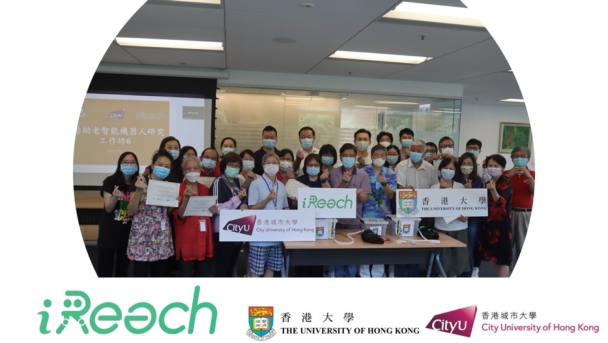
Phase 1 – From User Requirements to Initial Prototypes We enrolled 8 males and 8 females (54–87 years, M = 64.63 years, SD = 8.90). Among them, one reported being the primary user, another one reported being the primary user and the caregiver simultaneously. The remaining 14 reported being the caregivers, mainly taking care of a person with mobility difficulties. With careful design, we focused on one theme per session and collected feedback from the participants accordingly. Figure 1 displays a group photo of the workshop.
Figure 1: Participatory workshops organized by the i-REACH project.
Participants reflected that their care recipients or themselves have difficul- ties in daily living. Three major barriers were repeatedly mentioned: inability to walk for long distances, insufficient muscle strength to climb the stairs, as well as incompetence in carrying heavy things such as food purchased from the supermarket. Additionally, participants provided valuable insights into user requirements such as concerns about the usefulness and the ease of use of wearable robots. After gauging initial feedback and requirements, we decided to develop two wearable robots: hand robots and knee robots.
Participants tried the first generation of the wearable robot prototypes in the participatory workshop and offered suggestions for improvements. For instance, they requested anti-allergic materials, with adjustable size, and being waterproof. Moreover, concerns about marketable products were raised. For example, the durability of the wearable robots, privacy issues based on the insertion of sensors, and maintenance service. Finally, they found
that the prototypes were too bulky and inconvenient to the users. Table 2 details the workshop themes, activities, and feedback from the participants.
Despite these, the feedback was generally positive, and users found the wearable robots promising to assist daily living among older adults with sarcopenia potential. More importantly, they believed that wearable robots could bring hope to older adults who wish to maintain independent living in the community.
Table 2. Selected themes, activities, and feedback collected at the participatory workshops.
Table available in the original PDF paper.
# Themes Activities Example feedback/requirements
1 Context exploration
Constant rest time needed during walking
Difficulties in stair climbing
Unable to carry heavy things
Participants were invited to reflect on mobility difficulties they or their care recipients faced
2 Unmet needs examination
Usefulness (tailor-made, enhance effectiveness in performing daily living tasks, trendy, lightweight, safe)
Participants were invited to conduct the user, task, environment (UTE) analysis
Ease of use (easy to control, able to learn within a short period, affordable price, with maintenance service) 3 Robots’ components showcase
Researchers presenting nanosensors and two prototypes (hand robot and knee robot)
4 Prototypes’ try on (I)
Participants were invited to try on the two prototypes (hand robot and knee robot)
Acceptance (easy to wear on and off by the user, anti-allergy, size, portable, noise, balance, fall detection, hygiene, price) 5 Co-creating robots
Participants were invited to design and co-create ideal robots
Focus on lower limb robots and demand effectiveness in assisting walking, sit-to-stand, and stair climbing 6 Prototypes’ try on (II)
Current prototypes are too bulky
Participants were invited to try on the two prototypes (hand robot and knee robot)
Hydraulic-powered knee robots are inconvenient to users
Wearing the robots requires assistance from another person, reduces independence
Materials used for hand robots are rigid which creates uncomfortable feelings
Advancing the Development of Intelligent Wearable Robots 43
Phase 2 and 3 – From Comparisons to Robotics Systems Design Data were collected from 157 participants who resided in the commu- nity of Hong Kong, with ages ranging from 65 to 84 years (M = 69.05 years, SD = 3.39). Approximately two-thirds of the participants were female (n = 102) and married (n = 99). We differentiated the participants accord- ing to the performance-based risk hierarchy (Lou et al., 2023). Overall, it was found that approximately 49% of the participants had two risks or more. For this paper, we defined the low-risk group as participants with either no risks or only one risk, consisting of 80 individuals. The medium-risk group encom- passed participants with two to three risks, totaling 48 individuals. Lastly, the high-risk group included participants with all four risks, amounting to 29 individuals. Table 3 indicates the physiological, functional, and behavioral level data along the performance-based risk hierarchy.
Table 3. Physiological, functional, and behavioral level findings by risk groups (N = 157).
Table available in the original PDF paper.
L (N=5) M (N=15) H (N=18) Statistics Physiological level Step length (cm)** 39.88 (3.01) 34.25 (4.06) 32.95 (4.28) F(2,35) = 5.696 Stride length (cm)* 76.65 (6.00) 65.68 (7.96) 63.13 (8.87) F(2,35) = 5.300 Opposite foot contact (%) 26.20 (5.04) 30.46 (3.59) 30.69 (6.38) F(2,35) = 1.510 Foot off (%) 63.17 (2.42) 65.19 (1.85) 65.47 (3.41) F(2,35) = 1.372 Functional level L (N=41)@ M (N=41)@ H (N=28) Knee MVC at 73
(kgf)*** 18.52 (6.26) 14.80 (5.64) 11.03 (4.35) F(2,105) = 14.385 Handgrip strength (kg)*** 27.90 (7.87) 21.94 (7.34) 15.23 (5.56) F(2,154) = 33.079 Behavioral level L (N=80) M (N=49) H (N=28)#
Gait speed (m/s)*** 0.98 (0.20) 0.67 (0.13) 0.54 (0.17) F(2,154) = 85.167 SPPB (range: 0–12)*** 11.84 (.40) 9.78 (1.46) 7.75 (1.14) F(2,154) = 194.401 Chair stand test (s)*** 8.14 (1.87) 13.17 (4.92) 17.01 (3.91) F(2,151) = 76.107 Note. L, low-risk group. M, Medium-risk group. H, High-risk group. MVC, Maximum voluntary contrac- tion. SPPB, Short Physical Performance Battery. @The numbers of participants performing the handgrip strength test in the low-risk group and medium-risk group are 80 and 49, respectively. #The number of participants performing the chair stand test in the high-risk group is 26.
After the preliminary analysis of the data collected at three levels, the research team further improves the wearable robots’ design and seeks out- come indicators to test the effectiveness of wearable robots. Regarding the knee robots, physiological level data provided evidence of the relationships between risk hierarchy and two gait motion parameters: step length and stride length. Findings indicated linkages between gait motion and muscle strength, which guided the research team to develop a trigger system using electromyography. At the functional level and behavioral, knee maximum voluntary contraction (MVC) at three angles was important to inform the development of knee robots. With higher risks, participants perform worse in knee MVC. To this end, the research team focuses on improving the knee robots’ design from hydraulic-powered to air-powered and decided to use the chair stand test as an outcome indicator in subsequent user experiments.
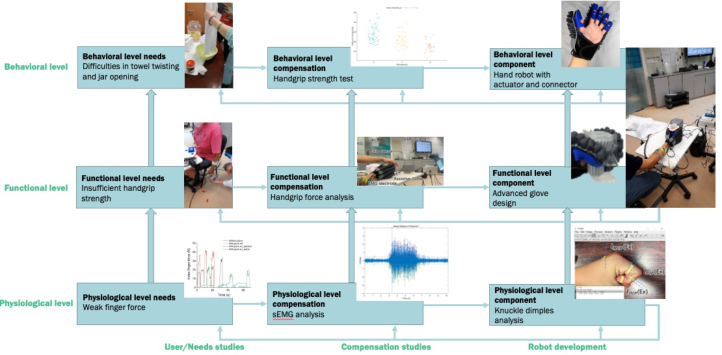
Apart from the knee robots, we also used the collected data to inform the development of hand robots. Figure 2 shows a schematic diagram of the processes. Further details of the hand robots have been published elsewhere (Liu et al., 2024).
Figure 2: Schematic diagram of the hand robots’ development.
DISCUSSION
The application of the UC3 framework in developing intelligent soft wearable robots for older adults with sarcopenia potential, as outlined in the i-REACH project, has shown promising results. The framework emphasizes the involve- ment of potential users as peer researchers throughout the development cycle, addressing gaps such as inadequate transdisciplinary collaboration, insuffi- cient user engagement, and ineffective data curation. This approach ensures that the wearable robots meet the specific needs and preferences of the target user group.
In the first phase of the study, user requirements were obtained through a participatory workshop involving 16 participants. Valuable feedback and insights were collected, highlighting the daily living difficulties faced by older adults with sarcopenia potential, including walking long distances, climbing stairs, and carrying heavy objects. This information guided the development of two wearable robot prototypes: hand robots and knee robots. The partic- ipants found the prototypes promising and believed that they could enhance independent living among older adults in the community.
In the second and third phases, a controlled experiment and an expanded experiment were conducted to collect data at physiological, functional, and behavioral levels. The data provided insights into the feasibility and effec- tiveness of the wearable robots. The participants were differentiated into low-risk, medium-risk, and high-risk groups based on their performance in various tests. The results showed that approximately 49% of the participants had two or more risks, indicating the prevalence of sarcopenia potential in the
Advancing the Development of Intelligent Wearable Robots 45
older adult population. This data informed the design of the robotic systems and helped improve the wearable robot prototypes.
The use of the UC3 framework in the i-REACH project has several advantages. By involving potential users as peer researchers, the frame- work ensures that their perspectives, needs, and preferences are considered throughout the development process. This user-centered approach increases the acceptance and adoption of wearable robots among the target user group. Additionally, the framework promotes transdisciplinary collaboration, bring- ing together researchers from multiple disciplines to contribute their expertise and knowledge. This collaboration enhances the development of intelligent soft wearable robots that are effective and practical.
However, there are some limitations to consider. The study sample was recruited from the community in Hong Kong, which may limit the general- izability of the findings to other populations or cultural contexts. Addition- ally, the study focused on the development and initial testing of wearable robot prototypes, and further research is needed to evaluate their long-term effectiveness and usability in real-world settings.
In general, the application of the UC3 framework in the i-REACH project has shown promise in developing intelligent soft wearable robots for older adults with sarcopenia potential. The involvement of potential users as peer researchers and the integration of data from multiple levels have contributed to the development of effective and user-friendly wearable robot prototypes. Further research and evaluation are needed to assess the long-term effective- ness, usability, and impact of these wearable robots in improving the quality of life and independent living among older adults with sarcopenia.
CONCLUSION
In conclusion, the application of the UC3 framework in the i-REACH project has shown promise in the development of intelligent soft wearable robots for older adults with sarcopenia potential. By involving potential users as peer researchers and incorporating their perspectives, needs, and preferences, the framework ensured an enhanced user-centered approach. The participatory workshop and subsequent experiments provided valuable insights into the daily living difficulties faced by older adults with sarcopenia potential and guided the development of effective hand and knee robot prototypes. While further research is needed to evaluate long-term effectiveness and usability, the UC3 framework offers advantages such as enhanced user-centeredness, increased acceptance, and improved transdisciplinary collaboration. Overall, these wearable robots have the potential to enhance the quality of life and support independent living among older adults with sarcopenia, addressing an important need in this population.
ACKNOWLEDGMENT
The authors would like to thank all study participants and the teams at The University of Hong Kong and the City University of Hong Kong. The work described in this paper was fully supported by a grant from the Research
Grants Council of the Hong Kong Special Administrative Region, China (Project No. [T42-717/20-R]).
REFERENCES
Baltrusch SJ, Houdijk H, Dieën JH van, et al. (2020) Perspectives of End Users on the Potential Use of Trunk Exoskeletons for People With Low-Back Pain: A Focus Group Study. Human Factors 62(3): 365–376. Beaudart C, Edwards M, Moss C, et al. (2017) English translation and validation
of the SarQoL®, a quality of life questionnaire specific for sarcopenia. Age and ageing 46(2): 271–276. Bertschi D, Kiss CM, Beerli N, et al. (2022) Impact of sarcopenia on daily functioning: a cross-sectional study among older inpatients. Aging Clinical and Experimental Research 34(9): 2041–2046. Cakmak S,Cegindir NY and Yilmaz HG (2022) The development of posture support-
ing soft exosuit design for adolescent idiopathic scoliosis. International Journal of Clothing Science and Technology 34(2): 228–240. Chen K and Lou VWQ (2020) Measuring Senior Technology Acceptance: Development of a Brief, 14-Item Scale. Innovation in Aging 4(3): igaa016-. Chen L-K, Woo J, Assantachai P, et al. (2020) Asian Working Group for Sarcope-
nia: 2019 Consensus Update on Sarcopenia Diagnosis and Treatment. Journal of the American Medical Directors Association 21(Geriatr Gerontol Int 17 2017): 300–307.e2. Cheng CYM, Lee CCY, Chen CK, et al. (2022) Multidisciplinary collaboration on exoskeleton development adopting user-centered design: a systematic integrative review. Disability and Rehabilitation: Assistive Technology. Epub ahead of print 2022. doi: 10.1080/17483107.2022.2134470. Goher KM and Fadlallah SO (2020) Assistive devices for elderly mobility and
rehabilitation: review and reflection. Elsevier, pp. 305–341. Available at: https: //dx.doi.org/10.1016/b978-0-12-818546-9.00016-6. Guralnik JM, Ferrucci L, Pieper CF, et al. (2000) Lower Extremity Function and Subsequent Disability: Consistency Across Studies, Predictive Models, and Value of Gait Speed Alone Compared With the Short Physical Performance Battery. The Journals of Gerontology: Series A 55(4): M221–M231. Liu H, Wu C, Lin S, et al. (2024) From Skin Movement to Wearable Robotics:
The Case of Robotic Gloves. Soft Robotics. Epub ahead of print 2024. doi: 10.1089/soro.2023.0115. Lou VWQ (2023) Traditional Chinese Hong Kong version of the SarQoL®. the Sar- QoL®. Available at: https://www.sarqol.org/sites/sarqol/files/SarQoL%20Traditi onal%20Chinese%20for%20Hong%20Kong.pdf. Lou VWQ, Cheng CYM, Chen K, et al. (2023) Applying an Innovative User-Centric
Co-Creation (UC3) Approach in Developing Intelligent Wearable Robots for Elderly Assistance: From a Transdisciplinary Lens. In: Structural Health Moni- toring 2023 (eds S Farhangdoust, A Guemes, and F-K Chang), United States of America, 2023, pp. 2023–2035. DEStech Publi cations, Inc. Lowe BD, Billotte WG and Peterson DR (2019) ASTM F48 Formation and Standards for Industrial Exoskeletons and Exosuits. IISE Transactions on Occupational Ergonomics and Human Factors 7(3–4): 230–236. Mehmet H, Yang AWH and Robinson SR (2020) Measurement of hand grip strength
in the elderly: A scoping review with recommendations. Journal of Bodywork and Movement Therapies 24(1): 235–243.
Advancing the Development of Intelligent Wearable Robots 47
Morris L, Diteesawat RS, Rahman N, et al. (2023) The-state-of-the-art of soft robotics to assist mobility: a review of physiotherapist and patient identified limi- tations of current lower-limb exoskeletons and the potential soft-robotic solutions. Journal of NeuroEngineering and Rehabilitation 20(1): 18. Norman CD and Skinner HA (2006) eHEALS: The eHealth Literacy Scale. Journal
of Medical Internet Research 8(4): e27. Ohtsubo T, Nozoe M, Kanai M, et al. (2022) Association of sarcopenia and physical activity with functional outcome in older Asian patients hospitalized for rehabilitation. Aging Clinical and Experimental Research 34(2): 391–397. Papadopoulou SK (2020) Sarcopenia: A Contemporary Health Problem among
Older Adult Populations. Nutrients 12(5): 1293. Umegaki H, Bonfiglio V, Komiya H, et al. (2020) Association Between Sarcopenia and Quality of Life in Patients with Early Dementia and Mild Cognitive Impairment. Journal of Alzheimer’s Disease 76(1): 435–442. United Nations (2022) Asia-Pacific Report on Population Ageing 2022. United
Nations. Available at: https://repository.unescap.org/rest/bitstreams/0aeae6b6- f480-43c6-9c8c-dfe81bfec6cf/retrieve. Ushiyama N, Kurobe Y and Momose K (2017) Validity of maximal isometric knee extension strength measurements obtained via belt-stabilized hand-held dynamometry in healthy adults. Journal of Physical Therapy Science 29(11): 1987–1992. World Health Organization (2021) Ageing. Available at: https://www.who.int/heal
th-topics/ageing#tab=tab_1.
LISTED IN THE AHFE DIGITAL BOOKSTORE CATALOGUE
Explore the complete digital volume
Human Factors and Wearable Technologies
Read this individual research paper free through the original publisher, or explore the full digital proceedings book.
ISBN 978-1-964867-17-5
Explore this ISBN in the AHFE Bookstore ↗Listed in the July 2026 bookstore catalogue; search by ISBN to confirm current availability · Digital book purchase optional