Runting Zhong, Saihong Han, Mengyao Ma, Yunlong Xu, Meiyu Fan, Yixuan Chang (2024). Understanding Chinese Adults’ Attitudes Towards IoT Home Care Technologies. In: Human Dynamics, Product Evaluation and Quality. AHFE Open Access, vol. 131, pp. 72–80. https://doi.org/10.54941/ahfe1004865
Internet of Things (IoT) technology provides innovative solutions for home care. This study investigates Chinese adults’ preferences and influencing sociodemographic factors of using IoT home care technologies. A total of 512 Chinese (Mean age = 46.1 years, SD = 18.1 years) were investigated about their use and interest in 26 types of IoT home care technologies, overall willingness to use the technologies, and sociodemographic information using an online survey. Stepwise regression was used to identify predictors for ownership of IoT home care technologies and willingness to use IoT technologies. This study found that the overall ownership of IoT home care technologies was not high (Mean number of IoT technologies ‘already in use’ = 8.1 among the 26 selected technologies, SD = 5.0). Chinese users generally had a positive attitude towards such technologies. Their concern focused on home safety and health. People who were younger, more competent with housework, had a monthly disposable income of over 3000 Chinese Yuan (CNY), had more communication with neighbours, lived in a city, had better self-reported health status, lived in a villa and with Internet connection had higher overall scores for ownership of IoT technology. People with better communication skills, who were younger, lived in a city, had a monthly disposable income of 5000–10000 CNY, were more competent with housework and continued to work were more willing to use IoT home care technologies. This study helps stakeholders and policymakers understand the sociodemographic diversity the requirements for IoT home care among Chinese adults.
The Internet of Things (IoT) smart home provides innovative solutions for home care (Chen, 2020; Javaid and Khan, 2021). IoT technology refers to a modern technology that can connect devices (mobile phones, computers, sensors, voice assistants, etc.) and people in an intelligent way anytime, any- where (Lee et al., 2020). It was estimated that the IoT market in China would surpass $300 billion in 2025, according to an industry report (Xinhua, 2021).
Understanding Chinese Adults’ Attitudes Towards IoT Home Care Technologies 73
Sociodemographic factors influence IoT home care technologies’ adoption. Wilkowska et al. (2021) found that health status and gender affected Ger- man older participants’ opinions to assistive technologies the most among individual factors. Arthanat, Wilcox and Macuch (2019) found those who were female, 60–70 years old, living in a two-level home, physically impaired, with a history of falls, experienced in information and communication (ICT) technology were likely to be smart home ‘brisk adopters’. Marital status, home security and overall ICT ownership are predictors of smart home ownership, while being female, concern over home security and perceived independence predict readiness to use smart home technology. He et al. (2022) found that Chinese adults with good health skills had better utilisa- tion of smart home technologies, while Huang et al. (2022) found that older adults’ age, number of children, frequency of children visiting parents, ade- quate senior care, self-reported health, chronic disease, smartphone use and attitude toward smart senior care were significantly associated with willing- ness to choose smart senior care. Zeng and Chen (2023) found that the future older adults in China have a positive and open attitude toward smart homes, whereas they have worries about the use of smart home at present.
This study reports the results of a survey study to understand Chinese adults’ attitudes towards IoT home care technologies. This study aims at answering the following questions: RQ1. What kind of IoT home care tech- nologies are preferred among Chinese users? RQ2. Who are more willing to use IoT home care technologies among Chinese users? This study provides the following contributions. First, it highlights the priority of IoT technolo- gies that are needed by Chinese adults. Second, it identifies sociodemographic predictors of IoT technology ownership and willingness to use IoT home care technologies.
This paper is structured as follows. Section 1 presents the background and research questions of this study. Section 2 describes the method of this study including questionnaire design, participants, and data analysis. Section 3 presents our results. Section 4 discusses what these results indicate, as well as their implications and limitations. Section 5 gives a summary of this study.
METHOD
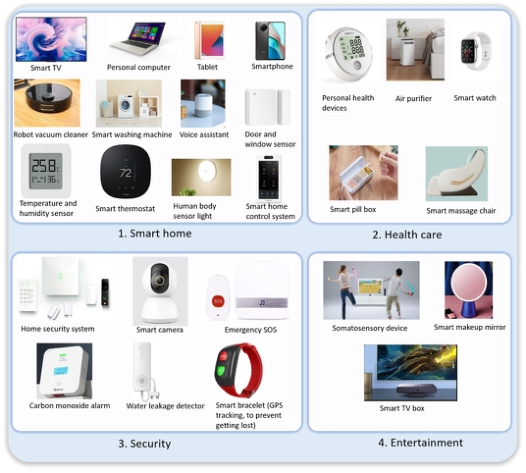
Questionnaire Design A questionnaire was designed with 58 questions. Participants were invited to report their use and interest in 26 types of IoT home care technologies, their expectations, overall willingness to use IoT home care technologies, and sociodemographic information with an online survey. The original IoT devices were selected from previous literature (Arthanat et al., 2018; Li et al., 2017; Tiersen et al., 2021). The research team members discussed and deleted devices that were not commonly used in China, for example, backup gener- ator and auto-shutoff stove (Arthanat et al., 2018). The research team also added some devices that were not mentioned in previously reviewed litera- ture, for example, smart pill box, smart massage chair and smart makeup mirror. The devices were primarily divided into four categories: smart home; health care; security; and entertainment (see Figure 1), with reference to a previous study (Lee et al., 2020). Participants’ level of interest in IoT tech- nologies was evaluated using a three-point scale: ‘already in use’; ‘never used
but interested in using it’; and ‘never used and not interested in using it’. The willingness to use IoT home care technology services consisted of seven questions measured by a five-point Likert scale ranging from 1 (strongly dis- agree) to 5 (strongly agree): ‘I am able to use the Internet’, ‘I would like to use the Internet’, ‘I am able to use a smartphone’, ‘I would like to use a smart- phone’, ‘I have heard of the Internet of Things’, ‘I am currently using IoT technology’ and ‘I would like to use IoT home health services’.
Participants Chinese adults from 28 provinces or municipalities were invited to complete the online questionnaires. Those interested in the study were allowed to fill in the online questionnaire. Participants were recruited through community, social media, and word of mouth. Older adults unable to use smartphones or computers were allowed to complete the questionnaire with the help of their children or grandchildren. The participants were paid for their participation in the survey.
Questionnaires are distributed through https://www.wjx.cn/. The partici- pants were informed about the objective of the questionnaire and assured of the anonymity of data collection at the beginning of the questionnaire. The authors’ university approved the study ethics. The survey ran from 22 Jan- uary 2022 to 13 February 2022. A total of 550 questionnaires were received, of which 512 were valid (93.1%). We excluded questionnaires using the fol- lowing methods: (1) speeders (those who answered unreasonably quickly) who finished the survey at an average speed of less than two seconds per question (Zhang and Conrad, 2014); (2) the participant did not complete the questionnaire; and (3) participants who reported an age that did not match their birth year asked.
A total of 512 Chinese adults (Mean age = 46.1 years, SD = 18.1 years, 56.6% female) participated in the study. More than half (56.6%) of the par- ticipants had some college education and higher. 76.6% of the participants reported residence in a city and 23.4% rurally. Nearly half (49.3%) of the sample had a disposable income per month of less than 3000 CNY (US $ 446.1) and 50.9% had a disposable income per month of more than 3000 CNY; around China’s per capita disposable income. More than half (52.5%) of the participants lived in an apartment. Most of the participants lived with others, while 7.4% lived alone.
Data Analysis The study first used descriptive statistics to analyse the use of IoT technology. The 26 IoT technologies selected for the study were coded according to the responses of the participants: 2 = already in use; 1 = never used but interested in using it; 0 = never used and not interested in using it. Therefore, the overall acceptance score for IoT technology ranged from 52 (owning all 26 devices) to 0 (not using or interested in using any of the devices). The willingness to use IoT home care technologies was calculated as the average value of the seven questions mentioned before, ranging from 5 (highest willingness) to 1 (lowest willingness). The Cronbach’s alpha for the willingness to use IoT home care technologies was 0.948.
Understanding Chinese Adults’ Attitudes Towards IoT Home Care Technologies 75
A multiple stepwise regression was used to determine the predictors of IoT technology ownership and willingness to use IoT home care technologies. The dependent variables were IoT ownership and willingness to use IoT home care technologies. The independent variables were the sociodemographic factors of the participants, including age, gender, education, residence, dis- posable income per month, residential housing, who they lived with, Internet access, whether there was a disease, number of falls, self-reported health status, self-reported mental status, whether there was medical insurance, medication, whether using assistive equipment, vision, hearing, commu- nication, competent with housework, marital status, communication with children, communication with neighbours, communication help, and work- ing status. These variables were chosen because they were likely to affect the IoT technologies that participants owned and their willingness to use IoT home care technologies. The categorial variables (e.g. gender, education, residence) were set as dummy variables. Multicollinearity was verified. Any predictor variable with tolerance less than 0.1 and a variance inflation factor above 5 was removed from the model.
Data analysis was conducted using IBM SPSS v.26. The level of statistical significance (p) was set to 5%. The data to support the study findings are available from the corresponding author upon request.
Figure 1: Selected IoT devices in this study.
RESULTS
IoT Experience and Preferences Among Chinese Users The overall ownership of IoT devices was not high. The average number of IoT home care technologies ‘already in use’ was eight (SD = 5.0). Only
six IoT devices (smartphone, smart TV, personal computer, smart washing machine, tablet and personal health devices) exceeded the ownership rate (i.e. already in use) of 50%. However, most participants showed an inter- est in using IoT devices, indicating an overall positive attitude towards such technologies. The top five devices that had not been used but which partic- ipants were interested in using were emergency SOS (75.4%), smart home control system (67.8%), water leakage detector (66.6%), home security sys- tem (65.4%) and smart thermostat (65.4%). The top five devices that had never been used or that they were interested in using were smart makeup mirrors (47.7%), somatosensory devices (37.3%), smart pill boxes (31.1%), smart watches (29.1%) and water leakage detector (27.1%).
Predictors of IoT Technology Ownership and Willingness to Use IoT Home Care Technologies The stepwise regression results are presented in Table 1. The average IoT ownership score was 28.7 (SD = 8.9). Predictors entered into the model to predict the IoT ownership score were: age; competent with housework; disposable income; communication with neighbours; residence in city; self- reported health status; residential housing; and connected to the Internet. This indicated that people who were more competent with housework, had a monthly disposable income of over 3000 CNY, had more communication with neighbours, lived in a city, had better self-reported health status, lived in a villa and with Internet connection had higher overall scores for own- ership of IoT technology (ps < 0.05). Increasing age and living in a nursing home were negative predictors of IoT ownership score (ps < 0.05). The model explained 36% of the total variance.
The average willingness to use IoT home care technologies was 4.3 (SD = 0.9), indicating that the participants had a positive attitude towards such technologies. Predictors of the willingness to use IoT home care tech- nologies were: communication skill; age; residence in a city; disposable income; competent with housework; working status. This indicates that peo- ple with better communication skills, who were younger, lived in a city, had a monthly disposable income of 5000–10000 CNY, were more competent with housework and continued to work were more willing to use IoT home care technology (ps < 0.05). Increasing age was a negative predictor of willingness to use IoT home care technologies (ps < 0.05). The model explained 22% of the total variance.
Table 1. Standardised coefficient of stepwise regression: IoT ownership score and willingness to use IoT home care technologies.
Table available in the original PDF paper.
Independent Variables IoT Ownership Score
Willingness to Use IoT Home Care Technologies Age −0.39∗∗ −0.18∗∗ Competent with houseworka 0.11∗ 0.12∗ Disposable incomeb
10000 CNY and above 0.26∗∗ n.s.
(Continued)
Understanding Chinese Adults’ Attitudes Towards IoT Home Care Technologies 77
Table 1. Continued Independent variables IoT ownership score
Table available in the original PDF paper.
Willingness to use IoT home care technologies 5000–10000 CNY 0.28∗∗ 0.11∗ 3000–5000 CNY 0.17∗∗ n.s. Communication with neighboursc 0.17∗∗ n.s. Communication skilld 0.21∗∗ Residence in citye 0.14∗∗ 0.13∗∗ Self-reported health statusf 0.10∗ n.s. Residential housingg
Villa 0.09∗ n.s. Nursing home −0.08∗ n.s. Connected to the Interneth 0.07∗ n.s. Continue to worki n.s. 0.12∗ Note: n.s. = not significant. Measured by Likert scale: 1 = strongly disagree, 5 = strongly agree Reference group: 500 CNY and below 0 = no neighbours, 1 = no communication at all, 2 = monthly communication, 3 = weekly communica- tion, 4 = daily communication Measured by Likert scale: 1 = very bad, 5 = very good Reference group: Residence in rural Measured by Likert scale: 1 = very bad, 5 = very good Reference group: Apartment Reference group: No connection to the Internet Reference group: Retirement
DISCUSSION
For RQ1, the overall ownership of IoT home care devices was not high (M = 8.1, SD = 5.0), but users had a positive attitude towards this technol- ogy. IoT devices with higher ownership rates included smartphones, smart TVs, PCs, smart washing machines and tablets. The top five devices that had not been used but which participants were interested in using were: emergency SOS (75.4%), smart home control system (67.8%), water leak- age detector (66.6%), home security system (65.4%) and smart thermostat (65.4%). This reflects the participants’ concern for home safety and health, which can be used as a focus of future IoT home care technology promotion.
The IoT home health technologies required by the Chinese were different from people in the US (Arthanat, Wilcox and Macuch, 2019). Chinese users were more concerned about safety-related services (such as emergency call systems), similar to the study by Lee et al. (2020). In a previous study on Chinese adults’ preferences concerning smart home voice assistants, we also found that people gave a high score for emergency services (Mean = 4.7/5) in relation to smart home voice assistants (Zhong et al., 2022). This result indicates the potential of including safety-related services in the current IoT home care design. However, the popularity of such services is not high at present. Taking the emergency call system as an example, only 6.4% of users
were already using them, but a considerable proportion of users expressed interest in using them. Therefore, the preferred services in this study could be promoted and invested with more stakeholders’ attention, and used as a key to resolving smart home concerns in the future.
For RQ2, people who were working, had higher incomes, were younger, communicated more with neighbours, had better self-assessment of health status and lived in cities had higher overall ownership scores of IoT tech- nologies. People who were working, had strong communication skills, lived in cities, had higher education levels and better self-assessed health status were more willing to use IoT home care technology. Most of the factors iden- tified in this study were similar to previous studies (He et al., 2022; Huang et al., 2022). Gender (Arthanat, Wilcox and Macuch, 2019; Wilkowska et al., 2021) and marital status (Arthanat, Wilcox and Macuch, 2019), which were found to be significant factors influencing IoT use in previous studies, were not significant factors in this study. We also found that communicat- ing with neighbours was a significant factor that influenced the ownership of IoT technologies. In addition, communication skills were a significant fac- tor influencing the willingness to use IoT technologies. The results revealed that keeping socially active and communication with others may play an important role in adoption of IoT technologies.
While many IoT home health services benefit older adults, adults with bet- ter socio-economic status and better health have higher levels of ownership of such services. This shows that there is a ‘digital divide’ in the use of IoT home care technology. Consistent with the ‘reverse information approach’ pro- posed by (Shen et al., 2017), those who need them most use services less and thus gain less from the development of health-related ICTs. From the perspec- tive of market popularity, it is easier to popularise and promote to younger and middle-aged adults. Older adults need social support because it is diffi- cult for them to learn such technology services. In practice, the government could popularise IoT home care technologies through community support and training activities. Older residents could also improve their technology literacy through communication with their children and neighbours.
This study has several limitations. First, the study was conducted during the COVID-19 period (in January-February 2022). So the results indicates Chinese adults’ attitude towards IoT home care technologies in this period and the generation of the results needs caution. Second, the proportion of older adults over 60 years old in this study was relatively small because it was relatively difficult for them to complete the online questionnaire. Future study could investigate the attitudes of Chinese adults towards IoT home care technologies after the COVID-19 to make a comparison. Future study may expand the recruitment channel of older adults, such as using offline recruitment and paper-pencil questionnaire.
CONCLUSION
This study investigated Chinese adults’ attitudes towards IoT home care tech- nologies via an online survey. The results revealed that Chinese users generally have positive attitudes towards such technologies. The top IoT devices that
Understanding Chinese Adults’ Attitudes Towards IoT Home Care Technologies 79
the participants had not used but were interested in using were: emergency SOS (75.4%), smart home control system (67.8%), water leakage detector (66.6%), home security system (65.4%) and smart thermostat (65.4%). This indicates the participants’ concern for home safety and health. People who were younger, more competent with housework, had a monthly disposable income of over 3000 CNY, had more communication with neighbours, lived in a city, had better self-reported health status, lived in a villa and with Inter- net connection had higher overall scores for ownership of IoT technology. People with better communication skills, who were younger, lived in a city, had a monthly disposable income of 5000–10000 CNY, were more com- petent with housework and continued to work were more willing to use IoT home care technology. This study helps stakeholders and policymak- ers understand the sociodemographic diversity in requirements for IoT home care among Chinese adults.
ACKNOWLEDGMENT
This study is supported by National Natural Science Foundation of China [72101100]. We are grateful to the participants who provided their opinions for the questionnaire.
REFERENCES
Arthanat, S., Wilcox, J. and Macuch, M. (2019) ‘Profiles and predictors of smart home technology adoption by older adults’, OTJR: occupation, Participation and Health, 39(4), pp. 247–256. Chen, K. (2020) ‘Use of Gerontechnology to Assist Older Adults to Cope with the
COVID-19 Pandemic’, Journal of the American Medical Directors Association, 21(7), pp. 983–1003. He, F. et al. (2022) ‘Chinese adult segmentation according to health skills and analysis of their use for smart home: a cross-sectional national survey’, BMC Health Services Research, 22(1), pp. 1–14. Huang, Q. et al. (2022) ‘The willingness and influencing factors to choose smart
senior care among old adults in China’, BMC Geriatrics, 22(1), pp. 1–12. Javaid, M. and Khan, I. H. (2021) ‘Internet of Things (IoT) enabled healthcare helps to take the challenges of COVID-19 Pandemic’, Journal of Oral Biology and Craniofacial Research, 11(2), pp. 209–214. Lee, H. et al. (2020) ‘Discrepancies in Demand of Internet of Things Services Among
Older People and People With Disabilities, Their Caregivers, and Health Care Providers: Face-to-Face Survey Study’, Journal of Medical Internet Research, 22(4), p. e16614. Shen, C. et al. (2017) ‘Health App Possession Among Smartphone or Tablet Owners in Hong Kong: Emergence of an “Inverse ICT Law?” Findings From the FAMILY Project’, JMIR Mhealth & Uhealth, 5(6), p. e77. Wilkowska, W. et al. (2021) ‘Insights Into the Older Adults’ World: Concepts of
Aging, Care, and Using Assistive Technology in Late Adulthood’, Frontiers in Public Health, 9, p. 653931. Xinhua (2021) China’s IoT market to top $300b in 2025: report. Available at: https://www.chinadaily.com.cn/a/202112/05/WS61ac3f36a310cdd39bc796d f.html (Accessed: 9 September 2023).
Zeng, F. and Chen, T.-L. (2023) ‘A study of the acceptability of smart homes to the future elderly in China’, Universal Access in the Information Society, 22(3), pp. 1007–1025. Zhang, C. and Conrad, F. (2014) ‘Speeding in web surveys: The tendency to answer
very fast and its association with straightlining’, in Survey research methods, pp. 127–135. Zhong, R. et al. (2022) ‘User acceptance of smart home voice assistant: a comparison among younger, middle-aged, and older adults’, Universal Access in the Information Society, pp. 1–18.
LISTED IN THE AHFE DIGITAL BOOKSTORE CATALOGUE
Explore the complete digital volume
Human Dynamics, Product Evaluation and Quality
Read this individual research paper free through the original publisher, or explore the full digital proceedings book.
ISBN 978-1-964867-07-6
Explore this ISBN in the AHFE Bookstore ↗Listed in the July 2026 bookstore catalogue; search by ISBN to confirm current availability · Digital book purchase optional