Galo Enrique Valverde Landivar, David Perez (2024). Comparative Analysis of a Machine Learning model for Water Quality forecasting of the Guayas River based on the Internet of Things. In: Intelligent Human Systems Integration (IHSI 2024): Integrating People and Intelligent Systems. AHFE Open Access, vol. 119, pp. 278–291. https://doi.org/10.54941/ahfe1004492
The objective is to propose the design of an intelligent model of real-time data capture based on IoT for monitoring and visualization of monitoring of the environmental variables of the water of the Guayas River of a network, through a Machine Learning Model for water quality forecasting: to be able to carry out a study to determine the economic and technical impact of the case in a specific area of the Guayas River. Oriented on cases or study models of water quality or treatment; the design of the network formed by IoT Sensors, Communication Network, and Cloud; and the design of the Dashboard of prediction model in the quality of the water in stages to present the indicators according to the data obtained from the sensors. The initial cost of the model in implementation for data capture, transfer, prediction and presentation may be high, but the long-term benefits and advantages in data management are transcendental for making different decisions related to water quality and the environment in the Guayas River
Water has an impact on every living being, today water management is very important for any urban, agricultural, commercial or industrial sector; Every- one can suffer discomfort from the contamination of the vital liquid, and it is currently possible to monitor the quality of the water from its obtaining from rivers or wells to its mouth. Maintaining or monitoring water quality is a challenge, technology can be leveraged for this kind of challenge, water pol- lution in rivers or wells is caused by: population increase, industrialization, sending wastewater to the ground, use of chemicals, among other factors that cause waterborne diseases; Any nation or country uses rivers or wells to pro- cess it and turn it into drinking water, as existing microorganisms are harmful and affect human, animal and plant health.
Water pollution affects our entire ecosystem, it is necessary to monitor water quality to know the biological, physical and chemical condition from rivers, wells or other sources of vital liquid that allow corrective measures
Comparative Analysis of a Machine Learning Model for Water Quality Forecasting 279
to be taken in the short and long term; Water consumption requires that it be “free of colour, microbes, turbidity and odor”, not only is it necessary to optimize the quantity of water it is also necessary to optimize the quality of the water, in addition other technologies are being developed to purify seawater (Farhan Mohd Pu’ad et al., 2020).
The analysis of water quality is currently carried out almost manually because samples are collected at water sources and then quality indexes are obtained in a laboratory, that is, there is a lost time between obtaining the sample and the results to know the quality of the water. Obtaining water qual- ity parameters dynamically and online is essential to generate early warnings and effective detection of unusual levels of parameters, which can be obtained by IoT devices, in addition algorithms can be used to predict contamination or poor quality on that information (Omambia et al., 2022).
The Internet of Things (IoT) used to obtain water parameters in real time and notify control authorities to take adjacent actions. Monitoring water quality gives greater guarantee in the consumption and health of people, minimizes diseases transferred by water, minimizes ailments derived from pollution in rivers, maximizes the distribution of water already processed, improves health and water management becomes more efficient (Omambia et al., 2022).
IoT technologies are used in water management to: minimize waste, min- imize pollution, control water pumps, control water levels, optimal water distribution, obtain quality indexes in tanks, discover water leaks, check drinking water quality (Farhan Mohd Pu’ad et al., 2020). Instead, Machine Learning is used to predict the necessary amount of water, decide water quality, check drinking water, and reduce reading errors.
Water is a vital resource, the increase in water consumption makes man- agement a challenge, water from wells and rivers are important, efficient monitoring of water quality is necessary. IoT devices are more economical, water purification companies measure water quality only after the purifica- tion process; checking the water quality in a river helps identify pollution zones or dirty areas or send alerts, sensors are useful for collecting data and networks are useful for transmitting the data.
In Ecuador, the river Guayas has an area of 34 thousand square kilome- tres, begins on Puná Island and extends until the influence of the tide and salinity, that is, about 100 kilometres within the continent, is formed by the basins of the rivers Babahoyo and Daule, and form the Guayas River in the Puntilla of Samborondón near the city of Guayaquil 5 kilometres away (Hernández-Vaca, 2022). Guayaquil obtains its drinking water from the river Daule and distributes it to the population centres of the areas of Duran, Daule and Samborondón.
A network of IoT sensors can be installed in various parts of the Guayas river, there is the potential to minimize monitoring costs on water quality, because it replaces manual tools and tasks, an IoT network needs less main- tenance, it can be deployed on a larger scale because the obtaining-transfer of data does not need human intervention and can be installed in non-accessible areas. A Machine Learning algorithm helps in the prediction of water quality, the more data you have the better the accuracy will be (Kabi & Maina, 2021);
280 Landívar and Moran
whereas the Cloud has the power to store and process the amounts of data demanded; a dashboard can present the indexes according to the installed sensors.
An information management model is presented to capture, monitor, anal- yse and project properly, dynamically and online, the key indicators captured on the water quality of the Guayas River in real time to measure parameters such as: alkalinity, acidity (pH), temperature, turbidity, conductivity, oxygen, salinity, amount of dissolved ions; The model starts with the collection of data on water quality in rivers based on IoT, projects the quality through Machine Learning, and visualize these water indices in a dashboard.
In addition, Machine Learning performs a predictive scheme on the data stored by IoT devices; the goal of Machine Learning is to “improve learn- ing the way it is automated”. At present, pollutants and chemicals adhere to water bodies in rivers, wells and lakes, there is a continuous change in the level of pollutants in water, water parameters change continuously and generate large amounts of data; on this generated dataset can be analysed / classified using Machine Learning techniques (Rakesh & Kumaran, 2021).
DESIGN METHODS IoT is a system or set of physical devices that are connected and accessible from an interconnected network such as the Internet, objects or devices in IoT are sensors, actuators, integrated devices, among others; these devices have an IP address to communicate, collect and transfer data over the network with- out human intervention; the value of IoT is in the data collected by the sensors and the possible uses of this data; Some advantages of IoT are: easy com- munication between objects-devices, remote device management, obtaining real-time data and automation (Shankar & Dakshayini, 2018).
Machine Learning Machine Learning is part of Artificial Intelligence and computer research related to algorithm design; Machine Learning activities include modelling, guessing, grouping and finding predictive schemes. These activities apply to available datasets are obtained through experience, data collection, knowl- edge or experimentation. The goal of Machine Learning is to “improve learning the way it is automated.” At present, pollutants and chemicals adhere to water bodies in rivers, wells and lakes, there is a lasting change in the level of contaminants-water quality, water parameters change contin- uously and generate large amount of data. This generated dataset can be analysed/classified using Machine Learning techniques (Rakesh & Kumaran, 2021). An online monitoring dashboard is useful for municipalities, water purifi- cation companies and control authorities to monitor the quality parameters of existing water in rivers and take preventive actions, researchers can obtain historical data on water parameters and make statistics or projections (Omambia et al., 2022).
Singh and Padalkar (Singh & Padalkar, 2021) developed an IoT device to obtain the turbidity and pH of the water and send it to Android devices,
Comparative Analysis of a Machine Learning Model for Water Quality Forecasting 281
the data is captured by the sensors and presented on the Android devices, this proposal is a portable solution for conservation, consumption and analysis of water that are useful for all activity and especially agriculture; the sensors are connected to an Arduino microcontroller, and sends the data via Bluetooth to the cell phone or tablet.
Farhan (Farhan Mohd Pu’ad et al., 2020) implemented a drinking water quality monitoring system, uses sensors to obtain acids, turbidity, tempera- ture, and water level using pH, turbidity, temperature and ultrasound sensors respectively, the sensors are connected to an Arduino board and sends the data by Wi-Fi to the cloud; The authors state that the system can be used by any area or industry.
Chowdhury (Chowdhury et al., 2022) They made a prototype for moni- toring the level in water tanks, also performs the control of the water engine, verification of quality indexes, discovery of leaks and water flow; The pro- totype can stop or start the flow of liquid automatically; The prototype uses flow, flow, solenoid valve, turbidity and ultrasound sensors, connects to the internet via Wi-Fi a mobile application visualizes the data and controls the engine; The engine is used to obtain water from the underground-pipes and then send to the tank, the prototype has a cost of 77 US dollars.
Choubey (Choubey et al., 2022) created an IoT device to monitor the level of stored water and control the engine remotely or automatically, also obtains data on the pH of the water, the data is sent by message to the user; the project uses pH sensor, level sensor, Arduino, display and ignition modules.
Darshan (Darshan et al., 2021) implemented a system for water man- agement in wells, using an IoT device to start or stop the motor, it is also protected from voltage variations, overload and short circuit, it is connected to an Arduino for on/off signals; with respect to Machine Learning they use the ANN algorithm for predictions in quantities of water needed by the pop- ulation, they also use a mobile application for engine ignition and engine and water statistics.
Geetha (Geetha, 2021) propose an IoT system with sensors of temperature, conductivity, pH and turbidity of the water that runs through pipes, the sen- sors are connected to a microcontroller and passes the data to the cloud, the data is managed by an application in.NET; with respect to Machine Learning they use the algorithms Fast Forest, SVM, Logistic Regression and Average Perceptron to improve accuracy and verify if the water is potable or not.
Omambia et al., 2022 propose a model that captures water quality with sensors of temperature, turbidity, flow, oxygen, pH and chemicals, the sen- sors are located at various points of water distribution and determine if it is suitable for human consumption; The sensors are connected to a Rasp- berry that sends the data to a data centre on the Internet and are visualized in mobile applications, Machine Learning is used to “decide the quality of the water”.
Lekshmy et al., 2020 developed a model to measure the amount of water in tanks in rural areas using sensors connected to Raspberry modules, data on water consumption are sent to local computers in text files, i.e. they do not use central servers; With respect to Machine Learning they use Linear
282 Landívar and Moran
Regression to predict the need for water in each rural locality, the model obtains the data from the text files and has little error rate.
Water management is proposed in agriculture (Swetha et al., 2021), the temperature and humidity of the soil are obtained by IoT sensors connected to Arduino and send the data via Wi-Fi to the cloud, the data is stored by date and time; With respect to Machine Learning, KNN, SVM, Decision Tree and Random Forest are used to classify the collections into healthy and unhealthy plants, with this it is decided that part of the crop needs water irrigation.
The Prototype (Kabi & Maina, 2021) monitors the water level in rivers using IoT sensors and sent via radio to the cloud; With respect to Machine Learning, KMeans is used to detect and exclude erroneous readings from IoT sensors that capture water level data.
While (Rakesh & Kumaran, 2021) use pH, temperature and turbidity sen- sors that are connected to a Raspberry that sends alarms to start an engine; the data obtained are stored in the cloud and presented on a web page and serve to monitor water quality using Machine Learning techniques such as Naive Bayes, Random Forest, Logistic Regression, the results serve as a probability that the water is for human consumption.
DISCUSSION
In this phase the PRISMA model is used (Page et al., 2021) 89 scientific articles were obtained, 44 from IEEE, 29 from ACM and 9 from Scopus; From this first selection, 30 articles are removed in duplicate or not rele- vant; Abstracts of the remaining 52 articles were then examined and 13 were excluded because they do not deal with water quality. There are 39 articles left for detailed analysis, of which there are finally 17 scientific articles useful for research, which contain cases or models on the study of water quality or treatment through IoT and Machine Learning technologies. Table 1 presents the 17 articles on the subject of study.
Cases Articles Implemented Systems (Darshan et al., 2021), (Geetha, 2021), (Swetha et al., 2021), (Kumar Koditala & Shekar Pandey, 2020) Model (Omambia et al., 2022), (Lekshmy et al., 2020), (Aggarwal & Sehgal, 2022), (Aggarwal et al., 2020), (Abusukhon & Altamimi, 2021), (Grammatopoulou et al., 2020) Prototype (Kabi & Maina, 2021), (Rakesh & Kumaran, 2021), (Kumar & Udgata, 2022), (Sugumar et al., 2021), (Quintero et al., 2022), (Tretjakova et al., 2022), (A. Al-Mulla & B. Al-Badi, 2021)
24%, of the articles implemented, the IoT network with Machine Learning was operational; 35% of the articles only present a model or architecture in a theoretical study of the information they can obtain and present; 41% of
Comparative Analysis of a Machine Learning Model for Water Quality Forecasting 283
the articles present prototypes, they carry out tests or small trials in order to present relevant information on water quality.
The research used to analyse the components of the Machine Learning model and describe the use case; this allows describing the economic and technical impact in the case study in a specific area of the Guayas River of maximum 500 linear meters. In addition, individual values are obtained to list the measurable parameters of the water: alkalinity, acidity (pH), temper- ature, turbidity, conductivity, oxygen, salinity and quantity of dissolved ions, these express the quality of the water, which when examined with Machine Learning techniques determine, and can predict variations, the quality of the water.
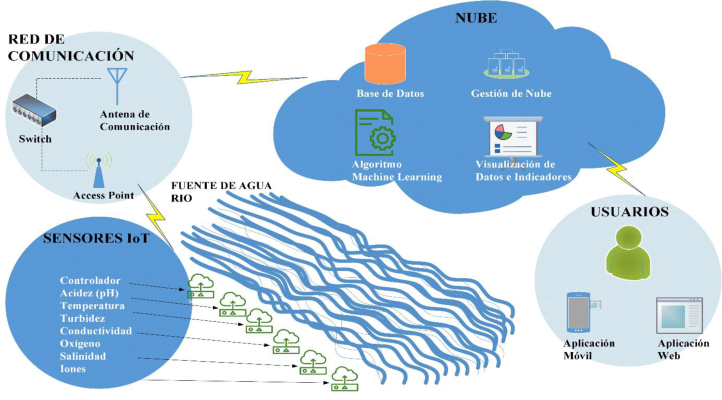
To design a network for monitoring and visualization of the water qual- ity of the Guayas River based on IoT, it starts with the IoT Sensor Network that captures or obtains the data, then this data is sent through the Commu- nication Network to a Data Warehouse in the cloud, the Machine Learning Model performs an analysis and forecasts of the data to present them in a dashboard through a web application or mobile, see Figure 1.
Figure 1: IoT network for water quality monitoring. (Adapted from Authors, 2023.)
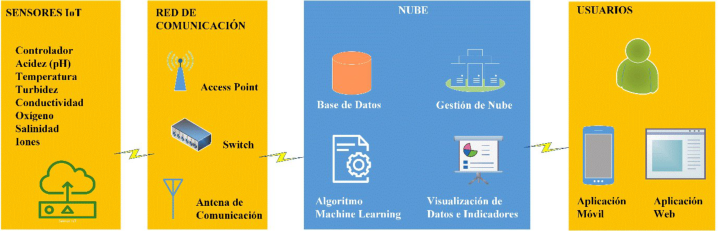
The network design proposed in four large modules: IoT Sensors, Commu- nication Network, Cloud and Technical Users, then the modules are described (figure 2).
IoT Sensor Network: The network obtains and presents eight physical parameters through the sensors: alkalinity, acidity (pH), temperature, tur- bidity, conductivity, oxygen, salinity and quantity of dissolved ions, these express the quality of different water samples, these sensors are connected to Arduino controllers each; the data captured by the sensors is sent to the network by the Arduino.
Communication Network: In this module are the data transfer devices to the cloud such as: Access Point to obtain the data from the Arduino, Router
284 Landívar and Moran
that connects the Access Point and other network devices, the Long Range Communication Antenna to send the data to the Internet provider.
Figure 2: IoT network for water quality monitoring. (Adapted from Authors, 2023.)
Cloud: In this module it is proposed to have a database for permanent stor- age of the data obtained from the IoT sensors, the processed data must also be stored, in addition to the program that has the Machine Learning algo- rithm that acted on the stored data, with a visualization tool on the detailed data of the sensors or processed by the algorithm. The entire cloud must exist on a platform of a provider so that this service managed on the internet.
Users: Users are laboratory technicians who analyse the physical or chem- ical analysis of water, or people such as food engineers, agro-industrialists or biologists, who wish to determine if the water is suitable for human con- sumption or measure wastewater or well water analysis or perform studies on haemodialysis water. Visualization tools present data via website or mobile app.
To identify and establish an appropriate Machine Learning model for water quality forecasting through presentation in a dashboard, of the 17 arti- cles selected in the systematic review, those proposed for water management were analysed; 29% of the articles use Artificial Neural Network, 18% use Support Vector Machine, and 12% of the articles use K-Nearest Neighbour, 41% of the other articles are used in smaller proportions, it is confirmed that Artificial Neural Network (ANN) is the most used in water management, see table 2.
Machine Learning is used to solve real-world problems to generate and identify knowledge from the data obtained in the IoT network, this technol- ogy helps us predict water pollution to take actions in the future; according to the scientific literature ANN is a very important ML technique in Regression and Data Classification, it is based on the neurons of the human brain and is one of the bases of Deep Learning; ANN is classified as Supervised Learning, i.e. there are input parameters and output parameters; ANN consists of three input-hidden-output layers, the first containing neurons that take the data to assimilate the pattern and predict the output in a new dataset.
RESULTS
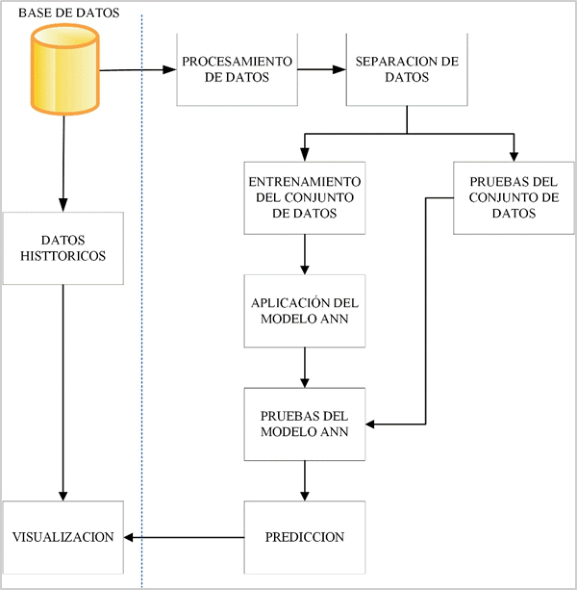
Three stages considered to develop a prediction model in water quality: Take the dataset, Model training, Testing-Analysis of the model. In figure 4, the
Comparative Analysis of a Machine Learning Model for Water Quality Forecasting 285
model starts with the data collection from the database itself, to perform the processing and separation of the data that interests the ANN algorithm, then applies the training of the data, applies the ANN model and the tests of the ANN model, finally has the data for prediction and these are presented through the visualization software.
Cases Articles (Darshan et al., 2021) Artificial Neural Network (Omambia et al., 2022) Artificial Neural Network (Aggarwal & Sehgal, 2022) Artificial Neural Network (Aggarwal et al., 2020) Artificial Neural Network (Sugumar et al., 2021) Artificial Neural Network (Kumar & Udgata, 2022) Support Vector Machine (Geetha, 2021) Support Vector Machine, Logistic Regression, Averaged Perceptron, Fast Forest (Swetha et al., 2021) Support Vector Machine, K-Nearest Neighbors, Random Forest, Decision Tree (Abusukhon & Altamimi, 2021) K-Nearest Neighbors (Kumar Koditala & Shekar Pandey, 2020) ML (A. Al-Mulla & B. Al-Badi, 2021) ML (Lekshmy et al., 2020) Multi Variable Linear Regression (Grammatopoulou et al., 2020) Q-learning (Kabi & Maina, 2021) KMeans (Rakesh & Kumaran, 2021) Logical Regression, Random Forest, Naïve Bayes (Tretjakova et al., 2022) Numeric water quality criteria (Quintero et al., 2022) Long short-term memory (Darshan et al., 2021) Artificial Neural Network
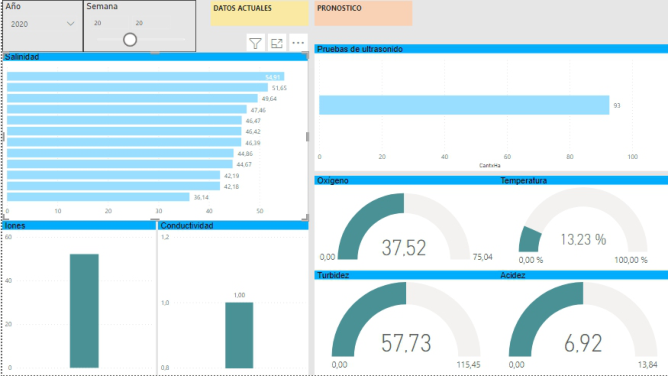
The design of the dashboard presents the indicators according to the data obtained from the sensors; to obtain current data timeline presented, in addition to the Current Data or Forecast filter. The salinity is designed to present the measurements of the last twelve days, for the other indicators the capture and presentation of the data should be every 15 minutes, the indica- tors of ultrasound, oxygen, temperature, turbidity, acidity, amount of ions, conductivity level are presented, see figure 4.
Articles were found that use Machine Learning models for monitoring or control of water, the attributes expressed are the characteristics, the algorithm used (can be Support Vector Machine (SVM), Logistic Regression (LR), Aver- age Perceptron (AP), Fast Forest (FF), K-Nearest Neighbour (KNN), Random Forest (RF), Decision Tree (DT)), the use or analysis of parameters, the pro- cessing of data samples also called instances, and the reliability of the tests of the applied algorithms, see Table 3.
The Support Vector Machine (SVM) algorithm most used in articles, in the first reference it has 99.4% accuracy, in the second reference it has 80% accuracy, in the third reference it has 94.28% accuracy; that is, it has more precision than the other algorithms.
In order to carry out a case study in a specific area of the Guayas River and determine the economic and technical impact, a list of components (hardware
286 Landívar and Moran
and software) to install in an area of 500 linear meters in a sector of the Guayas River. The components are as follows:
Figure 3: ANN model for water quality monitoring. (Adapted from Authors, 2023.)Figure 4: Dashboard for monitoring water quality. (Adapted from Authors, 2023.)
IoT sensors: The turbidity sensor obtains the level of turbidity, captures any optical alteration by using a photodiode containing a light source and
Comparative Analysis of a Machine Learning Model for Water Quality Forecasting 287
a photodetector; In other words, if more particles founded in the water, the greater the turbidity, the light spreads and this light received by the photodetector.
Table 3. Comparative analysis of machine learning models (Author, 2023).
The acidity sensor “obtains the concentration of hydrogen ions in solution, which determines the acidity and alkalinity of the solution”; the normal pH range in water is between 0 and 14, if the pH is equal to 7 units then the solution is neutral; if the pH is less than 7 units then the solution is acidic; if the pH is greater than 7 then the solution is alkaline.
The temperature sensor obtains the temperature of the water or the envi- ronment, usually one of the voltages measures the variation of the water temperature, the higher the voltage the higher the temperature. The ultrasonic sensor is used to measure distance through high-frequency sound waves, this sensor sends sound waves towards the object and then these waves return to the sensor; The distance is calculated by taking half the time that occurred between sending and receiving the sent signal.
The oxygen sensor obtains the amount of oxygen in the water; considered that the temperature and salinity existing in the water can interfere with oxy- gen concentrations. The conductivity sensor obtains the total concentration of ions in the water, in addition to obtaining the conductivity of the liquid, it is possible to use the sensor for different sample tests or plan experiments to establish variations in ion levels or total salinity.
The salinity sensor is a water-resistant meter to obtain the salt content in aqueous media according to the measurement ranges, contains a sodium chloride refractometer to measure specific weights, some sensors integrate temperature sensor. The ion sensor measures the ionic amount through “ion selective electrode” to automate the obtaining of this value; obtaining can be direct or incremental to the standard by means of addition or subtraction.
At the moment the sensors are installed in the water, the sensors obtain analog values and the microcontroller takes them, but it is not possible to process them because they do not have an analog-to-digital converter, then it is necessary to use a 12-bit A2D converter to convert the analog values into digital values and transmit them.
Cloud Software: A cloud platform to maintain data and computer appli- cations, also contains an IoT portal that manages the data obtained by the sensors from the link to the database in presentation of JSON packages
288 Landívar and Moran
(Azure, 2023). A “business analytics service” allows interactive visualiza- tion and users have the facility to generate reports and dashboards (PowerBI, 2023). Additionally, labour must be considered in the installation of devices and software in the cloud, a value that is paid only once in the project. In case of damage or maintenance in the IoT network there are occasional values for maintenance, if any device is damaged is necessary to buy and change. The total cost of ownership of the prototype for this kind of project estimated at 1,589.80 US dollars.
CONCLUSION
The results on online water quality in a specific area of the Guayas River present to be instantaneous and accurate for technicians or people who analyse variations in water parameters.
In addition, there is reduction of sampling, minimize intervals, minimize the delay in receiving information, minimize physical-time work, the model can help in the supply of drinking water with better quality, improve con- trol in impurity levels. That water samples depend on the level of moisture contained within the water.
The model is efficient in results, the model is of low monetary cost and in the implementation would be easy to use; Software and sensors need to be kept up to date because of the environmental impact on the hardware. The model is flexible; it is possible to add specialized chemical sensors to find other types of chemicals in the water, improves monitoring in other water parameters and verify the levels of soluble safety in water. The combination of IoT and Machine Learning in water quality control increases the possibility of saving lives and optimizing the experience of technicians, the model is adaptable to rivers that have electricity coverage and internet signal, fits into sources near urbanization or water purification plants. According (Swetha et al., 2021), the Support Vector Machine algorithm has better performance and better accuracy for real-time predictions, but ANN is the most widely used algorithm.
Access to discovered data can be wider through a cross-platform applica- tion; the design there are still functionalities, data design, covering other vari- ables, comparisons with normal conditions, suggestions of suitable sectors for water conditions.
Other government groups, foundations, or researchers to predict the vari- ables in the quality of the river water, in addition to other climatic factors and human preservation, can manage the data obtained; It is possible to use smaller, cheaper sensors to quantify water quality. The initial cost of the model in implementation for data capture, transfer, prediction and pre- sentation can be high, but the long-term benefits and advantages in data management are transcendental for making different decisions related to water quality and the environment.
A model based on IoT network for monitoring and visualization of water quality was presented and implemented in a specific sector of the Guayas
Comparative Analysis of a Machine Learning Model for Water Quality Forecasting 289
River, this network generates data that serves to forecast water quality based on a model established in Machine Learning.
The indicators analysed by the model (ultrasound, oxygen, temperature, turbidity, acidity, amount of ions, conductivity level) and are presented in a dashboard designed for this case; can help maximize sample analysis of water flows, minimize data collection efforts, and increase predictive information on water quality. In addition, it can minimize potential waterborne diseases and increase health safety.
Automation in data collection and prediction through IoT and Machine Learning have an important role in water management. The combination of these two technologies in a model that can be verified and implemented in future research such as water level monitoring, consumption prediction, sup- ply management, Controlled increase of water supply, verification of water quality, among other processes.
The proposed system is scalable and compatible; the dashboard is based on a simple design of current information and prediction; although to implement the model proposed it is unavoidable to have updated hardware, with the advantage of better and economic sensors and mass internet access.
ACKNOWLEDGMENT
The authors would like to acknowledge to Department of Computer Science, Universidad Politécnica Salesiana, Guayaquil and Aguas de Samborondón, Amagua.
REFERENCES
A. Al-Mulla, Y., & B. Al-Badi, T. (2021). IoT and RS Techniques for Enhancing Water Use Efficiency and Achieving Water Security. ACM International Conference Proceeding Series, 83–88. https://doi.org/10.1145/3490725.3490738 Abusukhon, A., & Altamimi, F. (2021). Water Preservation Using IoT: A proposed
IoT System for Detecting Water Pipeline Leakage. 2021 International Conference on Information Technology, ICIT 2021 - Proceedings, 115–119. https://doi.org/ 10.1109/ICIT52682.2021.9491667 Aggarwal, S., Gulati, R., & Bhushan, B. (2020). Monitoring of Input and Output Water Quality in Treatment of Urban Waste Water Using IOT and Artificial Neural Network. International Conference on Intelligent Computing, Instru- mentation and Control Technologies, 897–901. https://doi.org/10.1109/ICICIC T46008.2019.8993244 Aggarwal, S., & Sehgal, S. (2022). Automation of Water Distribution System by Pre-
diction of Water Consumption and Leakage Detection Using Machine Learning and IoT. 2022 12th International Conference on Cloud Computing, Data Sci- ence & Engineering (Confluence), 345–350. https://doi.org/10.1109/Confluence 52989.2022.9734192 Azure, M. (2023). Microsoft Azure. https://azure.microsoft.com/ Choubey, S., William, P., Pawar, A. B., Jawale, M. A., Gupta, K., & Parganiha, V.
(2022). Intelligent Water Level Monitoring and Water Pump Controlling System using IOT. Icesc, 423–427. https://doi.org/10.1109/icesc54411.2022.9885358 Chowdhury, A. A. S., Arafat, Y., & Alam, M. S. (2022). IoT-GSM Based Controlling and Monitoring System to Prevent Water Wastage, Water Leakage, and Pollution
290 Landívar and Moran
in the Water Supply. 2022 International Conference on Innovations in Science, Engineering and Technology, ICISET 2022, February, 567–572. https://doi.org/ 10.1109/ICISET54810.2022.9775876 Darshan, R. S., Pavan, H., Pratheesh, R., Raj, M. S., Suresh, K. V., & Prathap, C.
(2021). An IoT Enabled Water Management System with Water Usage Predic- tion using ANN. 2021 2nd Global Conference for Advancement in Technology (GCAT), 1–7. https://doi.org/10.1109/GCAT52182.2021.9587502 Farhan Mohd Pu’ad, M., Azami Sidek, K., & Mel, M. (2020). IoT based water quality monitoring system for safe drinking water in Pakistan. Journal of Physics: Conference Series, 1502(1), 012020. https://doi.org/10.1088/1742-6596/1502/1/ 012020 Geetha, N. (2021). IoT based smart water quality monitoring system. International
Journal of Nonlinear Analysis and Applications, 12(Special Issue), 1665–1671. https://doi.org/10.22075/IJNAA.2021.5853 Grammatopoulou, M., Kanellopoulos, A., & Vamvoudakis, K. G. (2020). A multistep and resilient predictive Q-learning algorithm for IoT: A case study in water supply networks. ACM International Conference Proceeding Series. https://doi.or g/10.1145/3277593.3277605 Hernández-vaca, F. (2022). Characteristics of currents in a section of the Guayas
River. Acta Oceanográfica, 4(1), 63–81. https://doi.org/https://doi.org/0.54140/ raop.v4i1.47 Kabi, J., & Maina, C. (2021). Leveraging IoT and machine learning for improved monitoring of water resources - A case study of the upper Ewaso Nyiro river. 2021 IST-Africa Conference, IST-Africa 2021, 1–8. Kumar Koditala, N., & Shekar Pandey, P. (2020). Water Quality Monitoring Sys-
tem Using IoT and Machine Learning. Proceedings of 3rd IEEE International Conference on Research in Intelligent and Computing in Engineering,. https: //doi.org/10.1109/RICE.2018.8509050 Kumar, Y., & Udgata, S. K. (2022). Machine learning model for IoT-Edge device based Water Quality Monitoring. IEEE INFOCOM 2022 - IEEE Conference on Computer Communications Workshops (INFOCOM WKSHPS), 1–6. https://doi. org/10.1109/INFOCOMWKSHPS54753.2022.9798212 Lekshmy, H. O., Krishnaprasad, T. R., Aishwaryaa, R., & Vinod, R. (2020). An IoT
based P2P model for Water Sharing using Machine Learning. 2020 International Conference on Communication and Signal Processing (ICCSP), 0790–0794. https: //doi.org/10.1109/ICCSP48568.2020.9182081 Omambia, A., Maake, B., & Wambua, A. (2022). Water Quality Monitoring Using IoT & Machine Learning. 2022 IST-Africa Conference (IST-Africa), 1–8. https: //doi.org/10.23919/IST-Africa56635.2022.9845590 Page, M. J., McKenzie, J. E., Bossuyt, P. M., Boutron, I., Hoffmann, T. C., Mulrow,
C. D., Shamseer, L., Tetzlaff, J. M., Akl, E. A., Brennan, S. E., Chou, R., Glanville, J., Grimshaw, J. M., Hróbjartsson, A., Lalu, M. M., Li, T., Loder, E. W., Mayo- Wilson, E., McDonald, S., … Moher, D. (2021). The PRISMA 2020 statement: an updated guideline for reporting systematic reviews. BMJ, n71. https://doi.org/10. 1136/bmj.n71 PowerBI, M. (2023). Microsoft Power BI. https://powerbi.microsoft.com/es-es/ Quintero, R., Parra, J., & Felix, F. (2022). Water quality assurance in aquaculture ponds using Machine Learning and IoT techniques. 2022 IEEE Mexican International Conference on Computer Science, ENC 2022 - Proceedings, 1–6. https://doi.org/10.1109/ENC56672.2022.9882920
Comparative Analysis of a Machine Learning Model for Water Quality Forecasting 291
Rakesh, N., & Kumaran, U. (2021). Performance Analysis of Water Quality Monitoring System in IoT Using Machine Learning Techniques. 2021 International Conference on Forensics, Analytics, Big Data, Security, FABS 2021, 2–7. https: //doi.org/10.1109/FABS52071.2021.9702592 Shankar, S., & Dakshayini, M. (2018). IoT-Mobile Enabled Smart Water Level
Controlling System to Regulate Water Wastage. 2018 International Conference on Advances in Computing, Communications and Informatics, ICACCI 2018, 2045–2048. https://doi.org/10.1109/ICACCI.2018.8554373 Singh, P., & Padalkar, P. (2021). IoT based Water Pollution Reporting System : An IoT based system for controlling pollution in water. 2021 2nd Global Conference for Advancement in Technology (GCAT), 1–6. https://doi.org/10.1109/GCAT52182. 2021.9587812 Sugumar, S. J., R, S., Phadke, S., Prasad, S., & R, S. G. (2021). Real Time Water Treat-
ment Plant Monitoring System using IOT and Machine Learning Approach. 2021 International Conference on Design Innovations for 3Cs Compute Communicate Control (ICDI3C), 286–289. https://doi.org/10.1109/ICDI3C53598.2021.00064 Swetha, T. M., Yogitha, T., Hitha, M. K. S., Syamanthika, P., Poorna, S. S., & Anuraj, K. (2021). Iot Based Water Management System for Crops Using Con- ventional Machine Learning Techniques. 2021 12th International Conference on Computing Communication and Networking Technologies, ICCCNT 2021, 6–9. https://doi.org/10.1109/ICCCNT51525.2021.9579651 Tretjakova, R., Halvorsen, H. P., Viumdal, H., Mylvaganam, S., Timmerberg, J.,
& Thiriet, J. M. (2022). Water Care System (WCS) for Numeric Water Quality Criteria (NWQC) with IoT/IoUT-Educational Implications of Sustainability Goal SDG 14. Proceedings of the 2022 31st Annual Conference of the European Asso- ciation for Education in Electrical and Information Engineering, EAEEIE 2022. https://doi.org/10.1109/EAEEIE54893.2022.9820188
LISTED IN THE AHFE DIGITAL BOOKSTORE CATALOGUE
Explore the complete digital volume
Intelligent Human Systems Integration (IHSI 2024): Integrating People and Intelligent Systems
Read this individual research paper free through the original publisher, or explore the full digital proceedings book.
ISBN 978-1-958651-95-7
Explore this ISBN in the AHFE Bookstore ↗Listed in the July 2026 bookstore catalogue; search by ISBN to confirm current availability · Digital book purchase optional