Wangzhi Wang, Manrong She, Shanguang Chen, Zhizhong Li (2024). Identification of Factors for Dynamic Function Allocation from the Perspective of Human Information Processing. In: Human Dynamics, Product Evaluation and Quality. AHFE Open Access, vol. 131, pp. 11–22. https://doi.org/10.54941/ahfe1004859
To ensure safe and efficient collaboration between humans and automated systems, it's essential to understand how to allocate functions dynamically. The first step involves identifying the factors that may trigger such dynamic function allocation. When factors influencing information processing emerge and reach a certain level of significance, individuals often experience changes in their states and performance. It is at this juncture that dynamic human-machine function allocation becomes necessary. Therefore, identifying these factors from the perspective of human information processing can help determine whether a task element will be affected by a specific factor and if dynamic function allocation should be initiated. By conducting an extensive literature review encompassing various related studies, this research identified factors that may impact different stages of human information processing. Subsequently, these factors were identified for dynamic function allocation in human-machine collaboration. This study is expected to provide a theoretical foundation for achieving dynamic function allocation in human-machine teaming.
As intelligent technologies continue to advance, automated systems are becoming increasingly capable of coexisting and collaborating with human. Despite these achievements, challenges persist in today’s human-machine teaming, such as problems arising from improper function allocation. To enable safe and efficient human-machine teaming, it is crucial to understand how to allocate functions between humans and automated systems effectively. Determining when control should be assigned to either party is the first step in addressing this issue. To addressing the challenge, it is necessary to identify the factors that influence dynamic function allocation.
Drawing on existing research, factors triggering dynamic human-machine function allocation can be classified into five main categories based on the triggering criteria (Feigh et al., 2012): operator-based, system-based, environment-based, task- and mission-based, and spatio-temporal triggers. Different categories of factors can be sensed, observed, and modelled indi- vidually or in combination to build an understanding of the current situation and provide input for selecting subsequent allocation options (Feigh et al., 2012). Previous research has identified various factors from literature review and individual studies that trigger the need for human-machine function alloca- tion. The present study takes a more systematic approach by examining the factors that influence human information processing functions, which in turn trigger the need for dynamic function allocation. Information processing is the core of human performance. In various tasks, human must perceive infor- mation, transform that information into different forms, assess the situation, make decisions and take an action based on the perceived and transformed information (Wickens & Carswell, 2021). When factors influencing informa- tion processing emerge and attain a certain threshold of influence, individuals often undergo changes in their states and performance. It is at this point that dynamic human-machine function allocation should come into play, ensur- ing both safety and performance. Thus, the factors that influence human information processing would directly impact the necessity and timing of human-machine function allocation. Since any task element involves one or more information processing functions, identification of the factors from the perspective of human information processing can well support the judg- ment whether a task element will be influenced by a specific factor and then whether dynamic function allocation should be triggered.
Therefore, this paper will start from the human information process- ing model. Through an extensive literature review encompassing numerous related works, the aim is to identify factors that may impact information processing, and finally obtain factors for dynamic function allocation in human-machine teaming. This human-centric perspective allows for a more systematic and thorough exploration of the factors influencing dynamic function allocation, ensuring a more complete understanding of the human operator’s limitations and the conditions under which human-machine col- laboration needs to adapt. In addition, from the perspective of machine, we also have a plan to explore the factors influencing machine information pro- cessing functions. However, this study will be conducted in the future and are not presented in this paper.
IDENTIFICATION OF FACTORS FROM THE PERSPECTIVE OF HUMAN INFORMATION PROCESSING In the subsequent sections, we will enumerate factors that may impact dif- ferent stages of human information processing. These factors are either associated with task characteristics and demands directly encountered during information processing or linked to the environment in which information processing is conducted. Additionally, they encompass factors related to an
Identification of Factors for Dynamic Function Allocation 13
individual’s state (physiological and psychological) before and during task execution.
It is noteworthy that certain factors, including age (e.g. Craik & Bialystok, 2006), gender (e.g. Speck et al., 2000), intelligence (e.g. Colom et al., 2004), experience (e.g. Weiss & Shanteau, 2003), personality (e.g. Costa & McCrea, 1978), and other intrinsic features of human, as well as potential health con- ditions such as vision or hearing defects, brain loss, mental illness, and other medical conditions (e.g. Blasiman & Was, 2018), may influence information processing performance. In addition, some substances that have a psychoac- tive effect, such as alcohol (e.g. Dougherty et al., 2000), nicotine (e.g. Blake & Smith, 1997), drugs (e.g. Barch, 2004), can also influence the performance of information processing. However, these factors share a common feature— be less prone to change throughout task execution. In function allocation, these factors may serve as input before task execution, exerting a “personal- ized” impact on subsequent dynamic function allocation based on individual differences. In the following analysis, we will refrain from further discussing these relatively stable factors and concentrate on those susceptible to change and manipulatable shortly before or during the task.
Before analysing the various factors, it is essential to provide an expla- nation of the information processing model. In this paper, we adopt as a framework the information processing model from Wickens et al. (2013), and mainly focus on the following parts: attention, sensory processing, per- ception, memory, decision and response selection, response execution. In addition, it should be noted that this study attempted to review as many factors influencing various stages of information processing as possible, but these factors may not be exhaustive.
Common Factors Before delving into the factors associated with various components of the human information processing model, we first introduce some common fac- tors. These factors may be associated with overall cognitive functions in individuals, exerting varying degrees of influence on information processing.
Mental Workload. Mental workload is closely related to human informa- tion processing performance. It characterizes “the demands of tasks imposed on the limited information processing capacity of the brain” (Wickens et al., 2013). Arousal. Arousal pertains to individuals’ level of activity (Wickens et al., 2013). It is crucial in regulating numerous cognitive processes (Cahill & McGaugh, 1998), and have complicated effects on human performance (Yerkes & Dodson, 1908).
Situation Awareness. Individuals possessing the highest levels of situation awareness can perceive pertinent information aligned with their goals and decisions, adeptly integrate this information to comprehend its meaning or significance, and are able to project possible future status (Endsley, 1995). Situation awareness is essential for making proactive decisions in challenging environments.
Attention The availability of attentional resources is constrained and influenced by various factors.
Distractions. Distractions describe interfering irrelevant stimuli or sec- ondary tasks that capture attention but should be ignored (Zickerick et al., 2020). For example, in driving tasks, The National Highway Traffic Safety Administration classifies distraction into four types: visual (e.g. looking away from the roadway), auditory (e.g. responding to a phone), biomechanical (e.g. manually adjusting the radio volume), and cognitive (e.g. mind wandering) (Ranney et al., 2001).
In addition, some psychological states of people when processing informa- tion may affect people’s attention resources.
Emotions. Emotions influence the allocation of attention (Compton, 2003; Vuilleumier, 2005). For example, several studies have shown that more atten- tion is drawn to and maintained by emotional stimuli (such as angry faces) than by neutral or novel ones (Fenske & Raymond, 2006).
Anxiety. Several studies have shown that anxiety modulates the function- ing of attention, and different categories of anxiety (state or trait) may impact attention differently (MacLeod & Mathews, 1988; Pacheco-Unguetti et al., 2010). Fatigue. Fatigue can have a negative impact on attention. Higher levels of mental or physical fatigue can reduce an individual’s capacity to maintain and shift attention effectively (Boksem et al., 2005; Faber et al., 2012).
Sleep Deprivation. Sleep deprivation can significantly impact attention and cognitive function, impairing sustained attention and leading to decreased vigilance and alertness (Doran et al., 2001; Gobin et al., 2015; Lim & Dinges, 2008). In addition to the factors mentioned above, salience is an important factor affecting attention allocation. Compared with salient features that attract attention, such as size, colour, intensity, contrast, and others, stimulus that do not have these features may not be noticed, even if they are important (Rensink, 2002; Simons & Levin, 1998; Wickens et al., 2009). However, it should be noted that in various tasks, the salience of the interface and objects in the environment are often predetermined during the design phase and are difficult to change before or during task execution. Therefore, they are not considered for dynamic function allocation.
Sensory Processing and Perception As the first step in information processing, the functions of sensory processing and perception are influenced by numerous factors in various tasks.
Visibility Conditions. Visibility conditions have a profound impact on visual sensation and perception. Good visibility conditions are crucial for the human visual system to effectively capture and interpret visual stimuli (Liu et al., 2020).
Noise. Noise significantly impacts on auditory sensation and perception of information (Helfer & Wilber, 1990). High levels of noise may impede individuals’ ability to capture and interpret crucial auditory signals from the environment.
Identification of Factors for Dynamic Function Allocation 15
Vibration. Exposure to a strong vibration environment, such as driving in a bumpy vehicle, can cause the eyes to shake and create blurred vision. This can impact the accurate observation of details and distant objects (Griffin & Lewis, 1978). Furthermore, under some exposure scenarios, vibrations may intensify the effects of noise and raise the risk of hearing loss (Hamernik et al., 1989). Scene Complexity. In actual task scenarios, scene complexity is mainly reflected in the quantity of information simultaneously present and the quan- tity of information to be processed per unit of time. For example, the information is available for only a limited time in the driver’s visual field when speed is high, potentially influencing visual perception (Hirschberger & Miedel, 1980; Rogé et al., 2004). Additionally, unexpected events in driving scenarios, such as traffic accidents, sudden braking, or the sudden appearance of pedestrians, introduce sudden changes in the scene, requiring drivers to process more information within a short time. Furthermore, scene complex- ity is also found to modulate activation in a network of regions commonly engaged in scene perception (Chai et al., 2010).
Memory In this paper we will focus on two different storage systems with different durations: working memory and long-term memory.
Two types of information, verbal and spatial, are stored in working mem- ory and are temporarily and effortfully preserved in either the phonological loop or the visuospatial sketchpad (Wickens et al., 2003). Auditory noise, such as ongoing irrelevant speech (Salame & Baddeley, 1982) or concurrent tones (Jones & Macken, 1993), disrupts the contents of the phonological loop, making it challenging to hear and understand spoken content. Similarly, the presence of “visual noise” interferes with the recall of visual attributes, reducing the vividness of visual images (Baddeley & Andrade, 2000), just as auditory noise interferes with information retention in the phonological loop.
For working memory, its limits are substantial and severely limit how peo- ple can process and retain information they see and hear. Therefore, we can also start from its limits to find out the factors that affect working memory.
Quantity of Information. Working memory is limited in its capacity (the amount of information it can hold). The upper limit of the capacity is four chunks (Cowan, 2001). Thus, an increase in the quantity of information to be memorized beyond an individual’s working memory capacity can result in forgetting, interference, and confusion of information.
Memory Duration. Working memory is also limited in how long informa- tion may remain. The notion of that our memory inexorably decays over time is an important part of models of working memory (Barrouillet et al., 2004; Burgess & Hitch, 2006).
Confusability and Similarity of Information. Confusion in working mem- ory may arise when different items share similar features because, as their representation decays before reactivation, there is a higher probability that the discriminating details will be lost (Wickens et al., 2003). Moreover, the impact of decay and time on recall is more disruptive to material that exhibits greater similarity, especially when the recall requires a particular order (Cowan, 2001).
In addition to the factors related to the limits of working memory men- tioned above, there are many other factors that affect working memory, such as: Emotions. Emotion can clearly influence performance on working memory tasks, with different emotions having different levels of impact. In general, negative emotion seems to have an impairing effect on working memory; however, under certain circumstances, positive emotion and motivation can enhance working memory performance (Brose et al., 2012; Sanada et al., 2013). Anxiety. Anxiety has a negative effect on working memory performance. Coy (1997) found evidence that increasing anxiety by increasing time pres- sure can increase task-irrelevant thoughts, and these thoughts may utilize working memory resources, leaving them unavailable for task performance. Tohill and Holyoak (2000) also induced anxiety through time pressure and obtained evidence supporting the idea that increased anxiety correlates with a reduction in working memory capacity.
Sleep Deprivation. Sleep deprivation has a consistently negative effect on working memory performance (Blasiman & Was, 2018). Researchers have demonstrated that individuals experiencing chronic sleep deprivation per- formed worse on tasks requiring working memory compared to non-deprived participants (Lieberman et al., 2002). This deficit is particularly strong under higher working memory loads (Cellini et al., 2014).
Temperature. Temperature has been found to affect working memory per- formance. Researchers have found a connection between cold temperatures and impaired working memory (Schoofs et al., 2009). Moreover, individuals’ subjective preferences for temperature also impact working memory perfor- mance. Specifically, individuals who are tested at temperatures they prefer exhibit improved working memory performance (Sellaro et al., 2015).
The retrieval of information in long-term memory is also influenced by various factors, some of which resemble those affecting working memory, such as anxiety. High levels of anxiety can adversely impact both work- ing memory function and the recall of information from long-term memory. Research suggests that anxiety may disrupt the encoding of new informa- tion into long-term memory (Mueller, 1979), resulting in reduced learning efficiency.
Decision and Response Selection Decision-making is regarded as the outcome of an information processing procedure, involving the selection of an action plan from multiple alternative options. Decision and response selection are shaped not only by the decision environment and task demands but also by the capabilities and states of the decision-maker.
Quantity of Information. Researchers have found that the quantity of information can impact decision-making, potentially leading them to experi- ence overload or delays in decision-making (Rogers, 1994).
Uncertainty. In situations characterized by a high degree of uncertainty within tasks, decision-makers find it challenging to accurately predict or
Identification of Factors for Dynamic Function Allocation 17
determine the outcomes of their decisions, thereby amplifying the inher- ent risks associated with decision-making. Generally, decision-makers are hesitant to take risks when dealing with imprecisely specified probabilities and are even willing to pay an additional cost to avoid vagueness (Kuhn & Budescu, 1996).
Time Pressure. Several studies have indicated specific impacts of time pressure on the decision-making process. According to Edland and Svenson (1993), effects of time pressure include an over-reliance on negative informa- tion and an increased reliance on fewer attributes or dimensions in making choices. Payne, Bettman, and Johnson (1993) suggested that deadlines to complete static tasks cause subjects to speed up processing of information and switch to simple decision strategies. Additionally, Wright (1974) noted that under time pressure, decision-making performance deteriorated when more rather than less information was provided.
Anxiety. Anxiety may affect decision and response selection. There is evi- dence that people scan alternatives in a more non-systematic fashion under anxiety (Payne et al., 1992).
Fatigue. Fatigue may compromise an athlete’s cognitive processing in a manner that diminishes their ability to control movement when rapid decision-making is required (Almonroeder et al., 2018).
Response Execution During the phase of response execution, there are several factors to consider. Firstly, certain tasks exhibit a high level of action complexity, demand- ing individuals to demonstrate heightened operational speed, accuracy, and range of motion. These aspects can significantly impact the performance of response execution. In addition, action execution requires individuals to employ psychomotor abilities, which are influenced by the individual’s fatigue level (Habay et al., 2021; Kahol et al., 2008). Furthermore, vibration can also affect the precision of action execution. Vibration may disrupt the performance of eye-hand coordination tasks unless the hand is stabilized by an external source (Brooks & Lack, 2006). In driving tasks, vibration in a vehicle can, for example, make touch screens extremely unreliable as input devices (Wickens et al., 2003).
In addition to the factors mentioned above, the execution of action may also be influenced by factors related to the interior layout and design, such as car seats, clothing, and the human-machine interface. These factors are often predetermined during the design phase and are difficult to alter before or during task execution. Therefore, they are not taken into consideration in this paper.
Integration and Supplement of Factors The previous section began with an exploration of human information pro- cessing functions, uncovering various influencing factors. In this section, we will organize and integrate some of the previously mentioned factors that expressed similar meanings while elucidating some additional ones not previously addressed. As a result, the following factors have been derived:
Task Size. We have highlighted that the quantity of information influ- ences various stages of human information processing, whether it pertains to the quantity of information to be memorized or the quantity of informa- tion used for decision-making. The greater the quantity of information to
be processed, the larger the corresponding task size. Hence, in relation to task-specific characteristics, we categorize this as “task size”.
Task Uncertainty. The uncertainty associated with task information and outcomes can influence decision-making. For example, in driving tasks, uncertainties such as unpredictable road conditions and sudden emergency can add complexity to a driver’s decision-making process.
Task Confusability. As mentioned earlier, individuals find it more chal- lenging to remember features with higher confusability and similarity. Thus, in relation to task-specific characteristics, we describe this factor as “task confusability.”
Task Duration. As previously mentioned, information in memory may gradually weaken or decay over time. In various tasks, we often encounter extended task durations. During the long duration of the task, the informa- tion in our memory may be gradually forgotten over time if not reminded by others.
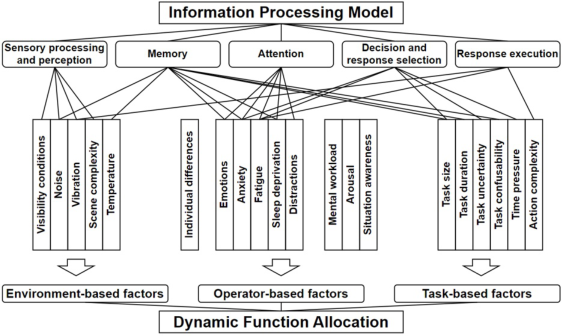
AGGREGATION OF FACTORS FOR DYNAMIC FUNCTION ALLOCATION After identifying all the factors influencing human information process- ing functions, following the trigger mechanisms proposed by Feigh et al. (2012) for dynamic function allocation, we aggregate these factors into the framework depicted in Figure 1. In the implementation of dynamic function allocation, a general principle is that, when factors that affect information processing functions arise within the scenario and reach a certain threshold of influence on the operators, we tend to shift the task to the automa- tion. Specifically, the factors covered by individual differences and experience are associated with the operators’ personal characteristics and may serve as input before task execution, exerting a “personalized” impact on subsequent dynamic function allocation. The remaining factors are continuously moni- tored and detected during the task, influencing dynamic function allocation in real-time.
Figure 1: Factors for dynamic function allocation in human-machine teaming.
Identification of Factors for Dynamic Function Allocation 19
CONCLUSION
In this paper, we started from the human information processing model, mainly focusing on the parts including attention, sensory processing, per- ception, memory, decision and response selection, and response execution. Through an extensive literature review encompassing numerous related works, we identified factors that may impact different stages of human infor- mation processing, and finally yielded factors for dynamic function allocation in human-machine teaming. In the future, we will also explore the factors influencing machine information processing functions.
ACKNOWLEDGMENT
This study was partly supported by the National Natural Science Foundation of China (Grant No. T2192932).
REFERENCES
Almonroeder, T. G., Tighe, S. M., Miller, T. M., & Lanning, C. R. (2018). The influence of fatigue on decision-making in athletes: A systematic review. Sports Biomechanics. Baddeley, A. D. & Andrade, J. (2000). Working memory and the vividness of imagery.
Journal of Experimental Psychology: General, 129, 126–145. Barch, D. M. (2004). Pharmacological manipulation of human working memory.
Psychopharmacology, 174, 126–135. Barrouillet, P., Bernardin, S., & Camos, V. (2004). Time constraints and resource sharing in adults’ working memory spans. Journal of Experimental Psychology: General, 133, 83–100. Blake, J., & Smith, A. (1997). Effects of smoking and smoking deprivation on the
articulatory loop of working memory. Human Psychopharmacology, 12, 259–264. Blasiman, R. N., & Was, C. A. (2018). Why is working memory performance unstable? A review of 21 factors. Europe’s Journal of Psychology, 14(1), 188. Boksem, M. A., Meijman, T. F., & Lorist, M. M. (2005). Effects of mental fatigue on
attention: An ERP study. Cognitive Brain Research, 25(1), 107–116. Brooks, A., & Lack, L. (2006). A brief afternoon nap following nocturnal sleep restriction: Which nap duration is most recuperative? Sleep, 29(6), 831–840. Brose, A., Schmiedek, F., Lövdén, M., & Lindenberger, U. (2012). Daily variability
in working memory is coupled with negative affect: The role of attention and motivation. Emotion, 12, 605–617. Burgess, N., & Hitch, G. J. (2006). A revised model of short-term memory and long-term learning of verbal sequences. Journal of Memory and Language, 55, 627–652. Cahill L., McGaugh J. L. (1998). Mechanisms of emotional arousal and lasting
declarative memory. Trends in Neuroscience, 21(7), 294–299. Cellini, N., de Zambotti, M., Covassin, N., Sarlo, M., & Stegagno, L. (2014).
Working memory impairment and cardiovascular hyperarousal in young primary insomniacs. Psychophysiology, 51, 206–214. Chai, X. J., Ofen, N., Jacobs, L. F., & Gabrieli, J. D. (2010). Scene complexity: Influence on perception, memory, and development in the medial temporal lobe. Frontiers in Human Neuroscience, 4, 1021. Colom, R., Rebollo, I., Palacios, A., Juan-Espinosa, M., & Kyllonen, P. C. (2004).
Working memory is (almost) perfectly predicted by g. Intelligence, 32, 277–296.
Compton, R. J. (2003). The interface between emotion and attention: A review of evidence from psychology and neuroscience. Behavioral and Cognitive Neuroscience Reviews, 2, 115–129. Costa, P. T., & McCrea, R. R. (1978). Objective personality assessment. In
M. Storandt, I. C. Siegler, & M. F. Elias (Eds.), The clinical psychology of aging. New York, NY, USA: Plenum Press. Cowan, N. (2001). The magical number 4 in short-term memory: A reconsideration of mental storage capacity. Behavioral and Brain Sciences, 24(1), 87–114. Coy, W. B. (1997). Evaluation anxiety, task-irrelevant self-statements, and working
memory: An evaluation of the cognitive interference theory. Unpublished doctoral dissertation, Bowling Green State University, Ohio. Craik, F. I. M., & Bialystok, E. (2006). Cognition through the lifespan: Mechanisms of change. Trends in Cognitive Sciences, 10, 131–138. Doran, S. M., Van Dongen, H. P., & Dinges, D. F. (2001). Sustained attention perfor-
mance during sleep deprivation: evidence of state instability. Archives Italiennes de Biologie, 139(3), 253–267. Dougherty, D. M., Marsh, D. M., Moeller, F. G., Chokshi, R. V., & Rosen, V. C.
(2000). Effects of moderate and high doses of alcohol on attention, impul- sivity, discriminability, and response bias in immediate and delayed memory task performance. Alcoholism: Clinical and Experimental Research, 24(11), 1702–1711. Edland, A., & Svenson, O. (1993). Judgment and decision making under time pressure: Studies and findings. In Time pressure and stress in human judgment and decision making (pp. 27–40). Boston, MA: Springer US. Endsley, M. R. (1995). Toward a theory of situation awareness in dynamic systems.
Human Factors, 37(1), 32–64. Faber, L. G., Maurits, N. M., & Lorist, M. M. (2012). Mental fatigue affects visual selective attention. PloS one, 7(10), e48073. Feigh, K. M., Dorneich, M. C., & Hayes, C. C. (2012). Toward a characterization
of adaptive systems: A framework for researchers and system designers. Human Factors, 54(6), 1008–1024. Fenske, M. J., & Raymond, J. E. (2006). Affective influences of selective attention.
Current Directions in Psychological Science, 15(6), 312–316. Gobin, C. M., Banks, J. B., Fins, A. I., & Tartar, J. L. (2015). Poor sleep quality is associated with a negative cognitive bias and decreased sustained attention. Journal of Sleep Research, 24(5), 535–542. Habay, J., Van Cutsem, J., Verschueren, J., De Bock, S., Proost, M., De Wachter,
J., Tassignon, B., Meeusen, R., & Roelands, B. (2021). Mental Fatigue and Sport-Specific Psychomotor Performance: A Systematic Review. Sports Medicine (Auckland, N. Z.), 51(7), 1527–1548. Helfer, K. S., & Wilber, L. A. (1990). Hearing loss, aging, and speech perception in reverberation and noise. Journal of Speech, Language, and Hearing Research, 33(1), 149–155. Hirschberger, H. G., & Miedel, H. (1980). Sicht und sehprobleme in der fahrausbil-
dung in der fahrausbildung. Zeitschrift für Verkerssicherheit, 26, 65–70. Jones, D. M., & Macken, W. J. (1993). Irrelevant tones produce an irrelevant speech effect: implications for phonological coding in working memory. Journal of Experimental Psychology: Learning, Memory, and Cognition, 19(2), 369–381. Kahol, K., Leyba, M. J., Deka, M., Deka, V., Mayes, S., Smith, M., Ferrara, J. J., &
Panchanathan, S. (2008). Effect of fatigue on psychomotor and cognitive skills. American Journal of Surgery, 195(2), 195–204.
Identification of Factors for Dynamic Function Allocation 21
Kuhn, K. M., & Budescu, D. V. (1996). The relative importance of probabilities, outcomes, and vagueness in hazard risk decisions. Organizational Behavior and Human Decision Processes, 68(3), 301–317. Lieberman, H. R., Tharion, W. J., Shukitt-Hale, B., Speckman, K. L., & Tulley, R.
(2002). Effects of caffeine, sleep loss, and stress on cognitive performance and mood during U. S. Navy SEAL training. Psychopharmacology, 164, 250–261. Lim, J., & Dinges, D. F. (2008). Sleep deprivation and vigilant attention. Annals of the New York Academy of Sciences, 1129(1), 305–322. Liu, J., Cai, J., Lin, S., & Zhao, J. (2020). Analysis of factors affecting a driver’s
driving speed selection in low illumination. Journal of Advanced Transportation, 2020, 1–8. MacLeod, C., & Mathews, A. (1988). Anxiety and the allocation of attention to threat. The Quarterly Journal of Experimental Psychology Section A, 40(4), 653–670. Mueller, J. H. (1979). Anxiety and encoding processes in memory. Personality and
Social Psychology Bulletin, 5, 288–294. Pacheco-Unguetti, A. P., Acosta, A., Callejas, A., & Lupiáñez, J. (2010). Attention and anxiety: Different attentional functioning under state and trait anxiety. Psychological Science, 21(2), 298–304. Payne, J. W., Bettman, J. R., & Johnson, E. J. (1992). Behavioral decision research: A
constructive processing perspective. Annual Review of Psychology, 43(1), 87–131. Payne, J. W., Bettman, J. R., & Johnson, E. J. (1993). The adaptive decision maker.
Cambridge University Press. Ranney, T. A., Garrott, W. R., & Goodman, M. J. (2001). NHTSA driver distraction research: Past, present, and future. No. 2001-06-0177. SAE technical paper, 2001. Rensink, R. A. (2002). Change detection. Annual Review of Psychology, 53(1), 245–277. Rogé, J., Pébayle, T., Lambilliotte, E., Spitzenstetter, F., Giselbrecht, D., & Muzet, A.
(2004). Influence of age, speed and duration of monotonous driving task in traffic on the driver’s useful visual field. Vision Research, 44(23), 2737–2744. Rogers, C. T. (1994). Intuition: An imperative of command. Military Review, 74, 38–38. Rouse, W. B., Geddes, N. D., & Curry, R. E. (1987). An architecture for intelligent
interfaces: Outline of an approach to supporting operators of complex systems. Human-Computer Interaction, 3(2), 87–122. Salame, P., & Baddeley, A. (1982). Disruption of short-term memory by unattended speech: Implications for the structure of working memory. Journal of Verbal Learning and Verbal Behavior, 21(2), 50–164. Sanada, M., Ikeda, K., Kimura, K., & Hasegawa, T. (2013). Motivation enhances
visual working memory capacity through the modulation of central cognitive processes. Psychophysiology, 50, 864–871. Schoofs, D., Wolf, O. T., & Smeets, T. (2009). Cold pressor stress impairs performance on working memory tasks requiring executive functions in healthy young men. Behavioral Neuroscience, 123, 1066–1075. Sellaro, R., Hommel, B., Manai, M., & Colzato, L. S. (2015). Preferred, but
not objective temperature predicts working memory depletion. Psychological Research, 79, 282–288. Simons, D. J., & Levin, D. T. (1998). Failure to detect changes to people during a real-world interaction. Psychonomic Bulletin & Review, 5, 644–649.
Speck, O., Ernst, T., Braun, J., Koch, C., Miller, E., & Chang, L. (2000). Gender differences in the functional organization of the brain for working memory. Neuroreport, 11, 2581–2585. Tohill, J. M., Holyoak, K. J. (2000). The impact of anxiety on analogical reasoning.
Thinking and Reasoning, 6, 27–40. Vuilleumier, P. (2005). How brains beware: Neural mechanisms of emotional attention. Trends in Cognitive Science, 9, 585–594. Weiss, D., & Shanteau, J. (2003). Empirical assessment of expertise. Human Factors,
45, 104–116. Wickens, C. D., & Carswell, C. M. (2021). Information processing. Handbook of Human Factors and Ergonomics, 114–158. Wickens, C. D., Helton, W. S., Hollands, J. G., & Banbury, S. (2021). Engineering
psychology and human performance. Routledge. Wickens, C. D., Hooey, B. L., Gore, B. F., Sebok, A., & Koenicke, C. S. (2009). Identifying black swans in NextGen: Predicting human performance in off-nominal conditions. Human Factors, 51(5), 638–651. Wickens, C. D., Gordon, S. E., Liu, Y., & Lee, J. (2004). An introduction to human
factors engineering (Vol. 2, p. 587). Upper Saddle River, NJ: Pearson Prentice Hall. Wright, P. (1974). The harassed decision maker: Time pressures, distractions, and the use of evidence. Journal of Applied Psychology, 59(5), 555. Yerkes, R. M., & Dodson, J. D. (1908). The Relation of Strength of Stimulus to Rapidity of Habit Formation. Journal of Comparative Neurology & Psychology, 18, 459–482. Zickerick, B., Thönes, S., Kobald, S. O., Wascher, E., Schneider, D., & Küper, K.
(2020). Differential effects of interruptions and distractions on working memory processes in an ERP study. Frontiers in Human Neuroscience, 14, 84.
LISTED IN THE AHFE DIGITAL BOOKSTORE CATALOGUE
Explore the complete digital volume
Human Dynamics, Product Evaluation and Quality
Read this individual research paper free through the original publisher, or explore the full digital proceedings book.
ISBN 978-1-964867-07-6
Explore this ISBN in the AHFE Bookstore ↗Listed in the July 2026 bookstore catalogue; search by ISBN to confirm current availability · Digital book purchase optional