Yanrong Huang, Manrong She, Chunhui Wang, Chao Zhu, Shanguang Chen, Zhizhong Li (2024). A Generalized Framework for Human-Machine Function Allocation. In: Human Dynamics, Product Evaluation and Quality. AHFE Open Access, vol. 131, pp. 23–32. https://doi.org/10.54941/ahfe1004860
Human-machine function allocation is the process of determining how a system functions or tasks are distributed between humans and machines. Reasonable human-machine function allocation is a key factor in ensuring system safety and performance. Considering the deficiency of existing methods of human-machine function allocation, this paper proposes a generalized framework for human-machine function allocation covering the static and dynamic function allocation phases. The functional units formed by task decomposition engage in the framework as input. The function allocation solution space is first established based on the consideration of strengths and weaknesses of humans and machines and the task requirements to their capabilities. Then feasible solution space is formed in response to situational factors to implement a flexible human-machine function allocation, so as to provide more possibilities for timely and effective response to various possible safety problems. Finally, optimal solution is determined by comprehensive evaluation with trade-off criteria and relative suitability rules of humans and machines to realize safer and more efficient human-machine collaboration. In addition, the limitation and preference rules in terms of human and machine capabilities, situational feasibility rules established with situational triggering indicators, a comprehensive evaluation with trade-off criteria and relative suitability rules of humans and machines are summarized to illustrate the application of the framework.
With the application of automation or autonomy technologies in various systems, the relationships between humans and machines in the joint per- formance of tasks has received more and more attention. In a traditional human-machine interaction, the operator controls a machine to complete task by giving the command to machine and supervising its work, while the machine passively executes the command and feeds the result back to the
operator through the display (Harel, 2020); while in the new type of inter- action, the interaction may be initiated by the machine, which senses the situation and gives suggestions, or adapts to the environment and actively performs tasks; accordingly, the operator performs the tasks based on the machine’s recommendations or the results of the tasks (Harel, 2020). How to reasonably allocate functions and power between humans and machines has become the key issue of human-machine integrated system design. Human- machine function allocation is the process of determining how a system functions or tasks are distributed between humans and machines (Depart- ment of Defense, 2011). Reasonable human-machine function allocation is a key factor in ensuring system safety and performance. If too many tasks are assigned to human, it may lead to overloading; if tasks are assigned to machines as much as possible, it is easy to cause human to become over- reliance, with a decline in their skills and situation awareness (“human out-the-loop”), making it difficult for them to deal with unexpected situ- ations (Endsley, 2015). Improper human-machine function allocation may lead to the conflict of human-machine intentions, decisions and actions, which is the root cause of accidents in many complex systems (Sun et al., 2020). Thus, it is important to fully consider the advantages and disadvan- tages of humans and machines to establish the function allocation solution space and find an optimal solution for a specific task situation, realizing safer and more efficient human-machine collaboration.
Many researchers summarized general principles, key factors and mea- surement criteria for the labour division between human and machine (Kim et al., 2008; Madni et al., 2018; Pritchett et al., 2014; Steinhauser et al., 2009). There are some human-machine function allocation methods, includ- ing MABA-MABA list (Fitts, 1951), Price’s decision matrix (Price, 1985), scenario-based method (Dearden et al., 2000), method based on automation level and information processing stage (Parasuraman et al., 2000) and so on. However, the existing methods of human-machine function allocation have been criticized for poor generalizability, incomplete solution exploration, and insufficient trade-off with limited criteria. As a result, the existing human- machine function allocation methods are difficult to be directly applied in engineering design. In addition, with the change of task context and human/- machine states, a predetermined human-machine function allocation solution may no longer be the optimal, or even no longer a feasible one, and thus needs to be adjusted in time. Although some methods put forward the con- cept of “dynamic” allocation according to the situation requirements and the state of human and machine, dynamic human-machine function allo- cation has not been really practiced in complex safety-critical systems at present. Thus, this paper proposes a generalized framework for human- machine function allocation covering static and dynamic allocation phases, with the consideration of strengths and weaknesses of humans and machines and situational factors. It provides a systematic framework and practical guidance for optimizing human-machine relationships in human-machine collaboration.
A Generalized Framework for Human-Machine Function Allocation 25
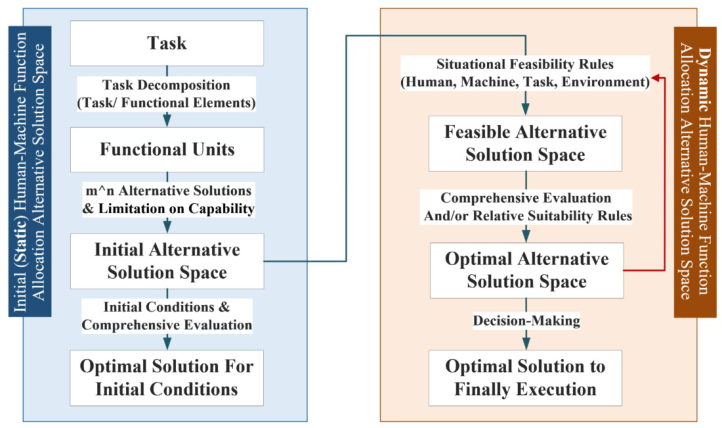
A GENERALIZED FRAMEWORK FOR HUMAN-MACHINE FUNCTION ALLOCATION The generalized framework for human-machine function allocation proposed in this paper includes static and dynamic allocation phases (see Figure 1) and can be divided into the following parts: Generation of functional units (Pritchett et al., 2014) for allocation based on task decomposition, where a functional unit means a set of task/function elements to be allocated together to one performer, either a human, a machine, or a team of humans, machines or their combinations; Screening human-machine function allocation alter- natives according to limitation and preference rules based on human and machine capability measures, resulting in an initial human-machine func- tion allocation alternative solution space; Applying situational feasibility rules established on situation assessment models when predefined trigger- ing criteria are matched, to identify the feasible human-machine function allocation solutions for the current situation; Determining the optimal solu- tion according to a comprehensive evaluation with trade-off criteria and/or relative suitability rules of humans and machines.
Figure 1: The generalized framework for human-machine function allocation.
Task Decomposition Task decomposition is the process of splitting a task into a series of functional units. A very tricky problem is when to stop task splitting. The smaller the granularity of the decomposition, the larger the space for human-machine function allocation alternatives. However, considering the cost of functional units switching between different performers and the fluency of human- machine collaboration process, the decomposition of functional units needs the appropriate granularity. One approach is to decompose the task layer into meta-operations (that is, the smallest operations or activities that can be
identified or defined) (Jonassen et al., 1989; Qiu et al., 2014) and then com- bine one or more meta-operations into a functional unit according to certain rules. Another approach is to break task down directly into the granularity that conforms to the established rules. Thus, the functional unit construction rules should be formulated according to the needs of stakeholders, the char- acteristics of actual tasks and the limitations of existing technical conditions. For example:
The order in which several meta-operations occur should be contiguous and fixed;
It is unnecessary to change performers for the adjacent meta-operations;
The cost of changing performers for the adjacent meta-operations is too high.
The functional elements involved in each functional unit could be iden- tified to help establish relevant limitation and preference rules and relative suitability rules based on human and machine capability measures. Based on cognitive activity theories such as Information Processing Model (Wickens, 1992) and Macrocognitive Model (Whaley et al., 2016), this study proposes a general framework of functional elements (see Table 1) that can be further expanded for specific applications.
Table 1. The general framework of functional elements.
Initial (Static) Human-Machine Function Allocation Base on Limitation and Preference Rules The human and machine capability boundary (limitations) are the basis for the preliminary screening of function allocation alternatives. Human abilities can generally be divided into two categories: cognitive capabili- ties and physical capabilities. Machine capabilities refers to the extent to which a machine/system is capable of performing a certain task/function. The technical indicators and performance parameters of the machine/system can be used to determine whether it has the ability to complete a certain task/function. Different scenarios and tasks have different requirements of human and machine capabilities, which means that the preliminary screening rules (i.e. limitation and preference rules) cannot be developed indepen- dently from the actual tasks. Therefore, it is necessary to determine the requirements of human and machine capabilities for each functional unit in a specific task, and then match it with the capability boundary to screen
A Generalized Framework for Human-Machine Function Allocation 27
out the alternatives in which the human or machine capabilities cannot meet the requirements, so as to obtain the initial (static) human-machine function allocation alternative solution space. With reference to the NASA Space Flight Human Systems Standard (NASA-STD-3001) (National Aero- nautics and Space Administration, 2022) and the Human Integration Design Handbook (NASA/SP-2010-3407) (National Aeronautics and Space Admin- istration, 2014), Table 2 sorts out human and machine capability indicators, and illustrates how to establish limitation and preference rules according to the actual task requirements.
In addition to human and machine capability boundaries, constraints such as policy and cost (such as restrictions on automation, authority of human and machine, costs of personnel training, operation and maintenance), orga- nizational constraint (considering whether an alternative solution conforms to combat tactics, procedures, regulations and culture) can also be used as the preliminary screening rules.
Feasible (Dynamic) Human-Machine Function Allocation Base on Situational Feasibility Rules The dynamic human-machine function allocation is mainly carried out based on various triggering indicators and their corresponding situational variables. Triggering indicators are different categories of information in a situation that can be perceived, observed, and modelled to build an understanding of the current situation or what is happening. There are many situational variables that may lead to changes in the human-machine function allocation (Feigh et al., 2012). The situational triggering variables mentioned in the literature are summarized and divided into five categories:
Table 2. Classification of human and machine capability indicators.
Table available in the original PDF paper.
Classification Indicators Rules (example) Cognitive capabilities Sensation and perception If the distance of the target in visual task (such as detection) ≥___, then performer should be___.
Visual perception: visual acuity, spatial contrast sensitivity, field of regard, depth perception, visual detection accuracy, etc Auditory perception: absolute threshold of hearing, auditory localization, auditory detection accuracy, etc.
Considering safety, human should make the decision.
Selection and decision- making
Information integration, logical reasoning, problem-solving, decision reliability Action execution
If the operation speed needs ≥___, then the performer should be___.
If the working time ≥___, then the performer should be___.
Working memory, information processing speed (reaction time), continuous working time
Physical capabilities
Reach envelope
Comfortable and maximum working area
If the distance of target to be operated on ≥___, then the performer should be___. Physical ability
Strength, aerobic capacity, speed, endurance
If the pulling force required to open a device is ___, then the performer should be___.
Operator variables include operator states and operator performance. Operator states refer to those variables that reflect the psychological and physiological states of an operator, such as workload (Hansson et al., 2009; Salvendy and Karwowski, 2021), fatigue (Phillips, 2015), situation aware- ness (Endsley, 2021), distraction (Hedlund, J. et al., 2006) etc. The change of personal states may trigger function reallocation between human and machine. Operator states behaviours affects task process, possibly resulted in abnormal behaviours and poor task performance (safety, efficiency and effectiveness). When operator performance is significantly reduced or an abnormal behaviour occurs during the task process, the automation may need to take over the task.
System variables include system performance (efficiency and effectiveness) and failures (unable to perform task as expected). When system performance decreases significantly or a system failure suddenly occurs, human need to take over the automated tasks.
Task variables are those task characteristics that may affect human or machine performance and their collaboration. This category triggers the real- location of human-machine function mostly for the change of task complex- ity (such as size, action complexity, temporal demand and so on) (Braarud and Kirwan, 2011; Liu and Li, 2012; Wood, 1986) and difficulty.
Environment variables refers to environmental states or spatio-temporal changes in the environment that may affect human or machine performance and their collaboration, including temperature, noise, vibration, visibility, etc.
There may be a number of situational variables that can be directly observed or measured to reflect the level of a situational trigger. The values and threshold of the situational variables can be converted into a “suitability” criterion. Suitability refers to the appropriateness of allocating a functional unit to a performer under a specific situation. It can be set up as a man- agement criterion, or determined by domain experts based on actual task requirements. Table 3 presents some examples of situational feasibility rules, noting that these rules are generalized, qualitative, and non-exhaustive.
Comprehensive Evaluation With Trade-Off Criteria and/or Relative Suitability Rules In both the initial (static) or the feasible (dynamic) human-machine function allocation phases, alternative solutions need to be evaluated to achieve an optimal solution. Two evaluation methods may be employed:
One is comprehensive evaluation with trade-off criteria. Through litera- ture review (Feigh and Pritchett, 2014; Kim et al., 2008; Madni et al., 2018; Parasuraman et al., 2000; Roth et al., 2019; Sushereba et al., 2019) and expert discussion, this study sorted out a set of trade-off criteria for human- machine function allocation. They can be divided into outcome criteria and process criteria. The former includes risk of safety (the possibility of an acci- dent/event occurring and the severity of the consequences), the degree of goal achievement (such as success rate and cost) and efficiency (such as completion time and resource utilization). The later includes team coordination, work- load, (shared) situation awareness, human reliability, machine reliability, etc.
A Generalized Framework for Human-Machine Function Allocation 29
The trade-off criteria can be evaluated by quantitative or qualitative evalu- ation methods. If needed, a comprehensive evaluation could be obtained by weighting the trade-off criteria.
The other is the use of relative suitability rules of humans and machines. The list of relative suitability of human and machine in Table 4 was con- structed based on the relevant researches (e.g. Cummings, 2014; de Winter & Dodou, 2014; Fitts, 1951; Schoettle, 2017). The relative suitability rules can be established by considering task requirements (see Table 5), which are used to evaluate the suitability of current feasible performers. Then the per- formers with the highest suitability of each functional unit could be selected as the optimal ones.
Table 3. Examples for situational feasibility rules (value are used as example only).
Table available in the original PDF paper.
Situational triggering indicator Situational feasibility rules Levels Operator Workload If workload level is high and the performer is a human, then his suitability is 30.
Available Unavailable
Low Medium High System System state If the system state is unavailable and the performer is a single system, then its suitability is 0.
Adequate Marginal Inadequate Task Available time If time is marginal and the performer is a human, then his suitability is 40. If time is inadequate and the performer is a human, then his suitability is 0.
Acceptable to human Acceptable to machine Too high or too low
Environment Temperature If temperature is beyond the acceptable level for human and the performer is a human, then his suitability is 0. If temperature is beyond the acceptable level for a machine, then the task needs to be terminated.
Table 4. Examples of relative suitability of human and machine.
Table available in the original PDF paper.
Dimension Indicator Human Machine Limited Wider than human Sensation and perception Range of perception (visual/auditory)
Information processing
Can only process a small amount of data
Better at processing mass data
Selection and decision- making Action execution Consistency of operation
Variable, especially for highly repetitive and routine tasks
Highly consistent, better especially for tasks requiring constant vigilance General indicators
Continuous working time
limited and relatively short working duration
Can work for a long duration
CONCLUSION
By summarizing the analysis process, advantages and disadvantages of the existing human-machine function allocation methods, this paper proposes a generalized framework for human-machine function allocation. The method includes some important steps: task decomposition, initial (static) human- machine function allocation base on limitation and preference rules, feasible (dynamic) human-machine function allocation base on situational feasibility rules, and comprehensive evaluation with trade-off criteria and/or relative suitability rules. The generalized framework provides a practical guidance for systematic and flexible human-machine function allocation analysis, to ensure safety and task performance by adjusting and optimizing the relationship between human and machine in different task situations.
Table 5. Examples for relative suitability rules (value are used as example only).
If complexity is high, and the performer is a machine, then the suitability is 30. If complexity is high, the available time is adequate, and the performer is a human, then the suitability is 90.
Knowledge- based task Otherwise
Task type If it is a knowledge-based task, and the functional elements involve evaluation and judgment, and the performer is a machine, then the suitability is 30. If it is a knowledge-based task, and the functional elements involve evaluation and judgment, and the performer is a human, then the suitability is 90.
ACKNOWLEDGMENT
This study was supported by the National Natural Science Foundation of China (Grant No. T2192932) and the Open Funding Project of National Key Laboratory of Human Factors Engineering (Grant No. GJSD22003).
REFERENCES
Braarud, P. Ø., Kirwan, B. (2011). Task Complexity: What Challenges the Crew and How Do They Cope, in: Skjerve, A. B., Bye, A. Eds., Simulator-Based Human Factors Studies Across 25 Years. Springer, London, pp. 233–251. Cummings, M. M. (2014). Man versus Machine or Man + Machine? IEEE Intelligent
Systems 29, 62–69. de Winter, J. C. F., Dodou, D. (2014). Why the Fitts list has persisted throughout the history of function allocation. Cogn Tech Work 16, 1–11. Dearden, A., Harrison, M., Wright, P. (2000). Allocation of function: scenarios,
context and the economics of effort. International Journal of Human-Computer Studies 52, 289–318.
A Generalized Framework for Human-Machine Function Allocation 31
Department of Defense (2011). Human Engineering Program Process and Procedures (Report No. MIL-HDBK-46855A). U. S. Department of Defense. Endsley, M. R. (2021). A Systematic Review and Meta-Analysis of Direct Objective
Measures of Situation Awareness: A Comparison of SAGAT and SPAM. Hum Factors 63, 124–150. Endsley, M. R. (2015). Situation Awareness Misconceptions and Misunderstandings.
Journal of Cognitive Engineering and Decision Making 9, 4–32. Feigh, K. M., Dorneich, M. C., Hayes, C. C. (2012). Toward a Characterization of Adaptive Systems: A Framework for Researchers and System Designers. Hum Factors 54, 1008–1024. Feigh, K. M., Pritchett, A. R. (2014). Requirements for Effective Function Alloca-
tion: A Critical Review. Journal of Cognitive Engineering and Decision Making 8, 23–32. Fitts, P. M. (1951). Human engineering for an effective air-navigation and trafficcontrol system, Human engineering for an effective air-navigation and traffic- control system. National Research Council, Oxford, England. Hansson, G.-Å., Balogh, I., Ohlsson, K., Granqvist, L., Nordander, C., Arvidsson, I.,
Åkesson, I., Unge, J., Rittner, R., Strömberg, U., Skerfving, S. (2009). Physi- cal workload in various types of work: Part I. Wrist and forearm. International Journal of Industrial Ergonomics 39, 221–233. Harel, A. (2020). System Thinking Begins with Human Factors: Challenges for the 4th Industrial Revolution, in: Systems Engineering in the Fourth Industrial Revolution. pp. 375–413. Hedlund, J., Simpson, H. M., Mayhew, D. R. (2006). International Conference on
Distracted Driving: Summary of Proceedings and Recommendations. Presented at the International Conference on Distracted Driving, Toronto, Canada, October 2–5, 2005. Jonassen, D. H., Hannum, W. H., Tessmer, M. (1989). Handbook of task analysis procedures, Handbook of task analysis procedures. Praeger Publishers, New York, NY, England. Kim, S. Y., Lee, S. M., Johnson, E. (2008). Analysis of dynamic function allocation
between human operators and automation systems. AIAA Modeling and Sim- ulation Technologies Conference and Exhibit, AIAA Modeling and Simulation Technologies Conference and Exhibit. Liu, P., Li, Z. (2012). Task complexity: A review and conceptualization framework.
International Journal of Industrial Ergonomics 42, 553–568. Madni, A. M., Sievers, M., Madni, C. C. (2018). Adaptive Cyber-Physical-Human Systems: Exploiting Cognitive Modeling and Machine Learning in the Control Loop. INSIGHT 21, 87–93. National Aeronautics and Space Administration (2022). NASA Space Flight Human-
System Standard (Report No. NASA-STD-3001 Volume 2). National Aeronautics and Space Administration (2014). Human Integration Design Handbook (Report No. NASA/SP-2010-3407). Parasuraman, R., Sheridan, T. B., Wickens, C. D. (2000). A model for types and levels
of human interaction with automation. IEEE Transactions on Systems, Man, and Cybernetics - Part A: Systems and Humans 30, 286–297. Phillips, R. O. (2015). A review of definitions of fatigue – And a step towards a whole definition. Transportation Research Part F: Traffic Psychology and Behaviour 29, 48–56. Price, H. E. (1985). The Allocation of Functions in Systems. Hum Factors 27, 33–45.
Pritchett, A. R., Kim, S. Y., Feigh, K. M. (2014). Modeling Human–Automation Function Allocation. Journal of Cognitive Engineering and Decision Making 8, 33–51. Qiu, Y., Pan, D., Li, Z., Liu, P. (2014). A Human Reliability Analysis Approach Based
on the Concepts of Meta-Operation and Task Complexity. Presented at the PSAM 2014 - Probabilistic Safety Assessment and Management. Roth, E. M., Sushereba, C., Militello, L. G., Diiulio, J., Ernst, K. (2019). Function Allocation Considerations in the Era of Human Autonomy Teaming. Journal of Cognitive Engineering and Decision Making 13, 199–220. Salvendy, G., Karwowski, W. Eds. (2021). Handbook of Human Factors and
Ergonomics, 1st ed. Wiley. Schoettle, B. (2017). Sensor Fusion: A Comparison of Sensing Capabilities of Human Drivers and Highly Automated Vehicles. Steinhauser, N. B., Pavlas, D., Hancock, P. A. (2009). Design Principles for Adaptive
Automation and Aiding. Ergonomics in Design 17, 6–10. Sun X., Zhang Y., Qin J., Li J., Wang S. (2020). Review on Human-Intelligent Syetem Collaboration. Packaging Engineering 41, 12. Sushereba, C. E., Diiulio, J. B., Militello, L. G., Roth, E. (2019). A Tradespace Frame-
work for Evaluating Crewing Configurations for Future Vertical Lift. Proceedings of the Human Factors and Ergonomics Society Annual Meeting 63, 352–356. Whaley, A. M., Xing, J., Boring, R. L., Hendrickson, S. M. L., Joe, J. C., Le Blanc, K. L., Morrow, S. L. (2016). Cognitive Basis for Human Reliability Analysis. U. S. Nuclear Regulatory Commission. Wickens, C. D. (1992). Engineering psychology and human performance, 2nd ed.
ed, Engineering psychology and human performance, 2nd ed. HarperCollins Publishers, New York, NY, US. Wood, R. E. (1986). Task complexity: Definition of the construct. Organizational Behavior and Human Decision Processes 37, 60–82.
LISTED IN THE AHFE DIGITAL BOOKSTORE CATALOGUE
Explore the complete digital volume
Human Dynamics, Product Evaluation and Quality
Read this individual research paper free through the original publisher, or explore the full digital proceedings book.
ISBN 978-1-964867-07-6
Explore this ISBN in the AHFE Bookstore ↗Listed in the July 2026 bookstore catalogue; search by ISBN to confirm current availability · Digital book purchase optional