Bo Han, Shoupeng Huang, Hao Li, Chunhui Wang (2025). Design and preliminary experimental verification of a passive resistance-type lower limb exoskeleton. In: Human Factors and Wearable Technologies. AHFE Open Access, vol. 175, pp. 22–29. https://doi.org/10.54941/ahfe1006355
Lower limb resistance training is a widely used method in fitness and rehabilitation training. However, existing methods exhibit certain limitations in meeting the synergistic requirements of lower limb joint coordination during human motion. We proposes a passive resistance-type lower limb exoskeleton design and conducts preliminary experimental validation. The exoskeleton employs single-stage or double-stage cylindrical compression spring mechanisms at the hip, knee, and ankle joints as resistance sources, achieving multi-joint synergistic movement through jaw-like structures and chain-like mechanisms.The paper first introduces the overall design scheme and key component designs of the exoskeleton. Subsequently, finite element analysis is utilized to evaluate the device's safety and reliability, followed by experimental validation under actual loading conditions. Results demonstrate that the exoskeleton enables coordinated multi-joint resistance functionality in the lower limbs while maintaining robust safety and comfort under extreme loads.
Good lower limb strength plays a crucial role in protecting lower limb joints and maintaining body balance (Cimino et al., 2010; Lee et al., 2018). Resistance training is an effective method to enhance muscle strength, primarily including weight training, elastic band exercises, and machine-based training, which mainly focus on single joints and muscles (Lopez et al., 2010; Wan, 2003). Since movement is achieved through coordinated interactions between muscles, the isolated development of individual muscle has limitations in meeting the synergistic requirements of human lower limb joint activities. Therefore, some scholars advocate for holistic training based on human movement patterns to balance the development of muscles involved in motion, thereby preserving the stability of the body’s overall structure (Boyle, 2016; Gambetta, 2004).
As a wearable human-machine interactive device, lower limb exoskeletons can facilitate coordinated activities across multiple joints and muscle groups in the lower limbs. Existing exoskeletons are predominantly used for
Design and Preliminary Experimental Verification of a Passive Resistance 23
walking assistance, while resistance-focused exoskeletons remain relatively rare (Bogue, 2009). For example, NASA unveiled the X1 exoskeleton robot in 2013, which combines active and passive mechanisms to enhance or inhibit lower limb joint movements (NASA, 2013). Cao et al. (2023) developed an exoskeleton specifically targeting hip abductor muscle training. Considering factors such as lightweight design, durability, and cost-effectiveness, we have designed a passive resistance-type lower limb exoskeleton capable of supporting multi-joint synergistic resistance training (e.g., walking, squats, etc).
DESIGN SCHEME Overall Structure
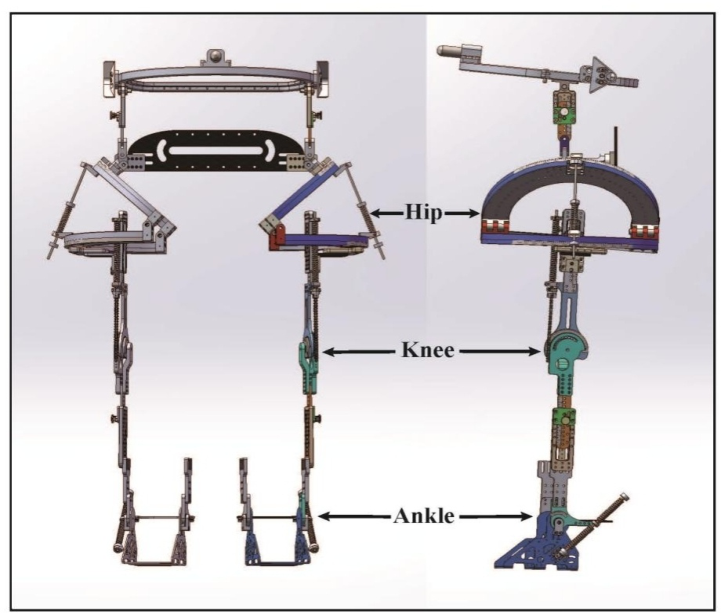
This design adopts a modular structure, primarily comprising three components: the hip joint, knee joint, and ankle joint (as illustrated in Figure 1). Each module utilizes single-stage or double-stage cylindrical compression spring structures to provide resistance at different joint locations. Each module employs either single-stage or double-stage cylindrical compression spring structures to generate resistive torque.
Figure 1: Modular lower limb exoskeleton design.
Joint Resistance Module Based on the motion characteristics of lower limb resistance training, distinct cylindrical compression spring structures were designed for the hip, knee, and ankle joints:
Hip Joint: Utilized a double-stage cylindrical compression spring structure to simulate resistance across wide-range motion.
Knee Joint: Employed a single-stage cylindrical compression spring mechanism with adjustable preload for resistance control.
Ankle Joint: Featured a tunable spring system where dynamic compression adjustment adapts to gait variations.
Finite Element Analysis (FEA) of Key Structures To ensure the device’s safety under extreme loads, we conduct finite element analysis methods on key structural components.
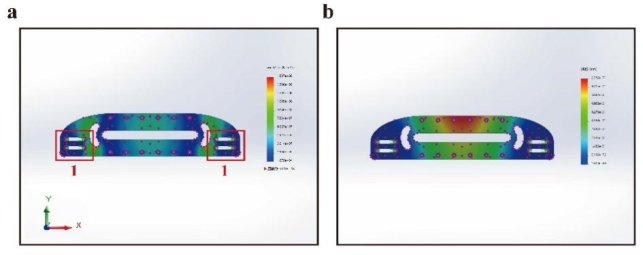
Lumbar Plate The lumbar plate serves as the structure that connects the lower limbs on both sides, bearing the weight of the users and the lower limb exoskeleton. This structure requires a material with high strength and excellent toughness. Due to its lightweight, high strength, and long-term durability, carbon fiber material is preferred for the lumbar plate of the lower limb exoskeleton (Hope and McDaid, 2017), as depicted in Figure 1. Stress analysis results indicate (see Figure 2): When a force of 2000N is applied along the Z-axis, the maximum stress generated by the structure remains below the allowable stress, with a deformation of 0.7 mm.
Figure 2: Stress analysis results for the lumbar plate (1 represents fixed support).
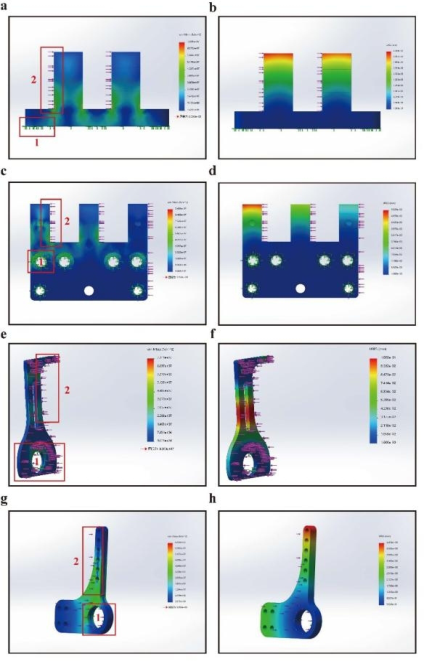
Lower Limb (Hip-Lumbar Connection, Simulated Hip Joint, Knee Joint, Ankle Joint) The core components are the primary load-bearing structures. When a loading force of 2000N is applied, the stress distribution and deformation results for these core components are shown in Figure 3. The maximum stress at the critical structural region of the hip-lumbar connection is
Design and Preliminary Experimental Verification of a Passive Resistance 25
43.87MPa which is significantly below the critical stress value. The maximum deformation is 0.03 mm. The maximum stress of the simulated hip joint, knee joint, and ankle joint core components are all below allowable stress.
The maximum deformations of the hip and knee joint core components are minimal, posing no impact on exoskeleton functionality. For the simulated ankle joint core structure under a loading force of 2000N, the maximum deformation at the critical point is 4.474 mm. In actual operating conditions, the loading force on this structure from the human body and mechanical devices is much less than 2000N, and the resulting deformation is also far below 4.474 mm. According to Class II medical device safety testing protocols, the deformations of exoskeleton terminal should not exceed 10 mm under a 196N lateral force, thus meeting safety standards (Wang et al., 2023). The lower limb exoskeleton developed in this study demonstrates maximum deformations below 10 mm even under extreme loading conditions of 2000N, fully complying with safety requirements.
Figure 3: Stress analysis of core structures for ankle joint (1 represents fixed support, 2 represents the direction of the applied force).
EXPERIMENTAL VERIFICATION Experimental Objectives
The experiment aimed to validate the motion resistance characteristics and safety of the exoskeleton under operational loads, with specific objectives:
1. Testing whether the motion resistance at each joint meets the design specifications; 2. Verifying the structural stability of the device under extreme loads; 3. Assessing user experience, such as comfort and flexibility.
Experimental Methods A gait simulation device was used to evaluate the motion resistance characteristics of the exoskeleton during locomotion.
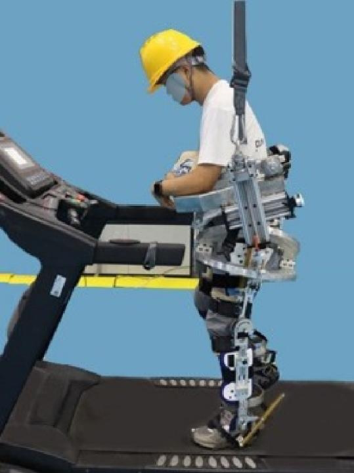
Experimental Results and Analysis Long-Distance Walking Fatigue Test To validate the durability of the exoskeleton in actual application, a long-distance walking experiments was conducted with 11 participants (BMI: 19–25; age: 23.6 ± 2.4 years; height: 1.72 ± 0.05 m; weight: 66.9 ± 7.4 kg). Real-time monitoring of critical components (joints and load- bearing connector assembly) was performed, and any abnormalities were recorded.
Figure 4: Long-distance walking test.
The result indicated that the exoskeleton maintained its core functionality effectively, with no significant decline observed even after extended periods of
Design and Preliminary Experimental Verification of a Passive Resistance 27
walking. All participants successfully completed the test tasks. Additionally, the main components exhibited no significant wear or damage before and after testing, suggesting robust durability, as evidenced by the assessment of the exoskeleton’s wear detection device. Experimental results confirmed that the exoskeleton’s core functionality maintained its integrity following prolonged walking, with all test subjects successfully completing the required tasks. Furthermore, post-test inspections revealed no evident wear or damage on the device’s primary structural components, indicating the design possesses substantial durability.
Comfort Assessment During the experiment, we collected participants’ comfort feedbacks through questionnaires and interviews. The average comfort score of 7.8/10 from participants underscores the exoskeleton’s ability to sustain high levels of comfort over extended periods. Detailed interviews were conducted after the experiment.
1. Localized pressure sensation: Only a few participants reported mild pressure in the lumbar areas during walking, which did not compromise the overall user experience. 2. Range of motion: Most participants acknowledged that the exoskeleton minimally affected their gait, with satisfactory joint flexibility maintained. Participants generally believed that the exoskeleton had minimal impact on gait and good joint flexibility.
Fatigue Assessment During the long-distance walking test, the Borg scale was utilized to assess participants’ fatigue levels. The time required to reach fatigue levels 4, 5, 6, and 7 is summarized in Table 1, and level 7 is considered unacceptable. The results indicate that the device supports continuous use for 40∼50 minutes. Although the system exhibited a notable level of support, allowing participants to accomplish long-distance walking tasks within this duration, its operational lifespan might necessitate further optimization to meet demands for prolonged or higher-intensity activities.
Table 1: Average time to reach different fatigue levels.
Table available in the original PDF paper.
Load Level Average Time (Minutes)
4 5 5 10 6 24 7 41
The experimental results indicate that the device has a certain ability to support long-distance walking. Nonetheless, additional enhancements are necessary to boost its capabilities for prolonged or more demanding applications.
CONCLUSION
This paper presents a design scheme for a passive resistance-type lower limb exoskeleton and experimentally validates its performance and safety. The results demonstrate that our design enables coordinated multi-joint resistance functionality in the lower limbs while maintaining robust safety performance under extreme loads.
Although preliminary achievements have been attained, several issues remain to be addressed: a. Weight Optimization: In the future, device weight can be reduced by adopting lightweight materials (e.g., carbon fiber) or optimizing structural designs. b. Flexibility Enhancement: Exploring more flexible joint mechanisms while preserving safety to improve user experience. c. Intelligent Adaptation: By integrating sensor technology, real-time adjustment of resistance magnitude can be achieved, further enhancing the device’s adaptability.
In conclusion, while the proposed exoskeleton demonstrates promising potential, continuous optimization and innovation are essential for achieving higher levels of practicality and usability in future applications.
ACKNOWLEDGMENT
This study was supported by the Foundation of Key Laboratory of Human Factors Engineering (No. 614222204042202).
REFERENCES
Bogue, R. (2009). Exoskeletons and robotic prosthetics: A review of recent developments. Industrial Robot: An International Journal. Volume 36, No. 5. Boyle, M. (2016). New Functional Training for sports. Human Kinetics. Cao, W. J., Shang, D. Y., Yin, M., et al. (2023). Development and evaluation of a
hip exoskeleton for lateral resistance walk exercise. IEEE/ASME Transactions on Mechatronics, Volume 28, No. 4. pp. 1966–1974. Cimino, F., Volk, B. S. and Setter D. (2010). Anterior cruciate ligament injury: Diagnosis, management, and prevention. American Family Physician, 82, 8:917- 922(2010). Gambetta, V. (2004). Athletic Development. Human Kinetics. Hope, J., McDaid, A. (2017). Development of wearable wrist and forearm
exoskeleton with shape memory alloy actuators. Journal of Intelligent & Robotic Systems, Volume 86, pp. 397–417. Lopez, P., Radaelli, R., Taaffe, D. R., et al. (2021). Resistance training load effects on muscle hypertrophy and strength gain: Systematic review and network meta-analysis. Medicine & Science in Sports & Exercise, Volume 53, No. 6. pp. 1206–1216. NASA’s Ironman-Like Exoskeleton Could Give Astronauts, Paraplegics Improved
Mobility and Strength. (2013). Website: https://www.nasa.gov/technology/nasas- ironman-like-exoskeleton-could-give-astronauts-paraplegics-improved-mobility. Wan, D. G. (2003). Modern Strength Training. Human Sports.
Design and Preliminary Experimental Verification of a Passive Resistance 29
Wang, J., Li, J., Liang, P., et al. (2023). Mechanism design and finite element analysis of lower limb exoskeleton robot. Technology Innovation and Application, Volume 28, pp. 40–44. Yoon, D. H., Lee J. Y. and Song, W. (2018). Effects of resistance exercise training on
cognitive function and physical performance in cognitive frailty: A randomized controlled Trial. Journal of Nutrition Health & Aging, Volume 22, No. 8. pp. 944–951.
LISTED IN THE AHFE DIGITAL BOOKSTORE CATALOGUE
Explore the complete digital volume
Human Factors and Wearable Technologies
Read this individual research paper free through the original publisher, or explore the full digital proceedings book.
ISBN 978-1-964867-51-9
Explore this ISBN in the AHFE Bookstore ↗Listed in the July 2026 bookstore catalogue; search by ISBN to confirm current availability · Digital book purchase optional