Zhaoyu Wang, Xiaoxiao Yan (2025). Analysis of Gamified Museum Exhibition Design from the Perspective of the DMC Model. In: Human Factors and Wearable Technologies. AHFE Open Access, vol. 175, pp. 129–137. https://doi.org/10.54941/ahfe1006366
The gamification of museum exhibitions enhances cultural heritage education and visitor experience by integrating components like points, badges, and leaderboards to boost engagement, mechanics such as challenges and feedback to foster immersion, and dynamics involving emotion and storytelling to deepen emotional connection. Using the DMC model, this paper presents a gamified exhibition design framework demonstrated through case studies from institutions like the British Museum, emphasizing balanced use of technology to maintain cultural authenticity and visitor autonomy. The proposed model aims to create interactive, educational, and immersive experiences that support both engagement and self-directed learning.
Museums play a key role in preserving and showcasing cultural heritage while serving the public and promoting education. Gamification, with its user-centered approach, aligns with museums’ people-focused mission, enhancing visitor engagement and intrinsic learning motivation. This paper examines the trend of museum exhibitions shifting from object-centered displays to gamified experiences. Using the DMC model, it analyzes domestic and international cases across components, mechanics, dynamics, and integration, proposing a gamified exhibition design framework to optimize visitor interaction and educational impact.
CONCEPTUAL DEVELOPMENT: THE TREND OF GAMIFICATION IN THE SHIFT OF MUSEUM EXHIBITIONS The Evolution and Development of Gamification
Gamification involves using game design elements in non-game contexts to boost motivation, enhance user experience, and increase engagement. It has evolved with contributions from disciplines like communication, theater, and design, expanding into fields such as education, health, and environmental protection.
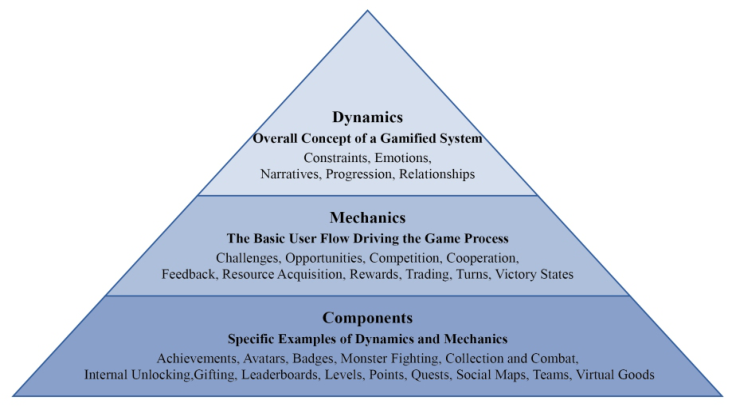
In For the Win, Werbach and Hunter introduced the DMC model (Dynamics, Mechanics, Components), organizing gamification elements into three levels: Components are concrete features like points and badges, Mechanics drive interaction, and Dynamics represent overarching system concepts. Participation in gamification is voluntary, fostering a flow experience where users immerse themselves in enjoyable, meaningful activities. The effective integration of Dynamics, Mechanics, and Components creates cohesive systems that enhance engagement and learning.
Figure 1: DMC Model (Werbach et al., 2012).
The Shift From Objects to Events in Museum Exhibitions Museums aim to preserve and showcase cultural heritage, with exhibition design shifting from “objects” to “stories” to enhance personal connections. Sree Sreenivasan emphasizes storytelling as key to bridging physical and virtual worlds. Following global trends, Chinese museums are adopting narrative-driven approaches, linking artifacts through themes of people, nature, and society. Events like the 2013 AAM conference and Zhang Wanzhen’s “narrative turn” have reinforced this shift. Gamification accelerates this change by encouraging interactive, immersive visitor participation. However, achieving inclusive and engaging exhibitions requires collaboration among museums, designers, and audiences.
The Application of Gamification in Exhibitions Exhibition design has shifted from artifact-focused displays to story-driven experiences, enhancing connections between the physical and digital worlds. Chinese museums have embraced this trend with narratives like “Let the artifacts speak” and “Tell the Chinese story,” inspired by themes such as the 2013 AAM’s “The Power of Story” and Zhang Wanzhen’s “narrative
Analysis of Gamified Museum Exhibition Design From the Perspective 131
turn.” Gamification furthers this transition by adding interactive elements, turning visitors into active participants and deepening their engagement. However, achieving immersive, balanced exhibitions requires collaboration among museums, designers, and audiences.
CASE STUDY: GAMIFICATION OF MUSEUM EXHIBITIONS BASED ON THE DMC MODEL This study explores the integration of gamification in museum exhibitions, focusing on enhancing cultural heritage experiences. Using the DMC model, it examines how components enable interaction, mechanics guide participation, and dynamics boost engagement. The analysis highlights how these elements combine to enhance visitor enjoyment, challenge, and content immersion.
Table 1: Gamification elements analysis table (illustration created by the author).
Table available in the original PDF paper.
Exhibition Name Category Primary Gamification
Purpose Content Elements
“Everyone is a Curator” Component Points, Badges,
Building a Transforming exhibition content
Elements Leaderboards, Achievements, Avatars, Levels, Tasks, Social Graphs
comprehensive gamified exhibition system to motivate participation.
into a PBL (Points-Badges-Leaderboard) format to engage audiences, serving as an auxiliary tool for museum promotion and dissemination. This approach enables audiences to quickly grasp the key content of the exhibition, meeting personalized needs and providing a sense of achievement. “Gifts to Athena” Mechanics
Challenges, Facilitating Exhibition
Using an adventure game format,
Elements Competition, Cooperation, and Feedback
Progress and Enriching the Experience
participants unlock new content within the game, learning relevant knowledge through play. “The Bureau of Ancient
Challenges,
Visitors must engage with on-site
Text Preservation: The Treasure of the Mountain and Sea Society”
Opportunities, Competition, Cooperation, and Feedback
exhibits to find clues, conduct reasoning, and solve interconnected puzzles, making the exhibition experience both engaging and intellectually stimulating. “The Mystery of the Grand
Challenges,
With modern digital technology as
Opportunities, and Cooperation
Canal: The Water Supervisory Bureau of the Ming Dynasty”
the primary medium, the exhibition experience is enhanced through narrative and props, guiding participants through layers of challenges. During this self-directed exploration, visitors complete the entire exhibition process while gaining knowledge about the Grand Canal. “Terracotta Army – The Dynamic
Emotions and Driving Audience
Providing a first-person exhibition
Elements Progression Painted Soldiers of the Emperor”
Motivation and Stimulating Interest in the Exhibition
mode for children allows them to experience the exhibition content in an immersive manner, fostering engagement and advancing the storyline. “1509: Who Do You Sit
Constraints,
Clear objectives are provided to the
Narratives, and Progression
With? – Wu School Painting Youth Education Interactive Exhibition”
audience, supported by a well-structured narrative framework that facilitates the progression of the viewing experience.
Continued
132 Wang and Yan
Table 1: Continued Exhibition Name Category Primary Gamification
Table available in the original PDF paper.
Purpose Content Elements The exhibition is driven by story
“Famen Dream Shadow
Constraints,Emotions,
Script Murder Activity”
Narratives, Progression, and Relationships
clues, enabling the audience to interact with cultural artifacts through an immersive experience. By focusing on the audience’s cultural engagement, the exhibition achieves the dual goals of knowledge dissemination and value transmission.
Component Elements Component elements, as the foundational gamification elements, are concrete examples of dynamics and mechanics. Various component elements, guided by mechanic elements, can form complex rules, with dynamic elements driving the system, thereby creating a complete gamified system. In the design of gamified exhibitions, component elements correspond to the basic game functions of the exhibition, aiming to utilize clear design elements to construct the full exhibition content.
For example, elements like points, badges, and leaderboards can motivate visitors to participate. In the Hangzhou Museum’s 20th Anniversary special exhibition “Grain Dao Mountain Plan No. 18,” the online pre-event “Everyone is a Curator” mainly utilized component elements such as points, badges, leaderboards, achievements, avatars, levels, tasks, and social maps. Among these, points, badges, and leaderboards were key to the structure of the exhibition. Visitors could select exhibits online to create an exhibition, generate a curatorial poster, and share it. Based on the frequency of shares, the visitors’ user levels would increase, and their points would accumulate according to the number of exhibits curated. Users with higher point rankings could win corresponding crystal cups and exhibition rewards. Finally, the true curators of the exhibition were determined based on the exhibit data chosen by the visitors, which became the reference for the final selection of the actual exhibits. This form of exhibition has become an auxiliary tool for museum promotion and dissemination, and an important way for visitors to quickly understand the exhibition content, thereby meeting personalized needs and providing a sense of achievement.
Mechanic Elements Mechanic elements play a crucial role in driving the exhibition’s progression and structuring user participation, enhancing the overall engagement and flow of the experience. By aligning gamified mechanisms with the exhibition design, these elements can be tailored to fit the content and create an interactive, immersive experience that encourages active exploration.
For example, the British Museum’s AR-based app “Gifts to Athena” employed mechanic elements like challenges, competition, cooperation, and feedback to transform the exhibition into a treasure hunt. Visitors, especially children, completed tasks by finding story details in artworks, battling animated monsters, and collaborating or competing with others. This interaction allowed participants to become heroes in their own story,
Analysis of Gamified Museum Exhibition Design From the Perspective 133
receiving positive feedback and rewards that reinforced their sense of accomplishment and engagement.
Similarly, the National Museum of Classic Books’ exhibition “The Treasure of the Mountain and Sea Society” utilized mechanic elements such as challenges, opportunities, competition, cooperation, and feedback. Puzzle clues, derived from ancient texts, were scattered across different exhibition spaces like “The River of Classics” and “National Treasures.” Visitors explored the exhibits, including ancient maps and artifacts, to find clues, make connections, and solve puzzles, immersing themselves in an engaging and interconnected decoding process that enhanced their understanding of the collections.
The China Grand Canal Museum’s interactive youth exhibition, “The Mystery of the Grand Canal: The Water Supervisory Bureau of the Ming Dynasty,” also applied mechanic elements like challenges, opportunities, cooperation, feedback, and rewards. This immersive exhibition used digital technology to recreate a narrative-driven puzzle-solving adventure. Visitors took on the role of Ming officials tasked with escorting a prince back to the capital while solving mysteries and completing tasks along the way. The experience was designed as a self-guided journey, with feedback mechanisms reinforcing progress and achievements, keeping visitors engaged and motivated throughout the storyline.
Dynamic Elements Dynamic elements, though abstract, are the driving force behind visitor engagement and exhibition motivation. They shape the overall experience through concepts like emotion, narrative, and relationships, requiring careful consideration in exhibition design.
For instance, the Children’s Museum of Indianapolis’ “Terracotta Army – The Painted Soldiers of the Emperor” used dynamic elements such as emotion, narrative, and progress to spark children’s curiosity. By role-playing as archaeologists in a simulated excavation, children experienced discovery while tracking their learning and skill development.
The Changsha Museum’s “Famen Dream Shadow” activity in the “Tomb Treasures – The Tang Dynasty Court Artifacts Exhibition” integrated constraints, emotions, and relationships. Visitors assumed roles within a storyline about Emperor Wuzong’s suppression of Buddhism, engaging with artifacts and cultural practices like tea and incense, deepening immersion and understanding.
In the Suzhou Museum’s “1509: Who Do You Sit With?” exhibition, dynamic elements like narrative, constraints, and progress placed visitors in the role of a servant in Ming-era Suzhou, tasked with inviting scholars to a gathering. This role-playing experience recreated daily life and fostered engagement through clear objectives and a strong narrative structure.
Integration The DMC model’s three layers—components, mechanics, and dynamics— provide a framework to understand the application and impact of
134 Wang and Yan
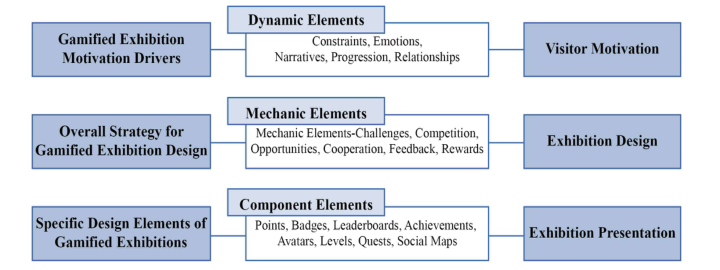
gamification in museum exhibitions. As shown in Table 2, each element plays a distinct role: components form the interactive framework of the exhibition, directly influencing visitor engagement; mechanics define the overall strategy, guiding exhibition flow and enhancing interactivity; and dynamics drive visitor motivation, deepening participation and meaning.
Gamification elements in exhibitions are crucial for creating engaging, efficient designs. As illustrated in Table 3, components enhance exhibition presentation and interaction, mechanics improve the flow and structure, and dynamics motivate participation to meet visitor needs. Effectively integrating these elements is key to gamified exhibition design, ensuring they work together to spark interest, increase engagement, and optimize learning outcomes
Table 2: Correspondence table for gamification components, mechanics, and dynamics in museum exhibitions (illustration created by the author).
Table available in the original PDF paper.
Category Gamification Corresponding
Corresponding Effects Specific Implementations
Elements Functions Components Points Gamified Exhibition
Displaying Audience
Small Collectible Items with Cultural
Design Elements Engagement Levels Significance, such as Artifact Logos Badges Visualized Achievement
Serving as Identity Displays, Stage
Indicators
Certifications, and Honorary Rewards, such as Crystal Trophies Leaderboards Visualizing Audience Progress Real-Time Display and Updates of
and Achievements
Personal Score Rankings and Points Achievements Final Goal Aligned with the Meeting Goals Related to Task
Exhibition Theme
Completion, Knowledge Acquisition, and Enhanced Exhibition Experience Avatars Visualized Audience Avatars Image Representations Related to Exhibition Content Levels Audience Growth Steps Digital Representation of Audience Levels
Throughout the Exhibition Process Quests Predefined Challenges to Drive
Tasks Divided into Treasure
Participation Flow
Hunting, Clue Finding, Puzzle Solving, and Encouraging Sharing and Dissemination Social Graphs Building a Social Network for Leveraging Mobile App-Based
Sharing Exhibition Progress, Habits, and Discussions
Online Groups or Offline Team Collaboration for Cooperative or Competitive Interactions Mechanics Challenges Gamified Exhibition
Learning Key and Challenging
Challenges Through Tasks Involving
Design
Intelligence or Physical Effort
Knowledge Points Conveyed by the Exhibition Competition Completing Competitions in Rank Comparisons Using
Leaderboards, Points, and Levels
Individual or Team-Based Formats Opportunities Randomized Elements Related
Rewards for Completing Tasks,
to the Exhibition Progress
Earning Points, and Randomized Achievements Cooperation Audience Collaborating in Grouping by Gender, Age, Family, or Other Demographics
Groups to Solve Puzzles for a Common Goal Feedback Real-Time Updates and Display Real-Time Display of Points, of Relevant Elements Leaderboards, Levels, and Progress Rewards Rewards for Actions Such as
Through Emphasis on Rules, Time Constraints, and Activity Organization
Continued
Analysis of Gamified Museum Exhibition Design From the Perspective 135
Table 2: Continued Category Gamification Corresponding
Table available in the original PDF paper.
Corresponding Effects Specific Implementations
Elements Functions
Exhibition Emotional Design
Emotions Fostering Emotional Dynamics Such as Curiosity, Competitiveness, and a Sense of Fulfillment Among Audiences
Exhibition Storytelling
Narratives Building Consistent and Sustained Narrative Storytelling
Exhibition Content Planning
Progression Witnessing the Progression of Audience Exhibition Journeys, Knowledge Acquisition, and Skill Development
Exhibition Community Building
Relationships Driving the Exhibition Through Social Interactions and Using the Exhibition to Foster Social Connections
Figure 2: DMC model-based gamified exhibition design model (illustration created by the author).
The combined use of these elements creates a dynamic, interactive, and educational environment, promoting deeper participation and learning. This DMC-based analysis not only highlights the complexity of gamified exhibitions but also demonstrates how they can be applied to enhance visitor experience and engagement in museum settings.
EXPERIENCE SUMMARY: GAMIFIED DESIGN OF MUSEUM EXHIBITIONS Museums, as key venues for cultural heritage exhibition, education, and dissemination, create a unique cultural atmosphere that sets them apart from other spaces. However, effectively communicating cultural content and enhancing user engagement remain significant challenges. Gamification, with its interactive elements and ability to motivate participation, offers valuable tools for addressing these issues. By integrating gamified elements, exhibitions can become more engaging, participatory, and meaningful. To fully leverage gamification, designers must embrace interdisciplinary collaboration and carefully tailor gamified features to align with exhibition goals and cultural content.
136 Wang and Yan
When selecting component elements, it is important to base choices on the exhibition’s theme and objectives. If the focus is on historical figures or personal growth, elements such as avatars, levels, and achievements can help emphasize the audience’s progression throughout the exhibition. For exhibitions centered on exploration or puzzle-solving, tasks can introduce challenges and encourage active participation. Additionally, if the content can be transformed into competitive or motivational experiences, components such as points, badges, and leaderboards can be used to foster engagement. For example, in “Everyone is a Curator,” gamification components were selected to allow visitors to step beyond the traditional role of “viewer” and become “curators” and “leaders.” Through an online selection of artifacts and exhibition planning, participants curated their own exhibition and shared their creations. This participatory design not only attracted visitors but also met the goals of cultural education, exhibition promotion, and co-curation by fostering a sense of ownership and achievement among visitors.
When designing mechanics, the focus should be on structuring the overall flow of participation and creating an engaging progression through the exhibition. Mechanics such as challenges, competition, and cooperation can drive interaction, while feedback and rewards guide visitors and reinforce their actions. In the “Treasure of the Mountain and Sea Society” exhibition, a puzzle-adventure format was employed, with clues hidden across exhibition spaces like “The River of Classics” and “National Treasures.” Visitors needed to match artifacts with clues, solve interconnected puzzles, and collaborate with others to progress. This immersive format transformed the exhibition into an adventure filled with exploration and discovery. To ensure historical accuracy and cultural integrity, the design team collaborated with historians and incorporated authentic texts, demonstrating the importance of interdisciplinary efforts in creating a meaningful and educational gamified experience.
Dynamic elements enhance the emotional and motivational aspects of the exhibition, helping visitors overcome unfamiliarity or fatigue related to cultural heritage learning. Elements such as constraints, emotions, and narratives immerse visitors in a compelling storyline, encouraging deeper engagement. It is essential to understand the audience’s needs and preferences when designing dynamics. For example, the “Famen Dream Shadow” murder mystery at the Changsha Museum used the popular “murder mystery” format to engage younger visitors. By immersing them in a storyline set during Emperor Wuzong’s suppression of Buddhism, the exhibition facilitated knowledge transfer while maintaining entertainment and emotional resonance. Visitors assumed different roles, interacted with exhibits, and engaged with historical themes through an immersive narrative.
Similarly, in the Suzhou Museum’s “Wu School of Painting: Youth Education Interactive Exhibition,” dynamic elements such as progress and relationships created a narrative-driven experience where visitors played the role of a servant tasked with inviting Ming scholars to a gathering. The exhibition provided clear objectives, social dynamics, and role-playing interactions, allowing visitors to experience life in Ming Dynasty Suzhou
Analysis of Gamified Museum Exhibition Design From the Perspective 137
while advancing their understanding of history through a structured, gamified storyline.
By carefully selecting and integrating components, mechanics, and dynamics, gamified exhibitions can effectively balance educational goals with engagement, creating immersive cultural experiences that resonate with diverse audiences and enrich the dissemination of cultural heritage.
CONCLUSION
Gamification, as an emerging exhibition method, cleverly introduces game elements and intricately integrates gamified design to achieve a gamified expression of the exhibition. It demonstrates exceptional creativity in aspects such as exhibition themes, content, effects, and public education. This paper, based on the DMC model, examines existing gamified exhibition cases, analyzing the similarities and differences in their use of gamification elements, and thus summarizes effective insights.
Gamified exhibitions represent the latest development in the evolution of human civilization, bringing unprecedented vitality. With the flow of time, more and more scholars continue to question, explore, and surpass current boundaries, anticipating various possibilities for gamification and building a diverse future for gamified exhibitions.
REFERENCES
Deterding, S., Dixon, D., Khaled, R., & Nacke, L. (2011). From game design elements to gamefulness: Defining “gamification.” Proceedings of the 15th International Academic MindTrek Conference: Envisioning Future Media Environments, 9 pages. Kidd, J. (2015). Gaming for affect: Museum online games and the embrace of
empathy. Journal of Curatorial Studies, 4(3), 414–432. Sailer, M., Hence, J. U., Mayr, S. K., & Mandl, H. (2016). How gamification motivates: An experimental study of the effects of specific game design elements on psychological need satisfaction. Computers in Human Behavior, 69, xx–xx. Werbach, K., & Hunter, D. (2012). For the Win: How Game Thinking Can
Revolutionize Your Business. Hangzhou: Zhejiang Harper Voyager. Wei, W., Jiang, X., & Xu, J. (2017). The controlled fantasy of natural games: On gamification design. Zhuangshi (Decoration), (10), 94–95. Xiong, L. (2022). A study on exhibition experiences based on role-playing game
mechanics [Doctoral dissertation, Guangzhou Academy of Fine Arts]. (p. 8).
LISTED IN THE AHFE DIGITAL BOOKSTORE CATALOGUE
Explore the complete digital volume
Human Factors and Wearable Technologies
Read this individual research paper free through the original publisher, or explore the full digital proceedings book.
ISBN 978-1-964867-51-9
Explore this ISBN in the AHFE Bookstore ↗Listed in the July 2026 bookstore catalogue; search by ISBN to confirm current availability · Digital book purchase optional