Weiyi Xu, Zhao Shuwang (2025). Gaming Immersion and Cultural Representation from the Perspective of Embodied Cognition: A Case Study of Black Myth: Wukong. In: Human Factors and Wearable Technologies. AHFE Open Access, vol. 175, pp. 138–147. https://doi.org/10.54941/ahfe1006367
With the development and popularization of virtual technology, the perception and experience of the subject in games have been extended and enhanced like never before, with the body becoming an important part of communication and interaction in virtual spaces. This article starts from Merleau-Ponty’s research on body and spatial perception, using the role-playing game Black Myth: Wukong as a case study, to explore how the technological body, under the influence of game culture, evolves into a cultural perception of space and a symbol of identity within the game world. By examining the real world and cultural landscape behind the game, the cultural implications of virtual space are extended to the real world.
American writer Neil Stephenson envisioned a spatial scene in the science fiction novel ‘Avalanche’, defined as the ‘Metaverse’, which is closely connected to the real social environment while balancing parallel spacetime and three-dimensional digital virtual space. At present, this concept guides the creative design concept of digital games and triggers continuous thinking on personal physical and virtual game immersion experience, which has a profound impact on the construction and expression of game culture. As the annual blockbuster of the recent 3A games, “Black Myth: Wukong” is based on the Chinese traditional cultural masterpiece “Journey to the West”and has received widespread attention worldwide since its release date. The game touches players’ hearts through a matrix of multiple media such as immersive interactive experience, scene effects, character shaping, and plot narrative, gradually completing the identity transition from immersive gaming experience to game culture construction in the process of exploring the game world.
As an important research theory exploring the interaction between the body and the environment, embodied cognition emphasizes the core role of the body in the cognitive process, and is an inseparable whole of perception, thinking, and behavior. It has also been applied in the study of games, attempting to understand how players can gain full body immersion through physical experiences in virtual environments, thereby achieving emotional empathy with the game’s theme culture. Based on this, this article uses Merlot Based on the embodied cognition of Ponty’s perceptual phenomenology, this study takes the popular digital game “Black Myth: Wukong” as the research object to explore how the game enhances players’ immersive experience through embodied cognition principles, ultimately achieving the construction of game culture meaning and the widespread dissemination of game culture, providing experiential references for future game creation and design.
LITERATURE REVIEW
Embodied Cognition and Immersive Gaming Experience The immersive experience of virtual gaming spaces is deeply influenced by philosophical thinking, as demonstrated by Merleau Ponty’s phenomenological research and Deleuze’s postmodern philosophical thought are representative. Merleau Ponty’s phenomenological research focuses on subjective behavior in virtual game scenes, and examines the perception and perceptual thinking of human spatial interaction from the perspective of spatial and morphological issues. On the other hand, Deleuze’s postmodern spatial view holds that the relationship between humans and virtual scenes is not static, but a dynamic balance of mutual constraints, achieving the construction of cultural significance in the process. It is not difficult to see that the mutual influence between the game itself and the virtual scenes of people and games is continuous.
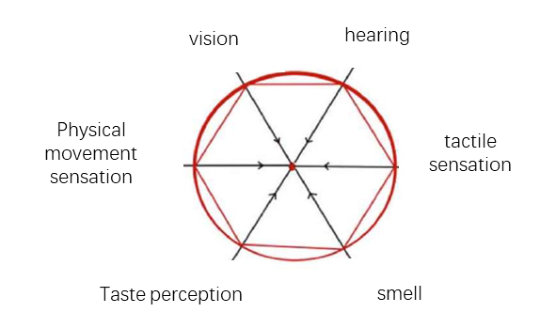
Merleau Ponty pointed out that every technology, at its essence, is a manifestation of bodily technology, which concretizes and expands the metaphysical structure of our physical body (Merleau-Ponty, 2007). Under the traditional cognitive framework, the body is often understood as an established, biological entity, while technology is seen as an external tool or auxiliary device independent of the body. However, with the development of the times, humans have deeply integrated into a highly technological and innovative social context. Technology is no longer just an external tool, but gradually permeates and integrates with the body, and in some contexts even becomes an extension and enhancement of bodily functions. This trend of technology merging with the body not only reshapes our bodily perception and experience, but also deeply influences us. The subjectivity construction and self-awareness model. In his view, everything about immersive experiences arises after the individual has established a relationship with space. Merleau Ponty proposed the body schema (as shown in Figure 1) through the comprehensive senses of the body. He believed that the body is the carrier of transformation between senses and context, and the generation of meaning is the integration and manifestation of various senses in the body through the body schema (Jiarui, 2015).
140 Xu and Zhao
Body schema is an idealized and orderly perceptual generation method that presents internalization and openness to movement in the process of sensory perception, while the unconscious generation of meaning by the body has certain limitations.
Figure 1: Merlot-Ponty body and perception.
In addition, from the perspective of the relationship between people and the virtual space of games, time and space jointly construct a subjective cognitive system, manifested as the process of game experience rather than the psychological state during the experience. The body as the subject is the main source of perceiving the game space, and it cannot exist independently without subjective consciousness. Therefore, immersive experiences contain both physical and conscious attributes. On the other hand, individuals have independent personalities, which leads to differences in the gaming experience for everyone. In Merleau Ponty believes that there is a close internal connection between time and space and the body. The body possesses temporal and spatial attributes, but does not exist in time and space. In contrast, individuals exist in real society, and each individual contains space and time.
Overall, the phenomenological perceptual system research consists of two parts: the experience constructed by the body and consciousness, which greatly helps to clarify the relationship between humans and the virtual space of the game, demonstrating the interactive media characteristics. By adapting human experience and behavior to the game space scene, interaction and dialogue are formed.
Construction of Cultural Representation The post structuralist philosophical system advocates diversity, openness, and fragmentation, represented by Baudrillard, Deleuze, and Foucault, among whom Deleuze’s ideas on space have influenced game experience design and cultural expression. In his view, the characteristics of space are intangible, presenting multidimensional and overlapping features. Aesthetics and culture
Gaming Immersion and Cultural Representation 141
are specific expressions that eliminate binary opposition and spatial centrism, presenting characteristics that balance flow, change, and diverse integration.
For multidimensional spaces, Deleuze conveyed a concept of folding and tuberization. Due to the complexity of his theoretical system, it is difficult to comprehensively expound his ideas and theories from a certain dimension. Foucault once said, “Deleuze may be the most important spatial culturalist of the 20th century, whose research system suggests that all things in the world have an inherent nature, which is like a desert like space, and concepts are scattered and settled in it like nomads.” The philosophy of spatialization has given us many new concepts, such as smoothness and stripes, nomadism and settlement, tubers and folds, etc (Buchanan and Lambert, 2017). He expressed in “The Thousand Plateaus” the “ever-changing and complex interconnectedness of all things” (Deleuze and Guattari, 2015). Among them, the “tuber” thinking is the core of its theoretical system on digital media, which includes characteristics of connectivity, heterogeneity, diversity, reinterpretation, collage, and illustration. Deleuze not only upholds the concept of “anti center system”, but also provides a systematic explanation of “fold”. In his representative work, “Leibniz and the Baroque Style,” he combined Leibniz’s monism, Baroque space, and fold theory to construct an aesthetic system based on post structuralism, known as nomadic aesthetics. Among them, “fold” and “nomadism” contain different levels of meaning, with “fold” being interpreted more as the coexistence, coordination, and rotation of differences; Nomadism “showcases the centrality and boundlessness of space,” requiring the integration of subjective cognitive experiences through new media technologies to break down physical barriers in spatial culture and achieve a virtual space that combines reality and virtuality. The traditional narrative style of space has been changed, presenting an open and diverse structure (Yongxiong, 2017).
Deleuze’s research system has achieved the exploration of nonlinear factors in game culture. His theory of folds generates new ways of interaction between space and the surrounding environment, serving as a philosophical starting point for the construction of cultural meaning after game experience. Among them, the concept game of tuber thinking can be interpreted as the development of time and the updating of scenes, transforming from linear time and virtual space to a diverse and complex dynamic spatiotemporal system, thus constructing cultural connotations.
RESEARCH DESIGN The research design takes embodied cognitive player gaming practice experience as the starting point to explore the practical role of interactive digital gaming media in cultural representation. Selecting “Black Myth: Wukong” as the research object, collect and analyze the game immersion experience feedback of Chinese and international players through Steam, the world’s largest digital game distribution and communication platform. The study first explores the dynamic feedback of players in the interactive community of the Steam platform, and evaluates player engagement, game
142 Xu and Zhao
progress, and positive reviews based on industry statistical data. Secondly, categorize and analyze the keywords of Chinese and English comments on the platform to examine players’ performance in embodied experience, emotional resonance, and cultural identity. Finally, through the study of keywords and data, explore the potential impact mechanism of game immersion experience and cultural representation (Bingyan, n.d.).
The study utilized Python programming software, integrating the PySide6 graphical interface library with the aiohttp library to develop a web scraping script. This script collected global evaluation data from the official website of the game Black Myth: Wukong between January 1, 2024, and February 1, 2025. To ensure data relevance and representativeness, only evaluations from players with at least 24 hours of gameplay were retained. Comments were further filtered to focus exclusively on immersive experiences and feedback related to the game, resulting in 26,239 high-quality comments as the final analytical sample.
Using the Term Frequency-Inverse Document Frequency (TF-IDF) method, the study extracted thematic keywords from player evaluations to identify terms with high informational value. Generic terms and function words lacking substantive contributions—such as the game title or phrases like “fun gaming experience”—were filtered out. The research ultimately identified the top 10 TF-IDF weighted keywords in player evaluations (see Table 1). Analysis of Chinese player evaluations revealed keywords such as “Journey to the West,” “culture,” “combat,” and “movement” within the top 10, reflecting domestic players’ strong emphasis on the game’s action elements, cultural depth, and narrative foundation. The combat system and narrative design aligned closely with player expectations, highlighting the game’s profound cultural heritage. In contrast, international player evaluations prioritized keywords such as [list omitted], with “Wukong” exhibiting exceptionally high weighting. This indicates the core character “Sun Wukong” holds significant appeal in global markets, serving as a crucial factor driving player engagement. In summary, Black Myth: Wukong successfully expands its global player base through highly interactive and immersive design, transforming embodied cognitive experiences into vehicles for transmitting China’s cultural heritage, thereby enhancing the global influence of Chinese culture in the gaming industry.
Table 1: Black Myth evaluation keywords.
Table available in the original PDF paper.
Number Domestic Keywords TF-IDF Foreign Keywords TF-IDF 1 Journey to the West 0.95 Story 0.92 2 Culture 0.89 Combat 0.88 3 Action 0.85 Amazing 0.84 4 Percussion sensation 0.82 Money 0.81 5 Playing method 0.78 Beautiful 0.76 6 Fluent 0.75 Journey 0.74 7 Skill 0.72 Bosses 0.71 8 Golden Hoop Rod 0.7 Action 0.69 9 Architecture 0.68 Visual 0.67 10 Attack 0.65 Fights 0.64
Gaming Immersion and Cultural Representation 143
ANALYSIS AND DISCUSSION Immersive Interaction Between Body and Game Environment
Embodied cognition theory posits that cognitive processes are fundamentally corporeal, emerging through the integration of body, perception, environment, and mind to enrich knowledge representation (Yuting et al., 2023). In game design, developers embed embodied experiences into scenarios through meticulous narrative construction, enabling players to attain intense corporeal awareness and character identification within virtual worlds.
First, the game enhances bodily perception through refined motion design. The protagonist Wukong’s movements—from basic walking, running, and jumping to complex combat combos—meticulously replicate real- world biomechanics. During the “Seventy-two Transformations” mechanic, players must strategically select morphing forms based on enemy types and environmental contexts, executing transformations through operational commands. This hyper-realistic motion design allows players to tangibly perceive virtual bodily states, fostering profound immersion.
Second, environmental interactivity bridges players’ physical sensations with the virtual realm. The game world features abundant interactive elements—climbing, jumping, and destructible environments—that engage corporeal perception. For instance, in the “Flower-Fruit Mountain” scenario, players navigate cliffs while experiencing simulated gravitational and frictional forces (Clark, 1997). Such immersive environmental design enables players to project real-world physical experiences onto virtual avatars, deepening their understanding of the game’s operational logic.
Third, multisensory feedback mechanisms amplify corporeal awareness. Synchronized audio effects, controller vibrations, and visual effects provide immediate operational feedback. Combat vibrations simulate weapon impact forces, while directional audio cues inform enemy attack trajectories, enabling responsive counteractions. This multisensory synergy enhances players’ perception of virtual corporeal states, elevating immersive realism. The resultant emotional fluctuations—tension, exhilaration—facilitate players’ internalization of the game’s value systems and spiritual essence (Artur, 2007).
Fashion-Oriented Landscape of Corporeal Consumption Jean Baudrillard’s consumer society theory argues that modern consumption transcends material acquisition, evolving into pursuit of symbolic values and cultural meanings encoded within commodities. As the perceptible boundaries between media and mediated environments increasingly dissolve (Chernysheva and Kostikova, 2007), this paradigm manifests acutely in virtual gaming worlds: players’ consumption of virtual avatars represents quests for symbolic satisfaction and cultural capital. Such avatars transcend functional utility, becoming semiotic vessels of cultural significance. Through character customization and rare equipment acquisition, players construct idealized digital selves while extending real-world identity negotiations into
144 Xu and Zhao
virtual spaces, addressing needs for self-actualization and social belonging. Thus, virtual corporeal consumption becomes a critical pathway for identity confirmation and cultural affiliation in the digital age.
In Black Myth: Wukong, developers construct a corporeal consumption space through avatar customization, gear systems, and visual symbolism, reflecting the deep integration of player cognition with virtual embodiment. Specifically, hairstyle, attire, and cosmetic customization options enable unique avatar creation, strengthening players’ identification with virtual bodies. Concurrently, the equipment system merges corporeal consumption with character progression—acquiring gear with distinctive aesthetics and stat bonuses simultaneously enhances combat efficacy and virtual self- worth. Furthermore, traditional cultural motifs like the “Somersault Cloud” and “Golden-Hooped Staff” craft an Eastern aesthetic landscape that subtly reshapes players’ cultural perceptions. These designs satisfy pursuits of symbolic value while positioning virtual bodies as cultural vectors, mirroring consumer society’s logic of idealized self-projection (Yidi, 2018). Notably, players’ investments in time and money to acquire digital goods reveal consumption society’s alienation mechanisms. Predesigned in- game monetization systems may covertly manipulate consumer autonomy, reflecting both insatiable material desires under late capitalism and the dominance of consumption-driven cultural logics.
Cultural Subjectivity in Embodied Cognition During gameplay, while players’ physical bodies remain in real space, their consciousness achieves a transcendent “presence” within virtual environments. Through digital avatars, players emotionally synchronize with narrative arcs, their affective states fluctuating in tandem with virtual experiences. Post-session, residual behavioral patterns and emotional affiliations with cultural signifiers may persist, altering real-world cognitive frameworks (Qianqian and Jingyi, 2022). This virtual-real interplay demonstrates how digital media reshape identity and behavior through embodied cognition, while underscoring games’ profound psychosocial impacts as cultural artifacts.
As virtual cultural spaces, games emerge from rich semiotic ecosystems. Within narrative environments, cultural symbols condense and reconfigure into unique semiotic fields. Transcending didactic cultural transmission or historical replication, these symbols become “simulation arenas” for historical empathy. Through narrative design and environmental worldbuilding, national sentiments and cultural identity undergo dynamic renegotiation in virtual spaces. Aligning with Deleuzian nomadic aesthetics, nonlinear cultural meaning-generation in Black Myth: Wukong enables players to reinterpret cultural values through interactions with mythological elements, traditional attire, and historical scenarios. This virtual cultural space transforms games into critical media bridging history and modernity, individual and collective, ultimately amplifying cultural symbols’ affective resonance in the digital era.
Gaming Immersion and Cultural Representation 145
The Transmedia Integration of Game Culture Under the dual impetus of globalization and digital technology, game culture is undergoing a profound transformation and reconstruction. Taking the phenomenal success of Black Myth: Wukong as an observational sample, it becomes evident that transmedia integration has revolutionized cultural dissemination. This cultural fusion not only transcends the boundaries of media forms but also establishes a shared aesthetic consensus among players from both the East and the West.
Moreover, the innovation brought by transmedia integration goes beyond enhancing dissemination efficiency—it also leads to a comprehensive upgrade in immersive experiences. For instance, when players engage in combat operations using a game controller, they are, in essence, engaging in an embodied practice of cultural cognition. At the same time, when Western players discuss the philosophical metaphors of “Sun Wukong” on Discord, traditional Chinese culture gains an opportunity for cross-cultural interpretation.
This innovative paradigm, driven by gaming, not only provides a technological pathway for enhancing cultural soft power but also imposes higher demands on cultural producers’ knowledge structures—specifically, how to achieve creative transformation in the digital age while maintaining cultural authenticity. Ultimately, this process fosters the grand transmedia integration of game culture.
CONCLUSION
In summary, Black Myth: Wukong achieves a deep integration of bodily perception and virtual environments, not only enhancing players’ sense of immersion but also utilizing cultural symbols as carriers to extend meaning from virtual space to the real world and reconstruct identity. From the perspective of the experiencer, the game itself is neutral and does not inherently possess moral attributes—the key lies in people’s perceptions and interpretive perspectives. Johan Huizinga argued that “culture has always contained elements and characteristics of play, and the origin and development of culture inherently involve playfulness.” From the perspective of cognitive psychology, the strong interactivity and accessibility of games as a unique medium provide designers with diverse possibilities for embedding cultural contexts. Black Myth masterfully integrates Chinese culture into its characters, architecture, and overall scene design, endowing the game with an authentic narrative background and cultural vitality. Moreover, since the game incorporates a vast array of cultural symbols—such as architecture, scriptures, poetry, and musical elements from Shanxi and Sichuan-Chongqing regions of China—it constructs a virtual “container” that serves as a space for the contemporary translation of traditional culture.
In the context of the digital era, video games have transcended traditional entertainment paradigms and emerged as the “ninth art form” on the mainstream cultural stage. The tangible virtual body within the gaming environment not only extends the physical self into cyberspace
146 Xu and Zhao
but also reconstructs reality through multidimensional artistic constructs— from visual representation to narrative design, from character shaping to emotional interaction—achieving both aesthetic reinterpretation and symbolic transcendence. As a technology-driven art form, games dynamically revitalize cultural symbols through algorithmic structures and engine rendering. When players control their virtual avatars, they are not merely engaging in mechanical interactions but, through immersive storytelling, community collaboration, and rule-based challenges, activating deeper cultural perception mechanisms. This embodied cognitive experience enables players to transcend the media interface, fostering cultural identification through the decoding of symbols and the reproduction of meaning.
Research indicates that the “presence effect” in gaming arises from a dual mechanism: on the technological level, audiovisual stimuli and interactive feedback construct perceptual immersion, while on the cultural level, the metaphorical translation of symbolic systems enables meaningful resonance. When players project their consciousness onto virtual avatars, they are essentially engaging in an embodied practice of cultural symbols—this digital survival experience provides a dynamic perceptual interface for cultural transmission. Although cultural identity formation is a gradual process, the media characteristics of games—blending the virtual and the real— have indeed opened up innovative pathways for contemporary cultural communication. Therefore, this study extends embodied cognition theory to the domain of digital gaming, revealing how the technological body serves as a medium for transforming immersive experiences into cultural identity. Furthermore, through empirical data analysis, the research verifies how blockbuster games construct and empower traditional cultural meanings in a globalized context, offering a “technology-culture-perception” triadic model for future game design. However, this study is limited to player reviews on the Steam platform. Future research could incorporate more diverse data sources—such as physiological sensor experiments and cross- cultural comparative studies—to further validate the universal mechanisms of embodied cognition.
Overall, as a cultural vehicle in the digital era, games are reshaping individual perception and cultural identity logic through embodied cognition. This process also opens new possibilities for the digital revitalization and global dissemination of traditional culture.
REFERENCES
Anna Chernysheva, Anna Kostikova. “Culture as an Environment of Cult: The Philosophy of Culture” [C]. Proceedings of the 2nd International Conference on Contemporary Education, Social Sciences, and Ecological Studies (CESSES 2019). Gilles Deleuze and Félix Guattari. Capitalism and Schizophrenia: A Thousand
Plateaus [M], 2015. Lan Buchanan and Gregg Lambert. Deleuze and Space [M]. Edinburgh: Edinburgh University Press, 2017. Li Qianqian, Wang Jingyi. “‘Mechanical Art’: Technological Imagination and
Multiple Paths of Cultural Inheritance in Games”[J]. Exploration and Contention, 2022(02).
Gaming Immersion and Cultural Representation 147
Lugmayr Artur R. “Framework for Emotional Mobile Computation for Creating Entertainment Experience” [J]. Multimedia on Mobile Devices, 2007. Mai Yongxiong. “Postmodern Multidimensional Space and Literary Intertextuality—Key Concepts of Deleuze’s Poststructuralism and the Construction of Contemporary Literary Theory” [J]. Tsinghua University Journal, 2017. Maurice Merleau-Ponty. Eye and Mind [M]. Translated by Yang Dachun. Commercial Press, 2007, p. 39. Tang Bingyan. “Research on the Innovative Development of Network Literature
and Art under the Background of Mobile Digitalization” [J]. Computational Intelligence and Neuroscience. Wang Yuting, Liang Junping, Li Zhihe. “The Value Implication and Practical Path of Labor Education Using Intangible Cultural Heritage Resources—From the Perspective of Embodied Cognition Theory”[J]. Theory and Practice of Education, 2023, 43(29): 28–33. Wu Yidi. “Player Engagement with the Game World from the Perspective of Phenomenology of Perception” [J]. Studies in Philosophy of Science and Technology, 2018(06). Zhang Jiarui. “Interactive Body from the Outside to the Inside: New Organic Digital
Architecture” [J]. New Architecture, 2015(05): 40–45.
LISTED IN THE AHFE DIGITAL BOOKSTORE CATALOGUE
Explore the complete digital volume
Human Factors and Wearable Technologies
Read this individual research paper free through the original publisher, or explore the full digital proceedings book.
ISBN 978-1-964867-51-9
Explore this ISBN in the AHFE Bookstore ↗Listed in the July 2026 bookstore catalogue; search by ISBN to confirm current availability · Digital book purchase optional