Susan Xu, Rachel F Jones, Neethan Ratnakumar, Kübra Akbaş, Jeffrey Powell, Ziqing Zhuang, Alex Zhou (2024). Impact of Self-Contained Breathing Apparatus (SCBA) Weights on Firefighter’s Kinematics During Simulated Firefighter Tasks. In: Human Dynamics, Product Evaluation and Quality. AHFE Open Access, vol. 131, pp. 142–149. https://doi.org/10.54941/ahfe1004872
Firefighters face a multitude of hazards in their line of duty, with overexertion being the foremost cause of injuries or fatalities, as referenced in studies [1, 2]. This high risk is often amplified by the physical demands of their role, further exacerbated by the burden of carrying heavy SCBA. The objective of this research is to examine how the weight of SCBA affects the musculoskeletal joint movements of firefighters. There is an urgent requirement for precise measurement and analysis of firefighters' movements to understand the impact of SCBA weight on both performance and injury risk. Traditional motion capture techniques, which are primarily optical-based or inertia-based, have their limitations, such as marker obstructions due to clothing or lower accuracy and drift issues. To overcome these obstacles, this study introduces a groundbreaking hybrid motion capture technique, combining the advantages of both existing methods. This new method is expected to offer a detailed and accurate evaluation of how SCBA weight influences the kinematics of firefighters.MethodsIn this study, six professional firefighters (average age: 34.2±5.2 years) were involved in performing four simulated tasks: stair climbing, searching, hose advance, and overhaul, under three different SCBA weight scenarios: only gear, gear with a standard 45-minute SCBA, and gear with an SCBA plus an additional 10 lbs (SCBA-10). Data collection included optical markers on key equipment like helmets, boots, and gloves, 17 IMUs, EMG, pressure insoles, and a metabolic mask. A novel hybrid inverse kinematics method, blending IMU data with optical markers, was utilized to minimize drift errors and precisely reconstruct joint movements. Joint angle data, particularly for hose advance and overhaul, were segmented and normalized for comprehensive statistical analysis. Preliminary Results and DiscussionInitial analysis of data from two human subjects showed that heavier SCBA weights led to increased hip joint movement during stair climbing, with a noticeable 10% increase in hip angle range under the heaviest SCBA condition (SCBA-10). In hose advance tasks, firefighters showed less lumbar extension with SCBA, indicating a preference for using arm movements over the back and torso to maneuver the hose. Traditional inverse kinematics with only markers showed significant errors in joint angles, especially in pelvic tilt and hip flexion, which were effectively corrected with the new hybrid method. This innovative approach allows for a more precise evaluation of the effects of SCBA weight on firefighter kinematics and musculoskeletal load. Additional data is expected soon, which will provide a greater understanding of the effects of SCBA. While our current analysis is based on a small sample, we expect that expanding the study to more participants will reveal further kinematic changes due to loading.Preliminary Conclusions To the best of our knowledge, this research represents the first endeavor to precisely record the movement of firefighters engaged in activities while fully equipped with gear and SCBA using both inertia and optical motion capture systems. Our initial findings validate this method and suggest its potential to refine SCBA weight standards based on scientific evidence. We noted that SCBA's weight substantially modifies the movement patterns of firefighters, possibly increasing musculoskeletal strain. This research paves the way for future dynamic analyses and contributes significantly to understanding how SCBA weight impacts musculoskeletal health, ultimately provide the possibility of recommending SCBA weight limits for injury prevention.DisclaimerThe findings and conclusions in this report are those of the authors and do not necessarily represent the official position of the National Institute for Occupational Safety and Health (NIOSH), Centers for Disease Control and Prevention (CDC).References[1]M. M. Alemi, J. Geissinger, A. A. Simon, S. E. Chang, and A. T. Asbeck, "A passive exoskeleton reduces peak and mean EMG during symmetric and asymmetric lifting," Journal of Electromyography and Kinesiology, vol. 47, pp. 25-34, 2019.[2]M. J. Karter, "Patterns of firefighter fireground injuries," National Fire Protection Association, 2014.[3]S. Wang, C. Feng, X. Chen, M. Shan, and W. Niu, "A biomechanical evaluation of firefighters’ musculoskeletal loads when carrying self-contained breathing apparatus in walking and running," Journal of Safety Research, 2023.
Firefighters risk injury frequently as part of their occupation. It has been reported that there were 65,880 total firefighter injuries in 2022, increased by 8% from the 60,750 injuries reported in 2021 (Campbell, 2023). Among these reported injuries, 33% occurred on the fireground. The two leading causes of injury to firefighters on the fireground are overexertion/strain (O/E) and slips/trip/falls (STF), at 31% and 22% (Campbell, 2023), respectively. Most O/E injuries can be attributed to handling a hose line and actions performed during overhaul operations.
There is a recent trend of utilizing heavier, extended duration (45, 60 min- utes) SCBAs in fire service due to various regulation changes and other factors (Campbell, 2003 and Petrucci, 2012). However, the heavier SCBAs may lead to more rapid fatigue and a higher likelihood of injuries. Balancing the weight
Impact of Self-Contained Breathing Apparatus (SCBA) Weights on Firefighter’s 143
of the SCBA against the need for sufficient mission time is a critical chal- lenge, necessitating guidelines for selecting the appropriate SCBA size for firefighting tasks.
Quantifying the SCBA weight’s impact on balance, gait, and muscular fatigue is crucial to establishing safe weight limits for firefighters engaged in various activities. The kinematic changes from the added mass need to be examined to understand how they affect movement and strain. Biomechan- ical modelling programs have been used to evaluate the maximum weight that would enable firefighters to safely and comfortably perform firefight- ing tasks that require extension, tension, and rotational movements (Xu, 2020 and Xu, 2021), but are limited in the ability to accurately predict static strengths, loadings, and spinal compression forces status. Therefore full-body dynamic motion analysis is essential for this study, but capturing comprehen- sive motion data is difficult due to the bulky nature of turnout gear and the weight of the SCBA. In most firefighting motion studies, only foot motion was captured (Kesler, 2018 and Horn, 2015).
There is an urgent need for precise measurement and analysis of full- body firefighter movements to understand the impact of SCBA weight on both performance and injury risk. Traditional motion capture techniques, which are primarily optical- or inertia-based, have their limitations, such as marker obstructions due to clothing or lower accuracy and drift issues. To overcome these obstacles, this study introduces a novel hybrid motion cap- ture technique, combining the advantages of both existing methods. This new method enables kinematic analyses of subjects performing firefight- ing activities through 3D musculoskeletal (MSK) models, enhancing our understanding of SCBA’s influence on firefighter movement kinematics and dynamics and injury risks.
METHODS
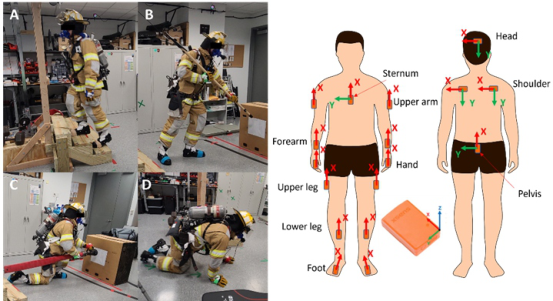
Data Collection Six male firefighters (34.2±5.2 years old, 93.1±16.1 kg weight, 180.8± 4.2 cm height) with an average of 12.4±6.8 years of professional firefight- ing experience were recruited for the experiment. The study was approved by the New Jersey Institute of Technology Institutional Review Board (IRB protocol number 2204019302), and participants provided informed con- sent. Each subject performed four simulated firefighter tasks – stair climbing, hose advance, overhaul, and simulated search (crawling) (see Figure 1). The four tasks were repeated for three weight conditions – firefighter ensemble (turnout gear, 12.8kg), turnout gear with SCBA (SCBA, 26.2kg), and turnout gear with SCBA and additional 10 lbs. (SCBA + 10, 30.7kg). The Turnout gear condition was always the initial condition, while the sequence of the other two load conditions alternated among half the participants. Each task was performed for two minutes for each weight condition; additionally, the subjects had an optional two-minute rest between tasks and a mandatory 10-minute rest between weight conditions. While performing the tasks, sub- jects were equipped with inertial measurement units (IMU) (MTw Awinda,
Xsens Technologies, Culver City, CA USA) (see Figure 2) and optical markers (OptiTrack, NaturalPoint, Corvallis, OR USA).
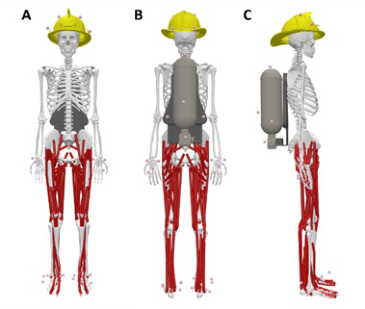
Musculoskeletal Model The simulated firefighter activities performed in this study involve full body motion with deep lumbar and knee flexion. We adopted a full-body MSK model, initially developed by Rajagopal et al. (2016), for 3D motion analysis in OpenSim (Seth, 2011). This model has a complex knee joint to reflect its translational and rotational degrees of freedom accurately. The ROM limits for the free pelvis joint and the knee were extended to accommodate motion ranges across all four activities. Additionally, 3D models of a helmet and SCBA were added to the model to assist in the placement of virtual markers (see Figure 3).
Figure 1: (left) Firefighter activities. (A) Stair climbing, (B) overhaul, (C) hose advance (D) search; (right) inertial measurement unit placement.Figure 2: Model used in OpenSim analysis, based on Rajagopal full body model with some minor adjustments. A SCBA cylinder and firefighter helmet were added to the model for simplicity in identifying marker positions with some minor adjustments. (A) Front view, (B) back view, (C) side view.
Impact of Self-Contained Breathing Apparatus (SCBA) Weights on Firefighter’s 145
Inverse Kinematics (IK) Capturing the complete body motion is essential to accurately assess mus- culoskeletal loadings during dynamic firefighting activities. However, con- ventional optical motion capture systems face significant challenges when attempting to record full body firefighting motions, particularly when sub- jects are clad in turnout gear and SCBA.
The loose-fitting nature of clothing and the portions of the body covered by the SCBA make it difficult for traditional systems to capture precise data. Relying solely on optical marker-based IK for joint angle estimation reveals limitations, such as marker occlusions arising from the diverse and demand- ing movements involved in firefighting activities. Simultaneously, IMU-based motion capture introduces issues such as drifting – inaccuracies and noise in acceleration and angular velocity measurements that accumulate over time – and generally exhibits lower accuracy compared to optical motion capture. To tackle these challenges comprehensively, our approach involves integrat- ing optical marker data and IMU-derived joint angles. This combination allows us to enhance the accuracy and reliability of IK, providing a more robust estimation of joint angles even in the demanding context of firefighting activities.
To obtain joint angles from IMUs, Xsens HD reprocessing (a set of pro- prietary Xsens algorithms to clean up the data) was applied to the collected data. The raw optical marker trajectories were gap-filled and filtered. Our IK method passes through each time step (frame) of motion and calculates joint coordinate values to closely align the pose with the experimental marker and Xsens joint angles. This alignment is achieved by formulating a weighted least squares problem, wherein the objective is to minimize errors in both markers and coordinates mathematically, i.e.: [Equation or mathematical symbol available in the original paper PDF][Equation or mathematical symbol available in the original paper PDF]
2 X
2 +
min
qIMU
wi
ωj
j −qj
i −xi(q)
[Equation or mathematical symbol available in the original paper PDF] X
[Equation or mathematical symbol available in the original paper PDF] (1)
xexp i∈markers
j∈coords
where q is the vector of generalized joint coordinates (angles) being solved for, xexp
i is the experimental position of marker i, xi(q) is the position of the corresponding model marker, qjIMU is the experimental value for coordinate j obtained from the Xsens sensor output, and wi and ωj are weights that specify how strongly that marker error or joint angle error term should be minimized. This minimization problem was solved with a gradient-based optimization algorithm in OpenSim. The convergence criterion was set to 0.0001 and the number of iterations was set to 1000.
RESULTS
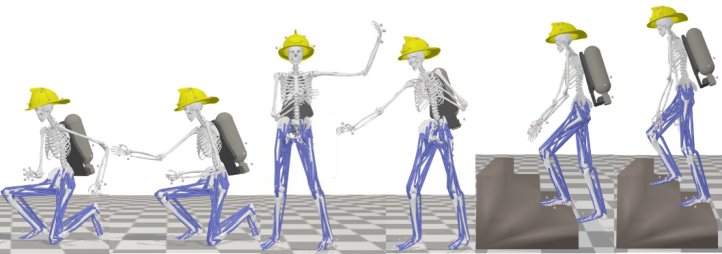
Figure 3 presents snapshots illustrating the IK results captured at different moments during the simulated hose advance, overhaul, and stair climbing firefighting activities. Note the left knee is right on the ground during hose advance activity despite the absence of markers on the shank and thigh areas. Table 1 shows the mean ROM for lumbar flexion/extension, obtained by
averaging time normalized activity cycles. The percentage changes between the turnout gear condition and the two weighted conditions are also pre- sented. The analysis of IK data from the hose advance and stair climbing tasks revealed that firefighters experience a reduced range of lumbar flexion/exten- sion as the weight of their turnout gear increases. Specifically, transitioning from regular turnout gear to wearing an SCBA showed a more significant decrease in lumbar ROM than adding an extra 10 pounds to the SCBA. For hose advance tasks, the lumbar flexion ROM decreased by 56.08% or 9.28 degrees on average when wearing an SCBA (both conditions) compared to just the turnout gear, and for stair climbing, it decreased by 34.09% or 7.14 degrees. The data from overhaul activities presented a less definitive trend, with different subjects showing varying patterns of ROM change across weight conditions. One subject showed increased ROM moving from turnout gear to SCBA, then a decrease from SCBA to SCBA + 10, while another exhibited the opposite pattern. Notably, an average increase of 7.10% in hip flexion ROM and a 29.40% increase in hip rotation ROM were observed during the stair climbing activity when wearing an SCBA compared to just the turnout gear. These findings suggest that while the increased weight from an SCBA generally decreases lumbar ROM, it may lead to compensatory increases in hip motion, especially during more complex activities like stair climbing.
Figure 3: Snapshots of the hose advance (left), overhaul (middle), and stair climbing (right) motion obtained from the IK. The results are depicted by two instances each.Table 1. Mean lumbar flexion/extension range in degrees (the mean curve was obtained by averaging time normalized joint angle data across activity cycles. Subsequently the range was estimated as the difference between min and max values of this mean curve). Percent change is calculated in reference to the turnout gear condition.
Our extensive testing showed that traditional IK solely with markers (excluding the second term in equation 1) resulted in significant errors, particularly noticeable in joint angles such as pelvic tilt and hip flexion. Addi- tionally, the absence of markers on the shank and thigh areas frequently led to knees inadvertently penetrating the ground during hose advance and crawl- ing activities. Conversely, relying solely on IMU for motion capture presented issues manifested in various ways, such as moving or floating feet during activities like hose advance, overhaul, stair climbing, knee-ground pene- tration, or separation during crawling. Introducing our innovative hybrid method successfully addressed and rectified all these issues.
DISCUSSION
Our novel hybrid IK approach, integrating optical marker-based and IMU- based motion capture techniques, offers a precise way to capture the kine- matics of firefighting activities. Compared to the marker only method, our approach avoids movement errors associated with markers on firefighter clothing. Furthermore, it mitigates drifting errors commonly encountered with standalone IMU systems by strategically placing additional markers on selected locations to eliminate drift. While our hybrid approach addresses these issues, it may still face limitations such as marker occlusions during specific tasks (e.g., hose advance and crawling) and potential IMU slip- page. Additionally, errors in model scaling and virtual marker placement may contribute to IK inaccuracies.
Despite these limitations, this methodology enables a more accurate evalu- ation of SCBA weight impact on firefighter movements and musculoskeletal stress. The observed decrease in lumbar ROM in Table 4 could be related to force production. In a 2019 study by Martinez-Cava et al. (2019), the authors compared force production with ROM during bench press activ- ities and found greater force production during activities with less ROM. In the context of SCBA usage, heavier loading conditions could necessitate increased muscular activation in the lower lumbar region for spinal support and stabilization, thereby altering lumbar movement patterns. Additionally, the rigidity of the SCBA could further restrict lumbar movement and induce discomfort, limiting ROM.
The feasibility demonstration and insights gained from our study, based on a small sample, lay the groundwork for future research with an expanded participant pool. Such extended investigations could unveil further kinematic and dynamic alterations due to increased loading, deepening our understand- ing of SCBA weight effects on firefighter movement dynamics and offering valuable insights into musculoskeletal stress in operational settings.
CONCLUSION
To the best of our knowledge, this is the first study that employed a hybrid motion capture system to analyze firefighters’ movements during simulated tasks, marking a significant advancement in firefighter kinematics research. Our results demonstrate that the weight of an SCBA notably alters move- ment patterns, potentially increasing musculoskeletal strain. Specifically, we observed a 56.08% reduction in lumbar flexion ROM during hose advance tasks and a 34.09% reduction during stair climbing when wearing an SCBA compared to standard turnout gear. These findings are crucial for under- standing the biomechanical impact of SCBA weight, contributing to the development of evidence based SCBA weight standards. This research lays the groundwork for future dynamic analyses and has substantial implications for musculoskeletal health in firefighting, paving the way for recommendations on SCBA weight limits to prevent injuries.
ACKNOWLEDGMENT
The authors would like to thank the CDC National Institute for Occupational Safety and Health, National Personal Protective Technology Laboratory for its financial support of this research. The authors also thank Jeff Peterson, W. Jon Williams, and Rohan Fernando for their thoughtful review of this manuscript.
REFERENCES
Campbell, R. and Hall, S. (2023) “United States Firefighter Injuries in 2022,” in “NFPA Research,” National Fire Protection Association. Horn G. P. et al., (2015) “Physiological responses to simulated firefighter exercise
protocols in varying environments,” Ergonomics, vol. 58, no. 6, pp. 1012–21, doi: 10.1080/00140139.2014.997806. Kesler R. M. et al., (2018) “Impact of SCBA size and fatigue from different firefighting work cycles on firefighter gait,” Ergonomics, vol. 61, no. 9, pp. 1208–1215, doi: 10.1080/00140139.2018.1450999. Martinez-Cava A. et al., (2019) “Range of motion and sticking region effects on the
bench press load-velocity relationship,” Journal of Sports Science and Medicine, vol. 18, pp. 645–652. Petrucci, M. N., Harton, B., Rosengren, K. S., Horn, G. P., and Hsiao-Wecksler, E.
T. (2012) “What causes slips, trips, and falls on the ground? A survey,” in 36th Annual Meeting of the American Society of Biomechanics. Rajagopal, A., Dembia, C. L., DeMers, M. S., Delp, D. D., Hicks, J. L., and Delp, S. L.
(2016) “Full body musculoskeletal model for muscle-driven simulation of human gait,” IEEE Trans Biomed Eng, vol. 63, no. 10, pp. 2068–2079.
Impact of Self-Contained Breathing Apparatus (SCBA) Weights on Firefighter’s 149
Seth, A., Sherman, M., Reinbolt, J. A., and Delp, S. L. (2011) “OpenSim: a musculoskeletal modeling and simulation framework for in silico inves- tigations and exchange,” Procedia IUTAM, vol. 2, no. 0, pp. 212–232, doi: 10.1016/j.piutam.2011.04.021. Xu, S., Hu, M., Powell, J., Zhuang, Z. (2020) “Biomechanical Modeling, and 3D
Simulation of Firefighting Tasks”, In: Cassenti D., Scataglini S., Rajulu S., Wright J. (eds) Advances in Simulation and Digital Human Modeling. AHFE Advances in Intelligent Systems and Computing, vol. 1206, pp. 174–179, 2021. Springer, Cham. https://doi.org/10.1007/978-3-030-51064-0_23. Xu, S., Hu, M., Powell, J., Zhuang, Z. (2021) “Comfortable SCBA Weights from Biomechanical Models for Firefighting Tasks.” In: Wright J. L., Barber D., Scataglini S., Rajulu S. L. (eds) Advances in Simulation and Digital Human Mod- eling. AHFE. Lecture Notes in Networks and Systems, vol. 264. Springer, Cham. https://doi.org/10.1007/978-3-030-79763-8_28
LISTED IN THE AHFE DIGITAL BOOKSTORE CATALOGUE
Explore the complete digital volume
Human Dynamics, Product Evaluation and Quality
Read this individual research paper free through the original publisher, or explore the full digital proceedings book.
ISBN 978-1-964867-07-6
Explore this ISBN in the AHFE Bookstore ↗Listed in the July 2026 bookstore catalogue; search by ISBN to confirm current availability · Digital book purchase optional