Shahnawaz Anwer, Maxwell Fordjour Antwi-afari, Imran Mehmood, Arnold Yu Lok Wong, Siu Ngor Fu, Heng Li (2026). Real-time detection and machine learning classification of physical fatigue in construction workers using multi-modal digital biomarkers. In: Cognitive Computing and Internet of Things. AHFE Open Access, vol. 205, pp. 21–32. https://doi.org/10.54941/ahfe1007358
This study introduces a multimodal wearable sensing framework that combines physiological (heart rate, breathing rate), thermoregulatory (skin temperature, electrodermal activity), and biomechanical (plantar pressure and acceleration) digital biomarkers for objective, real-time fatigue detection in construction workers. Fifteen healthy construction workers, aged 18 years or older, executed a standardized one-hour bar-bending tasks while utilizing wearable devices. Subjective fatigue levels were assessed using the Borg-20. Five supervised machine learning classifiers were assessed utilizing 10-fold cross-validation. In single-biomarker models, thermoregulatory features (Classification Accuracy [CA], 88.9%) surpassed physiological (CA, 72.3%) and biomechanical features (CA, 71.1%). The integration of physiological, thermoregulatory, and biomechanical parameters markedly enhanced classification accuracy (CA, 92.3%). The random forest is the most effective machine learning classifier for both single and multimodal biomarker data. This study constitutes the first direct comparison and integration of these three biomarkers specifically among construction workers, illustrating the evident superiority of multimodal methodologies. The suggested human-centred, AI-driven architecture effectively integrates medical physiology, ergonomics engineering, and wearable technology, providing a scalable, real-time early-warning system for fatigue-related hazards.
The construction industry is among the most dangerous sectors globally, constantly documenting elevated rates of occupational accidents, injuries, and fatalities (Pittri et al., 2025). Current estimates suggest that over 30% Received February 21, 2026; Revised April 3, 2026; Accepted April 23, 2026; Available online July 20, 2026
of worldwide occupational fatalities take place in the construction sector, resulting in nearly 60,000 deaths each year (International Labour Organisation (ILO), 2023). In addition to fatal incidents, the industry exhibits a significant occurrence of non-fatal injuries, occupational diseases, and near-miss incidents, which collectively result in productivity declines, schedule delays, elevated insurance expenses, and enduring socio-economic repercussions for workers and their families (Agyekum et al., 2022; Brauer, 2022).
Multiple underlying causes may lead to construction incidents. These factors include inadequate risk management, lack of personal protective equipment (PPE), improper techniques and materials, site limitations, insufficient training, ineffective hazard communication, individual issues such as fatigue, an adverse safety environment, performance pressures, and unpredictable working conditions (Gu and Guo, 2022; Ibrahim et al., 2023). Fatigue is acknowledged as a major contributor to construction site accidents, as it increases the probability of errors, impairs proprioception, prolongs reaction time, and negatively impacts eye-hand coordination (Gu and Guo, 2022; Ibrahim et al., 2023; Namian et al., 2021). Construction workers often suffer from fatigue owing to various variables, including extended work shifts with minimal breaks, physically strenuous tasks, confined work environments, and adverse weather conditions (Gu and Guo, 2022; Ibrahim et al., 2023). Performing work under such conditions subjects construction workers to the risk of physical fatigue (Anwer et al., 2021, 2023; Mehmood et al., 2022; Umer et al., 2020). The literature extensively documents the increasing prevalence of physical fatigue among construction workers. A survey conducted by Zhang et al. (2015) from 2010 to 2011 revealed that approximately 59% of construction workers in the US reported having fatigue either everyday or on certain days. Consequently, it is imperative to examine the fatigue characteristics of construction workers employed in high-risk industries and adverse situations.
Due to the significance of fatigue management among construction workers, various research have concentrated on fatigue monitoring and management. Historically, questionnaires served as the principal instrument for evaluating fatigue. Although these methods enhanced the understanding of fatigue across different construction trades, they are unsuitable for proactive real- time or near-real-time fatigue management due to their invasive nature, which disrupts ongoing work, and their impracticality for simultaneous monitoring of multiple workers (Anwer et al., 2021; Yu et al., 2019). Consequently, advancements in sensing technology have led to the endorsement of wearable sensors for the real-time evaluation of fatigue biomarkers, as literature indicates a high correlation between these digital biomarkers and the progression of fatigue (Anwer et al., 2021, 2023; Umer et al., 2020). Digital biomarkers are often categorized into three groups: Physiological (e.g., heart rate [HR] and breathing rate [BR]), thermoregulatory (e.g., skin temperature [ST] and electrodermal activity [EDA]), and biomechanical (e.g., foot plantar pressure and acceleration).
Although prior research has employed these digital biomarkers to assess physical fatigue, the precision of individual measures in predicting
Real-Time Detection and Machine Learning Classification 23 physical fatigue has been inadequate. This study intended to investigate a multimodal wearable sensor framework that incorporates physiological (HR and BR), thermoregulatory (ST and EDA), and biomechanical (foot plantar pressure and acceleration) digital biomarkers for objective, real-time fatigue identification in construction workers.
METHODS
Fifteen physically healthy construction workers, each aged 18 or older, participated in the study. Individuals with a history of neurological, musculoskeletal, or cardiovascular conditions were excluded. Participants were required to sign a written informed consent approved by the University Ethics Committee (Reference Number: HSEARS20190824004).
Experimental Procedure Participants were instructed to put on the EQ02 device (Equivital™, Cambridge, UK), Empatica E4 wristband, and wearable insole sensor to record physiological (HR and BR), thermoregulatory (ST and EDA), and biomechanical (foot plantar pressure and acceleration) parameters while engaging in a 1-hour construction task. The assignment included rebar labelling, cutting, bending, fabricating, placement, and fastening procedures. The baseline data of digital biomarkers (T0) were evaluated by wearables, while the subjective experience of fatigue was measured using the Borg-20 scale (Arney et al., 2019). The Borg-20 is a widely used subjective scale for assessing perceived exertion during and after physical activity. After the baseline evaluations (T0), each participant was directed to participate in one hour of their usual bar bending and repairing tasks. Subjective fatigue levels were evaluated using the Borg- 20 scale at four distinct intervals throughout the one-hour construction task. The time intervals were 15, 30, 45, and 60 minutes into the task, designated as T1, T2, T3, and T4, respectively. Physiological, thermoregulatory, and biomechanical digital indicators were obtained during the 5-minute interval prior to each time point (i.e., 15, 30, 45, and 60 minutes into the task). These characteristics were utilized at T1, T2, T3, and T4, respectively. RPE measures were recorded with timestamps during data collection via a button on the E4 watch for further data labelling.
Features Selection Both filter and wrapper methods are employed for feature selection. Wrapper approaches evaluate the efficacy of a feature subset by training a model on it, while filter methods assess feature significance based on their correlation with the dependent variable (Chandrashekar and Sahin, 2014). Filter methods are far more efficient than wrapper techniques as they do not necessitate model training. Filter methods assess a selection of features by statistical approaches, while wrapper methods utilize cross-validation. The employed filter method utilized a repeated-measures analysis of variance (ANOVA) to identify each digital biomarker significantly influenced by
physical fatigue in construction workers. The wrapper method employed sequential selection algorithms, namely forward selection techniques, which commenced with an empty set and progressively incorporated features into the model until the best features were identified, yielding the highest accuracy during cross-validation.
Classification of Physical Fatigue Using Machine Learning Classifiers To facilitate precise classification of physical fatigue utilizing physiological, thermoregulatory, and biomechanical features, five different types of supervised machine learning approaches were employed: (1) K-Nearest Neighbor (KNN); (2) Support Vector Machine (SVM); (3) Decision Tree (DT); (4) Random Forest (RF); and (5) Artificial Neural Network (ANN). Information regarding these strategies can be found in other sources (Umer et al., 2020; Antwi-Afari et al., 2023). Comparisons of individual supervised machine learning classifiers were performed to identify the best model parameters for training the dataset.
Digital biomarkers of physiological, thermoregulatory, and biomechanical signals obtained in the five minutes before to each time point (i.e., 15, 30, 45, and 60 minutes of the work) were utilized for feature selection to assess fatigue at T1, T2, T3, and T4, respectively. Subjective Borg-20 scores were assessed at baseline (T0) and at T1, T2, T3, and T4, combined with the relevant digital biomarker data over the intervals of 0 – 15, 16 – 30, 31 – 45, and 46 – 60 minutes of tasks.
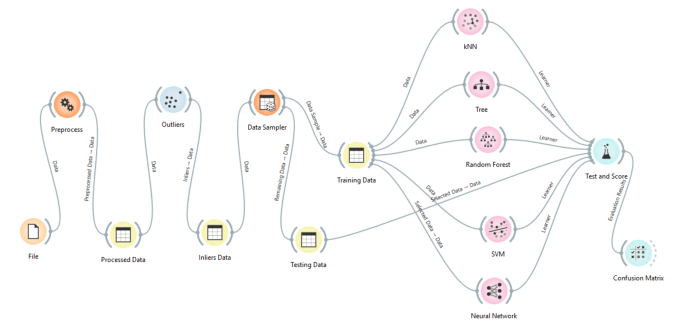
Model Assessments Seven classification models were constructed utilizing both individual and combination biomarker data obtained from physiological, thermoregulatory, and biomechanical features. Models 1, 2, and 3 exclusively employed physiological, thermoregulatory, and biomechanical features, respectively. Models 4 to 6 employed various combinations of biomarker features. Model 7 employed all biomarker features to detect and classify physical fatigue among construction workers. Borg-20 scores used as a reference for dividing physical fatigue into four levels: no fatigue (score < 6), mild fatigue (scoring 7 - 10), moderate fatigue (score 11 - 14), and severe fatigue (score ≥ 15) (Karvekar et al., 2019). The classifier models’ accuracy and validity were assessed by 10-fold cross-validation (Antwi-Afari et al., 2018). The data preparation and classification analysis were performed using the Orange data mining tool, as illustrated in Figure 1. Orange program features a canvas interface that allows users to drag and drop widgets to construct a data analysis workflow. Fundamental widget functions encompass data retrieval, data table presentation, feature selection, predictor training, comparative analysis of learning methodologies, and data item visualization. The user can interactively analyze graphics using the application or integrate segments of them into other widgets (Kukasvadiya and Divecha, 2017).
Figure 1: Process of classification analysis in orange data mining tool.
RESULTS
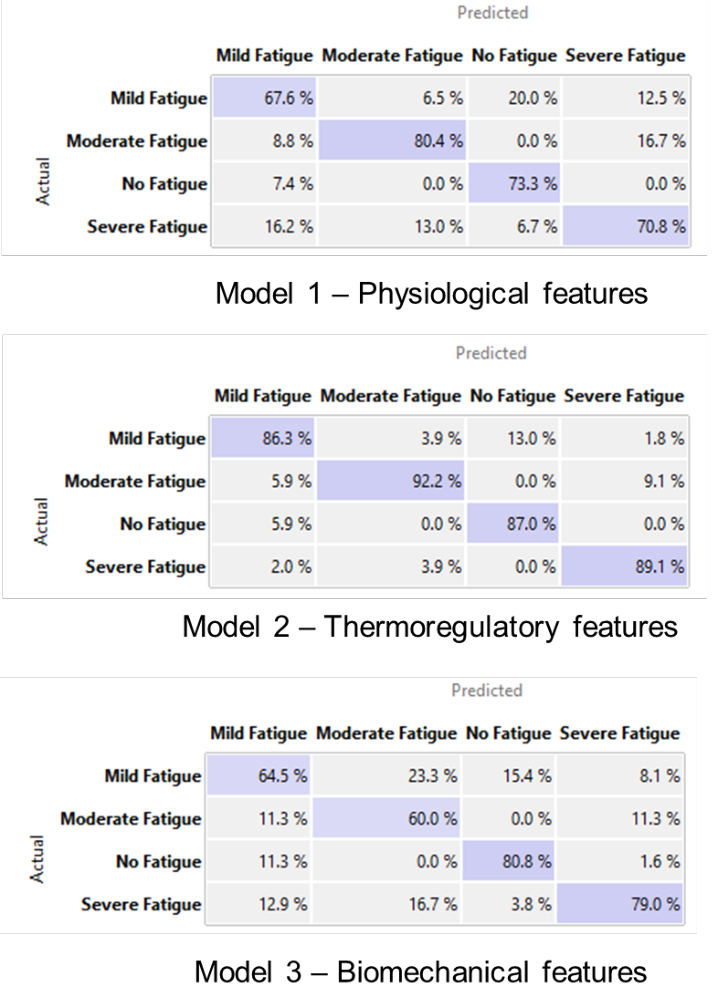
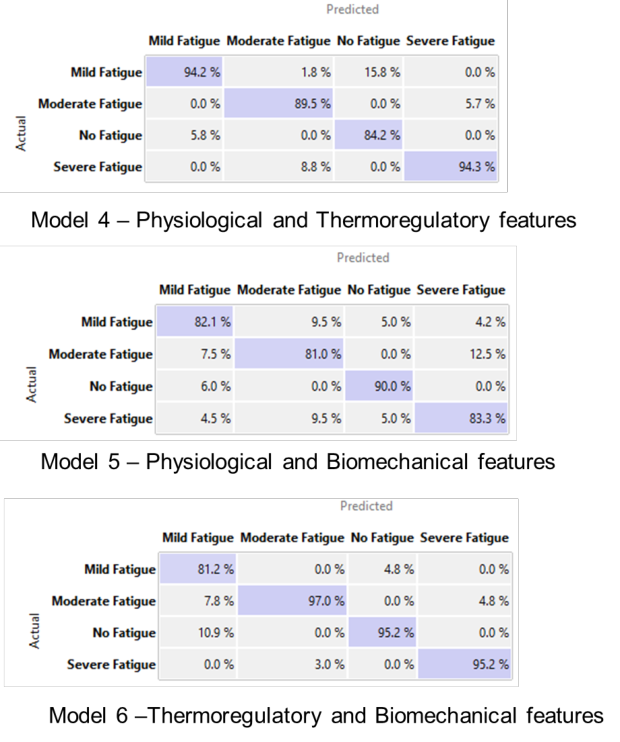
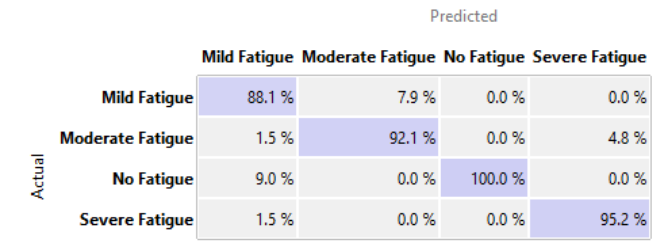
Three unique feature sets and their combinations, together with five machine learning classifiers, were employed in the classification tests to determine the optimal feature set and classifier combination for effectively identifying physical fatigue in construction workers. Table 1 outlines the evaluation parameters for each model employing several classifiers to assess physical fatigue in construction workers. In the comparison of machine learning classifiers’ performance utilizing individual feature datasets, the RF classifier exhibited the highest accuracy at 88.9% for thermoregulatory features, followed by the decision tree classifier at 85.6% for the same features. The RF classifier is the most effective machine learning model for classifying fatigue utilizing both individualized and combination data sets. In the comparison of individual feature sets, thermoregulatory features exhibited the highest accuracy at 88.9%, followed by physiological features at 72.3%, and biomechanical features at 71.1%. In a similar vein, the combination of physiological and thermoregulatory feature sets exhibited the best accuracy at 91.7%, followed by the thermoregulatory and biomechanical feature sets, which achieved 90.6% accuracy. The combination of all three features surpassed the individual and other combined models, achieving an accuracy of 92.3%. Figures 2 and 3 illustrate the confusion matrices for the individualized and combined feature sets employing the optimal classifier. Upon evaluating the accuracy of distinct feature sets (i.e., Models 1, 2, and 3), Model 2, which incorporated thermoregulatory features, exhibited the highest classification accuracy (Figure 2). The analysis of the integrated feature set revealed that model 6, which incorporates thermoregulatory and biomechanical variables, had the highest accuracy (Figure 3). The combination of all three feature sets demonstrated the highest accuracy in predicting and classifying physical fatigue (Figure 4).
Table 1: Comparison of physiological, thermoregulatory and biomechanical parameters to classify physical fatigue using the supervised machine learning classifiers.
Table available in the original PDF paper.
Models Classifiers Validation AUC CA F1 Precision Recall
ANN 0.930 0.746 0.740 0.743 0.746 Note: *Heart rate and breathing rate data; **Skin temperature and electrodermal activity data; ***Foot plantar pressure and acceleration data; KNN: K- nearest neighbour; DT: Decision tree; SVM: Support vector machine; RF: Random forests; ANN: Artificial neural networks
Figure 2: Comparison of classification accuracy for individual features set using random forest (RF) classifier.Figure 3: Comparison of classification accuracy for combined features set using random forest (RF) classifier.Figure 4: Comparison of classification accuracy for multimodal features set (including all three features set) using random forest (RF) classifier.
DISCUSSION
This study used multimodal data including physiological (HR and BR), thermoregulatory (ST and EDA), and biomechanical (foot plantar pressure and acceleration) to automatically identify and classify physical fatigue in construction workers. In addition, this study compared single and multiple features set to detect and classify physical fatigue among construction workers. The current findings revealed that various physiological, thermoregulatory, and biomechanical data were sensitive to physical fatigue, suggesting that these measures could be used to predict physical fatigue in construction workers. Although numerous studies have investigated HR and ST to evaluate physical fatigue (Aryal et al., 2017; Anwer et al., 2021, 2023; Umer et al., 2020), few studies have utilized BR, EDA, and biomechanical measures as fatigue biomarkers to monitor physical fatigue in construction workers (Anwer et al., 2020; Antwi-Afari et al., 2023).
Classification Performance Given that diverse physiological, thermoregulatory, and biomechanical data exhibit responsiveness to fatigue, it is expected that such data could facilitate the detection and classification of physical fatigue in construction workers by machine learning classifiers. The present study employed multimodal data to identify and classify physical fatigue among construction workers. Recent research has employed sensor informatics for the proactive monitoring of physical exertion in construction workers. The current work utilized a novel and simple approach to assess effort by evaluating multimodal data obtained from wearable sensors, in contrast to earlier research that employed various off-body and on-body sensors. Machine learning techniques were implemented in two phases to achieve optimal classification performance. The physiological, thermoregulatory, and biomechanical feature sets were individually utilized to identify the optimal classifier and the most suitable features for identifying physical fatigue. The integrated physiological, thermoregulatory, and biomechanical feature sets were then employed to identify the most effective classifier and the optimal selected features for identifying physical fatigue.
The RF classifier had the greatest accuracy for thermoregulatory parameters (88.9%) and physiological features (72.3%). The RF classifier is the most effective machine learning model for classifying fatigue utilizing multimodal feature sets, achieving an accuracy of 92.3%. The present study demonstrated that the accuracy of classifying fatigue using multimodal features surpassed that of predictions based solely on physiological, thermoregulatory, or biomechanical feature sets during physical exercise (Aryal et al., 2017; Umer et al., 2020). Nonetheless, previous studies have employed a combination of heart rate, respiratory rate, and skin temperature to achieve an accuracy of roughly 82% (Aryal et al., 2017). The superior classification accuracy of our strategy can be ascribed to the selection of digital biomarkers, encompassing physiological, thermoregulatory, and biomechanical factors, utilized in training the machine learning models. Aryal et al. (2017) developed a model
utilizing a limited set of features, mostly heart rate data and skin temperature. Our investigation, however, obtained physiological, thermoregulatory, and biomechanical data. The present work chose the most pertinent data through statistical tests prior to inputting this data into five machine learning models for training, aiming to determine the optimal model for detecting fatigue.
In the present study, RF exhibited the greatest accuracy rate among all evaluated classifiers for the classification of physical fatigue. The outcomes may be ascribed to RF’s capacity to manage computational complexity by permitting specific classification inaccuracies inside the training dataset (Ishaque et al., 2021). RF is a bagging method that, much to Adaboost, employs an ensemble of decision trees (Ishaque et al., 2021). In contrast to several robust learners that tend to overfit and memorize data, bagging techniques mitigate variation within a dataset, enhancing accuracy and minimizing overfitting. It also requires an extended training duration and substantial computer resources to handle the numerous decision trees utilized (Ishaque et al., 2021). Conversely, KNN had the lowest accuracy rate among most of the classifiers evaluated in this study. This may be attributed to the inductive bias of KNN. The KNN inductive bias is linked to the core assumption of the KNN method, which assigns the class label of most of the k nearest examples to each data point i by calculating the Euclidean distance. The KNN method computes the distance between instances by utilizing all characteristics and assigns equal weight to each feature. This may provide an issue for certain data windows, as merely a minuscule subset of the overall feature set is discriminative. Moreover, the efficacy of KNN is susceptible to noisy attributes. Despite the removal of a significant quantity of signal artifacts, it was unfeasible to eradicate all artifacts from physiological, thermoregulatory, and biomechanical signals, which constituted the unavoidable noise.
CONCLUSION
This is the initial finding from the application of multimodal data, including physiological, thermoregulatory, and biomechanical factors, to enhance the classification of varying degrees of physical fatigue in bar-benders through diverse machine learning algorithms. We found that differences in physiological, thermoregulatory, and biomechanical data induced by fatigue may be categorized using supervised machine learning techniques. The research demonstrates that the random forest classifier more accurately predicts fatigue in construction workers utilizing multimodal data. The integrated feature set of multimodal data surpasses the individual data set in evaluating physical fatigue. Further study is necessary to confirm the efficacy of multimodal measurements as a digital biomarker for assessing physical fatigue. The proposed method may mitigate work-related musculoskeletal injuries and other fatigue-related hazards by facilitating continuous monitoring of physical fatigue. Our findings may potentially facilitate the development of a monitoring and alert system for extreme physical fatigue, as well as assist in customizing ideal work-rest schedules for specific construction worker.
ACKNOWLEDGMENT
The authors acknowledged the following funding grant: GP Batteries Industrial Safety Trust Fund (R-ZDDR).
REFERENCES
Agyekum, K., Pittri, H., Botchway, E. A., Amudjie, J., Kumah, V. M. A., Kotei-Martin, J. N., & Oduro, R. A. 2022. Exploring the current technologies essential for health and safety in the Ghanaian construction industry, Merits, 2(4), 314–330. Antwi-Afari, M.F., Anwer, S., Umer, W., Mi, H.Y., Yu, Y., Moon, S. and Hossain,
M.U., 2023. Machine learning-based identification and classification of physical fatigue levels: A novel method based on a wearable insole device. International Journal of Industrial Ergonomics, 93, p. 103404. Antwi-Afari, M.F., Li, H., Yu, Y. and Kong, L., 2018. Wearable insole pressure system for automated detection and classification of awkward working postures in construction workers. Automation in construction, 96, pp. 433–441. Anwer, S., Li, H., Antwi-Afari, M.F., Umer, W. and Wong, A.Y., 2020.
Cardiorespiratory and thermoregulatory parameters are good surrogates for measuring physical fatigue during a simulated construction task. International journal of environmental research and public health, 17(15), p. 5418. Anwer, S., Li, H., Antwi-Afari, M.F., Umer, W. and Wong, A.Y.L., 2021. Evaluation of physiological metrics as real-time measurement of physical fatigue in construction workers: state-of-the-art review. Journal of Construction Engineering and Management, 147(5), p. 03121001. Anwer, S., Li, H., Umer, W., Antwi-Afari, M.F., Mehmood, I., Yu, Y., Haas, C. and Wong,
A.Y.L., 2023. Identification and classification of physical fatigue in construction workers using linear and nonlinear heart rate variability measurements. Journal of Construction Engineering and Management, 149(7), p. 04023057. Arney, B.E., Glover, R., Fusco, A., Cortis, C., de Koning, J.J., van Erp, T., Jaime, S., Mikat, R.P., Porcari, J.P. and Foster, C., 2019. Comparison of RPE (rating of perceived exertion) scales for session RPE. International journal of sports physiology and performance, 14(7), pp. 994–996. Aryal, A., Ghahramani, A. and Becerik-Gerber, B., 2017. Monitoring fatigue
in construction workers using physiological measurements. Automation in Construction, 82, pp. 154–165. Brauer, R.L., 2022. Safety and health for engineers. John Wiley & Sons. Chandrashekar, G. and Sahin, F., 2014. A survey on feature selection methods. Computers & electrical engineering, 40(1), pp. 16–28. Gu, J. and Guo, F., 2022. How fatigue affects the safety behaviour intentions of
construction workers an empirical study in Hunan, China. Safety science, 149, p. 105684. Ibrahim, A., Nnaji, C., Namian, M., Koh, A. and Techera, U., 2023. Investigating the impact of physical fatigue on construction workers’ situational awareness. Safety science, 163, p. 106103. ILO, 2023. International Labor Organization: Occupational Safety and Health
Management in Ishaque, S., Khan, N. and Krishnan, S., 2021. Trends in heart-rate variability signal analysis. Frontiers in Digital Health, 3, p. 639444. Karvekar, S., Abdollahi, M. and Rashedi, E., 2019. A data-driven model to identify
fatigue level based on the motion data from a smartphone. BioRxiv, p. 796854.
Kukasvadiya, M.S. and Divecha, N.H., 2017. Analysis of data using data mining tool orange. International Journal of Engineering Development and Research, 5(2), pp. 1836–1840. Mehmood, I., Li, H., Umer, W., Arsalan, A., Shakeel, M.S. and Anwer, S., 2022.
Validity of facial features’ geometric measurements for real-time assessment of mental fatigue in construction equipment operators. Advanced Engineering Informatics, 54, p. 101777. Namian, M., Taherpour, F., Ghiasvand, E. and Turkan, Y., 2021. Insidious safety threat of fatigue: Investigating construction workers’ risk of accident due to fatigue. Journal of construction engineering and management, 147(12), p. 04021162. Pittri, H., Godawatte, G.A.G.R., Atibila, D.W., Agyekum, K., Amartey, P.A.,
Botchway, E.A. and Dompey, A.M.A., 2025. Knowledge, training, and skills gaps for emerging construction technologies adoption in the construction industry of a developing country. International Journal of Construction Education and Research, pp. 1–27. Umer W, Li H, Yantao Y, Antwi-Afari MF, Anwer S, Luo X. Physical exertion modeling for construction tasks using combined cardiorespiratory and thermoregulatory measures. Automation in Construction. 2020 Apr 1;112:103079. Yu, Y., Li, H., Yang, X., Kong, L., Luo, X. and Wong, A.Y., 2019. An automatic
and non-invasive physical fatigue assessment method for construction workers. Automation in construction, 103, pp. 1–12. Zhang, M., Murphy, L.A., Fang, D. and Caban-Martinez, A.J., 2015. Influence of fatigue on construction workers’ physical and cognitive function. Occupational Medicine, 65(3), pp. 245–250.
LISTED IN THE AHFE DIGITAL BOOKSTORE CATALOGUE
Explore the complete digital volume
Cognitive Computing and Internet of Things
Read this individual research paper free through the original publisher, or explore the full digital proceedings book.
ISBN 978-1-964867-81-6
Explore this ISBN in the AHFE Bookstore ↗Listed in the July 2026 bookstore catalogue; search by ISBN to confirm current availability · Digital book purchase optional