Rezaul Karim, Usama Khan, Xingzhou Guo (2025). A Cross-Sector Framework for Human Factor Technologies: Comparative Analysis of Vertical and Horizontal Construction. In: Human Factors in Design, Engineering, and Computing. AHFE Open Access, vol. 199, pp. 1831–1840. https://doi.org/10.54941/ahfe1006994
Human factors research in construction has led to a range of technological and methodological advancements aimed at enhancing worker safety, efficiency, and well-being. However, these innovations often evolve separately within vertical building construction and horizontal transportation construction. This paper presents a comparative analysis of the two sectors to examine not only which human factors technologies can be effectively transferred between them, but also which cannot, and more importantly why. To support this, a structured decision-making framework (network diagram) is introduced to systematically categorize technologies into three transferability pathways: directly transferable, adaptable, or non-transferable. The analysis considers variations in work intensity, activity duration, and task frequency, as well as environmental and site conditions that shape human performance demands. Technologies originating in vertical building construction, such as wearable sensing systems and ergonomic assessment tools, are evaluated for their applicability in horizontal transportation construction, while transportation-based technologies such as fatigue monitoring and real-time safety analytics are assessed for potential use in vertical construction. Findings reveal both opportunities for cross-sector technology transfer and more importantly barriers rooted in differences in exposure duration, work environments, and operational logistics. The study contributes to developing a framework for adapting, refining, and contextualizing human factors technologies across diverse construction domains to advance human-centered design and safety performance.
Human factors in construction refers to the interplay of environmental, organizational, and individual characteristics that influence worker behavior and safety. It includes both physical ergonomics (e.g. reducing strenuous postures and musculoskeletal strain) and cognitive factors (e.g. managing workload, fatigue, and situational awareness). Human factors research
in construction has driven numerous technological and methodological advances to improve worker safety, efficiency, and well-being. Modern construction sites are increasingly adopting digital technologies to monitor workers in real time, with a growing focus on tracking physical and mental fatigue to proactively mitigate hazards (Karim et al., 2025). Wearable sensing systems, for example, can continuously track workers’ physiological indicators (such as heart rate, fatigue levels, etc.) and provide early warnings of unsafe conditions. Such innovations have become key to construction safety management, allowing data-driven assessment of worker status and risk in the field. However, these advancements have largely developed in isolation across different construction sectors. Vertical building construction (VBC) and horizontal transportation (infrastructure) construction (HTC) present distinct operational contexts, and human factors solutions often remain specialized to their domain. Building projects are usually confined to limited spaces and rise vertically with multiple floors and diverse trades, while transportation projects such as highways extend horizontally over large areas and involve heavy equipment and exposure to traffic. These fundamental differences mean that a technology effective on a high-rise site may not perform equally well in a highway work zone, and the reverse could also be true. This paper addresses that gap by comparing human factors research in vertical and horizontal construction to identify which safety technologies can transfer between the two sectors, which cannot, and more importantly why.
LITERATURE REVIEW
Human Factor Technologies in VBC Research on human factors in VBC has grown rapidly in the past two decades. It focuses on physiological monitoring, safety, technology-based interventions, etc. The studies address the challenges of high-rise projects, confined spaces, and repetitive manual work. Postural ergonomics is one of the major research areas. Tools such as Rapid Entire Body Assessment (REBA), Rapid Upper Limb Assessment (RULA), and the Ovako Work Posture Analysis System are commonly used. These studies show that construction workers face high ergonomic risks in tasks like bricklaying, concrete pouring, plastering, and material handling (Kulkarni and Devalkar, 2019). Wearable sensing devices have emerged as powerful monitoring tools. Research has explored inertial measurement units, electromyography (EMG), electrocardiography, and galvanic skin response sensors (Bangaru et al., 2022; Nnaji et al., 2021; Ouyang et al., 2023). Mental fatigue monitoring has advanced significantly with electroencephalography (EEG) technology, particularly through the use of multimodal in-ear EEG sensors (Fang et al., 2024). Research investigating working at height, using virtual reality and EEG, demonstrated that height exposure adversely affects vigilance and significantly increases mental fatigue (Tehrani et al., 2022). Building Information Modeling has been extensively integrated with safety management systems, facilitating proactive hazard identification, visualization of temporary safety facilities, and simulation-based safety
A Cross-Sector Framework for Human Factor Technologies 1833
training (Zaman et al., 2024). Exoskeletons have emerged as promising ergonomic interventions. Research on passive back-support exoskeletons for concrete workers demonstrated reduced lower back stress, though discomfort in other body areas and compatibility issues with existing safety gear require design modifications (Gonsalves et al., 2024).
Human Factor Technologies in HTC HTC faces unique human factor challenges that differ from those in building construction. Workers in these environments are constantly exposed to traffic and heavy machinery. Highway work zones are open and dynamic, where vehicles and large equipment operate close to ground personnel, creating major struck-by hazards. One study developed an untethered ultra- wideband real-time locating system for road worker safety, reaching 97% accuracy without needing cables for power or data transfer (Ochoa-de-Eribe- Landaberea et al., 2024). Recent research has also focused on ergonomic risks among transportation maintenance workers. Guo et al. (2025) introduced an automated fatigue detection system using physiological signals such as EMG, electrodermal activity, and heart rate monitoring. Field experiments on back exoskeletons showed promising results. Guo et al. (2023) found that exoskeletons reduced fatigue when workers lifted loads of 50 pounds or more. Hu et al. (2024) used video-based REBA and RULA assessments to study shoveling tasks among 26 maintenance workers. The study compared ergonomic handles and exoskeletons, demonstrating clear differences in ergonomic outcomes. Demeke et al. (2025) reviewed sensor technologies for highway work zone intrusion and proximity hazards. Their findings showed that most studies focus on vehicle-to-worker collision prevention. Other emerging technologies in HTC include vibrotactile alert systems, augmented reality-based safety alerts, and IoT-based heat stress monitoring platforms to enhance worker safety and health (Kim et al., 2020; Sabeti et al., 2024; Specht et al., 2025; Yang and Roofigari-Esfahan, 2023). Despite these advances, HTC research is still narrower in scope than building construction. It lacks the same level of integration between physiological monitoring, fatigue assessment, posture analysis, and other human factors that characterize vertical construction research. Therefore, cross-sector analysis is required between HTC and VBC.
METHODOLOGY
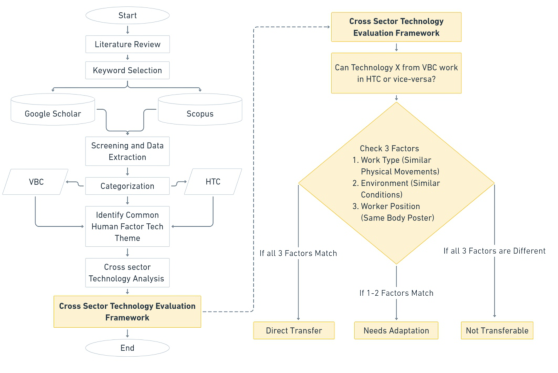
This study used a systematic comparative review approach. Relevant research was collected from Scopus and Google Scholar, covering the years 2020 to 2025, to capture the most recent technological advancements in human factor research within VBC and HTC. Studies were selected based on their focus on human performance, safety, and technology use in construction. Two datasets were created, one for vertical building construction and one for horizontal transportation construction. A total of 18 publications were selected based on screening criteria that included participants’ experience in the construction sector, work activity type, and experimental setup. The detailed methodology is shown in Figure 1. To move beyond a traditional “yes/no” assessment
and systematically diagnose the reasons behind transferability, a structured approach is necessary. The developed flowchart (titled as “Cross-sector Technology Evaluation Framework” in Figure 1) provides a clear framework for understanding the transferability of human factors technologies between VBC and HTC. Its primary insight is that successful transfer depends less on the technology itself and more on the context of its use. The model demonstrates that technologies can be systematically categorized into three distinct pathways. The first pathway includes technologies that are Directly Transferable (DT), as their function is universal and not constrained by specific site conditions. The second category, Needs Adaptation (NA), indicates that many technologies are only transferable if their implementation is adapted to overcome contextual barriers related to work tasks, environment, or operational logistics. Finally, the flowchart identifies a third pathway for technologies that are fundamentally Non- Transferable (NT) due to their inherent dependence on a specific context that does not exist in the other sector. This structured approach moves beyond a simple binary classification, offering a practical decision-making tool for identifying which technologies can be shared directly, which require modification, and which should not be considered for cross-sector application.
Figure 1: Methodological framework of the study.
RESULTS AND DISCUSSION
The analysis of human factors technologies across VBC and HTC reveals clear patterns in cross-sector transferability. By applying the decision- based framework from the flowchart diagram (Figure 1) to the studies summarized in Table 1, the technologies can be effectively categorized into three distinct pathways based on their contextual dependencies and adaptability requirements. First, some technologies are directly transferable. These are typically wearable sensors that monitor universal physical signals, like heart rate or muscle activity. For example, a wrist-worn fatigue monitor works equally well on a worker tying rebar on a high-rise or one laying
A Cross-Sector Framework for Human Factor Technologies 1835
asphalt on a highway, because the human body gets tired in the same way regardless of the setting. Second, many technologies require adaptation. These tools address a common human factor but are built for a specific task. A good example is the exoskeleton. The principle of reducing back strain is needed in both sectors. However, a bulky exoskeleton designed for shoveling on an open road might be too cumbersome and restrict movement for a steel erector working at height, where balance and unrestricted mobility are critical for safety. For it to transfer, the core idea remains, but the design must be adapted to the new environment. Finally, some technologies are not transferable because they are locked into a specific context. The clearest example is an in-vehicle camera system that monitors an equipment operator’s alertness. This technology is not useful for most VBC tasks because those workers are not sitting in a stationary vehicle; they move around the site, except for those who operate construction equipment on building sites. The context for which it was designed simply does not exist in the other sector. By applying this network diagram, industry decision-makers can more reliably identify which solutions can be shared directly, which require modification, and which are unsuitable, thereby optimizing investments in safety and productivity across vertical and horizontal construction.
Table 1: Cross-sector applicability and transferability between two sectors.
HTC (Tao et al., 2024) Physical fatigue; ergonomic assessment
DT Field data Gravel shoveling
HTC (Hu et al., 2024) Physical fatigue; ergonomic assessment
Simulated Excavation NT
HTC (Wang et al., 2024) Mental fatigue monitoring
NA
HTC (Mehmood et al., 2024) Mental fatigue Field data Excavation NA VBC (Zhang et al., 2023) Physical fatigue; Mental fatigue;
Simulated Heavy weight material handling DT
VBC (Tao et al., 2023) Physical fatigue; ergonomic assessment
Lab Rebar work, formwork, concrete, masonry NA VBC (Ma et al., 2023) Physical fatigue Simulated Rebar work DT HTC (Guo et al., 2023) Physical fatigue; ergonomic assessment Field data Lifting dry concrete mix bags
DT VBC (Lee et al., 2022) Physical fatigue Lab Material handling tasks Continued
Table 1: Continued
Table available in the original PDF paper.
Data Source Activity Transferability
Sector Ref. Human Factor Focus
DT
VBC (Dias Barkokebas et al., 2022) Ergonomic assessment
Simulated Window-frame assemble NA
VBC (Bendak et al., 2022) Physical fatigue; Mental fatigue; reaction time
Field data Carpentry, concrete finishing, bricklaying DT
VBC (Ferrada et al., 2021) Physical fatigue; Mental fatigue;
Field data General construction tasks Lab Rebar tying DT HTC (Li et al., 2020) Mental fatigue Simulated Excavation DT VBC (Jebelli et al., 2020) Physical fatigue; ergonomic assessment
DT formed the predominant category, with the methods and tools from 12 of the 18 papers analyzed (∼67%) falling into this pathway. These studies successfully bypass sector-specific barriers by focusing on technologies that measure universal human physiological and cognitive characteristics. The research on wearable sensor systems for HRV monitoring, EMG- based fatigue detection, and ECG measurements, as cataloged in Table 1, exemplifies this category. The technologies investigated in these papers measure fundamental biological signals that remain consistent across both VBC and HTC environments, allowing them to transition between sectors without the need for modification. Similarly, assessment methodologies including fuzzy Bayesian network for ergonomic risk assessment and psychometric testing for sleep quality demonstrated direct transferability because their core analytical approaches are independent of specific sectoral contexts (Ferrada et al., 2021; Tao et al., 2023). Ma et al.’s sweat- based fatigue monitoring further reinforces this pattern, as hydration and energy depletion represent universal physiological processes affecting workers in both sectors (Ma et al., 2023). The category of “Technologies Requiring Adaptation”(denoted as “NA”in Table 1) represented a significant minority, comprising five of the studied cases (∼28%). These technologies addressed transferable human factors principles but required modifications to their implementation. The exoskeleton research by Hu et al. (2025) and Guo et al. (2023), followed this pathway, where the core principle of reducing musculoskeletal strain proved universally applicable, but the physical implementation required sector-specific modifications for spatial constraints and task variability. Furthermore, facial recognition for mental fatigue detection demonstrated partial adaptation needs, as the core computer vision technology transfers well between equipment operators but requires different camera positioning solutions for varied operational contexts (Mehmood et al., 2024). In addition, the research by Bendak et al. (2022), while finding that reaction-time-based fatigue assessment is applicable to both sectors, is fundamentally tied to a specific environmental context like high ambient temperatures in Gulf climates. Its transfer to colder or moderate regions
A Cross-Sector Framework for Human Factor Technologies 1837
would require adaptation and re-calibration of its models. Similarly, the physiological measurement framework for fatigue proposed by Zhang et al. (2023) was validated in a simulated setting. For effective transfer to the dynamic and unpredictable conditions of real-world construction sites in either sector, the technology would need robustification and field validation to handle environmental interference and ensure reliable data collection. Finally, Non-Transferable Technologies (NT) were rare, with only one clear example (∼6%) identified. Smart cushion system by Wang et al. (2024) fell into this category, as its non-contact monitoring principle showed cross- sector potential, but its implementation was limited to seated equipment operations, a context not universally present across all construction tasks. This finding suggests that most human factors technologies possess at least some transfer potential when their core principles are separated from specific implementations. The transferability patterns observed consistently reflected the three key factors outlined in the evaluation framework. Work type compatibility emerged as the primary determinant, with technologies addressing universal human factors like physiological fatigue (HRV, EMG, ECG monitoring) and cognitive assessment (psychometric testing) showing highest transferability. Environmental factors presented the most significant barriers for adaptation-required technologies, particularly for systems needing stable measurement conditions or specific physical setups. Worker position considerations primarily affected wearable and assistive technologies, where ergonomic design and mobility requirements varied between sectors. This categorization provides practical guidance for industry stakeholders seeking to leverage existing technologies across construction domains. The framework suggests that investment should prioritize DT technologies for immediate implementation, while allocating development resources to adapt promising technologies with sector-specific barriers.
CONCLUSION
This study successfully addresses the critical gap in understanding the cross- sector transferability of human factors technologies between vertical building construction and horizontal transportation construction. By systematically analyzing 18 research studies, a clear decision-making framework was developed to categorize technologies into three distinct pathways: Directly Transferable, Needs Adaptation, and Non-Transferable. The analysis revealed that the majority of technologies, particularly those based on universal physiological monitoring, are directly transferable. A significant portion requires contextual adaptation, primarily due to differences in environmental conditions and task-specific implementations. Only a small fraction was found to be non-transferable, being intrinsically locked to a specific operational context. The primary outcome of this research is a practical framework that moves beyond a simple binary assessment. It provides industry stakeholders and researchers with a structured methodology to efficiently identify, adapt, and implement human factors technologies across construction domains.
REFERENCES
Bangaru, S. S., Wang, C., Aghazadeh, F., 2022. Automated and Continuous Fatigue Monitoring in Construction Workers Using Forearm EMG and IMU Wearable Sensors and Recurrent Neural Network. MDPI. Bendak, S., Jouaret, R., Rashid, H., 2022. Effects of high ambient temperature on
construction workers performance: A longitudinal empirical study. J Safety Res 81, 197–202. Demeke, A., Younesi Heravi, M., Dola, I., Jang, Y., Le, C., Jeong, I., Lin, Z., Wang, D., 2025. Advancing Highway Work Zone Safety: A Comprehensive Review of Sensor Technologies for Intrusion and Proximity Hazards. https:// doi.org/10.48550/arXiv.2503.13478. Dias Barkokebas, R., Al-Hussein, M., Li, X., 2022. VR–MOCAP-enabled ergonomic
risk assessment of workstation prototypes in offsite construction. J Constr Eng Manag 148, 04022064. Fang, X., Li, H., Ma, J., Xing, X., Fu, Z., Antwi-Afari, M. F., Umer, W., 2024.
Assessment of Construction Workers’ Spontaneous Mental Fatigue Based on Non-Invasive and Multimodal In-Ear EEG Sensors. Buildings 14, 2793. Ferrada, X., Barrios, S., Masalan, P., Campos-Romero, S., Carrillo, J., Molina, Y.,
2021. Sleep duration and fatigue in construction workers: A preliminary study. Organization, technology & management in construction: An international journal 13, 2496–2504. Gonsalves, N. J., Yusuf, A., Ogunseiju, O., Akanmu, A., 2024. Evaluation of concrete workers’ interaction with a passive back-support exoskeleton. Engineering, Construction and Architectural Management 31, 4585–4601. Guo, X., Chen, Y., Zhang, J., 2025. Automated detection of physical fatigue
in transportation maintenance workers through physiological and motion data. Theor Issues Ergon Sci 26, 158–177. Guo, X., Hu, X., Chen, Y., 2023. Exploration of Back Exoskeleton’s Effectiveness on Transportation Maintenance Workers during Lifting Activities. Physical Ergonomics and Human Factors 103. Hu, X., Guo, X., Chen, Y., Zhang, J., 2024. Video-based Ergonomic Risk Assessment
among Transportation Maintenance Workers in Shoveling. Human Factors in Design, Engineering, and Computing 159. Hu, X., Guo, X., Chen, Y., Zhang, J., 2025. Usability of Passive Back Exoskeletons and Ergonomic Handles for Transportation Maintenance Workers: A Field-Based Study in Shoveling, in: CIB Conferences. p. 175. Jebelli, H., Seo, J., Hwang, S., Lee, S., 2020. Physiology-based dynamic muscle
fatigue model for upper limbs during construction tasks. Int J Ind Ergon 78, 102984. Karim, R., Guo, X., Wu, H., Barman, M., 2025. Advancing Research on Workers’ Fatigue. Physical Ergonomics and Human Factors 185, 77. https://doi.org/10.54941/ahfe1006466. Kim, J. H., Jo, B. W., Jo, J. H., Kim, D. K., 2020. Development of an IoT-based construction worker physiological data monitoring platform at high temperatures. Sensors 20, 5682. Kulkarni, V. S., Devalkar, R. V, 2019. Postural analysis of building construction
workers using ergonomics. International Journal of Construction Management 19, 464–471.
A Cross-Sector Framework for Human Factor Technologies 1839
Lee, W., Lin, K.-Y., Johnson, P. W., Seto, E. Y. W., 2022. Selection of wearable sensor measurements for monitoring and managing entry-level construction worker fatigue: A logistic regression approach. Engineering, Construction and Architectural Management 29, 2905–2923. Li, J., Li, H., Umer, W., Wang, H., Xing, X., Zhao, S., Hou, J., 2020. Identification
and classification of construction equipment operators’ mental fatigue using wearable eye-tracking technology. Autom Constr 109, 103000. Ma, J., Li, H., Yu, X., Fang, X., Fang, B., Zhao, Z., Huang, X., Anwer, S., Xing, X.,
2023. Sweat Analysis-Based Fatigue Monitoring during Construction Rebar Bending Tasks. J Constr Eng Manag. https://doi.org/10.1061/jcemd4.coeng- 13233. Mehmood, I., Li, H., Umer, W., Ma, J., Shakeel, M. S., Anwer, S., Antwi-Afari, M. F., Tariq, S., Wu, H., 2024. Non-invasive detection of mental fatigue in construction equipment operators through geometric measurements of facial features. J Safety Res 89, 234–250. Nnaji, C., Awolusi, I., Park, J., Albert, A., 2021. Wearable sensing devices: Towards
the development of a personalized system for construction safety and health risk mitigation. Sensors 21, 682. Ochoa-de-Eribe-Landaberea, A., Zamora-Cadenas, L., Velez, I., 2024. Untethered ultra-wideband-based real-time locating system for road-worker safety. Sensors 24, 2391. Ouyang, Y., Liu, M., Cheng, C., Yang, Y., He, S., Zheng, L., 2023. Monitoring Inattention in Construction Workers Caused by Physical Fatigue Using Electrocardiograph (ECG) and Galvanic Skin Response (GSR) Sensors. Sensors. https://doi.org/10.3390/s23177405. Sabeti, S., Morris, N., Shoghli, O., 2024. Mixed-method usability investigation
of ARROWS: Augmented reality for roadway work zone safety. International Journal of Occupational Safety and Ergonomics 30, 292–303. Specht, J. W., Garcia, S., Wegman, D. H., Glaser, J., Schlader, Z. J., Amorim, F. T.,
2025. Heat strain in road construction workers during the summer in New Mexico: a preliminary study. Ann Work Expo Health 69, 225–229. Tao, Y., Hu, H., Xu, F., Zhang, Z., 2023. Ergonomic risk assessment of construction workers and projects based on fuzzy Bayesian network and DS evidence theory. J Constr Eng Manag 149, 04023034. Tao, Y., Hu, H., Xu, F., Zhang, Z., Wang, R., Huang, H., 2024. Ergonomic Risk Assessment in Construction: Integrating Vision-based Postural Assessment and EMG-based Fatigue Analysis, in: 2024 IEEE International Conference on Industrial Engineering and Engineering Management (IEEM). IEEE, pp. 1044–1048. Tehrani, B. M., Wang, J., Truax, D., 2022. Assessment of mental fatigue using
electroencephalography (EEG) and virtual reality (VR) for construction fall hazard prevention. Engineering, Construction and Architectural Management. https://doi.org/10.1108/ECAM-01–2021-0017. Wang, L., Li, H., Wu, H., Yao, Y., Yu, C., Umer, W., Han, D., Ma, J., 2024.
Monitoring Mental Fatigue of Construction Equipment Operators: A Smart Cushion–Based Method with Deep Learning Algorithms. Journal of Management in Engineering 40, 4024044. Wang, Q., Li, K., Wang, Xiuyuan, Wang, Xiang, Qin, J., Yu, C., 2025. CWMformer: A Novel Framework for Long-Term Fatigue Conditions Measurement and Prediction of Construction Workers With a Wearable Optical Fiber Sensor System. IEEE Trans Instrum Meas.
Xing, X., Zhong, B., Luo, H., Rose, T., Li, J., Antwi-Afari, M. F., 2020. Effects of physical fatigue on the induction of mental fatigue of construction workers: A pilot study based on a neurophysiological approach. Autom Constr. https:// doi.org/10.1016/j.autcon.2020.103381. Yang, X., Roofigari-Esfahan, N., 2023. Vibrotactile alerting to prevent accidents in
highway construction work zones: An exploratory study. Sensors 23, 5651. Zaman, A. A. U., Abdelaty, A., Sobuz, M. H. R., 2024. Integration of BIM data and real-time game engine applications: Case studies in construction safety management. J. Inf. Technol. Constr. 29, 117–140. Zhang, Z., Xiang, T., Guo, H., Ma, L., Guan, Z., Fang, Y., 2023. Impact
of physical and mental fatigue on construction workers’ unsafe behavior based on physiological measurement. J Safety Res. https://doi.org/10.1016/ j.jsr.2023.04.014.
LISTED IN THE AHFE DIGITAL BOOKSTORE CATALOGUE
Explore the complete digital volume
Human Factors in Design, Engineering, and Computing
Read this individual research paper free through the original publisher, or explore the full digital proceedings book.
ISBN 978-1-964867-75-5
Explore this ISBN in the AHFE Bookstore ↗Listed in the July 2026 bookstore catalogue; search by ISBN to confirm current availability · Digital book purchase optional