Rezaul Karim, Xingzhou Guo, Hongyue Wu, Manik Barman (2025). Advancing Research on Workers’ Fatigue in Construction: A Cluster-Based Review. In: Physical Ergonomics and Human Factors. AHFE Open Access, vol. 185, pp. 77–87. https://doi.org/10.54941/ahfe1006466
Workers’ fatigue research in the construction industry has advanced significantly with growing attention on the physical and mental aspects and their impacts on safety and health. As construction sites adopt more digital and sensor-based technologies, this study conducts a cluster-based review to highlight how fatigue detection has evolved into an advanced stage, featuring adaptive modeling, biochemical sensing, and artificial intelligence (AI)-driven prediction tools. Using VOSviewer bibliometric analysis, this review mapped the thematic structure of recent fatigue research and identified four key clusters: psychological health, cognitive-task performance, ergonomic and occupational risks, and physical health promotion. This cross-disciplinary approach merges physiological data analysis, AI, and construction ergonomics to provide practical insights for researchers and practitioners. Key recommendations include the need for large-scale field validation, multimodal sensor integration, and user-friendly wearable systems. Overall, this review consolidates current knowledge and outlines future directions to improve safety and resilience in construction environments.
Construction workers’ fatigue has been identified as a major contributor to accidents, productivity loss, and health deterioration in construction environments. For example, fatigue accounts for up to 33% of occupational injuries and is associated with impaired balance, slower reaction time, and reduced hazard recognition among workers (Kim et al., 2024). In this dynamic and labor-intensive industry, workers often face physically demanding tasks, irregular schedules, and harsh environmental conditions that accelerate fatigue onset (Ibrahim et al., 2023). Empirical studies have shown that fatigue impairs attention, situational awareness, and hazard recognition, thereby increasing the risk of accidents and safety violations (Namian et al., 2021). Traditional fatigue assessment relied heavily on subjective self-reports or observational checklists, which are limited by
recall bias, inconsistency, and lack of precision (Anwer et al., 2021b). To overcome these drawbacks, researchers have increasingly turned to objective methods such as physiological monitoring and wearable sensors (Chen and Tserng, 2022; Ma et al., 2023a; Yu et al., 2019). These technologies not only allow for continuous, real-time fatigue monitoring but also enable the development of predictive fatigue models. Recent literature increasingly focuses on advanced monitoring approaches using wearable sensors and machine learning (ML) models (Antwi-Afari et al., 2023; Bangaru et al., 2022; Li et al., 2019; Ma et al., 2023b, 2023a). Simultaneously, mental and cognitive fatigue arising from sustained attention, stress, and information overload is gaining attention as a major contributor to unsafe behavior on- site (Boksem and Tops, 2008; Zong et al., 2024). To address this, recent studies have adopted electroencephalogram (EEG)-based monitoring and ML models to objectively detect the related fatigue through changes in brainwave activity (Mehmood et al., 2023). Moreover, there is increasing interest in integrating environmental and contextual factors such as shift timing, heat stress, workload type, and work-related mental stress (Anwer et al., 2021b; Yi et al., 2016). These factors interact closely with physiological fatigue indicators and are critical for developing robust predictive models. However, despite this progress, research gaps persist. Few studies offer interdisciplinary reviews that connect physical and mental fatigue in real- world construction environments, and even fewer integrate environmental factors into fatigue modeling. To better understand how these physical demands, mental stressors, and environmental factors contribute to workers’ fatigue, this review brings together recent studies on workers’ fatigue in the construction industry. By organizing the literature from 2018 to 2024 into key thematic clusters, this paper provides an overview of the main research trends, technologies used for monitoring, and current limitations. The goal is to help guide future research and support the development of practical fatigue management strategies that can be applied in real construction settings.
METHODOLOGY
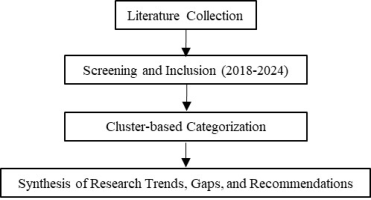
This review employed a structured cluster-based approach to analyze recent fatigue research in construction from 2018 to 2024. Figure 1 represents the methodology, which consists of the following steps.
Figure 1: Flowchart of the methodology used in this cluster-based fatigue review.
Advancing Research on Workers’ Fatigue in Construction: A Cluster-Based Review 79
Literature Collection: Both peer-reviewed journal articles and conference papers were sourced, focusing on fatigue in construction settings. Search databases included ScienceDirect, PubMed and Google Scholar, using keywords such as “fatigue”, “physical fatigue”, “mental fatigue”, “cognitive fatigue”, “construction”, “construction safety”, and “wearable sensors”.
Screening and Inclusion: Studies published between 2018 and 2024 were selected based on their application to physical, mental, cognitive or multimodal fatigue detection, real-time monitoring, and prediction modeling in construction workers. Both field-based and simulation studies were included.
Cluster-based Categorization: Based on keyword co-occurrence using VOSviewer, the papers were grouped into four clusters: (i) Psychological Health, (ii) Cognitive-task Performance, (iii) Ergonomic and Occupational Risks, and (iv) Physical Health Promotion.
Synthesis of Research Trends, Gaps, and Recommendations: Techniques, sensor types, modeling methods, and validation strategies were discussed across clusters. Common themes, emerging technologies, and unresolved challenges were synthesized.
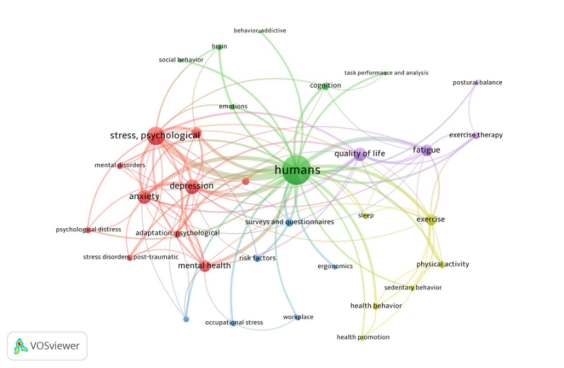
VOSVIEWER KEYWORD CO-OCCURRENCE ANALYSIS To complement the cluster-based literature review, a bibliometric keyword co-occurrence analysis was performed using VOSviewer software. This technique identifies dominant research themes based on how frequently specific keywords appear together in academic publications. The analysis spans literature from 2018 to 2024, offering a visual clustering of the major conceptual domains explored in fatigue research. Initially, 97 publications were collected. Then, to ensure thematic clarity and methodological consistency in this cluster-based review, the selection was narrowed down to 22 papers. Screening was done based on whether each study aligned with at least one of the clusters identified by the VOSviewer analysis, while papers that were only theoretical or not directly related to construction were excluded. Figure 2 displays the VOSviewer keyword co-occurrence network map generated from the 22 papers. The map visually clusters related terms based on their frequency and co-appearance across studies, helping identify dominant research themes in construction fatigue. These clusters are color- coded and reflect distinct but interconnected areas of focus. This visual framework supports the thematic structure used in the subsequent analysis.
CLUSTER-BASED REVIEW OF WORKERS’ FATIGUE RESEARCH Based on the VOSviewer keyword co-occurrence analysis from Figure 2, the literature was categorized into four main clusters: Psychological Health (red cluster), Cognitive-Task Performance (green cluster), Ergonomic and Occupational Risks (blue cluster), and Physical Health Promotion (yellow cluster). These clusters represent the dominant research directions in construction-related fatigue studies from 2018 to 2024 and serve as the organizational framework for the following review.
Psychological Health (Red Cluster) This cluster encompasses research on stress, anxiety, mental health, and their impacts on workers’ safety and well-being. Fatigue can significantly impair situational awareness and hazard perception, thereby elevating safety risks on site. For example, a field study conducted by Ibrahim et al. (2023) reported that construction workers’ ability to recognize hazards dropped by about 13% under fatigue, confirming that psychological fatigue undermines alertness and hazard identification. Recent EEG-based studies corroborate these findings by linking mental fatigue to measurable changes in brain activity, such as reduced frontal lobe engagement and emotional processing deficits (Yue et al., 2024). Fang et al. (2022) demonstrated that physiological computing techniques can detect not only fatigue but also stress and emotional strain in real time using signals like EEG, electrodermal activity (EDA), and heart rate variability (HRV). Such advances highlight the potential of integrating real-time stress monitoring into wearable systems to protect workers’ psychological health on the job.
In addition to objective sensing, several works emphasize the behavioral and safety consequences of mental fatigue. Prolonged mental strain has been associated with heightened anxiety, slower reaction times, and lapses in attention. For instance, Yue et al. (2024) observed that construction workers experiencing mental fatigue exhibited reduced P300 brainwave amplitudes, identified in EEG as event-related potentials, which are critical markers in neuroscience for measuring attention and decision-making capacity. These cognitive effects reinforce why mental well-being metrics should be incorporated into construction safety programs. Overall, the psychological health cluster underlines that managing stress and cognitive overload is essential for maintaining alertness and preventing accidents on site.
Advancing Research on Workers’ Fatigue in Construction: A Cluster-Based Review 81
Cognitive-Task Performance (Green Cluster) Research in this cluster focuses on how fatigue affects cognitive functioning and task performance in construction activities. Cognitive fatigue, arising from sustained mental effort, information overload, or decision-making stress, has been linked to quantifiable physiological changes and an increased likelihood of errors (Azeez et al., 2019; Cheng et al., 2022; Yue et al., 2024). For example, HRV and breathing patterns can vary significantly with different task demands, suggesting that mentally demanding tasks manifest fatigue in distinct physiological ways (Umer et al., 2022). In addition, a study by Pillsbury et al. (2020) demonstrated that HRV and breathing rate varied significantly across tasks and individuals, indicating that task-specific cognitive demands influence how fatigue manifests physiologically. These insights have important implications for job redesign and fatigue-informed scheduling strategies aimed at minimizing mental overload.
In parallel, advanced sensing and modeling techniques are being used to detect and predict cognitive fatigue in real time. Wearable EEG devices coupled with artificial intelligence (AI) models have shown high efficacy in classifying workers’ mental fatigue states. For instance, Mehmood et al. (2023) trained a convolutional neural network on EEG signals from equipment operators and achieved over 90% accuracy in detecting mental fatigue. Characteristic EEG changes such as increases in frontal theta waves and suppressed alpha activity were identified as early indicators of cognitive overload. Building on these advancements in EEG-based monitoring, researchers have also explored multimodal approaches for broader applicability. Xing et al. (2020) provided further validation of EEG’s utility in construction settings by showing that physical fatigue can exacerbate mental fatigue, as evidenced by reduced brain responsiveness in the frontal and temporal lobes during post-exertion hazard recognition tasks. Their findings bridge physical and cognitive domains of fatigue, reinforcing the importance of continuous brain-activity monitoring in tasks where both exertion and mental focus are required. In addition, Wang et al. (2024) proposed a smart cushion system that passively collects physiological data including heart rate (HR) and respiration from seated operators to predict mental fatigue using Bidirectional Long Short-Term Memory models. This method provides a practical, non-intrusive alternative to traditional EEG caps. Similarly, Umer et al. (2022) demonstrated the compounding effect of cognitive stress on physical fatigue metrics in dual- task construction scenarios, stressing the need for integrative cognitive monitoring. These studies support the use of brain and body signal measurements in construction safety practices, especially for tasks that require constant focus, such as crane operation, working on scaffolding, or night shifts. However, using these tools in real work settings is still limited because of issues like uncomfortable devices, inaccurate data from movement, and differences in normal readings between workers.
Ergonomic and Occupational Risks (Blue Cluster) This cluster examines how physical task demands, ergonomic factors, and environmental stressors contribute to fatigue in construction, and how combined fatigue states impact safety. Research shows that heavy workloads, repetitive tasks, and poor ergonomics such as awkward postures or improper tool use significantly speed up fatigue development (Guo et al., 2024, 2022; Hu et al., 2024a; Umer et al., 2020). Keywords such as workplace stress, ergonomics, and postural balance commonly appear in this cluster. This cluster addresses external and occupational factors contributing to fatigue that are often not captured through wearable biosensors. These include heat stress, awkward posture, workload scheduling, and prolonged static or dynamic physical exertion. Research has shown that such conditions can significantly impact workers’ cognitive and physical performance on-site. For instance, Ibrahim et al. (2023) found that situational awareness and hazard recognition deteriorated significantly with elevated fatigue levels, especially when working under thermal stress or shift-related fatigue. Similarly, Ouyang and Luo (2024) highlighted how fatigue influences visual scanning behavior and reduces attention to high-risk zones during safety-critical inspections, increasing the likelihood of overlooked hazards. Both studies emphasize the need to account for environmental and operational stressors when assessing fatigue-related safety risks, as these external conditions can undermine the effectiveness of purely physiological monitoring.
To better understand how task design affects fatigue, researchers have applied ergonomic analysis using posture classification tools. Studies using inertial measurement units and computer vision-based tracking have revealed strong links between poor body alignment and elevated fatigue scores (Yu et al., 2021). Complementing these findings, textile-based wearable systems evaluated by Anwer et al. (2021a) demonstrated high reliability in monitoring physical strain during repetitive lifting and bending tasks in construction environments. These tools enable proactive ergonomic feedback, supporting the redesign of tasks to minimize fatigue buildup over time. Moreover, Anwer et al. (2021a) found that such integrated wearable systems could flag early signs of fatigue during heavy labor, enabling timely interventions like adjusting work techniques or micro-breaks to prevent injury and performance decline.
Recognizing that fatigue is rarely caused by a single factor, researchers are increasingly turning to multimodal monitoring and AI-driven prediction systems to address combined fatigue risks (Guo et al., 2025; Hu et al., 2024b). By integrating data from various sensors such as physiological signals including HR and HRV, biochemical indicators like sweat biomarkers, and brain activity measures such as EEG-based metrics, more holistic fatigue assessments can be achieved. Building on such approaches, Umer et al. (2022) demonstrated that a ML model combining HR, skin temperature, EDA and respiration could classify simultaneous physical and mental fatigue with 94.7% accuracy, effectively capturing stress under different task loads. Additionally, Kim et al. (2024) developed an Internet of Things integrated ensemble system, the ChronoEnsemble Fatigue Analysis System, which
Advancing Research on Workers’ Fatigue in Construction: A Cluster-Based Review 83
merged wearable sensor streams (including sweat, HRV, and EEG signals) to continuously predict fatigue across diverse job roles and conditions. Their system maintained high predictive robustness even as work intensity and tasks varied, marking a significant step toward context-aware fatigue monitoring. Similarly, Fang et al. (2024) introduced a fuzzy online sequential learning model, namely the Fuzzy Online Sequential Extreme Learning Machine, that dynamically filters noisy sensor data and updates its fatigue predictions in real time. This adaptive AI approach addresses the challenge of low-quality or variable data in the field, improving reliability of fatigue alarms under complex site conditions. Collectively, these innovations in the Ergonomic and Occupational Risks cluster highlight a shift toward comprehensive solutions that account for human factors, task ergonomics, and environmental context. Incorporating ergonomic adjustments and environmental sensors into fatigue detection not only enhances accuracy but also helps tailor interventions such as redesigned tools, climate control, adjusted work-rest schedules to reduce fatigue-related risks on construction sites.
Physical Health Promotion (Yellow Cluster) The Physical Health cluster addresses fatigue in the context of workers’ physiological condition, health maintenance, and injury prevention. It includes advances in physical fatigue monitoring as well as strategies for managing fatigue to protect long-term health. A major theme is the rise of wearable sensors and biomarker-based monitoring to continuously track physical fatigue on-site. Recent studies have proven that non-invasive measurements such as sweat biochemical analysis and HR can indicate a worker’s fatigue state in real time. For example, Ma et al. (2023a) validated that sweat lactate and glucose levels closely correlate with construction workers’ exertion during repetitive tasks. In rebar-bending experiments, a sweat-sensing fatigue model achieved classification accuracies as high as 96%, demonstrating the promise of biomarker-based fatigue detection (Ma et al., 2023b). Traditional physiological metrics like HR, HRV, respiration rate, and skin temperature also remain standard metrics. Nasirzadeh et al. (2020) and Umer et al. (2023) applied these parameters in conjunction with posture sensors and textile-integrated monitors to build robust fatigue scoring systems. Wearables such as EQ02 and custom smart vests were evaluated for test-retest reliability, achieving intra-class correlation coefficient values over 0.8 in most parameters. All of these works support the growing consensus that physical fatigue can be continuously monitored on-site through passive sensing, especially when combined with lightweight AI models. Beyond monitoring, this cluster also links fatigue to broader health promotion and preventative interventions in construction. As part of this shift toward long-term well-being, fatigue management is increasingly viewed as part of occupational health programs, emphasizing hydration, nutrition, and recovery along with immediate safety (Ma et al., 2023b). In addition to short-term safety, effective fatigue mitigation also plays a role in long-term health, as chronic exposure to fatigue has been associated
with musculoskeletal disorders and cardiovascular stress over time (Umer et al., 2020). Another example is the work by Jebelli et al. (2020), who developed a physiology-based model to estimate upper-limb muscle fatigue accumulation during construction tasks. Their system dynamics model could predict the time to fatigue failure for a worker’s arm muscles and was used to optimize rest-work cycles and recommend pre-task fatigue assessments. By simulating how different work-rest schedules impact fatigue buildup, such models help in planning interventions like scheduling additional micro- breaks or job rotations to prevent injury and maintain productivity. Overall, the Physical Health Promotion cluster highlights that managing fatigue is not only about immediate performance but also about sustaining workers’ health. Continuous physiological monitoring, combined with smart interventions such as rest scheduling, hydration strategies, and fitness programs, forms a foundation for reducing fatigue-related incidents and promoting a safer and healthier workforce.
RECOMMENDATIONS Based on the reviewed literature, several recommendations are proposed to improve workers’ fatigue monitoring and intervention strategies in the construction industry. Firstly, there is a need to develop non-invasive, seat-integrated fatigue detection systems that can be deployed in real-time during equipment operation without requiring workers’ participation or body contact. Current tools like EEG caps or wearables can be intrusive and raise compliance issues. A promising direction involves smart infrastructure, such as sensor-integrated seats and vehicle surfaces that passively collect physiological signals like HR and respiration for fatigue prediction, reducing the need for direct skin sensors. Secondly, fatigue assessment models must become adaptive to real-time data quality and context. Most current models are static and do not respond well to fluctuations in data quality or working conditions. Future systems should integrate online learning algorithms with uncertainty quantification, enabling models to update themselves incrementally and reject noisy input during harsh site conditions. This would support robust fatigue tracking throughout long shifts. Finally, fatigue monitoring should transition from single-modality to multimodal fusion systems, combining physiological, cognitive, and environmental data to produce more reliable fatigue profiles. While some research has integrated sweat biomarkers, EEG, and HRV, future systems should also consider external factors like ambient temperature, task complexity, and shift duration. These context-aware, hybrid sensing frameworks could improve detection accuracy and personalize intervention thresholds.
From a practical standpoint, construction sites should adopt fatigue- aware scheduling by rotating workers based on task demands and observable fatigue indicators to minimize safety risks. To support this approach, supervisors should be trained to identify early signs of fatigue and implement simple interventions such as micro-breaks or task reassignment. To ensure timely and effective action, a sector-wide framework should be established
Advancing Research on Workers’ Fatigue in Construction: A Cluster-Based Review 85
to detect workers’ fatigue as early as possible using non-invasive methods, particularly before high-risk tasks are performed.
CONCLUSION
This review synthesized recent developments in workers’ fatigue research within the construction industry, identifying key clusters such as psychological health, cognitive-task performance, ergonomic risks, and physical health promotion. Using VOSviewer-based keyword co-occurrence analysis, the review mapped thematic clusters and research trends to better understand the structure of current literature. Through extended thematic analysis, it also highlighted emerging directions in multimodal sensing, AI-driven monitoring, and advanced fatigue assessment. Collectively, these findings underscore a shift toward real-time, context-aware, and integrated fatigue detection systems aimed at improving workers’ safety and productivity.
However, this review is subject to several limitations. Firstly, while the cluster-based analysis provides structured insights, it may oversimplify complex overlaps between physiological, psychological, and environmental fatigue domains. Secondly, although bibliometric and thematic analyses offer a strong overview, detailed meta-analysis of experimental outcomes such as model accuracy and sensitivity was beyond the scope of this review. Lastly, as wearable and AI-based monitoring technologies continue to evolve rapidly, some findings discussed in this review may become outdated unless periodically revisited and updated. Despite these limitations, this review offers a valuable foundation for guiding future research and practice, particularly in the design of adaptive, worker-centered fatigue mitigation strategies in construction.
ACKNOWLEDGMENT
These contents do not constitute a standard, specification, or regulation.
REFERENCES
Antwi-Afari, M. F., Anwer, S., Umer, W., Mi, H. Y., Yu, Y., Moon, S., Hossain, M. U.,
2023. Machine learning-based identification and classification of physical fatigue levels: A novel method based on a wearable insole device. Int J Ind Ergon. Anwer, S., Li, H., Antwi-Afari, M. F., Umer, W., Mehmood, I., Al-Hussein, M., Wong, A. Y. L., 2021a. Test-retest reliability, validity, and responsiveness of a textile-based wearable sensor for real-time assessment of physical fatigue in construction bar-benders. Journal of Building Engineering. Anwer, S., Li, H., Antwi-Afari, M. F., Umer, W., Wong, A. Y. L., 2021b. Evaluation
of Physiological Metrics as Real-Time Measurement of Physical Fatigue in Construction Workers: State-of-the-Art Review. J Constr Eng Manag. Azeez, M., Gambatese, J., Liu, D., 2019. Comparison of job cognitive and physical demands in different industries for implications on safety outcomes, in: Proceedings, Annual Conference - Canadian Society for Civil Engineering.
Bangaru, S. S., Wang, C., Aghazadeh, F., 2022. Automated and Continuous Fatigue Monitoring in Construction Workers Using Forearm EMG and IMU Wearable Sensors and Recurrent Neural Network. MDPI. Boksem, M. A. S., Tops, M., 2008. Mental fatigue: Costs and benefits. Brain Res Rev
59, 125–139. Chen, W. C., Tserng, H. P., 2022. Real-time individual workload management at tunnel worksite using wearable heart rate measurement devices. Autom Constr. Cheng, B., Fan, C., Fu, H., Huang, J., Chen, H., Luo, X., 2022. Measuring
and Computing Cognitive Statuses of Construction Workers Based on Electroen- cephalogram: A Critical Review. IEEE Trans Comput Soc Syst. Fang, W., Wu, D., Love, P. E. D., Ding, L., Luo, H., 2022. Physiological computing for occupational health and safety in construction: Review, challenges and implications for future research. Advanced Engineering Informatics 54, 101729. Fang, X., Li, H., Ma, J., Xing, X., Ren, Q., Umer, W., Wang, L., 2024. Online
Assessment of Spontaneous Mental Fatigue in Construction Workers Considering Data Quality: Improved Online Sequential Extreme Learning Machine. J Constr Eng Manag 150, 4024148. Guo, X., Chen, Y., Zhang, J., 2025. Automated detection of physical fatigue in transportation maintenance workers through physiological and motion data. Theor Issues Ergon Sci 26, 158–177. Guo, X., Chen, Y., Zhang, J., 2022. Exploration of ergonomic injuries and
risky activities among transportation maintenance workers, in: International Conference on Transportation and Development 2022. pp. 129–137. Guo, X., Chen, Y., Zhang, J., Hubbard, B., 2024. A new framework for exploration of transportation maintenance-related prevalent work injuries, hazardous activities, and effectiveness of ergonomic solutions in the United States. Theor Issues Ergon Sci 25, 753–775. Hu, X., Guo, X., Chen, Y., Zhang, J., 2024a. Video-based Ergonomic Risk Assessment among Transportation Maintenance Workers in Shoveling. Human Factors in Design, Engineering, and Computing 159. Hu, X., Guo, X., Chen, Y., Zhang, J., 2024b. Classification of Physical Fatigue
Levels in Shoveling Using Heart Rate, Electrodermal Data, and Skin Temperature, in: International Conference on Computing in Civil and Building Engineering. Springer, pp. 259–269. Ibrahim, A., Nnaji, C., Namian, M., Koh, A., Techera, U., 2023. Investigating the impact of physical fatigue on construction workers’ situational awareness. Saf Sci. Jebelli, H., Seo, J., Hwang, S., Lee, S., 2020. Physiology-based dynamic muscle
fatigue model for upper limbs during construction tasks. Int J Ind Ergon 78, 102984. Kim, B., Sri Preethaa, K. R., Song, S., Lukacs, R. R., An, J., Chen, Z., An, E., Kim, S.,
2024. Internet of things and ensemble learning-based mental and physical fatigue monitoring for smart construction sites. J Big Data 11, 115. Li, H., Wang, D., Chen, J., Luo, X., Li, J., Xing, X., 2019. Pre-service fatigue screening for construction workers through wearable EEG-based signal spectral analysis. Autom Constr. Ma, J., Li, H., Huang, X., Fang, B., Zhao, Z., Mehmood, I., Liu, Y., Zhang, G.,
Fang, X., Arashpour, M., Anwer, S., 2023a. Fatigue assessment of construction equipment operators using a sweat lactate biosensor. Int J Ind Ergon. Ma, J., Li, H., Yu, X., Fang, X., Fang, B., Zhao, Z., Huang, X., Anwer, S., Xing, X., 2023b. Sweat Analysis-Based Fatigue Monitoring during Construction Rebar Bending Tasks. J Constr Eng Manag.
Advancing Research on Workers’ Fatigue in Construction: A Cluster-Based Review 87
Mehmood, I., Li, H., Qarout, Y., Umer, W., Anwer, S., Wu, H., Hussain, M., Fordjour Antwi-Afari, M., 2023. Deep learning-based construction equipment operators’ mental fatigue classification using wearable EEG sensor data. Advanced Engineering Informatics. Namian, M., Taherpour, F., Ghiasvand, E., Turkan, Y., 2021. Insidious Safety Threat
of Fatigue: Investigating Construction Workers’ Risk of Accident Due to Fatigue. J Constr Eng Manag. Nasirzadeh, F., Mir, M., Hussain, S., Darbandy, M. T., Khosravi, A., Nahavandi, S., Aisbett, B., 2020. Physical fatigue detection using entropy analysis of heart rate signals. Sustainability (Switzerland). Ouyang, Y., Luo, X., 2024. Effects of Physical Fatigue on Construction Workers’
Visual Search Patterns during Hazard Identification. J Constr Eng Manag 150, 4024120. Pillsbury, W., Clevenger, C. M., Abdallah, M., Young, R., 2020. Capabilities of an assessment system for construction worker physiology. Journal of Performance of Constructed Facilities 34, 04019120. Umer, W., Li, H., Yantao, Y., Antwi-Afari, M. F., Anwer, S., Luo, X., 2020. Physical
exertion modeling for construction tasks using combined cardiorespiratory and thermoregulatory measures. Autom Constr 112, 103079. Umer, W., Yu, Y., Antwi Afari, M. F., 2022. Quantifying the Effect of Mental Stress on Physical Stress for Construction Tasks. J Constr Eng Manag. Umer, W., Yu, Y., Fordjour Antwi Afari, M., Anwer, S., Jamal, A., 2023. Towards
automated physical fatigue monitoring and prediction among construction workers using physiological signals: An on-site study. Saf Sci. Wang, L., Li, H., Wu, H., Yao, Y., Yu, C., Umer, W., Han, D., Ma, J., 2024.
Monitoring Mental Fatigue of Construction Equipment Operators: A Smart Cushion–Based Method with Deep Learning Algorithms. Journal of Management in Engineering 40, 4024044. Xing, X., Zhong, B., Luo, H., Rose, T., Li, J., Antwi-Afari, M. F., 2020. Effects of physical fatigue on the induction of mental fatigue of construction workers: A pilot study based on a neurophysiological approach. Autom Constr 120, 103381. Yi, W., Chan, A. P. C., Wang, X., Wang, J., 2016. Development of an early-warning
system for site work in hot and humid environments: A case study. Autom Constr 62, 101–113. Yu, Y., Li, H., Yang, X., Kong, L., Luo, X., Wong, A. Y. L., 2019. An automatic and non-invasive physical fatigue assessment method for construction workers. Autom Constr. Yu, Y., Umer, W., Yang, X., Antwi-Afari, M. F., 2021. Posture-related data collection
methods for construction workers: A review. Autom Constr. Yue, H., Ye, G., Liu, Q., Yang, X., Xiang, Q., Luo, Y., 2024. Impact of cognitive fatigue on attention and the implications for construction safety: A neuroscientific perspective. J Constr Eng Manag 150, 04024102. Zong, H., Yi, W., Antwi-Afari, M. F., Yu, Y., 2024. Fatigue in construction workers:
A systematic review of causes, evaluation methods, and interventions. Saf Sci 176, 106529.
LISTED IN THE AHFE DIGITAL BOOKSTORE CATALOGUE
Explore the complete digital volume
Physical Ergonomics and Human Factors
Read this individual research paper free through the original publisher, or explore the full digital proceedings book.
ISBN 978-1-964867-61-8
Explore this ISBN in the AHFE Bookstore ↗Listed in the July 2026 bookstore catalogue; search by ISBN to confirm current availability · Digital book purchase optional