Shoveling is a physically demanding task that has resulted in various physical injuries, particularly affecting workers’ lower backs and shoulders. Specifically, shoveling gravel has been identified as one of the primary activities leading to common ergonomic injuries among transportation maintenance workers. Previous research has focused on evaluating the risks of ergonomic injuries from shoveling through simulations in the construction industry and field experiments in the agricultural industry. However, there is a lack of studies about the ergonomic risks associated with shoveling activities by field experiments within the transportation industry. In addition, prior studies have proposed some ergonomic solutions to prevent injuries in shoveling activity, such as ergonomic handles and back exoskeletons (EXOs). However, no research has yet provided a direct comparison of ergonomic risk levels when workers utilize different ergonomic solutions while shoveling. To address these gaps, this research evaluated the ergonomic risk levels associated with shoveling activity using different ergonomic solutions among 26 transportation maintenance workers. The ergonomic risk evaluation was conducted using the Rapid Entire Body Assessment (REBA) and Rapid Upper Limb Assessment (RULA) methods based on videos of their shoveling activities. Videos were recorded from October 3rd to October 17th, 2022. Each participant completed four trials of shoveling gravel, averaging around 97 minutes, using a regular shovel, a back EXO, an ergonomic handle, and both the back EXO and the ergonomic handle. Between each two subsequent trials, a 15-minute break was provided for participants to recover from the previous trials. Moreover, participants finished the four trials of shoveling gravel following the Balanced Latin Square order, in order to avoid the carry-over and order effects. During each trial, participants first shoveled broken gravel from the ground to the skid steer loader and cleaned any residual gravel from the ground in Part 1. Then, they shoveled new gravel from the asphalt hot box machine to the ground and patched it in Part 2. A 5-minute break between Part 1 and Part 2 was also offered to simulate the real-life practice. Results found that wearing a back EXO did not significantly reduce ergonomic risks during shoveling gravel, whereas the use of ergonomic handles and the combined use of the back EXO and ergonomic handle significantly decreased ergonomic risk scores during shoveling gravel. This study not only fills the gaps of ergonomic risk evaluation in real-world transportation maintenance activities, but also provides valuable insights for enhancing worker safety and efficiency in such environments.
Video-Based Ergonomic Risk Assessment Among Transportation Maintenance Workers 1503
INTRODUCTION
In the United States, 7.2 million construction workers face a 40% higher chance of developing work-related musculoskeletal disorders (WMSDs) compared to other industries, due to performing activities of substantial physical demands in their jobs (Arauz et al., 2024; Dong et al., 2015; Lette et al., 2018). Both the construction and transportation sectors report high fatalities, with 1,282 deaths in transportation and 976 in construction (BLS, 2021). More specially, in Indiana, construction leads with 31 fatalities, followed by transportation with 26 (IDOL, 2021). Shoveling gravel, a particularly high-risk activity in transportation maintenance, significantly contributes to WMSDs based on previous studies by Guo et al. (2022, 2024). These disorders of transportation maintenance workers performing shoveling activities can lead to severe health problems, such as disability and early retirement, to employee themselves, and economic burdens, such as treatment costs, to their employers that are state Department of Transportation. Ergonomic risks experienced by shoveling workers in physically demanding tasks is a major factor causing ergonomic injuries (Hartvigsen et al., 2018; Koopman et al., 2019). Ergonomic tools like back exoskeletons (EXOs) and ergonomic handles can eliminate some of the physical strain on workers. EXOs, available in passive types with elastic components and active types with motors or hydraulics, support the back and reduce the load to prevent WMSDs (Okunola et al., 2023). Ergonomic shovels, designed to redistribute physical load across various muscles, also help reduce injury risk during shoveling (Kotowski et al., 2009). Previous research has primarily evaluated the ergonomic injury risks from shoveling through simulations in the construction industry and field experiments in agriculture. However, there is a gap in studies examining these risks through field experiments in transportation maintenance activities when different ergonomic interventions are applied. Therefore, this paper aims to study how various ergonomic interventions impact ergonomic risks experienced by transportation maintenance workers by conducting evaluations using the Rapid Upper Limb Assessment (RULA) and the Rapid Entire Body Assessment (REBA) methods (Hignett and McAtamney, 2000; McAtamney and Nigel Corlett, 1993).
LITERATURE REVIEW
There is no lack of research evaluating the ergonomic injury risks from shoveling by using RULA and REBA in other fields. For example, Arendra et al. (2020) evaluated the ergonomic risks of salt evaporation field workers, focusing on five high-risk activities through ergonomic risk analysis using RULA and REBA. They redesigned tools and demonstrated that replacing shovels with pan hoes can reduce the REBA score from 11 to 5 for the highest-risk activity of picking up salt. Domingo et al. (2015) evaluated the ergonomic risks faced by over 2 million construction workers who shovel soil, finding that tasks, such as shoveling, pose significant risks with RULA scores around 7 and REBA scores around 9, highlighting the need for task redesign. Sirikasemsuk et al. (2024) compared RULA and REBA
for assessing ergonomic risks during shoveling tasks in the metal coating process. The average RULA score indicated high risk, while the average REBA score indicated moderate risk, showing RULA’s greater sensitivity. Kotowski et al. (2014) qualitatively assessed ergonomic risks using RULA and REBA for South Korean farmers, focusing on activities like weeding, harvesting, and shoveling, revealing common issues such as severe flexion and highlighting unique risks such as deep knee flexion. There is still a gap in studies examining the ergonomic risks of shoveling through field experiments in transportation maintenance activities. Considering the differences in intensity, duration, and frequency of shoveling in transportation maintenance work, there is a need to use REBA and RULA to evaluate the ergonomic risks of shoveling activities when different ergonomic interventions are implemented in transportation maintenance activities.
METHOD
Shoveling activities were identified as the most frequent pulling/pushing activities in the transportation industry (Guo et al., 2023). To explore the ergonomic effect of different ergonomic interventions on transportation maintenance workers, field experiments were conducted with 26 transportation maintenance workers from October 3rd to October 17th, 2022. First, a demographic survey was distributed to collect participants’ information, including age, gender, weight, etc. Then, each participant was requested to perform a four-trial shoveling activity using the Balanced Latin Square order, to prevent carry-over and order effects between the four trials (Sheehe and Irwin 1961). During the four trials, participants shoveled gravel under four conditions: (1) only a regular shovel, (2) a back EXO and a regular shovel, (3) only a shovel with ergonomic handle, and (4) both a back EXO and a shovel with ergonomic handle. A 15-minute break was provided between every two trials, because proper work-rest schedule can help workers recover from the previous trials (Seo et al., 2016). During each trial, participants shoveled gravel from the ground to a skid steer loader and cleaned any residual gravel as Part 1, followed by shoveling new gravel from an asphalt hot box machine to the ground and patched as Part 2. However, in Part 2, it was found that participants were unable to shovel gravel with the ergonomic handle due to the difficulty of shoveling from the asphalt hot box machine. Therefore, the following analyses will use a total of 105 videos of shoveling in Part 1 to compare the effects of back EXO and ergonomic handle on ergonomic risk levels. This study performed REBA and RULA analyses to conduct ergonomic risk evaluation by TuMeke (TuMeke 2024a, TuMeke 2024b), to present risk levels of entire body and upper body during shoveling, respectively. One-way analysis of variance (ANOVA) and post-hoc analyses were utilized to compare the difference in back EXO and ergonomic handle’s effects on ergonomic risks during shoveling.
RESULTS AND DISCUSSION
As described in Table 1, this study gathered workers’ demographic information such as age, height, and tenure years, and biometric information such as height, weight, body mass index (BMI). Most of the 26 participants
Video-Based Ergonomic Risk Assessment Among Transportation Maintenance Workers 1505
are male workers (24; 92.31%). First, workers had an average age of 35 years old and an average metabolic age of 38 years old, showing that their metabolic health is slightly older than their chronological age. This discrepancy between workers’ metabolic age and their chronological age could indicate that transportation maintenance workers are experiencing an accelerated aging process or higher risk of age-related metabolic disorders. This result is consistent with previous studies, which have shown that transportation and construction workers have been identified as being at significantly high risk of metabolic syndrome (Davila et al., 2010; Hidaka et al., 2016; Naug et al., 2016). In addition, the discrepancy underscores the need for ergonomic solutions to delay human aging during shoveling activity in the transportation industry. Previous studies have shown that it is possible to delay human aging and promote healthy aging by integrating ergonomics in the workplace, especially for older workers (Rybnikár et al., 2023; Wang et al., 2017). Therefore, future studies can expand on the existing knowledge regarding the discrepancy between workers’ metabolic age and their chronological age in the transportation industry to develop targeted interventions aimed at addressing accelerated aging processes and reducing the risk of age-related metabolic disorders.
Second, workers had an average BMI of 29.18, which fell in the overweight range (25< BMI< 30) defined by Centers for Disease Control and Prevention (CDC 2024). This result indicates that most transportation maintenance workers engaged in shoveling were at risk of health issues associated with excess weight, such as metabolic disorders and cardiovascular diseases. Studies have shown that overweight and obesity could lead to higher risk of lower back pain, cancer development, musculoskeletal disorders, and higher costs related to sick leave (Bonauto et al., 2014; Shiri et al., 2010). Hence, this study suggests a need for exploring interventions to address potential health risks during shoveling, particularly due to overweight and obesity.
Table 1. Demographics of participants.
Table available in the original PDF paper.
Demographics Mean Standard Deviation Age (year) 35.35 9.65 Height (inch) 70.35 3.50 Arm (inch) 27.54 2.21 Shoulder height (inch) 60.54 2.55 Waist height (inch) 37.88 2.76 Knee height (inch) 22.42 3.58 Waist size (inch) 39.27 6.48 Weight (lb) 206.17 51.24 Body mass index 29.18 6.11 Body fat percentage (%) 26.06 10.59 Fat free body weight (lb) 147.02 20.37 Subcutaneous fat (%) 22.31 8.87 Visceral fat 11.78 5.71 Body water percentage (%) 53.24 7.90 Skeletal muscle (%) 47.57 7.31 Muscle mass (lb) 139.58 19.51 Bone mass (lb) 7.45 0.88 Protein (%) 16.85 2.52 Basal metabolic rate (kcal) 1810.35 199.45 Metabolic age (year) 37.70 10.37 Tenure (year) 3.91 4.10
Table 2 presents the ergonomic risk levels of 26 transportation maintenance workers during shoveling, assessed by REBA and RULA. For REBA evaluation, the results indicate that none of the shoveling tasks were classified as Acceptable, reflecting a score of 1 (0%). A small proportion of tasks (2.9%) were categorized as Low risk, with REBA scores ranging from 2 to 3. The majority of workers performing shoveling tasks (71.4%) fell within the Medium risk category, with REBA scores between 4 and 7. High risk tasks, with scores of 8 to 10, accounted for 27 out of 105 tasks (25.7%). Results of REBA assessment reveal that most participants experienced Medium to High ergonomic risk levels of entire body during shoveling gravel. In addition, results of RULA assessment show that participants were most likely (89.50%) to have high ergonomic risk of upper body during shoveling gravel. These findings highlight the need for reducing potential ergonomic risks, particularly ergonomic risks of upper body faced by transportation maintenance workers during shoveling. Existing research supports the importance of reducing ergonomic risks during shoveling, as shoveling has been identified as a risky activity associated with frequent lower back and shoulder injuries (Guo et al. 2023, Huang and Paquet 2002, Oluwole 2018).
Table 2. Ergonomic risk levels during shoveling.
Table available in the original PDF paper.
Assessment type Acceptable Low Medium High Very High REBA Score range 1 2–3 4–7 8–10 11–15 Number 0 3 75 27 0 Percentage 0% 2.90% 71.40% 25.70% 0% RULA Score range 1–2 3–4 5–6 7 N/A Number 0 2 9 94 0 Percentage 0% 1.90% 8.60% 89.50% 0%
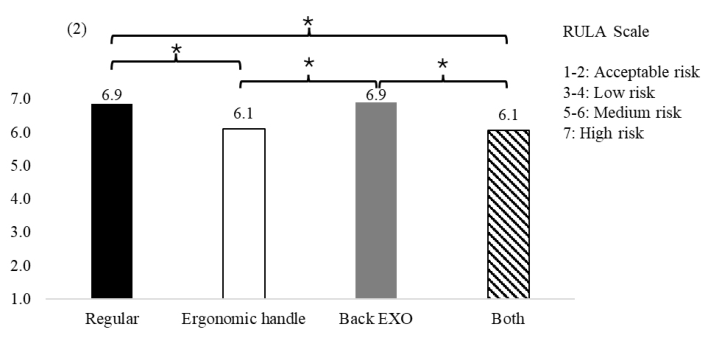
Figure 1 presents the effects of using different ergonomic tools (back EXO, ergonomic handle, and both the back EXO and ergonomic handle) on ergonomic risk levels, evaluated by REBA and RULA during shoveling gravel. It was found that REBA evaluation is consistent with RULA evaluation in this study. First, compared to shoveling by the regular shovel or back EXO, ergonomic risk scores had been significantly reduced by using an ergonomic handle. The effectiveness of using ergonomic handle in reducing physical strain and risk of musculoskeletal disorders has been demonstrated by previous studies (Susan E. Kotowski et al., 2009; Lewinson et al., 2014). Second, it was surprisingly found that using a back EXO could not significantly decrease ergonomic risk score compared to using a regular shovel. Previous studies have devoted the surprising result in this study, by exploring the use of back EXOs during manual material lifting, shoveling, or tasks involving prolonged trunk bending to reduce musculoskeletal discomfort and perceived work intensity (Kim et al., 2021; Thamsuwan et al., 2020). The discrepancy between previous studies and this study could be the specific design of the back EXO used in this study. Different types of exoskeletons, whether soft or rigid, passive or active, may have varying effects
Video-Based Ergonomic Risk Assessment Among Transportation Maintenance Workers 1507
on ergonomic risk reduction based on their design features and how well they align with the biomechanical demands of the task (Mohamed Refai et al., 2024; Schwartz et al., 2021). Finally, the combination use of the back EXO and ergonomic handle significantly reduced ergonomic risk scores compared to using a regular shovel. One possible reason for this result could be that ergonomic handle provides better grip and leverage to reduce risk of upper body (Silva et al., 2013), while the back EXO combined with the handle could offer additional support to maintain proper posture during shoveling gravel.
Figure 1: Ergonomic risk evaluation by (1) REBA and (2) RULA (* p < 0.05).
CONCLUSION
This study evaluated ergonomic risk levels during shoveling among 26 transportation maintenance workers and compared the effects of the back EXO and ergonomic handle on reducing ergonomic risks by video-based REBA and RULA analyses. Results show that (1) most transportation
maintenance workers had medium to high ergonomic risks in terms of whole body and high ergonomic risks of upper bodies during shoveling gravel; (2) using only ergonomic handle and both back EXO and ergonomic handle significantly decreased ergonomic risks, compared to shoveling by a regular shovel; and (3) the back EXO used in this study could not reduce ergonomic risks during shoveling. Research findings demonstrate the effectiveness of the ergonomic handle and its combined use with the back EXO in reducing ergonomic risks during shoveling. Additionally, the findings indicate the future need to address the high ergonomic risks to the upper body among transportation maintenance workers.
ACKNOWLEDGMENT
This work was supported in part by the Joint Transportation Research Program administered by the Indiana Department of Transportation and Purdue University. The contents of this paper reflect the views of the authors, who are responsible for the facts and the accuracy of the data presented herein, and do not necessarily reflect the official views or policies of the sponsoring organizations. These contents do not constitute a standard, specification, or regulation. The authors would like to thank Barry Partridge and Michael Lane for their help and support.
REFERENCES
Arauz, P. G., Chavez, G., Reinoso, V., Ruiz, P., Ortiz, E., Cevallos, C. and Garcia, G.
(2024) Influence of a passive exoskeleton on kinematics, joint moments, and self- reported ratings during a lifting task. Journal of Biomechanics, 162, p. 111886. Arendra, A., Akhmad, S., Mu’alim and Lumintu, I. (2020) Working tool redesign to reduce ergonomic risk of salt evaporation field workers based on RULA and REBA assessments using esMOCA Instrument. Journal of Physics: Conference Series, 1477(2), p. 022034. BLS (2021) National Census of Fatal Occupational Injuries in 2020., Available:
https://www.bls.gov/news.release/pdf/cfoi.pdf. Bonauto, D. K., Lu, D. and Fan, Z. J. (2014) Obesity prevalence by occupation in Washington State, Behavioral Risk Factor Surveillance System. Prev Chronic Dis, 11, p. 130219. CDC (2024) Adult BMI Categories, Available: https://www.cdc.gov/bmi/adult-calc
ulator/bmi-categories.html. Davila, E. P., Florez, H., Fleming, L. E., Lee, D. J., Goodman, E., LeBlanc, W. G., Caban-Martinez, A. J., Arheart, K. L., McCollister, K. E., Christ, S. L., Clark, J. C., III and Clarke, T. (2010) Prevalence of the Metabolic Syndrome Among U. S. Workers. Diabetes Care, 33(11), pp. 2390–2395. Domingo, J. R. T., Pano, M. T. S. D., Ecat, D. A. G., Sanchez, N. A. D. G.
and Custodio, B. P. (2015) Risk Assessment on Filipino Construction Workers. Procedia Manufacturing, 3, pp. 1854–1860. Dong, X. S., Wang, X. and Largay, J. A. (2015) Occupational and non-occupational factors associated with work-related injuries among construction workers in the USA. International Journal of Occupational and Environmental Health, 21(2), pp. 142–150. Guo, X., Chen, Y. and Zhang, J. (2022) Exploration of Ergonomic Injuries and Risky
Activities among Transportation Maintenance Workers. pp. 129–137.
Video-Based Ergonomic Risk Assessment Among Transportation Maintenance Workers 1509
Guo, X., Chen, Y. and Zhang, J. (2023) Applied Ergonomics. West Lafayette, IN: Purdue University. Guo, X., Chen, Y., Zhang, J. and Hubbard, B. (2024) A new framework
for exploration of transportation maintenance-related prevalent work injuries, hazardous activities, and effectiveness of ergonomic solutions in the United States. Theoretical Issues in Ergonomics Science, 0(0), pp. 1–23. Hartvigsen, J., Hancock, M. J., Kongsted, A., Louw, Q., Ferreira, M. L., Genevay, S., Hoy, D., Karppinen, J., Pransky, G., Sieper, J., Smeets, R. J., Underwood, M., Buchbinder, R., Hartvigsen, J., Cherkin, D., Foster, N. E., Maher, C. G., Underwood, M., Tulder, M. v., Anema, J. R., Chou, R., Cohen, S. P., Costa, L. M., Croft, P., Ferreira, M., Ferreira, P. H., Fritz, J. M., Genevay, S., Gross, D. P., Hancock, M. J., Hoy, D., Karppinen, J., Koes, B. W., Kongsted, A., Louw, Q., Öberg, B., Peul, W. C., Pransky, G., Schoene, M., Sieper, J., Smeets, R. J., Turner, J. A. and Woolf, A. (2018) What low back pain is and why we need to pay attention. The Lancet, 391(10137), pp. 2356–2367. Hidaka, T., Hayakawa, T., Kakamu, T., Kumagai, T., Hiruta, Y., Hata, J., Tsuji, M.
and Fukushima, T. (2016) Prevalence of Metabolic Syndrome and Its Components among Japanese Workers by Clustered Business Category. PLOS ONE, 11(4), p. e0153368. Hignett, S. and McAtamney, L. (2000) Rapid Entire Body Assessment (REBA).
Applied Ergonomics, 31(2), pp. 201–205. Huang, C.-t. and Paquet, V. (2002) Kinematic evaluation of two snow-shovel designs.
International Journal of Industrial Ergonomics, 29(6), pp. 319–330. IDOL (2021) Indiana census of fatal occupational injuries. In 2021., Available: https: //www.in.gov/dol/files/CFOI_2020.pdf. Kim, S., Nussbaum, M. A., Smets, M. and Ranganathan, S. (2021) Effects of an arm-
support exoskeleton on perceived work intensity and musculoskeletal discomfort: An 18-month field study in automotive assembly. American Journal of Industrial Medicine, 64(11), pp. 905–914. Koopman, A. S., Toxiri, S., Power, V., Kingma, I., van Dieën, J. H., Ortiz, J.
and de Looze, M. P. (2019) The effect of control strategies for an active back- support exoskeleton on spine loading and kinematics during lifting. Journal of Biomechanics, 91, pp. 14–22. Kotowski, S. E., Davis, K. G., Kim, H. and Lee, K. S. (2014) Identifying risk factors of musculoskeletal disorders on Korean farms. Work, 49(1), pp. 15–23. Kotowski, S. E., Davis, K. G. and Waters, T. R. (2009) Investigation of select
ergonomic interventions for farm youth. Part 1: shovels. Journal of Agromedicine, 14(1), pp. 33–43. Kotowski, S. E., Davis, K. G. and Waters, T. R. (2009) Investigation of Select Ergonomic Interventions for Farm Youth. Part 1: Shovels. Journal of Agromedicine, 14(1), pp. 33–43. Lette, A., Ambelu, A., Getahun, T. and Mekonen, S. (2018) A survey of workrelated injuries among building construction workers in southwestern Ethiopia. International Journal of Industrial Ergonomics, 68, pp. 57–64. Lewinson, R. T., Rouhi, G. and Robertson, D. G. E. (2014) Influence of snow
shovel shaft configuration on lumbosacral biomechanics during a load-lifting task. Applied Ergonomics, 45(2, Part B), pp. 234–238. McAtamney, L. and Nigel Corlett, E. (1993) RULA: a survey method for the investigation of work-related upper limb disorders. Applied Ergonomics, 24(2), pp. 91–99.
Mohamed Refai, M. I., Moya-Esteban, A., van Zijl, L., van der Kooij, H. and Sartori, M. (2024) Benchmarking commercially available soft and rigid passive back exoskeletons for an industrial workplace. Wearable Technol, 5, p. e6. Naug, H. L., Colson, N. J., Kundur, A., Santha Kumar, A., Tucakovic, L., Roberts,
M. and Singh, I. (2016) Occupational health and metabolic risk factors: A pilot intervention for transport workers. 29(4), pp. 573–584. Okunola, A., Akanmu, A. A. and Yusuf, A. O. (2023) Comparison of active and passive back-support exoskeletons for construction work: range of motion, discomfort, usability, exertion and cognitive load assessments. Smart and Sustainable Built Environment, ahead-of-print(ahead-of-print). Oluwole, A. H. (2018) Assessment Into Injuries Related With Sand Shoveling Work. Rybnikár, F., Kaˇcerová, I., Hoˇrejší, P. and Šimon, M. (2023) Ergonomics Evaluation
Using Motion Capture Technology—Literature Review. Applied Sciences, 13(1). Schwartz, M., Theurel, J. and Desbrosses, K. (2021) Effectiveness of Soft versus Rigid Back-Support Exoskeletons during a Lifting Task. International Journal of Environmental Research and Public Health, 18(15). Seo, J., Lee, S. and Seo, J. (2016) Simulation-Based Assessment of Workers’ Muscle
Fatigue and Its Impact on Construction Operations. Journal of Construction Engineering and Management, 142(11), pp. 04016063. Sheehe, P. R. and Irwin, D. J. B. (1961) Latin Squares to Balance Immediate Residual, and Other Order, Effects. Biometrics, 17(3), pp. 405–414. Shiri, R., Karppinen, J., Leino-Arjas, P., Solovieva, S. and Viikari-Juntura, E. (2010)
The association between obesity and low back pain: a meta-analysis. American Journal of Epidemiology, 171(2), pp. 135–154. Silva, L. C. C. B., Oliveira, A. B., Silva, D. C., Paschoarelli, L. C. and Coury, H. J.
C. G. (2013) 30
inclination in handles of plastic boxes can reduce postural and muscular workload during handling. Brazilian Journal of Physical Therapy, 17, pp. 307–318. Sirikasemsuk, K., Kittipanya-Ngam, P., Luanwiset, D. and Leerojanaprapa, K.
(2024) Work posture risk comparison of RULA and REBA based on measures of assessment-score variability: A case study of the metal coating industry in Thailand. International Journal of Innovative Research and Scientific Studies, 7(3), pp. 926–935. Thamsuwan, O., Milosavljevic, S., Srinivasan, D. and Trask, C. (2020) Potential exoskeleton uses for reducing low back muscular activity during farm tasks. American Journal of Industrial Medicine, 63(11), pp. 1017–1028. TuMeke (2024a) REBA: The Rapid Entire Body Assessment - Comprehensive
Overview, Available: https://www.tumeke.io/updates/reba-the-rapid-entire-body -assessment-comprehensive-overview. TuMeke (2024b) RULA: The Rapid Upper Limb Assessment - Comprehensive Overview, Available: https://www.tumeke.io/updates/rula-the-rapid-upper-limb- assessment-comprehensive-overview. Wang, X., Dong, X. S., Choi, S. D. and Dement, J. (2017) Work-related
musculoskeletal disorders among construction workers in the United States from 1992 to 2014. Occupational and Environmental Medicine, 74(5), p. 374.
LISTED IN THE AHFE DIGITAL BOOKSTORE CATALOGUE
Explore the complete digital volume
Human Factors in Design, Engineering, and Computing
Read this individual research paper free through the original publisher, or explore the full digital proceedings book.
ISBN 978-1-964867-35-9
Explore this ISBN in the AHFE Bookstore ↗Listed in the July 2026 bookstore catalogue; search by ISBN to confirm current availability · Digital book purchase optional