Aida Haghighi, Hossein Zolfagharinia, Elaheh Mizbani (2026). Risk Factors Contributing to Slips, Trips, and Falls Among Truck Drivers: Evidence from Canada. In: Safety Management and Human Factors. AHFE Open Access, vol. 227, pp. 18–27. https://doi.org/10.54941/ahfe1007913
1 School of Occupational and Public Health, Faculty of Community Services, Toronto, Metropolitan University, 350 Victoria Street, Toronto, ON, Canada ↗
2 Ted Rogers School of Management, Toronto Metropolitan University, 350 Victoria Street, Toronto, ON, Canada ↗
Slips, trips, and falls (ST&F) represent a major source of occupational injury among truck drivers; however, limited research has systematically examined the full range of contributing factors across work activities. This study investigates patterns and contextual risk factors associated with ST&F incidents among truck drivers in Canada using secondary accident report data obtained from Employment and Social Development Canada (ESDC). A descriptive analysis was conducted on 146 ST&F incident records to examine environmental conditions, work activities, incident contexts, and injury outcomes. The results indicate that ST&F incidents most frequently occurred during routine access and handling activities, particularly walking and stepping up or down. Incidents were more common during winter and spring and under cold or adverse weather conditions, reflecting the influence of surface hazards. Most incidents occurred at customer sites and in ground-level or vehicle-adjacent areas. Slips and trips were identified as the dominant hazardous event mechanism. Lower extremities were the most frequently affected body region, and although most injuries were classified as minor, a substantial proportion resulted in major injuries. The findings highlight the multifactorial nature of ST&F risk among truck drivers and emphasize the interaction between environmental, organizational, and task-related factors. Practical implications include the need for improved winter surface maintenance, safer vehicle access design, enhanced safety coordination at external sites, and targeted training for high-risk activities.
Trucking Industry As one of the largest industrial sectors, the trucking sector is essential to the global economy because it makes it easier for products to move, especially between the United States (U.S.) and Canada. Delivering goods to their destinations at a reasonable cost through road freight transit improves the reliability and flexibility of transportation services (Fortune Business Insights, 2026). The trucking industry is part of the bigger transportation and warehousing sector. In the U.S. trucking made up 80.7% of the
Risk Factors Contributing to Slips, Trips, and Falls Among Truck Drivers 19 transportation sector in 2022 (Elgin, 2025) and in Canada, the economy is completely dependent on an efficient, secure, safe, and sustainable transportation system (Freightera, 2014). The trucking industry is wide and varied, ranging from short-haul truck drivers (SHTDs) who move cargo within cities to long-haul truck drivers (LHTDs) who travel hundreds of miles. They are in charge of moving goods across continents and nations and keeping the integrity of the supply chain (Hayes, 2024). The industry has several global concerns, such as long hours, prolonged sitting, irregular meals, fatigue, traffic accidents, mental health issues, and being apart from loved ones, which have been made worse by the increased demand for land transportation, particularly in developing countries (Hayes, 2024). According to BLS (2025), the transportation and warehousing sector, recorded 930 fatal work injuries in 2023, ranking the sector as the most hazardous in terms of workplace fatalities. The trucking industry also ranks fifth in Canada for lost-time injury claims (AWCBC, 2023). Research indicates that truck drivers experience higher average rates of illness, fatal injuries, and nonfatal injuries compared with workers in other private-sector occupations, underscoring the critical importance of injury, disability, and mortality risks in this sector (Smith, 2015). Within the field of occupational health and safety (OHS) and workplace accident prevention, effective risk management begins with the systematic identification of hazards (Gan, 2019; Lui et al., 2023).
Hazards in the Trucking Industry Truck drivers are exposed to a wide range of occupational hazards, including overexertion, contact with objects, slips, trips and falls (ST&F), and transportation-related incidents, resulting in injuries such as sprains, fractures, traumatic injuries, and fatalities (OSHA, n.d.). Research consistently identifies musculoskeletal disorders (MSDs), transportation accidents, mental health challenges like stress, and ST&F as the primary hazards affecting this workplace (IHSA, 2019; Smith & Williams, 2014). MSDs are the most frequently reported occupational injuries among truck drivers and are associated with prolonged sitting, vibration exposure, repetitive movements, and physically demanding tasks (Bongers et al., 2002; Nunes & McCauley, 2012). Mental health risks are also frequent in trucking. Long working hours, time pressure, isolation, and lack of autonomy contribute to stress, anxiety, and other mental health disorders, which are linked to unsafe driving behaviors and reduced occupational performance (Delhomme & Gheorghiu, 2021; Oliveira & Carlotto, 2020; Shattell et al., 2010). Road traffic accidents constitute a major occupational hazard for truck drivers, particularly given the demands of long-distance transportation (Friswell & Williamson, 2019). Studies show that heavy-duty trucks are frequently involved in severe collisions, leading to substantial human and economic losses (Ma et al., 2022; Wu et al., 2023). Although ST&F have long been recognized as a leading cause of injury, disability, and fatality among truck drivers across many countries (e.g., Lin & Cohen, 1997; Bowen, 2019), they remain a significant occupational health and safety concern within the trucking industry. ST&F commonly result in injuries such as fractures,
sprains, contusions, and abrasions (Lin & Cohen, 1997), and the resulting disabilities can substantially impair an individual’s employment prospects as well as their quality of life both at work and at home (Hsiao, 2014).
Although numerous studies have investigated occupational injuries and fatalities in the trucking sector and identified ST&F as a major cause, ST&F remain one of the most overlooked risks to drivers’ health and safety (Jazrawy, 2019). Therefore, this study focuses specifically on ST&F among truck drivers.
Slips, Trips, and Falls (ST&F) Among Truck Drivers Bowen (2019) reported that over 30% of occupational injuries among truck drivers are caused by ST&F, with half of these incidents classified as serious. In addition, slips and falls have been recognized as a contributing factor in nearly half of all serious injuries within the trucking industry (IHSA, n.d.). Truck driving involves multiple non-driving tasks, including mounting and dismounting the cab, handling freight, and working at heights of up to 1.5 meters. Additionally, handling goods is a common part of truck drivers’ jobs. Several tons of items must be gathered, loaded, unloaded, and delivered in order to enable the trucks to transport them. All of which increase exposure to ST&F hazards (Shibuya et al., 2010).
Research Gap and Study Objective Identifying the factors that contribute to ST&F is crucial for preventing these incidents among truck drivers; however, relatively few studies have focused on the risk factors contributing to ST&F. To date, only one study (Shorti et al., 2014) has examined contributing factors, and it focused solely on falls that occur during mounting and dismounting. To address this gap, the present study aims to identify the full range of potential risk factors contributing to ST&F among truck drivers in Canada across all work-related activities.
METHODOLOGY
This study employs a quantitative research method (Gruchmann et al., 2024) to investigate the factors contributing to ST&F among truck drivers.
This study employed a secondary data analysis approach using ST&F-related accident reports obtained from Employment and Social Development Canada (ESDC). Relevant variables, environmental conditions, driver activities, injury characteristics, and organizational context, were systematically extracted and coded to construct an analytical dataset. This approach allowed the creation of a comprehensive dataset capturing the context, severity, and nature of ST&F incidents among truck drivers in Canada.
As part of a broader project on ST&F, this article focuses on descriptive analysis (Hege et al., 2019) conducted using R software (Dziuda et al., 2021). Descriptive analysis was used to summarize patterns and trends in ST&F incidents, including the frequency, severity, and type of injuries, as well as associated risk factors and work-related activities. This analysis provides
Risk Factors Contributing to Slips, Trips, and Falls Among Truck Drivers 21 a systematic overview of the contributing factors and outcomes of ST&F among truck drivers, supporting the identification of potential prevention strategies in the Canadian trucking industry.
RESULTS
The descriptive analysis was based on 146 ST&F accident reports obtained from ESDC accident reports. Most variables exhibited low levels of missing data, with fewer than 10% missing observations in the majority of cases. The exception was driver type, which had approximately 26% missing values. All descriptive statistics were computed using available-case analysis, and percentages were calculated based on non-missing observations for each variable.
Sample and Occupational Characteristics
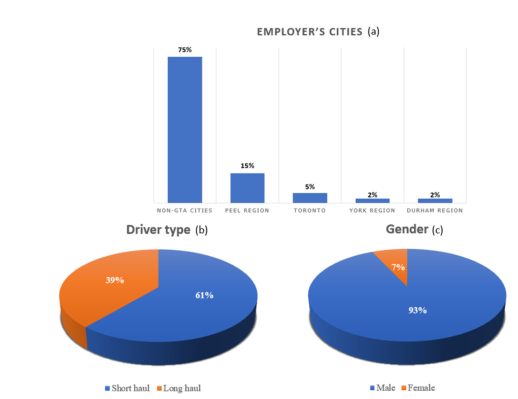
Figure 1 presents the geographic, occupational, and demographic characteristics of truck drivers involved in ST&F incidents. Most incidents were reported among employers located in non-Greater Toronto Area (GTA) regions (75%), followed by Peel Region (15%) and Toronto (5%). York Region and Durham Region each accounted for approximately 2% of reported cases (Figure 1a). This distribution indicates that ST&F incidents are widely dispersed across regional trucking operations and are not concentrated exclusively in major urban centres. With respect to occupational characteristics, SHTDs represented 61% of reported incidents, while LHTDs accounted for 39% (Figure 1b). This suggests that drivers engaged in frequent delivery and handling activities may face increased exposure to ST&F hazards. The sample was predominantly male, with male drivers accounting for 93% of reported cases and female drivers representing 7% (Figure 1c). This reflects the demographic composition of the trucking workforce in Canada.
Figure 1: Sample and occupational characteristics of truck drivers involved in ST&F incidents: (a) employer’s cities, (b) driver type, and (c) gender.
Environmental and Temporal Conditions
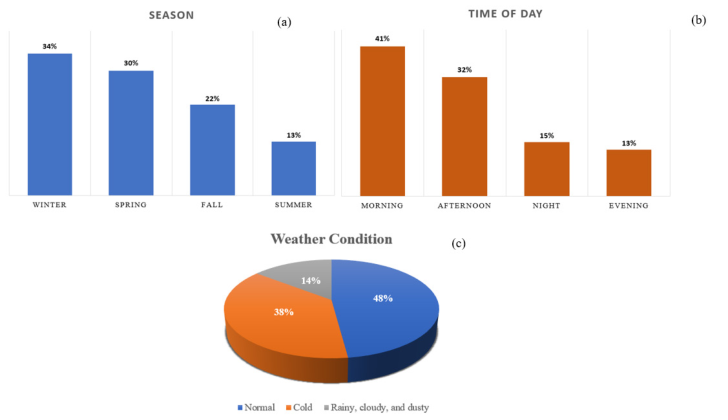
Figure 2 presents the seasonal, temporal, and weather-related conditions associated with ST&F incidents.
Incidents were most frequently reported during winter (34%) and spring (30%), followed by fall (22%) and summer (13%) (Figure 2a). This pattern indicates increased exposure to environmental hazards during colder and transitional seasons. With respect to time of day, most incidents occurred during morning (41%) and afternoon (32%) hours, corresponding to peak work activity periods. Fewer incidents were reported during night time (15%) and evening (13%) hours (Figure 2b). Regarding weather conditions, nearly half of all incidents occurred under normal conditions (48%), while a substantial proportion occurred during cold weather (38%) and adverse conditions such as rain, cloud, or dust (14%) (Figure 2c). These findings highlight the combined influence of climatic and surface conditions on ST&F risk.
Figure 2: Environmental and temporal conditions at the time of ST&F incidents: (a) season, (b) time of day, and (c) weather condition.
Work Activities and Incident Context The frequency and percentage distributions of work activities, incident sites, physical locations, and hazardous events are presented in Table 3.
Walking (36%) and stepping up or down (31%) were the most frequently reported activities at the time of ST&F incidents, followed by loading and unloading tasks (19%). Most incidents occurred at customer sites (62%), followed by employer sites (25%), indicating potential safety challenges in external operational environments. Ground-level areas around trucks accounted for the largest proportion of incidents (42%), followed by truck bodies and trailers (26%), highlighting vehicle access and material handling zones as critical risk locations.
Risk Factors Contributing to Slips, Trips, and Falls Among Truck Drivers 23 Slips and trips constituted the dominant hazardous event mechanism (66%), while falls accounted for 34% of cases, suggesting that loss of footing on contaminated or uneven surfaces remains the primary pathway to injury.
Injury Outcomes Injury characteristics and severity outcomes are summarized in Table 1. Lower extremities were the most frequently affected body region (42%), followed by upper extremities (22%) and trunk injuries (20%), reflecting the biomechanical consequences of slips and falls. Sprains (24%), fractures (14%), and soft-tissue injuries such as abrasions and bruises (15%) were among the most common injury types, while a substantial proportion of cases were classified as unspecified injuries (34%), indicating limitations in administrative reporting.
With respect to injury severity, most reported injuries were classified as minor (84%); however, major injuries accounted for 16% of cases, highlighting the potential for significant health and economic consequences associated with ST&F incidents.
Table 3: Work activities, incident characteristics, and injury outcomes.
Table available in the original PDF paper.
DISCUSSION
This study examined patterns and contextual factors associated with ST&F incidents among truck drivers in Canada using descriptive analysis of accident reports. The findings highlight the combined influence of environmental conditions, work activities, and incident contexts on ST&F risk.
The predominance of incidents during routine activities such as walking and stepping up or down emphasizes the importance of non-driving tasks as a major source of injury risk. Frequent transitions between vehicle surfaces, ground-level areas, and loading platforms may increase exposure to instability and loss of balance, consistent with previous research on access and material handling hazards.
Seasonal and weather-related patterns further underscore the role of environmental conditions in ST&F risk. Higher incident frequencies during winter and spring and under cold or adverse weather conditions align with existing evidence linking icy and slippery surfaces to increased slip and trip risk. Morning and afternoon peaks may reflect periods of intensified workload and time pressure.
The high proportion of incidents occurring at customer sites suggests that safety risks often extend beyond employers’ direct control. Variability in site infrastructure and maintenance practices may contribute to unsafe working environments, highlighting the need for stronger coordination between trucking companies and external facilities. Slips and trips were the dominant hazardous event mechanism, reinforcing the importance of surface conditions and access design in preventing those incidents. The concentration of incidents around ground-level and vehicle-adjacent areas further supports the need for improved housekeeping and vehicle access features. In terms of injury outcomes, lower extremities were most frequently affected, followed by upper extremities and trunk injuries, reflecting the biomechanical dynamics of slips, trips, and subsequent falls. Although most injuries were minor, the presence of major injuries indicates a substantial ongoing health and economic burden.
From a practical perspective, the findings suggest priority areas for intervention, including improved winter maintenance, safer vehicle access design, enhanced safety coordination at customer sites, and targeted training for high- risk activities. This study is subject to limitations related to the use of secondary administrative data, potential underreporting, and the descriptive nature of the analysis. Future research should incorporate larger datasets and multivariate approaches to examine causal pathways and intervention effectiveness. Despite these limitations, this study provides a concise overview of key risk patterns associated with ST&F incidents among Canadian truck drivers and supports the development of targeted, evidence-based prevention strategies.
CONCLUSION
In this work, we presented a descriptive analysis of ST&F incidents among truck drivers in Canada using administrative accident report data. By examining environmental conditions, work activities, incident contexts, and
Risk Factors Contributing to Slips, Trips, and Falls Among Truck Drivers 25 injury outcomes, the study identified key patterns associated with ST&F events in the trucking sector. The findings indicate that incidents are most frequently linked to routine access and handling activities, adverse seasonal and weather conditions, customer-site operations, and ground-level work environments. Slips and trips were the dominant incident mechanism, and lower extremities were the most commonly affected body region. Although most injuries were classified as minor, a substantial proportion resulted in major injuries, highlighting the continuing health and economic burden of ST&F incidents.
These findings underscore the importance of adopting integrated prevention strategies that address environmental hazards, work organization, site-level safety practices, and individual risk behaviors. Improving winter surface maintenance, enhancing vehicle access design, strengthening coordination with customer sites, and providing targeted safety training represent important opportunities for reducing ST&F risk among truck drivers.
ACKNOWLEDGMENT
The authors gratefully acknowledge the financial support of the Social Sciences and Humanities Research Council (SSHRC) of Canada through an Insight Development Grant (Grant No. 430-2023-00546). The authors also thank Employment and Social Development Canada (ESDC) for providing access to the accident reports.
REFERENCES
Association of Workers’ Compensation Boards of Canada (AWCBC). (2023).
National Work Injury / Disease Statistics Program. AWCBC. https://awcbc.org/ data-and-statistics/national-work-injury-disease-statistics-program/ Bongers, P. M., Kremer, A. F. M., & ter Laak, J. (2002). Are psychosocial factors risk factors for symptoms and signs of the shoulder, elbow, or hand/wrist? A review of the epidemiological literature. American Journal of Industrial Medicine, 41(5), 315–342. Bowen, K. (2019). Trips, slips, and falls. Truck News. https://www.trucknews.com/
features/trips-slips-and-falls/ Bureau of Labor Statistics (BLS). (2025, August 28). Heavy and tractor-trailer truck drivers. In Occupational Outlook Handbook. https://www.bls.gov/ooh/ transportation-and-material-moving/heavy-and-tractor-trailer-truck-drivers.htm Delhomme, P., & Gheorghiu, A. (2021). Perceived stress, mental health, organizational
factors, and self-reported risky driving behaviors among truck drivers circulating in France. Journal of Safety Research, 79, 341–351. Dziuda, Ł., Baran, P., Zieliński, P., Murawski, K., Dziwosz, M., Krej, M., Piotrowski, M., Stablewski, R., Wojdas, A., Strus, W., Gasiul, H., Kosobudzki, M., & Bortkiewicz, A. (2021). Evaluation of a fatigue detector using eye closure- associated indicators acquired from truck drivers in a simulator study. Sensors, 21(19), 6449. Elgin, S. (2025, February 19). Trucking industry trends, statistics, & forecast – 2025
Fortune Business Insights. (2026, January 19). Freight trucking market size, share & industry analysis, by truck type, by end user, and regional forecast, 2026–2034. Fortune Business Insights. https://www.fortunebusinessinsights.com/freight- trucking-market-105069 Freightera. (2014, August 29). 6 facts of the Canadian trucking industry. Freightera
Blog. https://www.freightera.com/blog/facts-and-figures-of-the-canadian- trucking-industry/ Friswell, R., & Williamson, A. (2019). Management of heavy truck driver queuing and waiting for loading and unloading at road transport customers’ depots. Safety Science, 120, 194–205. Gan, S. L. (2019). Importance of hazard identification in risk management. Industrial
Health, 57(3), 281–282. Gruchmann, T., Grenzfurtner, W., & Salzmann, A. (2024). From inside the cabin – Truck drivers’ technology acceptance of driving assistance systems. Logistics Research, 17. Hayes, D. (2024, September 13). How many truck drivers in the world. The Truck
How. https://thetruckhow.com/how-many-truck-drivers-in-the-world/ Hege, A., Lemke, M. K., Apostolopoulos, Y., Whitaker, B., & Sönmez, S. (2019). Worklife conflict among U.S. long-haul truck drivers: Influences of work organization, perceived job stress, sleep, and organizational support. International Journal of Environmental Research and Public Health, 16(6), 984. Hsiao, H. (2014). Fall prevention research and practice: A total worker safety
approach. Industrial Health, 52(5), 381–392. Infrastructure Health & Safety Association (IHSA). (n.d.). Slip and fall hazards for truck drivers (Safety Talk). Retrieved January 13, 2023, from https://www.ihsa.ca/ pdfs/safety_talks/slip_and_fall_hazards_for_truck_drivers.pdf Infrastructure Health and Safety Association (IHSA). (2019). Spotting the risks in
trucking (Vol. 19, Issue 1). IHSA.ca Magazine. https://www.ihsa.ca/pdfs/magazine/ volume_19_Issue_1/spotting-the-risks-in-trucking.pdf Jazrawy, J. (2019). Invest in slip fall protection: Safety footwear and fall protection protect truckers from specific hazards. Chilton’s Industrial Safety & Hygiene News, 53(6), 40. Lin, L. J., & Cohen, H. H. (1997). Accidents in the trucking industry. International
Journal of Industrial Ergonomics, 20(4), 287–300. Liu, R., Liu, H. C., Shi, H., & Gu, X. (2023). Occupational health and safety risk assessment: A systematic literature review of models, methods, and applications. Safety Science, 160, 106050. Ma, Y.-F., Yu, L.-H., Chen, S.-Y., Zhang, C.-X., Zhang, Z.-Y., & Zhou, M.-X. (2022).
Analysis of driving-stability factors for heavy-duty truck drivers under naturalistic driving conditions. Zhongguo Gonglu Xuebao/China Journal of Highway and Transport, 35(1), 169–179. Nunes, I., & McCauley, P. (2012). Work-related musculoskeletal disorders assessment and prevention. In I. L. Nunes (Ed.), Ergonomics – A systems approach. InTech. Occupational Safety and Health Administration (OSHA). (n.d.). Trucking industry:
Safety and health information. U.S. Department of Labor. Retrieved February 12, 2025, from https://www.osha.gov/trucking-industry/safety-information Oliveira, M. E. T. de, & Carlotto, M. S. (2020). Factors associated with common mental disorders in truck drivers. Psicologia: Teoria e Pesquisa, 36, e3653. Shattell, M., Apostolopoulos, Y., Sönmez, S., & Griffin, M. (2010). Occupational
stressors and the mental health of truckers. Issues in Mental Health Nursing, 31(9), 561–568.
Risk Factors Contributing to Slips, Trips, and Falls Among Truck Drivers 27 Shibuya, H., Cleal, B., & Kines, P. (2010). Hazard scenarios of truck drivers’
occupational accidents on and around trucks during loading and unloading. Accident Analysis & Prevention, 42(1), 19–29. Shorti, R. M., Merryweather, A. S., Thiese, M. S., Kapellusch, J., Garg, A., & Hegmann, K. T. (2014). Fall risk factors for commercial truck drivers. Journal of Ergonomics S, 3, 1–9. Smith, C. K., & Williams, J. (2014). Work related injuries in Washington State’s
Trucking Industry, by industry sector and occupation. Accident Analysis & Prevention, 65, 63–71. Smith, S. M. (2015). Workplace hazards of truck drivers. Monthly Lab. Rev., 138, 1. Wu, J., Rasouli, S., Zhao, J., Qian, Y., & Cheng, L. (2023). Large truck fatal crash severity segmentation and analysis incorporating all parties involved: A Bayesian network approach. Travel Behaviour and Society, 30, 135–147.
LISTED IN THE AHFE DIGITAL BOOKSTORE CATALOGUE
Explore the complete digital volume
Safety Management and Human Factors
Read this individual research paper free through the original publisher, or explore the full digital proceedings book.
ISBN 979-8-950676-03-1
Explore this ISBN in the AHFE Bookstore ↗Listed in the July 2026 bookstore catalogue; search by ISBN to confirm current availability · Digital book purchase optional