Wassim Kaci, Amit Sharma (2026). Human machine interaction failure modes in maritime grounding accidents: A decision-oriented data driven analysis. In: Advances in Human Factors of Transportation. AHFE Open Access, vol. 224, pp. 591–599. https://doi.org/10.54941/ahfe1007887
Grounding accidents in the maritime industry remain a critical safety concern despite advances in ship bridge automation. This study addresses the lack of structured, data-driven representations in maritime accident analysis by applying a dual geometric approach to a database of 30 grounding accident cases. Using Principal Component Analysis (PCA) as a dimensionality filter, the study demonstrates that grounding accidents cannot always be deemed random events but can be governed by a strong, low-dimensional structure. Subsequent Multiple Correspondence Analysis (MCA) identify two primary failure mechanisms as observed: a navigation phase characterized by a collapse in supervisory monitoring which is called “Passive Navigation” and a navigation phase driven by communication breakdowns and decision latency called an “Overloaded Navigation”. Hierarchical clustering reveals that while most situations reflect baseline variability, high-risk accidents emerge from extreme configurations of fatigue, authority gradients, and automation dependence. The findings are contextualized by referring to the classic Swiss Cheese Model (SCM) of human error and they provide a methodological foundation for the development of Decision Support Systems (DSS) and Bridge Resource Management (BRM) strategies aimed at detecting early warning signs of systemic degradation during maritime navigation.
Over the past two decades, maritime navigation has become highly automated, with systems like Electronic Chart Display and Information System (ECDIS), Automatic Radar Plotting Aids (ARPA), and advanced autopilots designed to improve safety and reduce the potential of human error on ship’s bridge. However, grounding accidents continue to occur in shipping, even with experienced crews and fully functional technology on board (Baric et al., 2023; Mazaheri et al., 2016). This highlights a paradox in modern shipping: automation has not substituted the human element but has instead reshaped human–machine interactions on board (Relling et al., 2018).
Traditional accident investigations often blame individual “human error” for the incidents, overlooking the broader systemic and organizational factors involved (Chauvin, 2011; Chauvin et al., 2013). Modern ship bridges Received March 5, 2026; Revised April 8, 2026; Accepted April 24, 2026; Available online July 20, 2026
592 Kaci and Sharma function as complex socio-technical systems, where failures typically arise from latent weaknesses in decision-making, communication, supervision, and reliance on automation (Da Conceicao et al., 2017). When these weaknesses align, they create pathways toward navigational accidents.
This research attempts to further the understanding causal pathways of maritime grounding accidents by identifying recurring configurations of human and operational factors. Using statistical methods such as Principal Component Analysis (PCA) and Multiple Correspondence Analysis (MCA), the study analysed coded accident report data to uncover patterns and clusters of interrelated failure modes. The goal is to move beyond isolated errors and provide a systemic understanding of how human-machine failures develop, ultimately informing better training, operational practices, and system design to improve maritime safety.
METHOD
Data Collection The empirical foundation of this research is built on a systematic analysis of official maritime accident investigation reports, primarily sourced from the Marine Accident Investigation Branch repository (MAIB, 2025). A curated sample of 30 grounding incidents was selected, all occurring from 2012 onwards. This temporal cutoff corresponds to the phased mandatory carriage of ECDIS under the SOLAS convention, ensuring that the research study reflects the modern operational realities of highly automated bridge environments (IMO, 2009). From these reports, 569 discrete decision points were extracted. A decision point is defined as a moment in the accident sequence where an action was taken (or omitted) that directly influenced the vessel’s safety margin. This approach allows qualitative narrative descriptions to be systematically translated into a structured, quantitative dataset suitable for multi-factorial analysis.
Variable Coding and Operationalization Each decision point was coded using a binary (0/1) system across four thematic categories, guided by the “Swiss Cheese” model of system accidents (Reason, 1990). The categories were described as:
Communication: Capturing the presence, absence, or miscommunication of critical information.
Decision-Making: Classifying actions as routine, corrective, emergency, delayed, or omitted.
Information Usage: Assessing interaction with sensors and alarms, including proper use, non-use, over-reliance, or ignoring warnings.
Human Factors: Identifying latent conditions and active failures, such as fatigue, single-person watchkeeping, task overload, authority gradients, and lack of cross-checking.
This operationalization allows geometric statistical methods to identify structural weaknesses, or “holes,” in the system’s defensive layers for maritime navigation.
Human Machine Interaction Failure Modes in Maritime Grounding Accidents 593 Statistical Framework: Principal Component Analysis and Multiple Correspondence Analysis
Principal Component Analysis (PCA) was used as the primary exploratory tool for dimensionality reduction (Greenacre et al., 2022). With a high number of interrelated variables, PCA transforms correlated variables into a set of linearly uncorrelated principal components, revealing which factors tend to cluster together. This approach helps identify the fundamental dimensions of system collapse and determine whether grounding accidents follow a structured latent logic or represent a collection of stochastic errors.
To complement PCA, Multiple Correspondence Analysis (MCA) was employed to analyse the categorical variables’ structural relationships. MCA provides a geometric representation of the co-occurrence of different failure categories, projecting them onto a low-dimensional map (Greenacre & Blasius, 2006). This mapping enables the identification of recurring patterns of human-machine interaction breakdowns, effectively visualizing the “failure space” of automated bridge operations.
RESULTS
Exploratory PCA Results The first stage of the analysis involved a Principal Component Analysis (PCA) to reduce the dimensionality of the 569 decision points. This exploratory phase was designed to identify the primary axes of variance and the underlying structure of decision-related variables.
Numerical Significance and Eigenvalues The statistical significance of the dimensions is first assessed through the eigenvalues, which represent the amount of variance captured by each principal axis.
Table 1: PCA Eigenvalues and cumulative variance.
Table available in the original PDF paper.
Dimension Eigenvalue Variance% Cumulative % Dim 1 4.4005 40.0049 40.0049
Dim 2 2.5122 22.8380 62.8428 Dim 3 1.3931 12.6646 75.5075
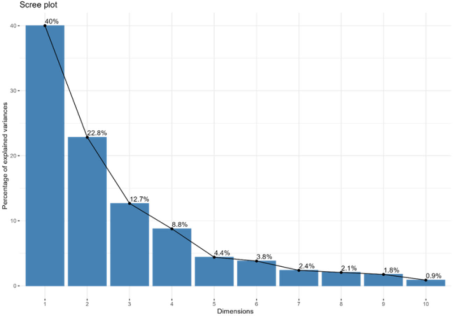
Dim 4 0.9632 8.7564 84.2638 This table details the eigenvalues for each component alongside the percentage of total variance they explain. The cumulative percentage column tracks the total amount of information retained as additional dimensions are included. High eigenvalues in the initial components indicate a strong underlying structure in the data, suggesting that a small number of dimensions can represent the majority of failure factors.
Visual Distribution of Variance To visually confirm the optimal number of dimensions to retain, the eigenvalues are plotted in a scree plot.
Figure 1: PCA scree plot.
The scree plot displays the eigenvalues in descending order. The primary focus is on the “elbow” of the curve, i.e. the point where the magnitude of the eigenvalues drops significantly and begins to level off. In this analysis, the sharpest decline occurs after the first two dimensions, indicating that these two axes contain the most significant structural information regarding accident sequences.
Variable Loadings and Axis Definition The relationship between the coded binary variables and the principal axes is visualized through a correlation circle, focusing specifically on the top contributing factors for each dimension.
Figure 2 : PCA correlation circle - top contributors.
This plot represents the projection of the variables that contribute most significantly to the definition of the failure space. The focus is on the vectors that extend furthest toward the edge of the circle, as these represent the
Human Machine Interaction Failure Modes in Maritime Grounding Accidents 595 variables with the highest quality of representation. The orientation of these top contributors relative to Dimension 1 and Dimension 2 defines the mathematical coordinates of the systems failure axes.
MCA Results Following the PCA, Multiple Correspondence Analysis (MCA) was applied to map the structural stability of the categorical levels.
Figure 3 : MCA eigenvalues table.
This plot highlights the distribution of inertia. The focus is on the relative prominence of the bars for Dimension 1 and Dimension 2, which confirms that the structural co-occurrence of failure factors is concentrated along these two primary paths.
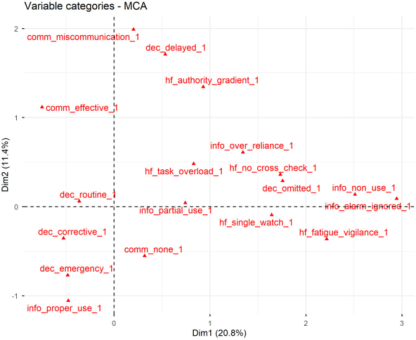
Mapping of Category Levels The geometric distances between the presence of specific failure factors are projected onto the MCA factor map.
Figure 4: MCA Factor map of categories.
596 Kaci and Sharma This map projects the active categories into a two-dimensional space. The focus is on the distance between points; categories that are clustered together have a high statistical affinity, appearing together frequently in the decision sequences. Points farthest from the origin are the most influential in defining the characteristics of the failure space.
DISCUSSION
Dimensional Convergence: Linking PCA and MCA Failure Modes The dual geometric approach employed in this study reveals strong structural consistency between the results of Principal Component Analysis (PCA) and Multiple Correspondence Analysis (MCA). This convergence indicates that the identified failure modes are not artifacts of a specific statistical method but rather represent robust latent pathways to grounding.
In both analyses, the first two dimensions capture the majority of meaningful variance within the dataset, effectively compressing the “failure space” into two dominant configurations: Passive Navigation and Overloaded Navigation. The alignment of these dimensions across independent statistical treatments strengthens the validity of the findings and suggests the presence of stable structural patterns in modern grounding accidents.
Dimension 1: Passive Navigation and Supervisory Collapse The first dimension, identified consistently in both PCA and MCA, reflects a failure mode characterized by a decay in active supervision and monitoring. In the PCA, this axis is dominated by variables associated with missing or omitted actions. The MCA confirms a strong categorical clustering between:
Single person watchkeeping
Omission of critical decisions
Non-use of available navigational information
Over-reliance on automated systems Together, these factors describe a transition from active navigation to passive monitoring. The operator remains physically present but functionally disengaged from dynamic decision-making. This configuration aligns with the Human-Out-of-the-Loop (HOOTL) phenomenon described by Endsley (1995), where sustained automation reliability reduces vigilance and situational awareness. Prolonged exposure to stable automated performance can foster automation complacency, a concept further developed by Parasuraman et al. (2000). In such states, deviations from safe conditions may go undetected because the operator no longer actively interrogates the system’s outputs.
The statistical linkage between single-watchkeeping and omitted decisions highlights the removal of a critical defensive layer: independent cross- checking. This directly reflects the systemic vulnerability described in the Swiss Cheese model proposed by Reason (1990), where latent weaknesses align and remain undetected until a triggering event produces failure. In this
Human Machine Interaction Failure Modes in Maritime Grounding Accidents 597 pathway, grounding emerges not from overt error, but from the silent erosion of supervisory vigilance in routine, low-stress environments.
Dimension 2: Overloaded Navigation and Coordination Friction The second dimension represents a structurally distinct pathway characterized by operational friction and temporal decay. Unlike Dimension 1, which centers on missing actions, Dimension 2 is defined primarily by delayed actions.
Both PCA and MCA identify a consistent cluster comprising:
Task overload
Delayed corrective decisions
Miscommunication or ineffective communication
Authority gradient effects This configuration reflects the breakdown of Bridge Resource Management (BRM) under high-demand conditions. As task complexity increases due to traffic density, weather, or technical anomalies, the cognitive capacity of the bridge team becomes saturated. According to the workload and attention framework proposed by Wickens (2008), excessive demand leads to decision latency and degraded performance.
The presence of authority gradients further destabilizes coordination. Hierarchical barriers may prevent junior officers from challenging decisions or escalating detected hazards, delaying corrective maneuvers. A study undertaken by Porathe (2020) highlights how such gradients impede timely intervention in modern bridge environments.
In contrast to Passive Navigation, this pathway describes a bridge team that is active but poorly synchronized. Communication degrades, corrective actions are postponed, and the narrowing safety margin is not matched by equally rapid coordination. The system does not fail through inattention, but through misaligned collective action.
Structural Stability of Navigational Failure The convergence of these two dimensions across PCA and MCA provides empirical support for the systemic accident logic underlying the Swiss Cheese framework. PCA filters noise within the 569 coded decision points to reveal the dominant axes of variance, while MCA confirms the categorical co-occurrence of the associated failure factors.
The stability of these dimensions suggests that post-2012 groundings are governed by two dominant failure scripts. The first reflects vigilance decay in routine environments; the second reflects coordination breakdown under stress. Together, they define the primary structural patterns through which modern automated bridge environment degrades before grounding accident occurs.
This dual structure provides a practical framework for recognizing early warning signs of systemic failure, moving beyond isolated human error toward identifiable patterns of human-machine interaction collapse.
The identification of these two dominant latent mechanisms offers direct implications for safety enhancement and system design.
For Bridge Resource Management (BRM), the findings indicate that grounding risk is closely linked to degradation in active monitoring and team coordination. Training programs should therefore reinforce mandatory cross-checking behaviors, including independent verification of ECDIS data through radar overlays and visual bearings, to counteract out-of-the-loop effects. Additionally, structured challenge protocols should be formalized to mitigate authority gradients and encourage timely intervention by junior officers.
For Decision Support Systems (DSS), the low-dimensional structure revealed in this study suggests that effective support does not require monitoring every possible variable. Instead, intelligent systems should focus on detecting the specific latent configurations associated with each failure mode.
In Passive Navigation scenarios, a DSS could identify high automation reliance combined with reduced operator interaction, such as prolonged automated track control without active chart interrogation and trigger high- priority engagement prompts.
In Overloaded Navigation scenarios, workload-aware systems could detect indicators of decision latency or communication breakdown and provide prioritization cues to guide the bridge team’s attention during high-stress maneuvers.
By targeting these two dominant failure pathways, future bridge systems can move beyond reactive alarms toward anticipatory safety mechanisms capable of identifying systemic degradation before it culminates in grounding.
CONCLUSION
The transition toward highly automated bridge environments has not eliminated maritime risk but has instead restructured it into predictable, latent failure configurations. This research, through a dual geometric analysis of 30 MAIB grounding reports since the 2012 ECDIS mandate, has successfully mapped the “failure space” of modern navigation.
The application of PCA and MCA as a dimensionality filter has proven that grounding accidents are not stochastic events but are governed by a limited number of dominant mechanisms. The identification of Passive Navigation (supervisory decay) and Overloaded Navigation (coordination friction) provides a data-driven framework that moves accident analysis beyond descriptive narratives toward systemic predictability.
The significant low-dimensional structure identified suggests that future Decision Support Systems (DSS) do not need to monitor thousands of variables. Instead, they should be designed to detect the specific categorical co-occurrences identified in this study, such as the alignment of single person watchkeeping with a lack of active chart interaction. By recognizing these “high-risk clusters” in real-time, technology can serve as a proactive barrier rather than a passive recorder. Ultimately, the technical and procedural solutions proposed, whether advanced DSS or refined BRM, will remain
Human Machine Interaction Failure Modes in Maritime Grounding Accidents 599 ineffective if they are not supported by a reconstruction of maritime safety culture.
Redefining Seamanship: Modern seamanship must be redefined as the human operator’s ability to maintain a “practical and moral framework” for supervising AI, ensuring automation remains a tool and not an opaque “black box”.
Calibrating Trust: The industry must move toward a real-time “calibration of trust,” where seafarers are trained to recognize and resist the complacency found in Dimension 1 and the coordination paralysis of Dimension 2.
As the maritime sector moves toward further autonomy, the failure modes identified in this work attempt to provide the essential baseline for ensuring that the human remains a resilient and active component within the safety loop.
REFERENCES
Barić, M., Grbić, L., Peričin, L., & Jelić, R. (2023). The role of the ECDIS on the development of situational awareness: A study on grounding accidents. TransNav: International Journal on Marine Navigation and Safety of Sea Transportation, 17(1), 219–225. Chauvin, C. (2011). Human factors and maritime safety. The Journal of Navigation,
64(4), 625–632. Chauvin, C., Lardjane, S., Morel, G., Clostermann, J. P., & Langard, B. (2013).
Human and organisational factors in maritime accidents: Analysis of collisions at sea using the HFACS. Accident Analysis & Prevention, 59, 26–37. Da Conceição, V. P., Dahlman, J., & Navarro, A. (2017). What is maritime navigation? Unfolding the complexity of a sociotechnical system. In Proceedings of the Human Factors and Ergonomics Society Annual Meeting (Vol. 61, No. 1, pp. 267–271). SAGE Publications. Endsley, M. R. (1995). Toward a theory of situation awareness in dynamic systems.
Human Factors, 37(1), 32–64. Greenacre, M., & Blasius, J. (2006). Multiple correspondence analysis and related methods. Chapman & Hall/CRC. Greenacre, M., Groenen, P. J., Hastie, T., d’Enza, A. I., Markos, A., & Tuzhilina, E.
(2022). Principal component analysis. Nature Reviews Methods Primers, 2(1), 100. International Maritime Organization (2009). Resolution MSC.282(86): Adoption of amendments to the International Convention for the Safety of Life at Sea (SOLAS), 1974, as amended. Marine Accident Investigation Branch (2025). Marine accident investigation reports.
GOV.UK. https://www.gov.uk/maib-reports Mazaheri, A., Montewka, J., & Kujala, P. (2016). Towards an evidence-based probabilistic risk model for ship-grounding accidents. Safety Science, 86, 195–210. Parasuraman, R., Sheridan, T. B., & Wickens, C. D. (2000). A model for types and
levels of human interaction with automation. IEEE Transactions on Systems, Man, and Cybernetics, 30(3), 286–297. Porathe, T. (2020). Human-in-the-loop: Some human factors aspects of maritime autonomous surface ships. Journal of Marine Engineering & Technology. Reason, J. (1997). Managing the risks of organizational accidents. Ashgate. Relling, T., Lützhöft, M., Østnes, R., & Hildre, H. P. (2018). A human perspective
on maritime autonomy. In International Conference on Augmented Cognition (pp. 350–362). Springer. Wickens, C. D. (2008). Multiple resources and mental workload. Human Factors, 50(3), 449–455.
LISTED IN THE AHFE DIGITAL BOOKSTORE CATALOGUE
Explore the complete digital volume
Advances in Human Factors of Transportation
Read this individual research paper free through the original publisher, or explore the full digital proceedings book.
ISBN 979-8-950676-00-0
Explore this ISBN in the AHFE Bookstore ↗Listed in the July 2026 bookstore catalogue; search by ISBN to confirm current availability · Digital book purchase optional