Josue Franca, Erik Hollnagel (2025). Reanalyzing the BP Texas City Refinery Accident with FRAM (Functional Resonance Analysis Method) - 20 years of complexity and learning. In: Human Error, Reliability, Resilience, and Performance. AHFE Open Access, vol. 173, pp. 34–43. https://doi.org/10.54941/ahfe1006279
This study reanalyzes the BP Texas City refinery accident of March 2005 using the FRAM (Functional Resonance Analysis Method) methodology, based on technical-scientific materials such as reports, articles, and documents from the institutions involved, regulatory agencies and interviews with former employees. The goal is to uncover the human factors and its complex interactions overlooked by traditional risk assessment techniques, which are suited for linear systems, but limited for complex high-risk workplaces, such as an oil refinery. The FRAM methodology was chosen for its ability to address the interactions in a complex sociotechnical system, enhancing a human factors approach. This reanalysis revealed the significant influence of organizational elements, as a fragmented culture and the workforce reduction, influencing the decision-making through hierarchical structures. Even two decades later, the study could highlight that there is still much to learn from this event, especially as FRAM enables a deeper understanding of the complexities inherent in high-risk work environments that compose most of the workplaces of the O&G industry, from the new plants to their decommissioning. The findings underscore the limitations of linear methodologies in analyzing complex sociotechnical systems, as well as provided a broader understanding of the event, emphasizing the importance of advanced approaches to address the variability and interconnectedness of tight coupled high-risk process plants.
Accidents in high-risk workplaces, particularly in the oil and gas industry, feature tightly coupled processes and complex infrastructures that increase systemic vulnerabilities. Despite regulatory advancements and significant investments, catastrophic failures continue to occur, often driven by complex organizational and operational dynamics that exceed the explanatory power of traditional linear accident models. The 2005 BP Texas City Refinery explosion stands as a paradigmatic case, not only due to its multidimensional impact, but also because of the multifactorial nature of its
Reanalysing the BP Texas City Refinery Accident With the FRAM 35
causes, ranging from technical deficiencies to organizational misalignments following corporate mergers. In this scenario, it is increasingly evident that non-linear interactions, emergent variability, and latent organizational conditions play a decisive role in the genesis of such accidents. In this sense, this reanalysis aims to enhance the learning of this accident, even after 20 years of occurrence, applying an appropriate non-linear methodology to expand the understanding of the complex interactions that formed its chain of events.
THE BP TEXAS CITY ACCIDENT (2005) On March 23, 2005, a massive explosion and fire occurred at the BP Texas City Refinery during the startup of the isomerization (ISOM) unit, resulting in 15 fatalities and 180 injuries (CSB, 2007). The chain of events that culminated in the accident was triggered by the overfilling of the raffinate splitter tower, a distillation unit used to separate light and heavy hydrocarbon components. Due to the complex combination of several equally complex factors, liquid hydrocarbons (naphtha graded) were accumulated in the tower, eventually overflowing into the overhead system (MacKenzie et al., 2007). Once the hydrocarbons filled up in the raffinate splitter tower, formed a sufficient hydrostatic pressure in the overhead piping, and added to the existing pressure of the tower. Consequently, the pressure at the bottom increased rapidly from 21psi to 64psi. For this reason, three pressure relief valves were opened and flammable hydrocarbons discharged to blow-down through a header collection tube to blowdown drum (that was not attached to the flare) and stack attached to it. It is worth to know that the blowdown was not connected to the flare. Blow-down drum was fully filled and the excess hydrocarbons released to the ground through a stack connected to the top of the blow-down (Abbasi et al., 2020).
The released hydrocarbons formed a dense vapor cloud, and once it has heavier density than the air, it has quickly move towards to the ground level of the refinery. The flammable vapor cloud quickly spread throughout the refinery’s work areas, finding an ignition source – likely the backfire of an idling diesel truck parked nearby – triggering a massive explosion and an extensive fire that lasted for hours and destroyed the isomerization (ISOM) unit (CSB, 2007). The explosion’s impact was exacerbated by the presence of temporary office trailers located near the blowdown drum, where all 15 fatalities occurred (MacKenzie et al., 2007). The force of the blast was powerful enough to damage structures up to three-quarters of a mile from the refinery, shattering windows and prompting a shelter-in- place order for approximately 43,000 residents of Texas City. Beyond the immediate explosion, secondary fires ignited due to the extensive spread of hydrocarbons, further complicating emergency response efforts (CSB, 2007). The BP Texas City accident was considered at the time the biggest national disaster in the U.S. and still remains today as one of the most devastating labour accidents in U.S. history, highlighting the severe consequences of such explosion and fire in industrial processing plants.
36 França and Hollnagel
THE FRAM (FUNCTIONAL RESONANCE ANALYSIS METHOD) The Functional Resonance Analysis Method (FRAM) is a methodology that allows a systemic approach to model and analyse the performance variability of the interactions in complex sociotechnical systems. The aim behind its development is the linear limitations of deterministic and probabilistic methodologies to assess and to understand complex systems’ functioning (Patriarca et al., 2020). Because of that, unlike these traditional analysis methods that rely on linear cause-effect relationships, FRAM is rooted in resilience engineering principles and recognizes that system outcomes emerge from the dynamic interactions between various functions (Hollnagel, 2012). The method was initially applied to accidents analysis, however evolving into a widely used analytical framework in multiple industries, including aviation, healthcare, and oil and gas (França et al., 2019). FRAM represents work processes as a network of interdependent functions, each characterized by six aspects: input, output, time, control, precondition, and resource. The graphical representation of the FRAM function is a hexagon, where each of these aspects (input, output, time, control, precondition, and resource) is one of the corners of the hexagon.
By understanding how normal performance variability can resonate and combine, FRAM enables the identification of the causes of an accident that are deeply rooted in the system, promoting the failure prevention as well as the system adaptability and robustness (Patriarca et al., 2020). Once FRAM is designed assuming that the complexity is the reality of the current sociotechnical system functional, it has the ability to analyse both retrospective and prospective scenarios, making it suitable for accident investigations as well as proactive risk assessments. Retrospective applications of FRAM have been used to uncover systemic vulnerabilities in events such as a mid-air collision, revealing gaps in air traffic management resilience (de Carvalho, 2011). In prospective analyses, FRAM has supported the design of safer maritime operations by mapping the interactions between ship and shore services, highlighting areas for intervention to enhance operational efficiency and safety (Praetorius et al., 2015). Therefore, FRAM unveils as an appropriate methodology to reanalyse the complex accident at BP Texas City, learning from the failures that occurred to strengthen safety in refineries.
THE REANALYSIS OF BP TEXAS CITY ACCIDENT WITH FRAM Accident analysis and investigation methodologies serve as essential tools for understanding incidents, identifying systemic vulnerabilities, and implementing preventive measures to avoid recurrence. Their core value lies in enabling a structured interpretation of complex events, facilitating the documentation and dissemination of findings, and fostering organizational learning (Leveson, 2004). In high-risk complex workplaces, such as the refinery of this research, this learning process becomes indispensable. It not only ensures the integrity and operability of process plants but also safeguards lives and the environment, while maintaining business continuity (França et al., 2023). With this perspective and using the FRAM
Reanalysing the BP Texas City Refinery Accident With the FRAM 37
methodology, the BP Texas City accident was comprehensively revisited. The objective was to explore how dynamic organizational factors, as fragmented culture, hierarchical structures, and merging of companies, have substantially contributed to the sequence of events culminating in the disaster. The outcomes of this reanalysis, modelled through FRAM, are showed in Figure 1.
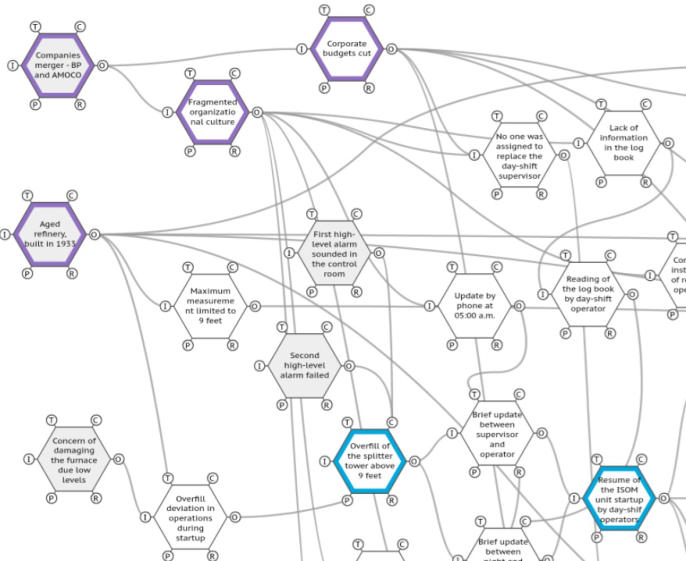
The functions in blue, “Overfill of the splitter tower above 9 feet” and “Overfill of the blow down drum”, represent the beginning of the analysis, from the moment the tower level began to no longer have control and the loss of containment of this process accident starts. In turn, the functions in purple, “Companies merger - BP and AMOCO”, directly connected to “Fragmented organizational culture”and “Corporate budgets cut”, as well as “Aged refinery, built in 1933”, are the organizational factors that contributed most to the accident, and date back to the merging of the companies BP and AMOCO, as well as the construction of the refinery itself, in 1933. These functions are showed in Figure 2.
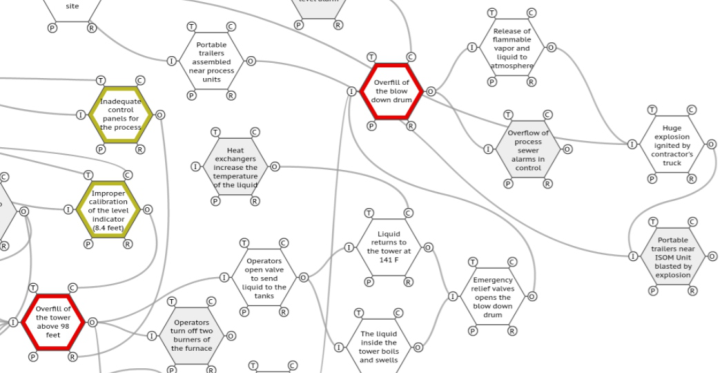
The functions in red, “Overfill of the tower above 98 feet” and “Overfill of the blow down drum”, represent the most critical occurrences of this accident, straight connected with the explosion. And, in particular, the functions in yellow, “Inadequate control panels for the process” and “Improper calibration of the level indicator (8.4 feet)”, are directly influenced by two of these organizational factors, “Aged refinery, built in 1933” and “Corporate budgets cut”, demonstrating how the resonance of these factors, within a complex sociotechnical system, had consubstantial relevance in the occurrence of this event. These functions are showed in Figure 3.
The organizational factors that contributed significantly to the BP Texas City Refinery accident, represented here in purple, demonstrate how these factors affect the entire system, determining preconditions that reverberate throughout the company, influencing strategic decisions, such as cost reduction (function “Corporate budgets cut”). In addition, these factors also influence on actions and contexts that are directly linked to the latest events of the accident, demonstrating that they have a perpetual and dynamic functioning within the systems. The appropriate management of mergers and acquisitions, especially in high-risk companies, directly impact in the post-merger performance. It is necessary to have careful attention in the integration strategies, respecting the core values of the cultures, while implementing the necessary changes for business (Radloff, 2023). The organizational impact in merging companies, especially in different cultures, as Amoco (North Americans) and BP (British), can hinder integration, reduce synergy realization, and affect safety in operations (Brede et al., 2024). In fact, the acquisition of Amoco by BP, in 1998, it is perceiving these dynamics, where the fragmentation of both cultures generated a loss of identity that impacted individual values and corporate decisions, misaligning the initial strategies of the merger with what in fact consolidated the fragmented culture of BP-Amoco, and later, only BP, in 2001 (Mahadewi, 2018). And this fragmented culture, complexly combined with other organizational factors, culminated in the Texas City refinery explosion, underlining the importance of balancing business strategic with cultural characteristics in
38 França and Hollnagel
Figure 1. The FRAM modelling of the BP Texas City accident.
Figure available in the original PDF paper.
Reanalysing the BP Texas City Refinery Accident With the FRAM 39
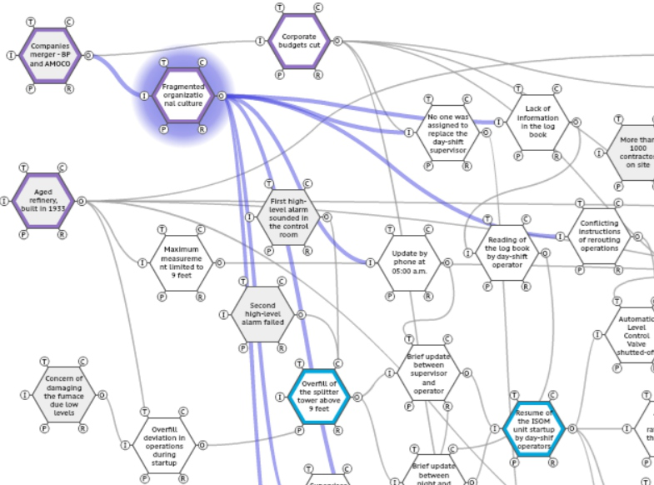
large-scale corporate integrations. In this FRAM analysis, the fragmented culture influences several causes of this accident, represented by the functions “Lack of information in the log book”, “No one was assigned to replace the day-shift supervisor”, “Conflicting instructions of rerouting operations”, “Update by phone at 05:00 a.m.”, “Day-shift supervisor arrives late at 07:15 h”, “Supervisor leaves the night-shift one hour earlier” and “Day- shift supervisor leaves the refinery earlier”. The function “Fragmented organizational culture” has a severe impact in seven causes of this accident. It is, undoubtedly, a relevant organizational factor that must be properly addressed in complex high-risk workplaces, such a refinery or an offshore oil platform. In Figure 4 is possible to see how the fragmented culture, born from the companies merging, influences the entire system, and directly other seven functions.
Figure 2: The FRAM’s functions responsible for the beginning of the loss of containment (in blue) and the most relevant organizational factors (in purple).
Another organizational factor that had a vital contribution to this accident was the budget reduction imposed by BP’s senior management, represented by function “Corporate budgets cut”, and which influenced other causes of this event, such as “Several units in maintenance at the same time”, “2nd control board operator position eliminated”, “Inadequate control panels for the process” and “Improper calibration of the level indicator (8.4 feet)”. It is important to notice, once more, that these two last causes were simultaneously impacted by two organizational factors: “Corporate budgets
40 França and Hollnagel
cut” and “Aged refinery, built in 1933”, which increased the complexity, and consequences, of this accident.
Figure 3: The FRAM’s functions that are the critical overfill before explosion (in red) and the functions that simultaneously receives influences from organizational factors (in yellow).Figure 4: The FRAM function “Fragmented organizational culture” and its influences in the entire system.
It is possible to perceive from this study that the occurrence of an accident, like the BP Texas City refinery, it is not a simple or linear event. It is
Reanalysing the BP Texas City Refinery Accident With the FRAM 41
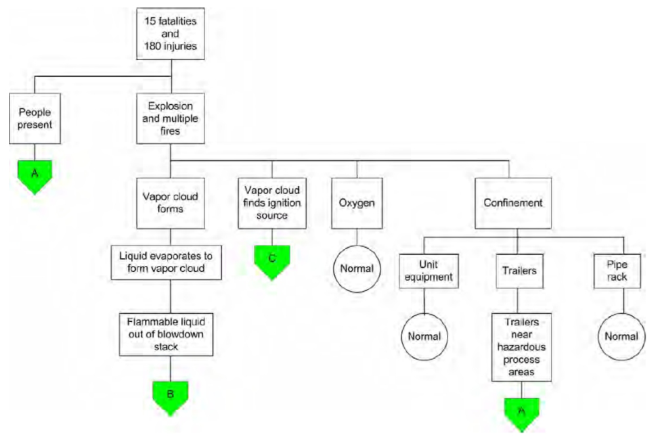
quite the opposite. It is a chain of complex events, which, combined in an equally complex way, will also generate complex consequences. Linear representations, such as the Fault Tree Analysis (FTA), presented in Appendix B of the CSB report (CSB, 2007), limit the understanding of entire accident, significantly decreasing the corrective actions and learning. Therefore, it is necessary to apply to a complex scenario, such as this accident, a methodology capable of examining as much as possible of all the complex relationships and interactions that occur, starting from the epistemological assumption of the non-linearity of today’s complex workplaces. Figure 5 presents the Logic Tree in Appendix B of the CSB report. Comparing this one with the FRAM analysis of Figure 1, it is possible to realize that linear tools are limited to deal with real complex demands of the high-risk environment of the O&G industry.
Figure 5: The first part of the logic tree in Appendix B of the CSB report.
Traditional accident investigation methods, often rooted in linear logic such as Fault Tree Analysis (FTA) or 5-Whys, have shown significant limitations when applied to complex sociotechnical systems. As highlighted in IOGP Report 621 (2018), these linear tools tend to overemphasize proximal causes, frequently attributing incidents to individual mistakes or simply “human error”, while overlooking deeper systemic contributors. This attribution bias can hinder organizational learning by prematurely terminating the investigation at the point of the human failure, rather than exploring the broader context in which decisions and actions made sense at the time. In contrast, non-linear methodologies, such as FRAM or AcciMap, enable more systemic understanding of accidents by mapping performance variability and uncovering the latent organizational, technological, and environmental conditions that shape human actions. These approaches not
42 França and Hollnagel
only identify individual behaviours but also contextualize them within a network of interconnected influences, fostering more robust and actionable insights for accident prevention and system resilience.
CONCLUSION
In complex sociotechnical environments, such as oil refineries and offshore oil platforms, the effectiveness of risk assessment and accident investigation intensely depends on the ability to understand not only what failed, but how the system work as a whole. Linear investigative approaches, while still widely adopted, tend to isolate causality in sequential chains and often culminate in attributing blame to individuals through the simplistic label of human error. This paradigm, however, fails to account for the multidimension nature of organizational decision-making, structural constraints, and contextual variability that shape human behaviour and system functioning. Indeed, human factors are not merely about individual actions but are embedded in the interactions among technological, environmental, organizational, and all other factors that compose complex sociotechnical system – most of the nowadays industrial workplaces. In this sense, non- linear methods, like FRAM, enables a broader comprehension of system interactions, capturing the emergent and non-linear couplings that can propagate throughout a high-risk workplace, whether in normal operation or during a crisis. Applied to the BP Texas City case, FRAM provided a deeper understanding and learning of how organizational transformations following the BP-Amoco merger, including cost-cutting and cultural restructuring, influenced the latent conditions that ultimately resonated in the accident. More than identifying broken links, this methodology reveals the systemic tensions, trade-offs, and adaptations that accumulate and eventually surface as critical events, fostering a better understand and learning from non- planned events.
ACKNOWLEDGMENT
The authors would like to acknowledge to all the workers and professionals that contribute to this research.
REFERENCES
Abbasi, S., Khourdustan, P., Sayyadi, R., Jalilpour, S. & Alizadeh S. S. (2020). BP Texas Refinery Incident Causes: A Literature Review. International Journal of Occupational Hygiene, 12 (3): 256–270. https://ijoh.tums.ac.ir/index.php/ijoh/ article/view/452 Brede, M., Gerstel, H., Wöhrmann, A. & Bausch, A. (2024). Mind the gap: The effect
of cultural distance on mergers and acquisitions - evidence from glassdoor reviews. Review of Managerial Science. https://doi.org/10.1007/s11846-024-00811-8 CSB – U. S. Chemical Safety and Hazard Investigation Board. (2007). Investigation report: Refinery explosion and fire, BP Texas City (Report No. 2005-04-I-TX). https://www.csb.gov. Report available at: https://www.csb.gov/bp-america-texas- city-refinery-explosion/.
Reanalysing the BP Texas City Refinery Accident With the FRAM 43
de Carvalho, P. V. R. (2011). The use of functional resonance analysis method (FRAM) in aviation safety: A case study. Reliability Engineering & System Safety, 96 (2), 1482–1498. https://doi.org/10.1016/j.ress.2011.05.009 França, J., Hollnagel, E., Luquetti dos Santos, I. & Haddad, A. (2019) FRAM AHP
approach to analyse offshore oil well drilling and construction focused on human factors, Cog Tech Work. https://doi.org/10.1007/s10111-019-00594-z Franca, J., Vaz, M., Coutinho, B. & Pina, L. (2023). Analyzing organizational gaps in process accidents with FRAM: The case of the Imperial Sugar refinery explosion (2008). Process Safety Progress. https://doi.org/10.1002/prs.12545 Hollnagel, E. (2012). FRAM: The Functional Resonance Analysis Method: Modelling Complex Socio-technical Systems. 1st Edition. New York: Ashgate. IOGP. (2018). Demystifying human factors: Building confidence in human factors
investigation. International Association of Oil & Gas Producers, Report No. 621. http://iogp.org/bookstore/product/iogp-report-621-demystifying-human-factors- building-confidence-in-human-factors-investigation/ Leveson, N. (2004). A new accident model for engineering safer systems. Safety Science, 42(4), 237–270. https://doi.org/10.1016/S0925-7535(03)00047-X MacKenzie, C., Holmstrom, D., & Kaszniak, M. (2007). Human Factors Analysis of the BP Texas City Refinery Explosion. Proceedings of the Human Factors and Ergonomics Society, 51(20), 1444–1448. https://doi.org/10.1177/ 154193120705102015 Mahadewi, L. (2018). Post-merger and Acquisition Integration: A Case Review of
Dial Henkel and BP Amoco. International Journal of Business Studies. 2. 49–61. https://doi.org/10.32924/ijbs.v2i1.33 Patriarca, R., Di Gravio, G., Woltjer, R., Costantino, F., Praetorius, G., & Ferreira, P.
(2020). Framing the FRAM: A literature review on the functional resonance analysis method. Safety Science. https://doi.org/10.1016/j.ssci.2020.104827 Praetorius, G. & Hollnagel, E. (2015). Control and resilience within the maritime traffic management domain. Journal of Cognitive Engineering and Decision Making, 9(3), 306–326. https://doi.org/10.1177/1555343414560022 Radloff, S. (2023). The influence of culture on the performance of mergers and
acquisitions. Master’s Thesis in Digital Transformation & Change Management, Technische Universität Wien. https://doi.org/10.34726/hss.2023.117643
LISTED IN THE AHFE DIGITAL BOOKSTORE CATALOGUE
Explore the complete digital volume
Human Error, Reliability, Resilience, and Performance
Read this individual research paper free through the original publisher, or explore the full digital proceedings book.
ISBN 978-1-964867-49-6
Explore this ISBN in the AHFE Bookstore ↗Listed in the July 2026 bookstore catalogue; search by ISBN to confirm current availability · Digital book purchase optional