Taewon Yang, Ronald Boring, Jooyoung Park (2025). Time Distribution Analysis for Task Primitives to Support Dynamic Human Reliability Analysis. In: Human Error, Reliability, Resilience, and Performance. AHFE Open Access, vol. 173, pp. 12–19. https://doi.org/10.54941/ahfe1006276
To support data collection for dynamic human reliability analysis (HRA), this study investigates time distributions for task primitives defined in the Goals, Operators, Methods, and Selection rules (GOMS)–Human Reliability Analysis (HRA) method and Human Reliability data EXtraction (HuREX). GOMS-HRA was developed to provide cognition-based time and human error probability (HEP) information for dynamic HRA calculations within the Human Unimodel for Nuclear Technology to Enhance Reliability (HUNTER) framework, while HuREX is a comprehensive HRA data collection method developed by the Korea Atomic Energy Research Institute (KAERI). In this paper, we examine time distributions by using experimental data collected from the Simplified Human Error Experimental Program (SHEEP) study, which proposes an HRA data collection framework to complement full-scope simulator research and gather input data for dynamic HRA by using simplified simulators such as the Rancor Microworld simulator. This paper investigates whether the time required for GOMS-HRA and HuREX task primitives fits 13 statistical distributions. Additionally, we compare and discuss the time distributions obtained from both student operators and professional operators. The result was that this study identified several time distributions for five GOMS-HRA and four HuREX task primitives. In the future, the results of this study are expected to provide objective reference data on the elapsed time for task primitives and aid in realistically simulating scenarios within dynamic HRA.
Human reliability analysis (HRA) is an approach used to evaluate human errors and quantify human error probabilities (HEPs) for application in probabilistic risk assessment (PRA) (Swain & Guttmann, 1983). The Risk- Informed System Analysis (RISA) pathway under the U.S. Department of Energy’s Light Water Reactor Sustainability (LWRS) Program sponsors several HRA-related projects aimed at creating better tools to support industry risk assessment needs. One such tool is the Human Unimodel for Nuclear Technology to Enhance Reliability (HUNTER) project (Boring et al., 2022). HUNTER is a framework designed to support the dynamic modeling of human error in conjunction with other modeling tools. It creates a virtual operator, or potentially a human digital twin, as a counterpart to plant
hardware modeling and simulation. The name HUNTER is intended as a counterpart to various animal-named modeling tools developed at Idaho National Laboratory (INL), such as the Risk Analysis Virtual Environment (RAVEN) and the Multiphysics Object-Oriented Simulation Environment (MOOSE). These tool names playfully combine to become tools such as RAVEN-HUNTER or MOOSE-HUNTER.
Our research team has developed an HRA data collection framework called the Simplified Human Error Experimental Program (SHEEP) to complement full-scope simulator studies and collect input data for dynamic HRA tools such as HUNTER (Park et al., 2022). The SHEEP framework aims to infer full-scope data based on experimental data collected from simplified simulators—specifically the Rancor Microworld Simulator (Rancor) and the Compact Nuclear Simulator (CNS). Within the SHEEP framework, our research team has experimentally collected human reliability data from 36 student operators and 36 professional operators using CNS and Rancor. The human errors and performance measurements collected from these experiments have been analyzed and discussed in previous research (Park et al., 2022; Park et al., 2023).
Within the umbrella of the SHEEP framework, this study aims to investigate time distributions for task primitives defined in the Goals, Operators, Methods, and Selection rules (GOMS)-HRA (Boring & Rasmussen, 2016) and Human Reliability data Extraction (HuREX) (Jung, Park, Kim, Choi, & Kim, 2020) methods. GOMS-HRA was developed to provide cognition-based time and HEP information for dynamic HRA calculations within the HUNTER framework, while HuREX was developed to generate HRA data (e.g., HEPs) by collecting and analyzing human performance data collected from a simulator.
In this study, we investigated time distributions for GOMS-HRA and HuREX task primitives by using the SHEEP database, which includes experimental data from 20 student operators and 20 professional operators using Rancor, and 16 student operators and 16 professional operators using CNS. From the experimental data, we investigated whether the time required for GOMS-HRA and HuREX task primitives satisfies 13 statistical distributions. We then compared and discussed the time distributions obtained from the student operators and professional operators.
GOMS-HRA AND HuREX TASK PRIMITIVES GOMS-HRA was developed to provide cognition-based time and HEP information for dynamic HRA calculations within the HUNTER framework. It has been used to model proceduralized activities and evaluate user interactions with human-computer interfaces in human factors research. As a predictive method, GOMS-HRA is well-equipped to simulate human actions under specific circumstances in a given scenario. The basic approach of GOMS-HRA consists of three steps: (1) breaking down human actions into a series of task-level primitives, (2) allocating time and error values to each task-level primitive, and (3) predicting human actions or task durations.
Table 1 shows the GOMS-HRA task primitives. GOMS-HRA originally suggested 12 task primitives performed in control rooms and in the field.
However, in this study, we focus on the five task primitives (i.e., AC, CC, RC, SC, and DP) highlighted in grey in the table. The SHEEP experiment concentrated on control room data, with a single operator running a simulator by attempting to apply the appropriate procedures. Consequently, task primitives related to field operations (i.e., AF, CF, RF, and SF), decision-making without procedures (i.e., DW), and communication between operators (i.e., IP and IR) were excluded from this study.
Table 1: GOMS-HRA task primitives.
Table available in the original PDF paper.
Task Primitives Description AC Performing required physical actions on the control boards AF Performing required physical actions in the field CC Looking for required information on the control boards CF Looking for required information in the field RC Obtaining required information on the control boards RF Obtaining required information in the field IP Producing verbal or written instructions IR Receiving verbal or written instructions SC Selecting or setting a value on the control boards SF Selecting or setting a value in the field DP Making a decision based on procedures DW Making a decision without available procedures
HuREX was developed to generate HRA data such as HEPs by collecting and analyzing human performance data from a simulator. HuREX has been used to provide HRA data to new HRA methods such as the Empirical data- Based crew Reliability Assessment and Cognitive Error analysis (EMBRACE) or to estimate the impact of performance-shaping factors (PSFs) on HEPs. As a data collection framework, HuREX is comprised of four steps: (1) preparation, such as experiment design; (2) data collection through simulator experiments; (3) data analysis; and (4) data reporting.
Table 2: HuREX cognitive activities.
Table available in the original PDF paper.
Cognitive activity Description Information gathering and
Checking discrete state or measuring parameter
reporting (IG) Response planning and
Entering/transferring procedure or step in
instruction (RP)
procedure, or directing information gathering, manipulation, notification/request Situation interpreting (SI) Diagnosing or predicting of situation, or identifying overall status Execution (EX) Discrete/continuous control or dynamic
manipulation, or notifying/requesting to MCR outside Others (OT) Unguided response planning, instruction,
manipulation
Time Distribution Analysis for Task Primitives 15
Table 2 shows the HuREX cognitive activities. In this paper, these are treated as task primitives corresponding to GOMS-HRA. HuREX originally defines five cognitive activities; however, “Others” is not considered in this paper because it is not included in the human cognitive process. Additionally, HuREX suggests generic task types, which are detailed for each cognitive activity, but this paper does not use them due to the insufficient amount of data available for detailed analysis.
THE SHEEP EXPERIMENT DATA The SHEEP data were collected from 20 student operators and 20 professional operators using Rancor, and from 16 student operators and 16 professional operators using CNS. Most of the professional operators were licensed reactor operators currently employed at nuclear power plants (NPPs). They were all operators on shift (i.e., shift supervisor, shift technical advisor, reactor operator, or turbine operator) or instructors at the training center. The student operators were undergraduate seniors or graduate students from the Department of Nuclear Engineering at Chosun University. They were knowledgeable about NPP systems and operations, having already completed a significant portion of their coursework, which included courses such as “Introduction to Nuclear Engineering,” “Reactor Theory,” “Reactor Control,” and “Simulator Operation.”
This study investigated the time distributions of GOMS-HRA and HuREX task primitives in relation to different scenarios. For example, normal scenarios aim to reach different stable operating modes such as startup or hot standby, while abnormal or emergency scenarios primarily consist of instructions for rapidly cooling down reactors. Accordingly, this study differentiated ten different Rancor scenarios and four CNS scenarios, as shown in Table 3. In this paper, the results of the time distribution analysis for the Steam Generator Tube Rupture (SGTR) scenario are primarily introduced in the following sections.
Table 3: Scenario information in the SHEEP experiment.
Table available in the original PDF paper.
Scenario Type Rancor CNS Normal
Fully auto startup
Shutdown
Startup (2% to 50%)
Startup with manual rod control
Shutdown (100% to hot-standby)
Startup with manual feedwater control
Continued
Table 3: Continued Scenario Type Rancor CNS
Table available in the original PDF paper.
Abnormal or
SGTR
Emergency
Failure of an RCP under full-power operation
LOFW
Failure of a control rod under full-power operation
Failure of a feedwater pump under full-power operation
Abnormal turbine trip under full-power operation
Steam generator tube rupture (SGTR)
Loss of feedwater pump (LOFW) TIME DISTRIBUTION ANALYSIS RESULTS: SGTR
Tabel 4 shows the number of tasks used for time distribution analysis on the elapsed time of the five GOMS-HRA and four HuREX task primitives in the SGTR scenario for each simulator, depending on participant type (i.e., student operators or professional operators). There were 490 total tasks counted when 20 student operators and 20 professional operators manipulated Rancor, and 842 total tasks when 16 student operators and 16 professional operators manipulated CNS. The number of tasks for student operators (248) was slightly higher than for professional operators (242) when using Rancor. In contrast, when using CNS, the number of tasks for student operators (380) was lower than for professional operators (462).
The differences in the number of tasks per participant type stem from cases in which a participant additionally performs instructions that can be omitted within a procedural context, or in which a participant cannot continue with a scenario because the reactor has abnormally tripped during that scenario.
Table 4: Number of tasks used for time distribution analysis (SGTR).
Table available in the original PDF paper.
Simulator Type
GOMS-HRA Task Primitive Number of Tasks per Participant Type
Total Number of Tasks Participant Type AC CC RC SC DP Rancor Student
59 80 49 10 50 248 490
operators Professional
57 78 49 10 48 242
operators HuREX Task Primitive Number of Tasks per Participant Type Participant Type IG RP SI EX Student
operators CNS GOMS-HRA Task Primitive Number of Tasks per Participant Type Total Number of Tasks Participant Type AC CC RC SC DP Student
123 170 6 38 43 380 842
operators Professional
151 192 10 58 51 462
operators
Continued
Time Distribution Analysis for Task Primitives 17
Table 4: Continued HuREX Task Primitive Number of Tasks per Participant Type Participant Type IG RP SI EX Student
Table available in the original PDF paper.
175 43 15 147 380
operators Professional
202 51 15 194 462
operators
Table 5: Number of time distributions with p>0.05 for task primitives, depending on simulator type, method, and participant type.
Table available in the original PDF paper.
Methods Student Operator Rancor GOMS-HRA AC CC RC SC DP AC CC RC SC DP 5 0 0 9 3 6 0 0 9 0 HuREX IG RP SI EX IG RP SI EX 0 3 N/A 5 0 0 N/A 6 CNS GOMS-HRA AC CC RC SC DP AC CC RC SC DP 3 4 12 4 2 3 4 12 5 0 HuREX IG RP SI EX IG RP SI EX 2 2 10 4 1 0 10 3
Table 6: Time distribution analysis on the five GOMS-HRA task primitives during the SGTR when using Rancor, depending on participant type (student vs. operator).
Table available in the original PDF paper.
Distribution P-value of Goodness of Fit Test Student Operator
AC CC RC SC DP AC CC RC SC DP Normal <0.005 <0.005 <0.005 0.014 <0.005 <0.005 <0.005 <0.005 0.237 <0.005 Normal 0.374 <0.005 0.010 0.653 0.070 0.340 <0.005 <0.005 0.237 0.041
Table 5 shows the number of cases in which the time required for each task primitive followed specific time distributions. The numbers within the table represent the number of distributions for which the goodness-of-fit test resulted in a p-value > 0.05 during the SGTR scenario. Table 6 then provides an example of time distribution analysis for the GOMS-HRA task primitives when using Rancor. For statistical distributions and goodness of
fit, p-values over 0.05 (i.e., p>0.05) indicate insufficient evidence to reject the null hypothesis that the data follow the hypothesized distribution. This does not prove that the sample data follow the specified distribution, but instead provides statistical evidence that the distribution fits the data.
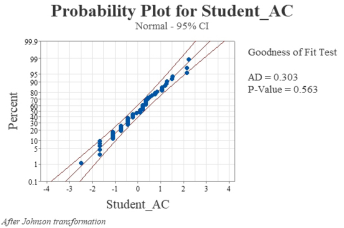
As shown in Tables 5 and 6, the AC task primitive for student operators satisfied five distributions (p>0.05): normal distribution after Box-Cox transformation, lognormal distribution, 2-parameter exponential distribution, loglogistic distribution, and normal distribution after Johnson transformation. Figure 1 shows one of the distributions representing the highest p-value (0.563). It includes a normal distribution (after Johnson transformation) for student operator tasks in the SGTR scenario. The average elapsed time from the time distributions is 11.92 seconds for AC.
Figure 1: Normal distribution (after Johnson transformation) of AC for student operator tasks in the SGTR scenario with rancor.
DISCUSSION & CONCLUSION This study investigated time distributions for the five GOMS-HRA and four HuREX task primitives. The result was that several time distributions for the task primitives were found to have p-values of over 0.05 (i.e., p-value > 0.05). Specifically, a greater number of time distributions was found in the CNS experiment than in the Rancor experiment. When using Rancor, manipulation-related task primitives such as AC (performing required physical actions on the control boards) and SC (selecting or setting a value on the control boards) in GOMS-HRA, as well as execution (EX)- related task types in HuREX (discrete or continuous control or dynamic manipulation), satisfied a relatively large number of distributions with p-values of over 0.05, in comparison to other task primitives.
On the other hand, in the experiment using the CNS simulator, the RC task primitive, which pertains to information-gathering in GOMS-HRA, satisfies a greater number of time distributions in comparison to other task primitives, as does the SI task primitive, which pertains to diagnosis and prediction of NPP states in HuREX.
Our research team continues to analyze the experimental data. Further analyses will be performed to clarify these issues and develop better time
Time Distribution Analysis for Task Primitives 19
distributions applicable to dynamic HRA. Already, these data show the potential of using task-level primitives to arrive at time distributions. Such time distributions may eventually prove as useful as outright HEP estimations in future HRA applications.
DISCLAIMER This information was prepared as an account of work sponsored by an agency of the U.S. Government. Neither the U.S. Government nor any agency thereof, nor any of their employees, makes any warranty, expressed or implied, or assumes any legal liability or responsibility for the accuracy, completeness, or usefulness, of any information, apparatus, product, or process disclosed, or represents that its use would not infringe privately owned rights. References herein to any specific commercial product, process, or service by trade name, trade mark, manufacturer, or otherwise, does not necessarily constitute or imply its endorsement, recommendation, or favoring by the U.S. Government or any agency thereof. The views and opinions of authors expressed herein do not necessarily state or reflect those of the U.S. Government or any agency thereof.
REFERENCES
Boring, R. & Rasmussen, M., (2016). GOMS-HRA: A method for treating subtasks in dynamic human reliability analysis. Proceedings of the European Safety and Reliability Conference, pp. 956–963. Boring, R. et al., (2022). Software Implementation and Demonstration of the Human
Unimodel for Nuclear Technology to Enhance Reliability (HUNTER), INL/RPT- 22-66564, Idaho National Laboratory. Jung, W. et al., (2020). HuREX–A framework of HRA data collection from simulators in nuclear power plants. Reliability Engineering & System Safety, vol. 194, p. 106235. Park, J. et al., (2022). A framework to collect human reliability analysis data for nuclear power plants using a simplified simulator and student operators. Reliability Engineering & System Safety, vol. 221, p. 108326. Park, J. et al., (2023). Analysis of human performance differences between students
and operators when using the Rancor Microworld simulator. Annals of Nuclear Energy, vol. 180, p. 109502. Swain, A. & Guttmann, H., (1983). Handbook of human-reliability analysis with emphasis on nuclear power plant applications, NUREG/CR-1278, Sandia National Laboratory, Albuquerque, NM, USA.
LISTED IN THE AHFE DIGITAL BOOKSTORE CATALOGUE
Explore the complete digital volume
Human Error, Reliability, Resilience, and Performance
Read this individual research paper free through the original publisher, or explore the full digital proceedings book.
ISBN 978-1-964867-49-6
Explore this ISBN in the AHFE Bookstore ↗Listed in the July 2026 bookstore catalogue; search by ISBN to confirm current availability · Digital book purchase optional