Hajer Jemai, Adel Badri, Nabil Ben Fredj (2026). Human-Centered Risk Intelligence: “La Cible SST® Software” for Smarter Occupational Health and Safety Performance Management. In: Human Interaction and Emerging Technologies (IHIET-AI 2026): Artificial Intelligence and Future Applications. AHFE Open Access, vol. 201, pp. 155–166. https://doi.org/10.54941/ahfe1007170
Occupational Health and Safety (OHS) remains a central issue in evolving industrial environments, where the increasing integration of digital technologies, automation, and artificial intelligence contributes to greater complexity in sociotechnical systems. In these contexts, evaluating OHS performance requires human-centered approaches capable of considering the interactions between organizational, technical, and behavioral dimensions of real work. Indeed, several recent industrial events have shown that traditional evaluation models do not sufficiently capture the dynamics of risk and situated decision-making processes.This paper presents the development of an occupational health and safety (OHS) decision-support software, called La Cible SST® (available in French only), designed to support the analysis and improvement of management systems in complex environments. The software provides a structured dashboard based on a set of indicators grouped into four interdependent dimensions: organizational, technical, human, and continuous improvement. It also enables the identification of the maturity level of the OHS management system according to the Capability Maturity Model (CMM), thereby helping to guide preventive decisions in a progressive and context-appropriate manner.The development of the software took place in two phases: a conceptual phase, which led to the modeling of the analytical framework, followed by an experimental phase conducted in various industrial and service settings. The results show that this approach enables a better understanding of human interactions within complex systems, strengthens risk anticipation capabilities, and supports a safer, more human-centered digital transformation.
Global competition and the diversity of customer requirements play a crucial role in the evolution of industrial production, requiring rapid adaptations to meet the constantly changing demands of the market Received November 11, 2025; Revised November 28, 2025; Accepted December 3, 2025; Available online April 1, 2026
(Rojko, 2017). Since the 18th century, industrialization has been the subject of several remarkable transformations (Badri et al., 2018). Today, the world is facing a fourth wave known as Industry 4.0, or smart manufacturing. In this context, machines are programmed to produce not only according to specifications but also based on demand. Software systems monitor inventories of raw materials and finished products, as well as distribution, thereby generating massive amounts of data (“big data”) for market strategy and management (Imran & Kantola, 2018; Shamim et al., 2016; Török, 2020, 2023; Zhou et al., 2015). The fourth industrial revolution is becoming the predominant reality, and the transformation of manufacturing systems toward Industry 4.0 will bring new changes that will impact the OHS (Badri et al., 2018). Indeed, the transition toward Industry 4.0 is leading to a new production approach in which decision- making becomes faster and more accurate, and work tasks become more organized and efficient—factors that can have a significant impact on OHS (Polak-Sopinska et al., 2020).
Although the transformations brought by the implementation of Industry 4.0 foster the evolution of manufacturing and the overall approach to occupational health and safety (OHS), they also present certain drawbacks for OHS management. First, it is important to emphasize that, according to systems theory, Industry 4.0 systems are sociotechnical systems that include both social (human) and technical (equipment) components. Despite the increased use of automation technologies, there is a general consensus that humans continue to play an essential role in these systems—whether in design, installation, maintenance, or operation (Neumann et al., 2021). However, during the implementation of innovative technologies, attention is primarily focused on operating conditions and production, without sufficiently considering the human contribution within the company (Fantini et al., 2020).
Systems have now become so complex that a new field of study has emerged: complexity science. Although no formal definition of a complex system has reached consensus, most researchers agree that a system is considered complex when it comprises numerous interacting elements and its overall behavior includes emergent components—meaning behavior that cannot be predicted from the sum of the functions of the system’s individual elements (Newman, 2011). While such sophisticated systems can be highly effective, the difficulty of predicting their behavior under all conditions represents a drawback and has proven consequences for OHS.
The integration of modern digital production systems and the widespread use of real-time monitoring, control, and communication of processes— along with the massive amounts of data they generate—promise considerable productivity gains. This interconnectedness will also have an impact on OHS (Jemai et al., 2023). For example, a short-term reorganization of production areas may involve changes in equipment layout and positioning, which may require a reassessment of the workplace OHS situation. Such changes can raise questions regarding workers’ adaptability, as well as the rigor with
Human-Centered Risk Intelligence: “La Cible SST® Software” 157 which companies and their employees manage their OHS responsibilities (Merve, 2019).
The insufficient consideration of the human factor in work design can lead to serious problems, including work-related mortality, which has reached 2.78 million deaths per year worldwide (Neumann et al., 2021). Moreover, several major accidents show that assessing OHS performance is a real challenge for complex sociotechnical systems. Over the years, numerous instruments have been developed to assess the OHS situation and performance of public and private organizations wherever employees are exposed to risks of work-related accidents or illnesses. However, several major accidents continue to remind us that OHS conditions and performance remain below expectations unless standardized and reliable OHS performance assessment tools—applicable to complex sociotechnical systems—are developed.
In this paper, we present a new OHS decision-support software, called La Cible SST, which provides an overview of an organization’s OHS performance and identifies the maturity level of its OHS management system according to the CMM model, thereby helping guide prevention decisions in a progressive and tailored manner. The remainder of the paper is structured as follows: Section 2 describes the adopted methodology. Section 3 presents the results of the conducted research. These results, along with the study’s limitations, are analyzed in Section 4, and our conclusion is provided in Section 5.
METHODOLOGY
The research project is divided into two distinct phases: a theoretical phase and a practical phase. The first phase aims to develop a model for assessing OHS performance, while the second phase seeks to validate this model by testing it in different workplace environments. This project received approval from the Research Ethics Committee of the Université du Québec à Trois- Rivières (UQTR).
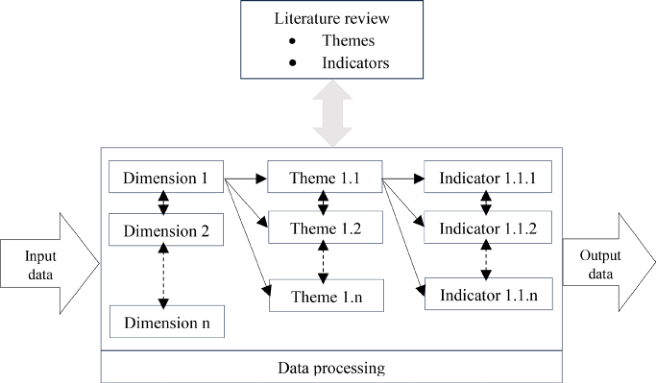
Theoretical Modelling The theoretical model was developed based on information gathered from documents included in the literature review, in which the key themes of OHS performance were identified from the work of Tremblay and Badri (2018b). These elements were then adapted to ensure that our OHS performance assessment tool would be better suited to the context of complex systems. The modeling process is summarized in Figure 1.
Figure 1: Theoretical model. (Adapted from Tremblay and Badri, 2018b).
In this project, we adopted the Capability Maturity Model (CMM) for the modeling of our software. The CMM is one of the methodological approaches used to assess organizational capability within the framework of continuous process improvement (Poghosyan et al., 2020). In the field of OHS, the CMM can be used as a decision-support tool. It not only makes it possible to assess an organization’s OHS performance, but also to indicate the maturity level of its OHS management process. Strutt et al. (2006) adopted a five- level maturity approach ranging from an initial level to an optimized level (Table 1). Furthermore, the model is based on the assumption that higher maturity levels incorporate the requirements of lower levels (Strutt et al., 2006). For example, an organization cannot be at level 3 without meeting the requirements of the preceding levels.
Table 1: Maturity levels adapted from (Strutt et al., 2006).
Table available in the original PDF paper.
Levels Maturity Description 1 Initial The organization has limited experience. It is in a learning and development phase.
2 Repeatable The organization can repeat what it has done before, but it does not necessarily define what it does.
3 Defined The organization defines what it does and how to do it (documentation available).
4 Managed The organization can control what it does in terms of OHS. It sets requirements and ensures that they are met.
5 Optimized The organization has best practices in place and is capable of learning and adapting.
Programming A list of performance indicators suggested in the literature was defined in accordance with the key OHS performance themes adapted from Tremblay
Human-Centered Risk Intelligence: “La Cible SST® Software” 159 and Badri (2018b). This list is essentially based on the indicators used in OHS performance assessment tools published between 2008 and 2019, which were identified by Jemai et al. (2021). Subsequently, a software application was developed.
Field Test During this phase, we involved companies of various sizes and from different sectors in order to test our software directly in the field. These tests aim to verify its proper functioning, confirm the relevance of the proposed indicators, and ensure that the tool accurately reflects the reality of workplace environments.
SEARCH RESULTS Structure of “La Cible SST®”
The decision-support software “La Cible SST®” (available in French only) is based on the structure proposed by Tremblay and Badri (2018b). It breaks down occupational health and safety performance into four fundamental dimensions: “Organizational,” “Technical,” “Human” and “Continuous Improvement.” The first three dimensions were then subdivided into several themes (sub-dimensions), selected from the literature and the essential components of OHS performance described by Tremblay and Badri (2018a). The overall structure of “La Cible SST®” is presented in Table 2.
Table 2. Dimensions and themes of “La Cible SST®”.
Personal protective equipment; Hazardous materials management; Inspection; Confined spaces; Working at heights; Thermal constraints; Lockout/tag-out.
OHS management; Leadership and commitment from management; Training; Hazard identification and risk management; Prevention program.
How “La Cible SST®” Works Input Data
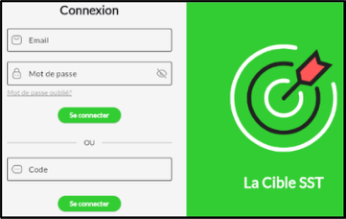
When opening the application, users of the “La Cible SST®” software must first log in (Figure 2). If the company is being assessed for the first time, it must be added to the list of companies. Subsequently, simply click on the company name to access the assessment.
Figure 2: Connection interface (La Cible SST®).
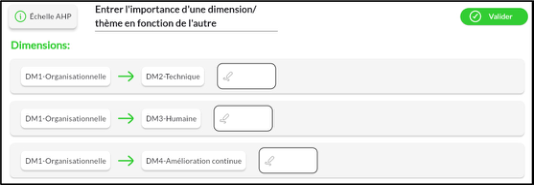
Before proceeding to the assessment, the software user must first fill in comparison matrices based on their company’s vision (Figure 3). The scale to be used is located at the top left of the weighting calculation interface. The results obtained will then be used to calculate OSH performance.
Figure 3: Weight calculation interface (La Cible SST®).
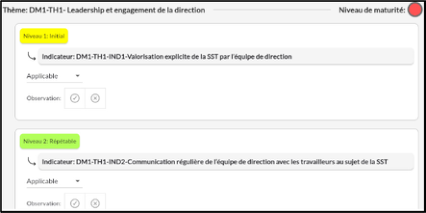
When evaluating the performance of such a company using the dashboard (Figure 4), the user must determine whether the performance indicator is met (score of 1) or not met (score of 0). If the indicator is only partially met, the user must consider it as not met, in order to avoid leaving room for interpretation. In some companies, it is impossible to assess all indicators. For example, some never work in confined spaces and therefore do not need to define any specific procedure. In such cases, non-applicable indicators can be deactivated.
Figure 4: Dashboard (La Cible SST®).
Human-Centered Risk Intelligence: “La Cible SST® Software” 161 Data Analysis
Once the assessment is complete, the software automatically assigns a percentage score to each theme. This score is calculated by dividing the number of indicators met (score of 1) by the total number of indicators assessed. For example, if the “Training” theme includes 8 indicators, only 3 of which are met, the score obtained will be 37.5% (3 ÷ 8). If one of these indicators is deemed not applicable and disabled by the user, the calculation will then be based on 7 indicators (3 ÷ 7). As each theme is weighted, the software then aggregates the thematic results to generate an overall performance percentage.
Output Data “La Cible SST®” allows users to make several observations at different times in order to track the evolution of their company’s performance. Each observation is automatically recorded in the software, along with the name of the user who made the assessment and the corresponding date. The software also offers the possibility of exporting the results in PDF format.
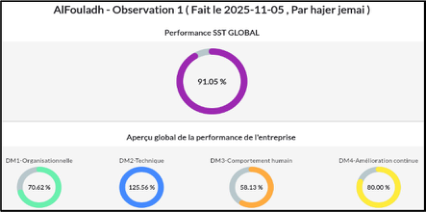
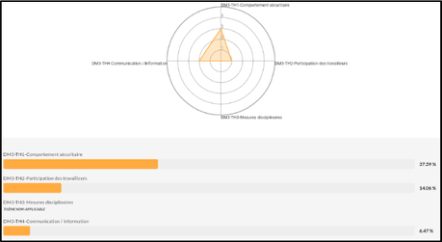
The results generated are presented in graph form (Figures 5 and 6) according to two levels of analysis. The first level displays the four dimensions of performance and provides an overview of the state of OHS in the company being assessed. The second level details the results for each of the themes associated with these dimensions. Radar charts also allow the maturity levels of the OSH management system to be visualized for each of the dimensions.
Figure 5: Overall and detailed overview of OSH performance (La Cible SST®).Figure 6: Overview of OSH performance and maturity levels for themes in the “Human” dimension (La Cible SST®).
DISCUSSION OF RESEARCH RESULTS In this section, we will examine the extent to which “La Cible SST®” met the following four requirements:
Simplicity and user-friendliness;
Identifying OSH deficiencies;
Prioritization of corrective measures;
Generalization of findings discussed.
In order to demonstrate the relevance of our software, we rely on the results obtained during field-testing. A total of six Tunisian companies from the industrial and service sectors (Table 3) were consulted.
Following the evaluations, participants were asked to complete an evaluation questionnaire and a semi-structured interview form. The questionnaire consists of 28 questions: the first seven relate to the participant’s characteristics, while the next 21 are closed questions designed to evaluate the software. These questions use a 9-point Likert scale ranging from “strongly disagree” (1) to “strongly agree” (9), with values from 4 to 6 corresponding to a neutral position or no opinion. The aim is to gather users’ perceptions of various aspects of the software, including visual quality, simplicity and user- friendliness of the interface, and the relevance of the indicators provided.
The semi-structured interview form allows for discussion of items not covered by the questionnaire. Participants are free to express their opinions and provide details on the functional aspects of the software and its use in a real-world context.
Table 3: Details of companies consulted.
E2 Packaging 250 Medium Production Manager E3 Engineering 12 Small Owner
E4 Construction 220 Medium Owner E5 Steel construction 12 Small Manufacturing Technician
60 Small Company manager
E6 Furniture manufacturing
Simplicity and User-Friendliness We combined and analyzed the data from the questionnaire and the interviews. The average scores (Likert scale) obtained for each aspect of this specification using the questionnaire are as follows:
Simplicity of the software: 8.6 (agreement).
Interface and display of results are attractive: 8.3 (agreement).
Ease of analysis and interpretation of results: 8 (agreement).
Ease of use of the software: 7.5 (agreement).
Compliance with the time required for evaluation: 7.8 (agreement).
Participants expressed a generally positive opinion on this subject, according to the questionnaire results. However, the interviews provided some nuance to these perceptions. Two participants indicated that the software is both simple to use and easy to understand, while four others pointed out that it is indeed simple to use, but that understanding certain indicators remains complex. In terms of aesthetics, all participants agreed that the interface and graphics are clear, legible, and well designed.
Identifying OSH Deficiencies Regarding the relevance, clarity, and adequacy of the indicators associated with each of the OHS performance themes, all participants strongly agreed, and none of the indicators received a low rating. However, four participants noted that some indicators should be reworded to further clarify their meaning.
Moreover, all participants emphasized that “La Cible SST®” enables companies to clearly identify their strengths in occupational health and safety, while highlighting areas for improvement.
Prioritization of Corrective Measures Regarding the development of the corrective action plan, four participants indicated during the interview that “La Cible SST®” significantly facilitates this process by focusing directly on the problems identified. The other two participants disagreed and made the following comments: “additional and more specific work is needed,” “an action plan requires more effort to identify corrections,” and “in the future, the tool could suggest a set of actions for each of the identified deficiencies.”
Regarding the prioritization of necessary improvements, four out of six participants believe that “La Cible SST®” essentially identifies corrective actions, but that setting priorities remains an additional step that is up to the company.
Generalization of the Findings Addressed by the Software Regarding this aspect, no consensus could be reached, as participants’ opinions were divided. Three of them believe that the selection of indicators makes it possible to clearly identify OHS needs for all companies. Conversely, the other three participants suggest improving and clarifying certain indicators so that they fully meet this requirement.
Furthermore, three out of six participants consider the indicators to be suitable for companies of different sizes, as they do not depend on the number of employees or the organizational structure. However, half of the participants do not agree that these indicators are appropriate for all business sectors. According to them, the current selection mainly reflects the reality of the industrial sector and would require adjustments to adequately cover other sectors, particularly construction or services.
Limitations and Areas for Improvement A new tool for evaluating occupational health and safety performance was tested in the field across various environments in order to strengthen the practical component of the research. Although the results obtained are encouraging, several limitations must be taken into consideration. First, the sample size remains small: only six participants from six small and medium-sized enterprises. A larger-scale experiment would help identify new areas for improvement and increase confidence in the tool’s reliability and consistency from one user to another. In addition, the tests were conducted exclusively in Tunisian SMEs. Consultation with Quebec-based companies would be essential to broaden the scope of the conclusions and support the generalization of the results. The selection of indicators will also need to be adjusted to ensure the tool’s effectiveness across different industrial sectors.
During the experimentation, participants made several recommendations related to the software itself. The details of the indicators were reformulated, with the majority highlighting the need to make them more understandable. They also noted that calculating the weights by theme unnecessarily complicates the use of the software. This issue was identified as one of the main areas for improvement.
Three major improvements are planned for the future. First, to revise the logic of the evaluation process to avoid redundancies and not calculate weights for themes that are not applicable. Second, to integrate a comparative report that automatically consolidates the results of different evaluations, thereby eliminating manual comparisons. Third, to create a functional link between identified gaps and the corrective actions to be implemented, in order to facilitate the development of a coherent and actionable plan.
CONCLUSION
In an industrial context of continuous transformation, characterized by accelerated digitalization and the increasing integration of emerging technologies, the human dimension remains a central issue. When implementing innovative solutions, attention is often focused on technical and operational performance, at the expense of human contribution and the associated risk management. Despite numerous advances, evaluating occupational health and safety performance remains challenging and requires approaches adapted to the realities of complex sociotechnical systems. The development of a new decision-support tool, better aligned with these contexts, represents a relevant response to this issue.
The software developed as part of this study has demonstrated its value. Companies that participated in its testing expressed satisfaction with the results, and users confirmed that the generated diagnostics accurately reflect their industrial realities. The tool provided them with a detailed and structured view of their OHS performance, thereby facilitating a comprehensive understanding of their strengths and weaknesses.
Human-Centered Risk Intelligence: “La Cible SST® Software” 165 However, further work is needed to strengthen its scope and broaden its applicability to all sectors of activity. The results are encouraging, but it is still too early to measure its real impact on sustainable improvements in occupational health and safety performance. Continuous validation and future iterations will consolidate its effectiveness and potential for widespread use.
ACKNOWLEDGMENT
The authors thank the Université du Québec à Trois-Rivières (UQTR), Mitacs Canada and Natural Sciences and Engineering Research Council of Canada (NSERC) for their financial support.
REFERENCES
Badri, A., Boudreau-Trudel, B., & Souissi, A. S. (2018). Occupational health and safety in the industry 4.0 era: A cause for major concern? Safety science, 109, 403–411. Fantini, P., Pinzone, M., & Taisch, M. (2020). Placing the operator at the centre
of Industry 4.0 design: Modelling and assessing human activities within cyber- physical systems. Computers & Industrial Engineering, 139, 105058. Imran, F., & Kantola, J. (2018). Review of industry 4.0 in the light of sociotechnical system theory and competence-based view: A future research agenda for the evolute approach. International Conference on Applied Human Factors and Ergonomics, Jemai, H., Badri, A., & Ben Fredj, N. (2021). State of the art and challenges for
occupational health and safety performance evaluation tools. Safety, 7(3), 64. Jemai, H., Badri, A., & Ben Fredj, N. (2023). Towards better understanding of the complex industrial systems: Case of production systems. International Review of Applied Sciences and Engineering, 14(3), 383–391. Merve, E. (2019). Occupational health and work safety systems in compliance
with industry 4.0: Research directions. International Journal of eBusiness and eGovernment Studies, 11(2), 119–133. Neumann, W. P., Winkelhaus, S., Grosse, E. H., & Glock, C. H. (2021). Industry 4.0 and the human factor–A systems framework and analysis methodology for successful development. International Journal of production economics, 233, 107992. Newman, M. (2011). Resource letter cs–1: Complex systems. American Journal of
Physics, 79(8), 800–810. Poghosyan, A., Manu, P., Mahamadu, A.-M., Akinade, O., Mahdjoubi, L., Gibb, A., & Behm, M. (2020). A web-based design for occupational safety and health capability maturity indicator. Safety science, 122, 104516. Polak-Sopinska, A., Wisniewski, Z., Walaszczyk, A., Maczewska, A., & Sopinski,
P. (2020). Impact of industry 4.0 on occupational health and safety. Advances in Manufacturing, Production Management and Process Control: Proceedings of the AHFE 2019 International Conference on Human Aspects of Advanced Manufacturing, and the AHFE International Conference on Advanced Production Management and Process Control, July 24-28, 2019, Washington DC, USA 10,
Rojko, A. (2017). Industry 4.0 concept: Background and overview. International journal of interactive mobile technologies, 11(5). Shamim, S., Cang, S., Yu, H., & Li, Y. (2016). Management approaches for
Industry 4.0: A human resource management perspective. 2016 IEEE congress on evolutionary computation (CEC), Strutt, J., Sharp, J., Terry, E., & Miles, R. (2006). Capability maturity models for offshore organisational management. Environment international, 32(8), 1094–1105. Török, L. (2020). Industry 4.0 from a few aspects, in particular in respect of the
decision making of the management: /Will the new industrial revolution change the traditional management functions? International Review of Applied Sciences and Engineering. Tremblay, A., & Badri, A. (2018a). Assessment of occupational health and safety performance evaluation tools: State of the art and challenges for small and medium-sized enterprises. Safety science, 101, 260–267. Tremblay, A., & Badri, A. (2018b). A novel tool for evaluating occupational health
and safety performance in small and medium-sized enterprises: The case of the Quebec forestry/pulp and paper industry. Safety science, 101, 282–294. Török, L. (2023). The importance of digitalization and robotization in vehicle production in the European Union. International Review of Applied Sciences and Engineering, 14(1), 125–131. Zhou, K., Liu, T., & Zhou, L. (2015). Industry 4.0: Towards future industrial
opportunities and challenges. 2015 12th International conference on fuzzy systems and knowledge discovery (FSKD).
LISTED IN THE AHFE DIGITAL BOOKSTORE CATALOGUE
Explore the complete digital volume
Human Interaction and Emerging Technologies (IHIET-AI 2026): Artificial Intelligence and Future Applications
Read this individual research paper free through the original publisher, or explore the full digital proceedings book.
ISBN 978-1-964867-77-9
Explore this ISBN in the AHFE Bookstore ↗Listed in the July 2026 bookstore catalogue; search by ISBN to confirm current availability · Digital book purchase optional