Hector Rafael Morano-okuno, Donovan Esqueda Merino, Emmanuel Garcia-moran, Luis Villagomez-guerrero (2023). Manufacturing Cell Working in a Cyber-Physical Environment Powered by a Microgrid System. In: Emerging Technologies and Future of Work. AHFE Open Access, vol. 117, pp. 223–232. https://doi.org/10.54941/ahfe1004422
In recent years, automated manufacturing systems have increased, new technologies such as the Internet of Things have emerged, and computer systems need to be more robust.This work shares the experiences obtained using a manufacturing cell that works in a cyber-physical environment powered by a micro grid system. The components that create the cyber-physical system and how they interact are mentioned. Some equipment used are CNC machines, industrial robots, conveyors, an automatic storage and retrieval system, and a plc.Throughout the article, the methodology used to analyze user opinions is shown. Subsequently, suggestions are included so that these systems can be replicated or implemented in other institutions.The conclusions mention the advantages and disadvantages presented during the use of this type of automated manufacturing system. Finally, recommendations are given for future work.
In the last ten years, there has been an increase in the number of pro- posals and economic evaluations for the use of cyber-physical systems and smart grids. Implementing cyber-physical systems powered by micro grids represents an innovative combination of IoT. Some of these works focus on determining the best option to implement grid distribution systems in Bangladesh’s metropolitan areas and power schools and hospitals (Ahmed et al., 2023). The proposed scheme involves a hybrid system of renewable energy (solar and wind) and non-renewable energy (diesel), with an auxil- iary battery storage system. A multivariable linear regression model is used to determine the best combination in terms of system size, cost, technical performance, and environmental stability. Other studies focus on the use of energy distribution systems in virtual plants (Popławski et al., 2021); in this way, the different electrical loads that are demanded from other con- sumers, such as car charging stations, can be simulated, as well as clean energy generators such as solar panels. These virtual plants are modeled as
control systems, aiming to optimize the energy consumption of the different users. Likewise, prediction models are used to establish the probable energy consumption and production for each renewable energy plant involved. Aca- demic events have also been organized at universities (Jordan et al., 2021) so that current and future engineers can understand, measure, and become aware of their developments’ positive or negative effects; this is the case of the beneficial or harmful factors that Smart cities and Smart grids could cause. To train users and researchers about the use of cyber-physical sys- tems that work with the micro grid, virtual testbeds (Chamana et al., 2023) have been created with scalable platforms that work in real-time, including protection systems that prevent damage to the different transmission net- works and communications control devices. These test benches faithfully replicate the behavior of real cyber-physical systems found in micro grids; they also generate the events that protection systems will face, such as a jamming attack, a sensor data manipulation attack, a false trip command attack, etc. The system’s vulnerability before and after cyber attacks is stud- ied using packet sniffing tools and a network packet analyzer. Adverse effects on the grid are examined by manipulating voltage swing, frequency drift, and power generation loss measures on the grid. An alternative to develop- ing some human-machine interfaces or 3D applications, such as simulators that work in cyber-physical spaces, is using the Unity software applica- tion. This application allows working in virtual environments through digital twins (Dosoftei, 2023); it also serves as a communication portal with com- mercial automation software for controlling PLC and pneumatic elements in a mechatronic systems environment. Currently, various frameworks of parallel manufacturing work with cyber-physical systems; one of them is DeFact (Yang et al., 2023), in which human workers and robots interact digitally. This cyber-physical system aims to avoid production downtime and the conflict of dissatisfied customers when purchasing a manufactured product.
On the other hand, frameworks have been developed to establish the appropriate architectures for manufacturing systems that work with the con- cepts of Industry 4.0; one of them is the HORSE framework (Traganos et al., 2021), which supports robots, automated guided vehicles, and augmented reality for smart devices. This framework allows interconnection between different teams, allowing collaboration between robots, manufacturing pro- cesses, and users. The HORSE framework has been successfully tested and evaluated in ten European manufacturing plants. New models for implement- ing automated manufacturing systems based on Industry 4.0 have been devel- oped (Fuertes et al., 2023). These models allow new equipment to be attached to existing manufacturing systems so that all the teams involved can exchange information and interact with each other. With these models, manufacturing systems can grow regardless of updating communications between differ- ent devices. Other manufacturing systems focus on the interaction between robots and users to work collaboratively (Umbrico et al., 2022). These sys- tems use artificial intelligence to adapt more quickly and effectively to the relationship between users and industrial robots. They also use augmented reality to promote flexibility between different activities; whether planning or
A Manufacturing Cell Working in a Cyber-Physical Environment 225
training. One more example of manufacturing applications in cyber-physical systems are those used in educational institutions (Tiwari et al., 2023) to offer students industrial experiences virtually. These applications promote learning outcomes related to industry 4.0 that will serve students through- out their professional lives. Proposals have also been made for distributed multi-task learning architecture for large-scale IoT-based cyber–physical sys- tems (Hamdan et al., 2023); These architectures allow managing various IoT devices, which generate a large amount of information and which would be impractical to upload to the cloud, which is why several distributed machine models are used that are trained using a combination of machine learning algorithms to be more efficient during the learning process. Some situations that affect cyber-physical systems are security attacks. In the case of manu- facturing systems, they can extend to stealing intellectual property. There are proposals for security-based manufacturing of industrial processes in micro grids with data classification using deep learning techniques (Reddy et al., 2023). These information classification systems use the Boltzmann-Markov model. Other more complex security systems are those used in military cyber- physical systems (Park et al., 2022); these systems must be alert to informa- tion theft attacks. They must have simulators and training stations for austere environments in armed conflicts. These systems are based on a multi-cyber range to classify the different risk states, for which there must be a proto- col for each situation. These cyber-physical systems aim to facilitate users’ work, reducing distractions or possible accidents due to long work days. Installing the different equipment in the automated manufacturing cells obeys ergonomic factors, which are evaluated through tests such as RULA or REBA (Okuno et al., 2023).
This article presents a manufacturing cell that works in a cyber-physical system to manage communications between devices such as conveyor belts, PLCs, CNC machines, industrial robots, and an automatic storage and retrieval system (ASRS). This manufacturing system is powered by a micro grid. Initially, the components of the cyber-physical system are described, and the type of use given to the manufacturing cell is mentioned. Subse- quently, the advantages and disadvantages that arise during the use of the cell are identified, and suggestions are made for possible implementation. In this type of manufacturing system, the results of the surveys applied to users are subsequently shared, and finally, the conclusions and future work are mentioned.
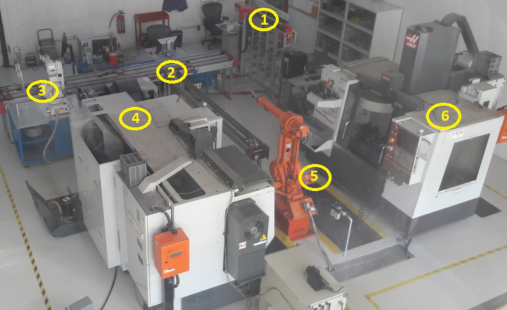
COMPONENTS OF THE CYBER-PHYSICAL SYSTEM The cyber-physical system connects the equipment in the manufactur- ing cell to each other and also sends monitoring signals from the same equipment to remote digital devices. The equipment in the manufactur- ing cell is: 1) an ASRS, 2) different conveyor belts, 3) an IRB140 ABB robot, 4) a Haas ST20 CNC lathe, 5) an IRB1200 ABB robot, 6) a Haas VF2 CNC milling machine and an Allen Bradley SLC 500 PLC (see Figure 1).
Figure 1: Manufacturing cell used.
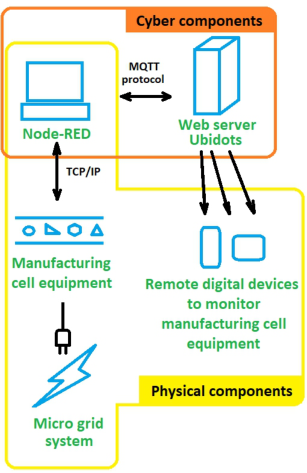
The equipment in the manufacturing cell is connected to the Node-RED application through the TCP/IP protocol, which communicates with a web server (Ubidots) through the MQTT protocol. The server sends monitor- ing data from the different equipment in the manufacturing cell to remote digital devices such as Workstations with a 2.71GHZ Intel Xeon E-2176M processor with 16 GB of RAM (see Figure 2).
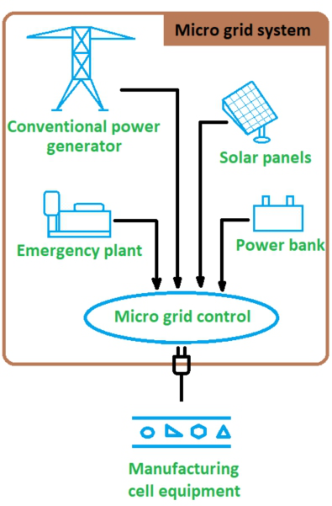
The power supply system for the different equipment in the manufacturing cell is through a micro grid system (see Figure 3). The general power supply is through a conventional power generator; an array of solar panels pro- vides approximately 20,000 KWH per year. There is also a 1250 kW diesel emergency plant and a small power bank of ten 12v 300Ah batteries each.
Figure 2: Cyber-physical system.
A Manufacturing Cell Working in a Cyber-Physical Environment 227
Figure 3: Micro grid for the power system.
METHODOLOGY
Manufacturing Cell Users Each semester, the approximate number of users is sixty-five students from the sixth semester of Mechatronics Engineering. During the same period, the manufacturing cell is used on average 36 hours a week. The labora- tory is open 12 hours daily for six days, from Monday to Saturday. During vacations, maintenance is carried out on the different equipment in the manufacturing cell unless some equipment fails during the semester. The main physical failures are the breakage of the CNC cutters and rarely any slight impact of the industrial robots with an obstacle. The most common shortcomings at the communications level occur between the Node-RED application and the web server (Ubidots). Fortunately, failures in the micro- grid are minimal, mainly when electrical storms arise; they are brief, and the power supply is restored quickly. Maintenance of the micro grid system is also scheduled at the end of each semester.
Objectives of the Research Study The purpose of this research is 1) to share the experiences and opinions of users when using an automated manufacturing cell that works in a cyber- physical environment powered by a micro grid system and 2) to show the survey results of the users in order to identify their perception regarding oper- ating this type of system and 3) make suggestions so that these systems can be replicated or implemented in other facilities.
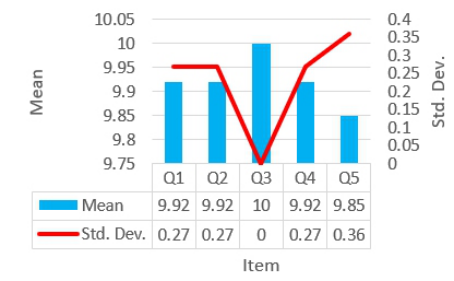
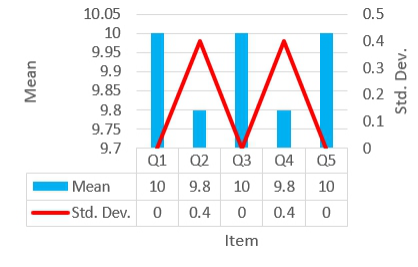
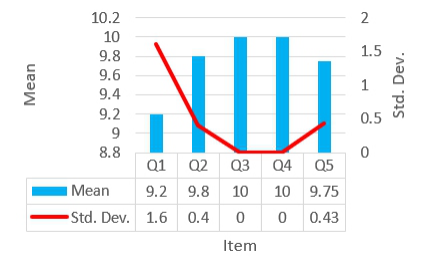
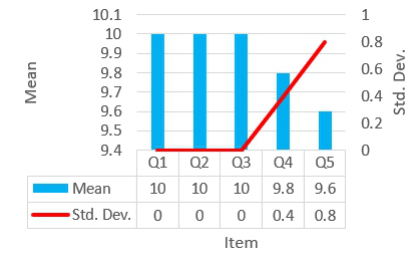
Analysis of Surveys and Opinions The application of surveys was carried out twice in 2022 and two other times in 2023. Table 1 shows the size of each sample. All participants were Mechatronic Engineering students taking the Manufacturing Systems Automation subject in the sixth semester. To encourage response to the sur- veys, it was decided to include only five questions since it has been detected that students are generally not motivated to participate in surveys. Table 2 shows the survey questions. The response scale goes from 0 to 10, with 10 being the highest value. Figures 4 to 7 show the results of the four surveys applied; they contain the average and standard deviation of each response.
Table 1. Information from each survey.
Table available in the original PDF paper.
ID-Survey Number of participants Survey 1–2022 29 Survey 2–2022 20 Survey 1–2023 20 Survey 2–2023 20
Table 2. Survey items.
Table available in the original PDF paper.
Definition Item number Q1 The configuration of the manufacturing cell and its electrical energy supply facilitate using the different equipment Q2 This type of installation develops new skills in users Q3 The cyber-physical system and the micro grid provide a safe and reliable environment Q4 The help programmed in the digital applications of each device is helpful in resolving problems that arise Q5 In general, the incorporation of cyber-physical systems and micro grids in manufacturing cells is essential
Figure 4: Survey 1-2022.
A Manufacturing Cell Working in a Cyber-Physical Environment 229
Figures 4 to 7 show that the four surveys harmonize with item Q3; that is, users believe that the cyber-physical system, together with the micro grid, provides a safe and reliable environment. The users of the surveys in Figures 5 and 7 agree with item Q1, believing that the configuration of the manu- facturing cell and its electrical energy supply facilitate the use of the different equipment. In contrast, the surveys in Figures 4 and 6 disagree. On the other hand, the surveys in Figures 5 and 6 coincide with item Q5, which refers to the fact that incorporating cyber-physical systems and micro grids in manu- facturing cells is essential. The survey in Figure 5 shows a sawtooth-shaped
behavior in the standard deviation and the mean of its responses, wherein items Q2 and Q4, they consider that this type of installation does not develop new skills in users and that the help programmed in the digital applications of each device is not useful to solve the problems that arise.
At the end of the survey, users were asked to comment on the cyber- physical system and the micro grid (see Table 3). Two areas of opportunity were detected: In Survey 1-2023, it is mentioned that the configuration of the cell makes its use difficult; this may be due to the high number of equipment used in the manufacturing cell. It would be necessary to find a way to simplify its programming since each piece of equipment requires different variables and uses other languages. The comments from Survey 2–2023 indicate that the help programmed in each device’s digital applications is sometimes not very useful; it should be made more user-friendly and expanded to have a more significant number of options to solve different failures that may occur.
Table 3. General comment about the cyber-physical system and the micro grid.
Table available in the original PDF paper.
ID-Survey Comments obtained Opportunity for enhance Survey 1–2022 The electrical power supply is innovative The cell configuration is very reliable Users reaffirm their knowledge when using this technology Survey 2–2022 These types of configurations are necessary for modern automated manufacturing facilities Survey 1–2023 The cell configuration makes it difficult to use ✓ Scheduled assistance is beneficial when communications fail Survey 2–2023 Programming different equipment develops new skills in users Thanks to the cyber-physical system, the use of the other equipment in the manufacturing cell is facilitated Sometimes, the program’s help is not very useful ✓
RECOMMENDATIONS FOR ITS IMPLEMENTATION For the implementation of a manufacturing cell that works in a cyber-physical environment, the following steps are suggested:
1.- Verify the type of communication protocol (TCP/IP, Modbus) used by the different equipment in the manufacturing cell (CNC machines, industrial robots, plc, conveyors). It is recommended that most of the equipment in the manufacturing cell use the same communication protocol; this will facilitate their programming and definition when registering them. 2.- Generate the connection nodes on the Node-RED platform. 3.- Enable communications and variables on the Ubidots web server. 4.- Program remote digital devices to display the monitoring signals pro- vided by Ubidots. 5.- Carry out signals sending tests from the different equipment to be displayed on digital devices.
CONCLUSION
The main advantage of using the cyber-physical system is the elimination of wiring. Each semester, it is about replacing the wired sensors with wireless
A Manufacturing Cell Working in a Cyber-Physical Environment 231
sensors, which allows the signals handled in the different equipment to be better identified.
The main disadvantage is that wireless sensors are more expensive; in addi- tion to this type of sensors, when the Internet fails, there is no way to put the sensors into operation until the Internet signal is re-established.
Another advantage is that by having the signals identified for each sensor, practices can be proposed for students to program applications that read these signals and transform them into valuable data, such as the number of assembled or manufactured parts, production times, and cycle counts., etc.
On the other hand, students can use different programming languages to generate their human-machine interfaces (HMI) and be able to display the required information on the behavior of the different variables of interest.
Another advantage is that the implementation of new sensors is relatively simple as long as they are compatible with the communication protocols of the other sensors.
FUTURE WORK
It is suggested to test new platforms other than Node-RED to create commu- nication nodes and evaluate different web servers (Ubidots) to identify the most efficient ones.
To study the stability and capacity of the cyber-physical system, it is recommended to increase the number of pieces of equipment used in the man- ufacturing cell; in this way, communications and, therefore, the exchange of information will increase.
It is necessary to combine different communication protocols within the cyber-physical system to determine the most stable or recommended for each piece of equipment in the manufacturing cell.
To have greater control of the manufacturing cell and its energy supply, it is proposed to involve the microgrid system within the cyber-physical envi- ronment; thus, its variables can be monitored and, in the future, be able to program some decision-making according to the energy requirements.
ACKNOWLEDGMENT
The authors would like to acknowledge the financial support of Writing Lab, TecLabs, and Tecnologico de Monterrey, Mexico, in producing this work.
REFERENCES
Ahmed, M. R., Hasan, M. R., Al Hasan, S., Aziz, M., Hoque, M. E. (2023) ‘Feasibility Study of the Grid-Connected Hybrid Energy System for Supplying Electricity to Support the Health and Education Sector in the Metropolitan Area’, Journals Energies, Volume 16, No. 4, 1571. https://doi.org/10.3390/en16041571 Chamana, M., Bhatta, R., Schmitt, K., Shrestha, R., Bayne, S. (2023) ‘An Inte-
grated Testbed for Power System Cyber-Physical Operations Training’, Jour- nal of Applied Sciences, Volume 13, No. 16, 9451. https://doi.org/10.3390/ap p13169451
Dosoftei, C-C. (2023) ‘Simulation Power vs. Immersive Capabilities: Enhanced Understanding and Interaction with Digital Twin of a Mechatronic System’, Jour- nal of Applied Sciences, Volume 13, No. 11, 6463. https://doi.org/10.3390/ap p13116463 Fuertes, J. J., González-Herbón, R., Rodríguez-Ossorio, J. R., González-Mateos, G.
Alonso, S., Morán, A. (2023) ‘Guidelines to develop demonstration models on industry 4.0 for engineering training’, International Journal of Computer Inte- grated Manufacturing, Volume 36, No. 10, pp. 1465–1481. https://doi.org/10. 1080/0951192X.2023.2189308 Hamdan, S., Almajali, S., Ayyash, M., Salameh, H. B., Jararweh, Y. (2023) ‘An intelligent edge-enabled distributed multi-task learning architecture for large-scale IoT-based cyber–physical systems’, Journal of Simulation Modelling Practice and Theory, Volume 122, 102685. https://doi.org/10.1016/j.simpat.2022.102685 Jordan, R., Agi, K., Arora, S., Martinez-Ramon, M., Lehr, J. (2021) ‘Peace engi-
neering in practice: A case study at the University of New Mexico’, Journal of Technological Forecasting and Social Change, Volume 173, 121113, 2021. https://doi.org/10.1016/j.techfore.2021.121113 Okuno, H., Sandoval, G., Castillo, R., Merino, D., Cordova, J., Garcia, A. (2023).
Simplified CAD model of a person for the simulation of their movements. In: Jay Kalra (eds) Human Factors in Aging and Special Needs. AHFE (2023) Interna- tional Conference. AHFE Open Access, Volume 88. AHFE International, USA. http://doi.org/10.54941/ahfe1003663 Park, M., Lee, H., Kim, Y., Kim, K., Shin, D., (2022) ‘Design and Implementation of Multi-Cyber Range for Cyber Training and Testing’, Journal of Applied Sciences, Volume 12, No. 24, 12546. https://doi.org/10.3390/app122412546 Popławski, T., Dudzik, S., Szelag, P., Baran, J. (2021) ‘A case study of a virtual power
plant (Vpp) as a data acquisition tool for pv energy forecasting’, Journals Energies, Volume 14, No. 19, 6200. https://doi.org/10.3390/en14196200 Reddy, A. S. K., Abdulkader, R., Reegu, F. A., Tashmuradova, B., Shankar, V. G., Arumugam, M., Ramtirthkar, C. (2023) ‘Industrial manufacturing process based on smart grid data classification with security using deep learning technique’, The International Journal of Advanced Manufacturing Technology. https://doi.org/10. 1007/s00170-023-11340-1 Tiwari, R., Agrawal, P., Singh, P., Bajaj, S., Verma, V., Chauhan, A. S. (2023) ‘Tech-
nology Enabled Integrated Fusion Teaching for Enhancing Learning Outcomes in Higher Education’, International Journal of Emerging Technologies in Learning, Volume 18, No. 7, pp. 243–249. https://doi.org/10.3991/ijet.v18i07.36799 Traganos, K., Grefen, P., Vanderfeesten, I., Erasmus, J., Boultadakis, G., Bouklis, P. (2021) ‘The HORSE framework: A reference architecture for cyber-physical systems in hybrid smart manufacturing’, Journal of Manufacturing Systems, Volume 61, pp. 461–494. https://doi.org/10.1016/j.jmsy.2021.09.003 Umbrico, A,. Orlandini, A., Cesta, A., Faroni, M., Beschi, M., Pedrocchi, N.,
Scala, A., Tavormina, P., Koukas, S., Zalonis, A., Fourtakas, N., Kotsaris, P. S., Andronas, D., Makris, S. (2022) ‘Design of Advanced Human–Robot Collabo- rative Cells for Personalized Human–Robot Collaborations’, Journal of Applied Sciences, Volume 12, No. 14, 6839. https://doi.org/10.3390/app12146839 Yang, J., Li, S., Wang, X., Lu, J., Wu, H., Wang, X. (2023) ‘DeFACT in Manu- Verse for Parallel Manufacturing: Foundation Models and Parallel Workers in Smart Factories’, in IEEE Transactions on Systems, Man, and Cybernetics: Sys- tems, Volume 53, No. 4, pp. 2188–2199. https://doi.org/10.1109/TSMC.2022. 3228817
LISTED IN THE AHFE DIGITAL BOOKSTORE CATALOGUE
Explore the complete digital volume
Emerging Technologies and Future of Work
Read this individual research paper free through the original publisher, or explore the full digital proceedings book.
ISBN 978-1-958651-93-3
Explore this ISBN in the AHFE Bookstore ↗Listed in the July 2026 bookstore catalogue; search by ISBN to confirm current availability · Digital book purchase optional