Shuwen Qiu, Zixuan Huang, Ren Long (2023). Exploring the Application of Virtual Digital Human in the Transmission of Food Culture. In: Human-Centered Metaverse and Digital Environments. AHFE Open Access, vol. 99, pp. 10–17. https://doi.org/10.54941/ahfe1003926
Food culture is an important branch of traditional Chinese culture, and it is an important medium for carrying civilization, memory and emotion. With the development of the Internet era, traditional food culture is gradually facing various challenges. First of all, the spread of traditional food culture is breaking down, impacting the information content of the public's exposure to food culture. Secondly, due to the rapidly accelerating pace of life, young people gradually lack initiative in acquiring food culture content, focusing more on the taste and preparation of food, making it more difficult to access the deeper food culture heritage. Thirdly , the input of multiple cultures has brought impact to traditional culture, and the living space of traditional food culture has been compressed.Currently, virtual digital humans are widely used in the meta-universe ecology, in which they take on the important role of producing and disseminating information, so virtual digital humans play an irreplaceable role in the inheritance of food culture. Through market research and other methods, this study finds that the existing culture transmission class platforms lack certain fun and initiative; through literature analysis method, experimental method, interview method and questionnaire method, it aims to prove that virtual digital human can play the role of connecting culture and life, and it can transmit the traditional Chinese food culture in a more amiable way.
The research background of this paper includes two aspects, one of which is the problems of recipe APP; the other is the emergence and development of virtual digital human. The widespread use of virtual digital people brings new opportunities for the transmission of food culture.
Taking recipe APP as an example, we analyze the three APPs on the market from six dimensions (see Table 1). We can find that most of them are biased towards practicality and lack interesting functions. There is a fault line betw- een food and culture, and the culture is too single, not comprehensive enough, and less food culture is involved.
Exploring the Application of Virtual Digital Human in the Transmission of Food Culture 11
many advertisements
Too many
categorized pictures,
trouble to find
practice of dishes
and clear information Over-functional, with
platform for food
exchange
is more detailed Less variety in the
rich and bright colors Detailed classification
orange There is a community
many tabs on the
home page
navigation is too long Black and white Cooking information
duplicated. Click-oriented, too
is not sufficient Simple Click colorless, with a little
simple and real Click, secondary
The content of the
board is very detailed complicated and
Rich content with a
food community The video instruction
Video tutorials with
illustrations and text The functions are
Table 1. Recipe APP market research analysis.
Table available in the original PDF paper.
APP Content planning Use experience Interaction Vision Advantages Disadvantages
In recent years, the term “metaverse” has come to the forefront of the public’s mind. The metaverse is an idea that originated in Neal Stephenson’s science fiction novel Snow Crash, which was published in 1992. The term “metaverse”combines the prefix “meta”with the word “universe”and refers to the concept of a virtual universe of linked, persistent, interactive, shared 3D virtual spaces. Concept (Mustafa Murat Inceoglu, 2022). Virtual digital human is an important part of the meta-universe. It is a com- prehensive product that exists in the non-physical world, created and used by computer means such as computer graphics, graphic rendering, motion capture, deep learning, and voice synthesis, and has multiple human chara- cteristics. In the future, the virtual identity in the meta-universe may become a new consumer subject (Jing Zhang, 2022).
Since Xinhua launched the world’s first AI-synthesized virtual anchor, virtual digital people have appeared in industries such as entertainment, fina- nce, government, home, retail and education. For example, in the financial sector, in April 2019, Pudong Development Bank launched an AI-driven 3D financial digital person——Xiaopu; in the entertainment sector, during the “Double Eleven” in 2021, Racer launched the first official e-commerce virtual anchor——Xiaofang Guan; In the service sector, on January 7, 2022, Shangmei Life released the first virtual digital person in the hotel industry——Xiaomei Shang. In the field of culture, the virtual digital person also has unlimited possibilities due to its unlimited qualities.
A large number of virtual digital people emerged as the guide of the meta- universe, which will further go into the physical society and form a world of virtual-real symbiosis, making it possible to personalize the image of virtual digital people in the inheritance of Chinese food culture (Chaoqun Wang et al., 2022).
Purpose and Significance of the Study Food culture is an important branch of traditional Chinese culture, and it is an important medium for carrying civilization, memories and emotions. In this modern society where the Internet is popular, people can access informa- tion and entertainment through the Internet. At the same time, the traditional food cultures are gradually facing various challenges (Songqi Zhan 2022). The purpose of this paper is to demonstrate the role of virtual figures in con- necting culture and life by combining them with traditional Chinese food culture in a more amiable way.
The purposes are as follows: (1) Due to the rapidly accelerating pace of life, young people gradually lack the initiative to acquire food culture content, focusing more on the taste and preparation of food, and less likely to be exposed to the deeper food culture underpinnings. The virtual digital human has strong interactivity, which can truly integrate users into the rich visual style and interesting picture details, and awaken people’s cultural awareness of traditional Chinese art. (2) It allows people to enhance the realism, fun and interactivity based on traditional Chinese cultural themes by interacting with the virtual digital human, so that the audience can be better immersed in Chinese food culture.
Exploring the Application of Virtual Digital Human in the Transmission of Food Culture 13
The significance is as follows: (1) Finding a younger and trendier interactive way to show the unique charm of Chinese food culture. (2) Break the traditional recipe APP’s single interaction method and enhance cultural communication. (3) Develop the use of virtual digital people in new directions.
LITERATURE REVIEW
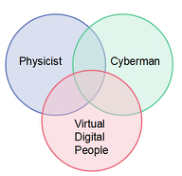
Definition of Virtual Digital People With the addition of the metaverse, the subject of information dissemination can be divided into physical people, virtual digital people and cyborgs (see Figure 1).
Figure 1: Subject of information transmission.
The physical person is the real physical body of existence, it is the key to information dissemination activities. Cyberman has physical existence and artificial intelligence augmentation. The virtual digital human exists as a digi- tal doppelganger of a real person, or is artificially injected with technology to give personification characteristics. Its non-physicality, controllability and personification characteristics break through the communication effect that cannot be achieved by the physical human body.
Characteristics of Virtual Digital People (1) Virtual digital people coexist in the metaverse between the real and the virtual, crossing the boundary between the real and the virtual for information dissemination activities. (2) The virtual digital human coexists with the digital human in heterotem- poral space, re-cutting and splicing time and space in a non-linear flow of space-time to provide a co-temporal information experience. (3) The intelligence of the virtual digital human and artificial intelligence, complete with the interactive integration of different technologies.
These qualities determine the virtual digital human as an essential core participant of human information dissemination activities.
INTRODUCTION
In recent years, more and more “Z-generation” people are interested in Chinese culture. With the advantage of natural flow and hotspots, digital
avatars increase emotional attributes, add warmth to services, establish con- nections with objects, and provide emotional values, which are more likely to meet the aesthetic and identity projection of the “Z generation”.
The traditional food of the old generation is weak among young people, and young people prefer fast food. In addition, in TV, cell phones, books and magazines, the public can only see the surface, but not eat the taste, and cannot be immersed in it.
In terms of cultural heritage, virtual digital people are gradually used in many fields, but there are fewer studies related to food culture. In this paper, from the perspective of virtual digital human, taking the cultural recipe class APP as an example, we give the virtual digital human the persona of Chinese national culture characteristics, explore the new interaction design experie- nce of Chinese food interaction platform, design experiments, and analyze the test subjects’ attitude towards virtual digital human in food culture inhe- ritance through questionnaire method and interview method. Based on this, this study proposes the following research questions.
(1) Can virtual digital people better transmit food culture? (2) Are people more willing to accept the transmission of food culture mediated by virtual digital people?
EXPERIMENTAL DESIGN Experimental Subjects
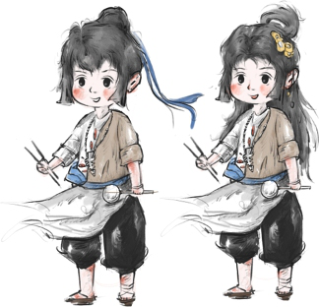
Object A: Establish a recipe class APP with Mei Yuan ‘s literary work “Suiyuan Food List”,and build a two-dimensional virtual digital person - Yuanyuan (see Figure 2), who is positioned as a gluttonous little book boy beside Mei Yuan and a food recommendation officer of the APP.
(1) The virtual digital person is mainly in ink and wash style, which can guide users to immerse themselves in experiencing the cultural stories behind the food.
Figure 2: Virtual Digital People - Yuanyuan.
Exploring the Application of Virtual Digital Human in the Transmission of Food Culture 15
(2) Through the form of changing hair, Yuan Yuan is able to change gender to better adapt to user needs. (3) Through the form of completing tasks to obtain exclusive props for the virtual digital person, users can customize a unique image of the virtual digital person to gain interaction between the virtual and the physical. (4) Chinese traditional colors are chosen in the color to make it more in line with the theme.
Object B: Conventional food and culture APP on the market.
Experimenter In this experiment, we focused the questionnaire on young people aged 10–28 with cooking needs that fit the characteristics of the target user group, in order to obtain more informative raw data.
Experimental Steps Step 1: Instruct participants and inform them of the purpose of our experiment, which is to explore the role of virtual digital people.
Step 2: Provide a comfortable experimental environment, issue a special cell phone, use the B APP for 10 minutes, and record your feelings.
Step 3: Take a 20-minute break to minimize the impact of the previous step on the participants.
Step 4: Provide the same comfortable experimental environment, issue a special cell phone, use App A for 10 minutes, and record your feelings.
Questionnaire
Table 2. Questionnaire.
Table available in the original PDF paper.
NO 1 2 3 4 5 YES
Are you interested in the culture behind the food? NO 1 2 3 4 5 YES Do you think the existing food culture APP lacks fun? NO 1 2 3 4 5 YES Do you think virtual digital people can better pass on food culture?
NO 1 2 3 4 5 YES
Would you like to try a food culture APP with a virtual digital person?
Interview Questions The interview questions consist of open questions and 10-point scale questions.
Table 3. Interview questionnaire.
Table available in the original PDF paper.
NO 1 2 3 4 5 YES
How does Experimental subjects-A make you feel,please summarize in 3 words. How does Experimental subjects-B make you feel,please summarize in 3 words. Has the use of virtual digital people made you feel more intimate? NO 1 2 3 4 5 YES Would you prefer to try a food culture APP with a virtual digital person?
RESULT
Demographic Data A total of 127 questionnaires were distributed, of which 85 were valid, and all questionnaires were filled out with feedback based on their own feelings.
Reliability analysis Use SPSS 25 as a tool for statistical data and predictive analysis.Perform reliability analysis on all variables.
Equation reproduced from the original PDF.Table 4. Reliability statistics.
Table available in the original PDF paper.
Reliability statistics Cronbach’s α Number of terms
.717 4
Descriptive Analysis (1) Question 1 has an average score of 3.72, most people are interested in the culture behind food and drink. (2) Question 2 had an average score of 4.03, with most people believing that the existing food and culture apps lacked fun. (3) The average score of question 3 was 4.22, and most peo- ple thought that virtual digital people could better transmit food culture. (4) The average score of question 4 was 3.22, and most people were willing to try the food culture app with virtual digital people.
Interview Results The results of the interviews with the three representative users are as follows.
The majority of interview users affirmed the positive impact of virtual digital people in the transmission of food culture.
Exploring the Application of Virtual Digital Human in the Transmission of Food Culture 17
Table 6. Interview results.
Table available in the original PDF paper.
User 1 User 2 User 3
1. Fun, easy to understand, proactive
Easy to understand, approachable and fun
Friendly, fun and lively 2. Generally, profitable, practical
Commercial, convenient and uninteresting
Practical, clean and easy to use 3. 4 5 3 4. 4 5 4
CONCLUSION
In summary, the virtual digital human can complete the creativity that can- not be done by real people under normal conditions (Songqi Zhan, 2022), build the virtual world “people-goods-field”, and open up online and offline business links and transformation. At the same time, the sense of intera- ction makes users feel real, which can meet the needs of contemporary young people’s user experience and willingness to interact. From the questionnaire method and interview method, it can be found that: actively exploring the industrial development and application of traditional culture in the scope of ‘meta-universe’ and inheriting the virtual digital people of national cul- ture can help promote the excellent Chinese traditional culture, make it new vitality and vigor, and let the traditional culture find a new channel to communicate with the contemporary audience (Yi Qin, 2022).
ACKNOWLEDGMENT
This article is my first exploration in interaction design with my partner, thanks to the step-by-step guidance from my teacher.
REFERENCES
Chaoqun Wang, Zhang, Jie. (2022) A new species of the genus Phyllostachys (Hymenoptera, Braconidae) from China. A study on the application of virtual digital human in Chinese traditional culture transmission. News Tide (11), 27–30. doi: Inceoglu, M. M., Ciloglugil, B. (2022). Use of Metaverse in Education. In: Gervasi,
O., Murgante, B., Misra, S., Rocha, A. M. A. C., Garau, C. (eds) Computational Science and Its Applications – ICCSA 2022 Workshops. ICCSA 2022. Lecture Notes in Computer Science, vol. 13377. Springer, Cham. https://doi-org-s.lib.hust. edu.cn:443/10.1007/978-3-031-10536-4_12 Jing Zhang (September 62, 2022). Virtual digital people landing in the fertile ground of metaverse. China Culture News, 007. Peng Lan. (2019). The Digital Survival of Human Beings in the Age of Intellige-
nce - Separable “Virtual Entities”, “Digital Components” and “Embodiment” that Will Not Disappear.” News Reporter (12), 4–12. doi:10.16057/j.cnki.31– 1171/g2.2019.12.002. Songqi Zhan. (2022). Research on the application of game interaction design in food culture communication (Master’s thesis, Lu Xun Academy of Fine Arts). Xiaobin Jiang (November 11, 2022). Virtual human carrying Chinese culture in the
meta-universe sea out. China Youth Daily, 004. Yi Qin (July 25, 2022). Virtual digital person “Qin Xiaoya”: Being a good recommendation officer of Qin cavity art. China Culture News, 003.
LISTED IN THE AHFE DIGITAL BOOKSTORE CATALOGUE
Explore the complete digital volume
Human-Centered Metaverse and Digital Environments
Read this individual research paper free through the original publisher, or explore the full digital proceedings book.
ISBN 978-1-958651-75-9
Explore this ISBN in the AHFE Bookstore ↗Listed in the July 2026 bookstore catalogue; search by ISBN to confirm current availability · Digital book purchase optional