Yawen Chang, Wei- Chi Chien (2023). Memories-to-go: A remote interactive experience for parents and their overseas adolescent children. In: Human-Centered Metaverse and Digital Environments. AHFE Open Access, vol. 99, pp. 18–28. https://doi.org/10.54941/ahfe1003927
Due to the COVID-19 pandemic, many people haven’t returned to their hometowns for several years. It also makes people pay more attention to long-distance interaction. Online meeting platforms these days expand their function beyond just face-to-face meeting but also uses virtual space to make them more interactive. More and more platforms provide a proximity video chat. People can walk in and out of conversations in their avatars. That makes people feel natural and seamless in virtual space.As a place preserved the lifestyle of local people, we found the traditional market is a meaningful place that reminds people of their hometowns. Most people have the experience going to the market with their family in their childhood. Thus, this study focuses on the parent-child memory in the market. By collecting the information of people’s memories, making them into Gather town, it provides remote interactive experiences for parents and their overseas adolescent children uniquely. Memories-To-Gather is a Gather Town space that makes people to experience the traditional market. Not just visiting an online market, but to bring the memorable time to their mind. Offering the possible solution for recalling memorable moments is based on the scene transition in virtual place. By collecting and integrating the stories of the participants, we transform these stories into scenes. Guided by the map, participants complete the tasks and slowly unravel the story line. Memories-To-Gather is designed for people to remind those family times in the market with elements of play, experimentation, and collaboration in the digital environment. There are two main research questions for this study:1. What kinds of parent-child interactions in the market are meaningful and worth discussing?2. How does a remote interactive experience trigger people’s memory and emotion?To answer these questions, we started a series of interviews to collect people’s memories in the market with their family. Participants are prompted to share their memorable moments when they went to the market with family via describing and drawing. Through field research, we also entered the market, which allowed us to better understand place and atmosphere in reality of the market, then report it based on our experiences. At the end of the research, we invited five pairs of overseas students and their parents to take part in the Memories-To-Gather in Gather Town’s experience and conducted interviews after the experience. Based on the analysis of our interview, we got the following conclusions: Gather town is an user-friendly tool which is easier to operate and get started. The 2D pixel style has a retro style and makes people feel they are brought back to the past. Memories-To-Gather breaks the barriers of space and distance, the collaboration in the platform enhances long-distance interactions within family members. The local style in the scene, story development and character interaction remind them of the experience in their hometowns. It triggers memories for young people in these days and change the perspective of traditional market. Memories-To-Gather provides a place of peace of mind, it helps people find comfort in this era of uncertainty. In the future research, we’re expecting that remote interactive experience will be more widely used in education or other fields. After the study, we are looking forward to seeing traditional market as more than shopping, but a place where culture and memories are preserved for younger generation as well.
In recent years, the number of people studying or working overseas has increased significantly (https://trends.google.com.tw/trends/explore?date =2004-01-01%202023-02-24&q=go%20overseas). At the same time, under the impact of epidemics in the past few years, transportation and traveling have been restricted. People began to try out the possibilities in the metaverse. However, within so many virtual spaces, the actual meaning of staying in one space is challenging (Circle, n.d.). Therefore, we are interested in making a virtual space with specific meaning to its user, and in this study, we want to recall people’s memories of their hometown through a designed online virtual space. and discuss how these senses of belonging to their hometown affect overseas travellers and their interactions with their families. Belonging, a vaguely defined and poorly theorized concept, is a personal, intimate feeling of being “at home” in a place (belonging to a place) (Antisnitch, M., 2010). According to Larch (1991), “memory draws hope and comfort from the past to enrich the present”, which is different from “nostalgia” for a hometown,
Memories-to-Go: A Remote Interactive Experience 19
not just the pain of not being able to return home, but a sense of belonging based on the memory of hometown Provide a positive influence on overseas travelers and have the power of stability in the face of the challenges of the new environment. People capture and observe emotions about places through memory and knowledge (Degnen, C., 2016). Gustafson (2006: 19) defines place attachment as “the interactive relationship between people and places based on emotion, cognition, and behavior”. When the bonds between people and places become stronger, people feel a sense of belonging. Place attach- ment is a connection based on memory, usually a relationship, an object, or a childhood memory. Most of them are abstract thoughts or feelings. The emotion for the place may be directly connected to the family because it is strengthened by the miss of an important relationship. Links to places. A sense of belonging to the past can be sustained through the abstract emoti- ons of memory and give more power to the time or space in the present (May, 2017). Thus, this article contributes to our understanding of how people use memory to create a continuous sense of self. The contribution of this paper is twofold: exploring users’ experiences in online spaces and analyzing Gather Town’s creativity and constraints and capabilities for interaction. Discuss the connection and impact of those who have left their homeland, their family, and their home memories. We hope our results will be of value for future interactions using online platforms.
RELATED WORK
Susan L. (1992) explored the concept of nostalgia, in the article understan- ding themes related to nostalgic experiences and the results of exploratory research on emotions. The study found that common themes associated with nostalgia included family, friends, and childhood memories, while shared emotions included joy, longing, and warmth. The authors also found that the intensity of nostalgia varied according to the emotional significance of the memory, the time experienced, and the personality of the individual. The article concludes with a discussion of the implications of these findings for understanding the psychological and social functions of nostalgia. The authors argue that nostalgia is a way for individuals to maintain a sense of continuity and identity over time, which can foster social connection and pro- vide life with a sense of meaning and purpose. This article provides insights into the themes and emotions associated with nostalgia and highlights the potential benefits of nostalgia for individuals and societies.
In the application of Gather Town, the research direction is mostly on online curation, online multi-person activities, or educational applications. For example, in the research of Celine Latulipe (2022), they conducted inte- rviews on the experience of artists, curators, and technical experts, and explores the process of curating and exhibiting interactive art in Gather town. Provides us with a case study of a virtual conference in curating an interactive art exhibition, and also contributes insights into online curation, interactive art, and the potential of engaging audiences in innovative ways. In addi- tion, in the article of Sangkyun Kim (2022), the potential of using gaming experience to promote sustainable learning in Metaverse is explored, through
20 Chang and Chien
different types of virtual worlds, providing a gaming experience for sustai- nable learning. The authors argue that play experiences have the potential to engage learners and promote sustainable behaviors in a more effective way than traditional educational methods. However, they also acknowledge that designing game experiences for sustainable learning in the Metaverse is com- plex and requires careful consideration of factors such as user motivation and feedback. The article concludes by emphasizing the importance of desi- gning gaming experiences for sustainable learning in the Metaverse, which can facilitate more engaging, effective, and sustainable learning.
Based on the above three, this article attempts to use the online platform Gather Town as a medium to explore the impact of memory and emotions on people. It is not simply to create an online virtual space. We expect people to interact with the scene to trigger their memories of their hometown.
METHOD
Designing of Memories-To-Go Gather Town is an online platform that allows users to create virtual spaces where they can interact with others using customizable avatars. The design process of the space in Gather Town involves several steps:
Conceptualization: The first step is to conceptualize the idea of the space that will be created. This includes determining the purpose of the space, the intended audience, and the activities that will take place there.
Sketching: The next step is to sketch out a rough layout of the space. This includes determining the size of the space, the location of different elements such as walls, doors, and windows, and the placement of furniture or other objects.
Creating a 2D Map: Once the sketch is complete, it is converted into a 2D map that will serve as a blueprint for the virtual space. This map will include all the elements of the space and will be used to guide the actual creation of the space in Gather Town.
Building the Space: The next step is to build the space in Gather Town using the 2D map as a guide. This involves placing walls, doors, windows, and other elements in the virtual space using the Gather Town editor.
Adding Objects: Once the basic structure of the space is in place, objects such as furniture, decorations, and interactive elements can be added to the space. These objects can be customized to suit the theme of the space or to provide specific functionality.
Testing and Refining: Finally, the space is tested to ensure that it is functi- onal and that users can navigate it easily. Any issues are identified and addressed, and the space is refined until it meets the desired specifications.
The process of designing a space in Gather Town involves a combination of conceptualization, planning, and hands-on creation using the Gather Town editor.
The author created the Memories-To-Gather virtual space on Gather Town, a long-distance social platform. During the video conference, there can be a game-like experience. The subjects can walk, talk, and interact in the virtual space. We chose Gather Town as our platform because of its rich
Memories-to-Go: A Remote Interactive Experience 21
interactive functions and easy-to-use interface. Not only can the subjects get started quickly, but the researchers can also adjust the configuration of the space arbitrarily.
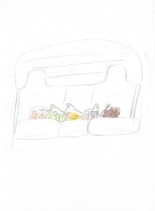
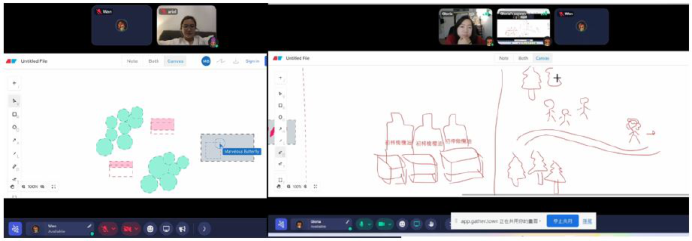
Idea Collection via Interview As a place that preserves the way of life of the local people, we found the traditional market to be a meaningful and representative space that reminds people of their hometowns. Moreover, most of us have had the experience of going to the market with our family as a child. Therefore, we conducted interviews to collect parent-child memories in the market. We interviewed 7 participants to collect their memories and experiences of the market as a source of information for the future construction of Memories-To-Gather. Of these interviews, three were online and four were in-person. During the interview, some people mentioned that their impression of the market is to help carry vegetables, ask for toys with family members, slip and fall in the market, etc. In retrospect, it makes people feel funny but very warm. The subjects also mentioned that if there will be children in the future, I will take my children to the market just like when I was a child. Finally, we also asked the subjects to draw their impressions of the market.
Figure 1: Subjects draw pictures of scenes from their memories (2022).
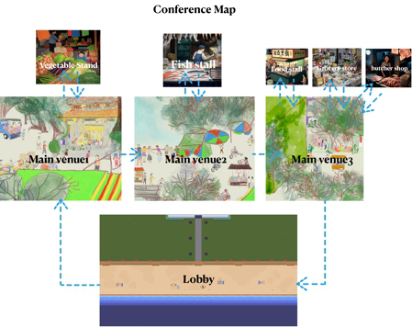
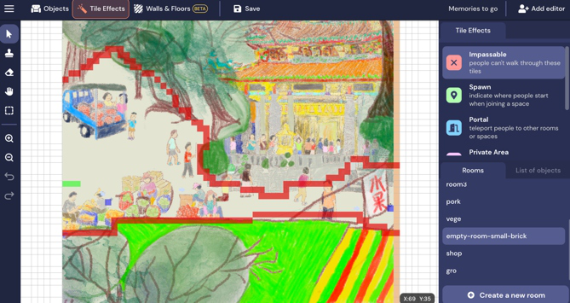
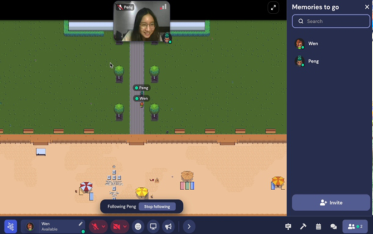
Space Design In the space design of Gather town, we deliberately enlarged the background to make the characters relatively smaller. The “small” avatars shuttle in the background, and they can feel that they are participating in the “third perspe- ctive”. In addition, we also believe that memories are always a little far away from now, and hope that through this “third perspective” method, the parti- cipants can walk into their own memories. There are three main venues and five sub-venues in this virtual space. According to the author’s arrangement, it is hoped that the tastes can experience the real feeling of shopping in the mar- ket, different street scene changes, and locomotives and vendors on the streets of Taiwan. Experience The feeling of an online virtual marketplace. We also designed some barriers, so that the subjects can walk according to the desi- gnated route, and follow the prompts of the arrows on the screen to find the correct direction to enter the portal and go to the next space. And press x to interact with the characters on the screen. Different from the original 2D pixel style of gather town, the author uses illustrations to describe the scene in the
22 Chang and Chien
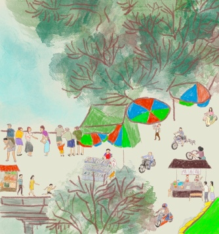
market more delicately, just like walking into a picture book, so that partici- pants can appreciate each scene in more detail. Based on the above-mentioned stories collected from the interviewees, many scenes that everyone may have experienced, such as riding a motorcycle, crowded crowds, and temples next to the market, etc., the author hopes to let the participants through these pictures, scenes, and sounds Can resonate and then associate with my own childhood experience of interacting with family members. We have also desi- gned some levels through Genially, hoping that the experience can have more interactions besides being able to walk in the space. In the beginning, we displayed the stories and illustrations collected in the previous interviews in the space, allowing participants to browse and also serving as a guide for this experience. We have also designed some simple answer quizzes, and they can enter the next scene only after passing the level.
Figure 2: Map of online conference space in Memories-to-go. Attendees could navigate by moving their avatars through the space. Dashed lines represent portals connecting rooms. (2023).Figure 3: Barriers and routes designed in Memories-to-go. (2023).
Memories-to-Go: A Remote Interactive Experience 23
Figure 4: Illustration scene in Memories-to-go. (2023).
USER TEST The main purpose of this interview study is to understand the experience of the respondents on the online near-platform Gather Town and the discussion of their hometown memories.
The author invited six overseas students to participate in the interviews of this study. The purpose of the overseas students is to discuss whether the memories of their hometown have an impact on them when they are away from home. The entire interview was conducted online, through “Line” calls and “Gather Town” experience, and screen recording and audio recor- ding. The interview lasted about 1.5 hours. The author first interviewed the participants with individual materials, then conducted the Memories-To-Go experience, and finally gave feedback and interviews after the experience. The interview data is analyzed and coded by the author to further understand the interview content and gain deeper insights.
As mentioned above, we interviewed six participants. Five are students from Taiwan who went to study in Zhejiang, Heidelberg, London, and Philadel- phia respectively, one is a student from Zimbabwe who went to Taiwan to study, the quotations of Taiwanese students are classified as A1, A2...A5, and one from Zimbabwe Citations for Bahrain International students are classified as B1.
24 Chang and Chien
Overall Experience Respondents said they generally enjoyed their Gather Town experience, which brought memories back home. Overall, the participants found the experience fun and interesting, with only a few technical issues. The average time spent per player is 34.8 minutes.
Reminiscing Experience The online market experience reminded the subjects of some of their own experiences in the market. Our detailed conversation analysis identified a number of recurring concepts that reflected the experiences of the respon- dents. We present these concepts below, with example citations.
1. Reminiscent of going to the market with your family:
After the experience, the participants can naturally think of their previous experiences, especially since most of them mentioned that the experience of going to the market for the first time was with their families. These experie- nces of getting along with family members are commonplace and insignificant daily chores, such as going grocery shopping together or going for a walk together, but these participants can feel steadfast, stable, calm, and warm through these memories.
“If my mother rarely wants to cook, she may go there to buy some food. Then she will buy breakfast.” A1 “There is a small market near our home, and it seems to have no name” A3 “I go to the central market of the Chéng Huáng Temple most often, and then I go with my parents. I go with my dad more often, just to buy vegetables” A2
“To drive somewhere, and we would have no idea where we’re going with this. Just follow, yes, and for us, it was really exciting.” B1 “As long as he is free, I will help him carry things like this, and then go shopping by the way” A5
2. The smell of the market:
The visual presentation of the picture reminds people of olfactory memory. Participants said that during the experience, the fish vendors on the screen reminded them of the smell of going to the market. The sense of smell can immediately evoke a series of memories. Long-lost memories also have the opportunity to find clues by smell.
“The smell of water, a little bit, the fishy smell is okay.” A1 “Then the water will flow to the ground, and then the place will smell very fishy” A4 “Actually, although it doesn’t look very bright, it doesn’t smell very bad, and it’s pretty clean,” said A2.
3. Food at the market:
Food culture is an integral part of Taiwanese culture. In addition to buying ingredients for cooking, people go to the market to eat local traditional deli- cacies from small vendors in the market, which is also a common memory of
Memories-to-Go: A Remote Interactive Experience 25
many people. Interestingly, we learned from the interview that eating together is not just a simple way to fill the stomach, but also a social activity for people to exchange emotions. Although people can have meals with distant family members through video conferences. This way still can’t meet the needs of people having meals with their families.
“It’s just eating together, because our family is more like eating out, and we don’t usually cook together,” A1 “Long-distance means that there is no way to have some physical intera- ction. Maybe you are in a bad mood and your sister gives you a hug. Or eat together, which is closer to the interaction in life” A1
“There will be purple rice balls, and the purple rice balls are delicious,” A1 “Buy pork ribs, then wonton soup, and sometimes I will buy some ready- made ones, such as drunk chicken or side dishes. There is also fried rice. There are also rice dumplings “ A2 “Every time I go with my mother, I will think about buying Yakult from him” A3
“There is a fruit stand with bananas hanging from it” A4
4. Voice of the market:
People describe the sounds in the market as particularly emotional, remi- niscent of the traditional market full of human interaction and humane feelings. The market is always full of the sounds of vendors hawking, the sound of motorcycles passing by, and the sound of children crying. These voices are not necessarily pleasant voices, but warm voices in people’s memory.
“It’s very dense and noisy, and everyone is asking for prices” A3 Technologist Reflections
During the experience, some testers were at a loss because they couldn’t find the right direction, and some testers were able to handle it after many attempts.
“I didn’t know at first, I thought it was a bug in the program” A1 “There are no clear paths on the map, a little help is needed” A3
DISCUSSION
The experience on Gather Town does trigger people’s associations with memories, which is also in line with our expectations for Metaverse. Through interaction and experience, people can generate real emotions in the vir- tual space. Memories bring people positive feelings and influences, provide warmth or encouragement to people who have left their hometowns, and may provide people with a sense of belonging or imagination of a better life. The study involved three separate experiments in which participants were asked to experience Memories-to-Go online, then answer a series of questi- ons about their emotions and themes that emerged from their experiences with family and traditional marketplace nostalgia.
In the first part, participants are asked to independently participate in the experience in Memories-to-Go and solve various levels without extra
26 Chang and Chien
intervention or guidance during the experience process. Behavioral and emotional responses in online spaces like Go. The researchers found that the guidance of the route needs to be more clear, otherwise the experi- ment will not be able to be carried out smoothly and the purpose of the experiment will be achieved. In the second part, the researchers asked the participants to answer their memories of their own experiences interacting with family members in the market. The most common themes were rela- ted to relationships (e.g., parents, grandparents, babysitter), daily life events (e.g., grocery shopping, eating lunch), and places (e.g., childhood home or hometown). In our study, most of the memories mentioned by people included positive emotions, such as happiness, warmth, and contentment, and were associated with complex combinations of negative emotions, such as sadness, regret, and loneliness. In the third part of the experiment, the researchers used interviews to discuss whether memories or emotions about hometown or family would lead to changes in self-perception. Par- ticipants were asked to share a memorable memory of getting along with family members in the past, and the impact of these memories or experie- nces of getting along with family members in the past on their current life. The results showed that past experiences helped participants have higher self-worth. Overall, the study suggests that remembering is a complex emo- tional experience and that remembering may also have a positive impact on self-identity. Finally, we also ask the subjects to draw the most impres- sive scene after this experience and provide it as information for our future improvement.
Figure 6: Subjects try to draw the scene that impressed them in the experience (2023).
CONCLUSION & FUTURE WORK This article contributes to the understanding of interactive experiences in online virtual spaces, describes the limitations and functions of Gather Town, and discusses the impact of memory on international students with their hometowns and families. Using the creation of pictures and the interaction of virtual space, we aroused the emotional feedback of the subjects, for exam- ple, the participants said this reminds them of the meals they used to go to with their family when they were young. Gather Town also provides a virtual environment that facilitates full online interviews with overseas participants.
Memories-to-Go: A Remote Interactive Experience 27
We learned from the interviews that even if the students go overseas, they still maintain the same lifestyle and interaction with their families. People will not change their original lifestyle and definition of identity because of changes in the environment. Message-based, because it can break through the time difference, it is a more convenient choice compared with calls or video calls. Except that they cannot eat together or have physical contact restrictions, most people think that they still maintain close interaction with their families. When people go overseas, a sense of belonging is very impor- tant. Those memories in their hometown and the memories with family and friends help them to continue to have a positive impact when they are over- seas, whether it is a sense of belonging from family or hometown, or it is the sense of belonging that comes from making friends or building a life circle in a new environment. The connection established with a place can actually provide people with stable strength.
In addition, in Memories-To-Go, we asked the subjects to find the cor- rect route according to the guidance on the screen. Some people began to feel anxious or angry because they could not find the correct direction, and even thought it was an error generated by the system. Some people can find their way by observing the rules of the route through their own groping, which produces the same psychological state as the experience in the physical environment. In the future, we will invite more than two subjects to experie- nce online at the same time to observe their interaction with each other and with the virtual space. We also expect more plot designs to allow partici- pants to have a richer experience. The online environment is very suitable for observing people’s abstract emotional performance in different environ- ments, which opens up new design challenges for studying people’s online experiences in virtual spaces.
REFERENCES
Anthias, F. (2006). Belongings in a globalizing and unequal world: Rethinking translocations. The situated politics of belonging, 17–31. Antonsich, M. (2010). Searching for belonging–an analytical framework. Geography
Compass, 4(6), 644–659. Arcidiacono, C., Procentese, F., & Di Napoli, I. (2007). Youth, community belonging, planning and power. Journal of Community & Applied Social Psychology, 17(4), 280–295. Bianchini, C., Immovilli, F., Lorenzani, E., Bellini, A., & Davoli, M. (2012).
Review of design solutions for internal permanent-magnet machines cogging torque reduction. IEEE Transactions on Magnetics, 48(10), 2685–2693.44 Chianese, A., & Piccialli, F. (2015). Improving user experience of cultural environment through IoT: the beauty or the truth case study. In Intelligent interactive multimedia systems and services (pp. 11–20). Springer, Cham. Cohen, L. (1999). Where it hurts: Indian material for an ethics of organ transplan-
tation. Daedalus, 128(4), 135–165. De Goey, H., Hilletofth, P., & Eriksson, L. (2019). Design-driven innovation: a systematic literature review. European Business Review. Degnen, C. (2016). Socialising place attachment: place, social memory and embodied
affordances. Ageing & Society, 36(8), 1645–1667.
28 Chang and Chien
Edlund, A., Lundström, M., Karlsson, S., Brännström, B., Bucht, G., & Gustafson, Y.
(2006). Delirium in older patients admitted to general internal medicine. Journal of geriatric psychiatry and neurology, 19(2), 83–90. Gotzsch, J. (2006). Product talk. The Design Journal, 9(2), 16–24. Hammersley, M. (2006). Ethnography: problems and prospects. Ethnography and education, 1(1), 3–14. Hirschman, E. C., & Holbrook, M. B. (1982). Hedonic consumption: emerging
concepts, methods and propositions. Journal of marketing, 46(3), 92–101. Holak, S. L., & Havlena, W. J. (1992). Nostalgia: An exploratory study of themes and emotions in the nostalgic experience. ACR North American Advances. Johansson-Sköldberg, U., Woodilla, J., & Çetinkaya, M. (2013). Design thinking:
past, present and possible futures. Creativity and innovation management, 22(2), 121–146. Karana, E., Hekkert, P., & Kandachar, P. (2009). Meanings of materials through sensorial properties and manufacturing processes. Materials & Design, 30(7), 2778–2784. Lasch, C. (1991). Liberalism and civic virtue. Telos, 1991(88), 57–68. Latulipe, C., & Turnbull Tillman, D. (2022, June). Curating Interactive Art for
Online Conferences: Artist, Curator and Technologist Experiences in Gather. Town. In Creativity and Cognition (pp.380–391). Leary, M. R., & Baumeister, R. F. (2000). The nature and function of self-esteem: Sociometer theory. In Advances in experimental social psychology (Vol. 32, pp. 1–62). Academic Press. May, V. (2017). Belonging from afar: Nostalgia, time, and memory. The Sociological
Review, 65(2), 401–415. Park, S., & Kim, S. (2022). Identifying world types to deliver gameful experiences for sustainable learning in the metaverse. Sustainability, 14(3), 1361. Smith, J. B., & Colgate, M. (2007). Customer value creation: a practical framework.
Journal of marketing Theory and Practice, 15(1), 7-23. Souza, T. R. C. B. D., & Bernardes, J. L. (2016, July). The influences of culture on user experience. In International Conference on Cross-Cultural Design (pp. 43–52). Springer, Cham. Verganti, R. (2008). Design, meanings, and radical innovation: A metamodel and a
research agenda. Journal of product innovation management, 25(5), 436–456. Verganti, R. (2009). Design driven innovation: changing the rules of competition by radically innovating what things mean. Harvard Business Press. Verganti, R., Öberg, Å. (2013). Interpreting and envisioning—A hermeneutic
framework to look at radical innovation of meanings. Industrial Marketing Management, 42(1), 86–95.
LISTED IN THE AHFE DIGITAL BOOKSTORE CATALOGUE
Explore the complete digital volume
Human-Centered Metaverse and Digital Environments
Read this individual research paper free through the original publisher, or explore the full digital proceedings book.
ISBN 978-1-958651-75-9
Explore this ISBN in the AHFE Bookstore ↗Listed in the July 2026 bookstore catalogue; search by ISBN to confirm current availability · Digital book purchase optional