Sarah Rudder (2026). Improving System Design by Mapping a Human-Factors Integration (HFI) Ontology to a Model-Based Enterprise Architecture (MBEA) Metamodel. In: Industrial and Systems Engineering. AHFE Open Access, vol. 219, pp. 41–48. https://doi.org/10.54941/ahfe1007774
This paper builds on the author’s previous work regarding domain-specific ontologies (DSO) and its importance in the human-factors integration (HFI) space. Explicit term definitions captured by a DSO allow the HFI vocabulary to be mapped into a model-based enterprise architecture (MBEA). Integrating this terminology into the overall MBEA provides insight into the role that individuals play by considering personnel as a critical system component. Often considered external actors, human resources are typically not accounted for in the original solution design. However, MBEA promises to reverse this trend by implementing the Unified Architecture Framework (UAF). The UAF is composed of various domains and their aspects and is meant to graphically illustrate enterprise concepts such as strategy, operations, resources, personnel, and services in a digital environment. Capturing HFI information in a model improves the traceability of person(s) and organizational concerns, responsibilities, and competencies to highlight gaps that must be addressed. The incorporation of the HFI DSO into an MBEA enhances communication between disciplines and provides transparency for stakeholders. This research demonstrates the feasibility of constructing a DSO based on an HFI body of knowledge; leveraging the Web Ontology Language (OWL), the subject-predicate-object (SPO) approach, and the Protégé ontology editor. It also shows that by importing the OWL file into a concept model, understanding HFI terms facilitates MBEA while maintaining personnel as a critical part of a successful organization. This research identifies areas for improvement of the UAF domain-specific modeling language (DSML) to ensure that it adequately addresses HFI concerns by mapping like-terms.
Although systems engineering (SE) and human-factors integration (HFI) depend on each other, their respective approaches are not immediately compatible (Bruseberg, 2008). The main focus of the enterprise architecture (EA) Human View (HV) is to capture human data and information about the interactions both between humans and with other system elements. The Unified Architecture Framework (UAF) Personnel viewpoint replaces select U.S Department of Defense (DoD) Architecture Framework (DoDAF) Received February 4, 2026; Revised April 6, 2026; Accepted April 23, 2026; Available online July 20, 2026
42 Rudder Operational Views (OV) and System Views (SV) intending to identify characteristics of human resources (e.g., organizations, persons, posts) that are necessary to participate in the operational architecture (Martin & O’Neil, 2021).
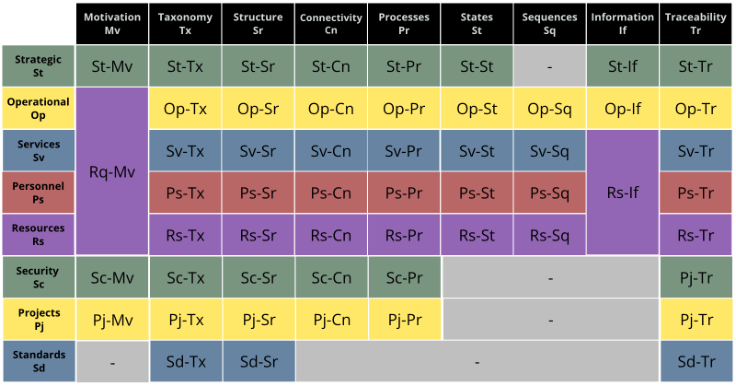
Research Background The SE discipline utilizes frameworks to provide insights into the current and future states of systems which incorporate human-factors integration (HFI) aspects (Bruseberg, 2008)1. Model-based systems engineering (MBSE) introduces the value of model-based enterprise architecture (MBEA) and its contribution to the state-of-the-art techniques for ensuring traceability between organizational domains. The UAF v1.3, published by the Object Management Group (OMG), is the exemplar methodology examined in this paper. The purported UAF “grid” represents a common set of stakeholder viewpoints (rows) and relevant aspects (columns) as shown in Figure 1.
Figure 1: Rendering of the UAF grid (Object Management Group, 2025).
The UAF Personnel (Ps) viewpoint is derived from the U.K Ministry of Defense (MoD) Architecture Framework (MoDAF) with influence from the DoDAF and North Atlantic Treaty Organization (NATO) Architecture Framework (NAF) (Object Management Group, 2025). The MoDAF HVs are meant to enable communication in the acquisition process (Bruseberg, 2008). Similarly, the focus of the NAF HVs is to capture human data and information about the interactions amongst humans and their exchanges with other system elements (Handley & Houston, 2010). Table 1 shows prominent deliverables associated with traditional MBEA HVs.
1Human-factors integration (HFI) is the U.K equivalent to the U.S term human- systems integration (HSI).
Table 1: Enterprise architecture HVs.
Table available in the original PDF paper.
View Focus Description HV-A Concept A high-level representation of the human component in the enterprise architecture
HV-B Constraint Characteristics that are used to adjust the expected roles and tasks based on human capabilities HV-C Task Descriptions of the human-specific activities in the system
HV-D Role Defines human interaction with other elements of the system HV-E Human Network Communication patterns that occur as a result of ad hoc or deliberate team formation
HV-F Training Accounts for how training requirements, strategy, and implementation will impact the human HV-G Metric A repository for human-related values, priorities and performance criteria
HV-H Human Dynamics Dynamic aspects of human system components defined in other views When evaluating respective elements that are provided by the UAF Modeling Language (UAFML), the genesis of terms is not immediately clear. Table 2 describes the five (5) concrete classes within the UAF Ps domain.
Table 2: UAF Personnel classes.
Table available in the original PDF paper.
UAF Term Description Competence A specific set of abilities defined by knowledge, skills and aptitude Organization A group of Persons, Posts, Organizations and/or Responsibilities that are associated for a particular purpose
Person A type of a human being used to define characteristics (e.g., properties such as address, telephone number, nationality, etc.)
Post A type of job title or position that a person can fill (e.g., Lawyer, Solution Architect, Machine Operator or Chief Executive Officer) Responsibility The type of duty required of a Person or Organization
Further investigation into the origin of UAF concepts regarding human resources and their importance within an MBEA is warranted to properly bridge the gap between the SE and HFI domains.
Research Objective This research aims to improve current MBEA frameworks with respect to HFI aspects by aligning a DSO to the UAF metamodel. By constructing an HFI ontology based on established HVs and mapping the classes to the UAF metamodel elements, potential gaps are identified in the implementation of the UAF Ps viewpoint.
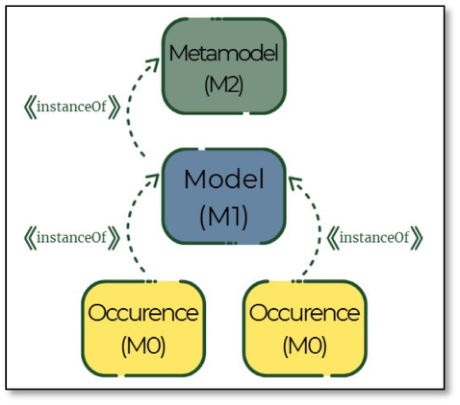
Metamodeling is a widely applied technique in the construction of domain-specific modeling languages (DSML) to constrain the semantics of all instantiations (Sprinkle et al., 2007). They are models that consist of statements about models (Jeusfeld et al., 2009). that are used to describe the concepts of a DSML, the relationships between abstractions, and the rules that constrain model elements (Bertoa & Vallecillo, 2010). Figure 2 represents the relationship between metamodels, models, and occurrences.
Figure 2: Model layers of abstraction.
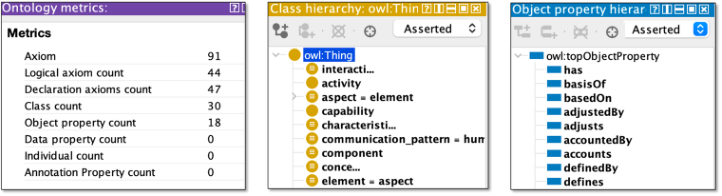
Research Approach An ontology of the HFI HVs in Table 1 is constructed within the open-source ontology editor, Protégé, to highlight equivalencies and relationships of the fundamental terminology. Figure 3 shows the basic metrics of the HFI DSO within Protégé where classes are the nouns, object properties represent the relationships between them, and axioms are predicate triples.
Figure 3: HFI DSO basic metrics.
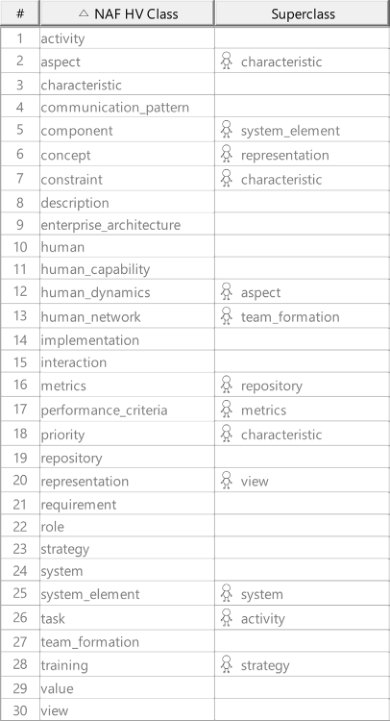
Improving System Design by Mapping a Human-Factors Integration (HFI) Ontology 45 The “Ontology metrics” show simple counts of core ontological elements; the “Class hierarchy” shows a subset of subjects and objects; and the “Object property hierarchy” shows a select few predicates within the Protégé OWL file. After the thirty (30) classes are imported into a CCM, refinement of the taxonomy is conducted. Figure 4 shows the HFI DSO class taxonomy results.
Figure 4: Representation of HFI DSO class taxonomy within a CCM.
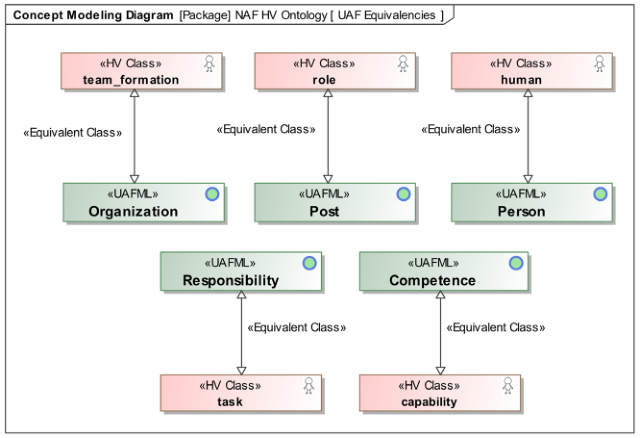
This representation adheres to the ontological concept of “is a” relationships. For example, an “HV Class” “representation” is a type of “view”. The UAFML metamodel is constructed within a Cameo Concept Model (CCM) using Dassault Systemés CATIA Magic software. CCMs enable the mapping between ontologies and the metamodels of DSMLs. Metamodel principles are founded on OWL, but are focused on the semantics and syntax of a specific modeling language instead of a comprehensive body of knowledge. Figure 5 shows a concept modeling diagram that exemplifies the “Equivalent Classes” between the imported HFI ontology and the five (5) UAFML metamodel Ps classes identified in Table 2.
Figure 5: UAFML equivalent classes to HV concepts.
As an example, the viewer understands that the “HV Class” “human” is an “Equivalent Class” of the “UAFML” term “Person”.
Research Results
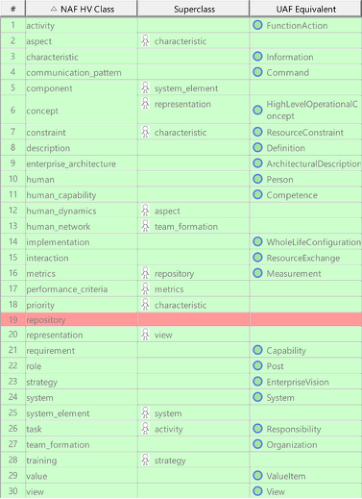
Figure 6 shows the HFI classes taxonomy and equivalent UAF terms as defined within a concept model.
Figure 6: Recommended HFI and UAFML mappings.
Improving System Design by Mapping a Human-Factors Integration (HFI) Ontology 47 Discussion of Results
The integration of HVs into the UAF exemplifies the importance of a cross- domain approach to enterprise architecture. Almost all classes within the HV metamodel are equivalent to a MBEA DSML term; however, they span several viewpoints as shown in Table 3.
Table 3: Domains of equivalent UAF terms.
Table available in the original PDF paper.
UAF Term UAF Domain ArchitecturalDescription Summary & Overview
Constructing an initial HFI DSO iteration was completed by extracting key terms from traditional deliverables to leverage a SPO approach. Like-terms are then mapped to the UAF metamodel to highlight gaps and areas for improvement within the modernized MBEA method. Based on the results, the sole “repository” class is not captured by the UAF DSML. This research demonstrates the feasibility of HFI integration with the SE discipline using the UAF as a case study. Future work will include additional DSO iterations and subsequent mappings between DSMLs that intend to capture HFI information.
REFERENCES
Bertoa, M. F., & Vallecillo, A. (2010, July). Quality Attributes for Software Metamodels. Proceedings of the Workshop on Quantitative Approaches to Object- Oriented Software Engineering (QAOOSE 2010). https://www.academia.edu/ download/67122780/Quality_attributes_for_software_metamode20210505- 10487-7upd2a.pdf
Integration and Systems Engineering. Journal of Cognitive Engineering and Decision Making, 2(3), 220–248. https://doi.org/10.1518/155534308X377090 Handley, H. A. H., & Houston, N. P. (2010). NATO Human View Architecture and Human Networks. https://ntrs.nasa.gov/api/citations/20100012886/ downloads/20100012886.pdf Jeusfeld, M., Jarke, M., & Mylopoulos, J. (Eds.). (2009). Metamodeling for Method
Engineering. The MIT Press. https://www.researchgate.net/profile/Manfred- Jeusfeld/publication/234824865_Metamodeling_for_Method_Engineering/ links/61335f732b40ec7d8be40546/Metamodeling-for-Method-Engineering.pdf Martin, J. N., & O’Neil, D. P. (2021). Enterprise Architecture Guide for the Unified Architecture Framework (UAF). INCOSE International Symposium, 31, 242–263. https://doi.org/10.1002/j.2334-5837.2021.00836.x Object Management Group. (2025). Unified Architecture Framework Modeling
Language (UAFML) v1.3 (Version 1.3). https://www.omg.org/spec/UAF/1.3/ Beta1/UAFML/PDF Sprinkle, J., Rumpe, B., Vangheluwe, H., & Karsai, G. (2007). Metamodelling: State of the Art and Research Challenges. In H. Giese, G. Karsai, E. Lee, B. Rumpe, & B. Schätz (Eds.), Model-Based Engineering of Embedded Real-Time Systems (Vol. 6100, pp. 57–76). Springer, Berlin Heidelberg. https://doi.org/10.1007/978- 3-642-16277-0_3
LISTED IN THE AHFE DIGITAL BOOKSTORE CATALOGUE
Explore the complete digital volume
Industrial and Systems Engineering
Read this individual research paper free through the original publisher, or explore the full digital proceedings book.
ISBN 978-1-964867-95-3
Explore this ISBN in the AHFE Bookstore ↗Listed in the July 2026 bookstore catalogue; search by ISBN to confirm current availability · Digital book purchase optional