Sustainable and circular manufacturing practices have become imperative for modern industries due to the escalating environmental challenges, stricter regulatory policies, and shifting consumer preferences towards more sustainable products. Among the multitude of technological advancements that enable this transition, Computer Vision (CV) is rapidly emerging as a game-changer. However, a comprehensive investigation is required to understand the role and impact of CV in the context of data-driven and servitized manufacturing. This review paper provides a thorough analysis of the relationship between CV and sustainable manufacturing. It highlights the various ways that CV improves sustainability by leveraging a rich corpus of academic studies as well as industry case studies. This covers the function of CV in enhancing resource efficiency, decreasing waste, enabling predictive maintenance, and assuring product quality. Nevertheless, there are several challenges in integrating CV technologies into manufacturing. Therefore, this paper offers a detailed analysis of these issues, ranging from technical complexities to data privacy and skills gap. Consequently, this study proposes potential solutions and strategies, turning these challenges into avenues for future research and innovation. Through this paper, our endeavor is not only to enrich the academic discourse around this topic but also to catalyze future research and provide actionable insights for practitioners at the intersection of technology and sustainability in manufacturing.
Sustainable manufacturing techniques are now a necessary requirement rather than a choice in the face of escalating environmental problems. Modern industries are going through a major paradigm shift because of increased environmental awareness, stricter regulations, and changing con- sumer preferences for sustainable products and services (Ahner et al., 2022; Bocken et al., 2014). The adoption of cutting-edge technologies like artifi- cial intelligence, machine learning, and particularly Computer Vision (CV), which are revolutionizing the manufacturing landscape, is key to this change (Manyika et al., 2013). The science of computer vision, which automates and improves the human visual system, offers a wide range of applications, from autonomous automobiles to medical diagnostics (Kanchana et al., 2021; Charleen et al., 2021).
The manufacturing industry is increasingly realizing CV’s potential to transform operations and improve sustainability. However, a thorough inves- tigation of this interdisciplinary space is required to comprehend the signif- icance of CV’s impact on industrial sustainability. The scientific research on how CV might leverage sustainability in a manufacturing context is sparse, despite the widely acknowledged importance of sustainable manufacturing methods and CV technology. This information gap affects not only the cre- ation of efficient plans for implementing CV in manufacturing, but also prevents a thorough comprehension of both its advantages and challenges.
This paper aims to bridge this gap, providing a detailed review of how CV technologies are contributing to sustainable manufacturing practices. Although sustainability can also include economic and social aspects, our paper focuses the ecological sustainability dimension, since it is most impor- tant in the realm of production. It highlights the different ways that CV might enhance sustainability, based on different academic research. Further- more, this study acknowledges the challenges of integrating CV technologies into manufacturing, providing a thorough analysis of these issues and poten- tial solutions. Our endeavor is to enrich the academic discourse around this topic and to catalyze future research, while also providing actionable insights for practitioners at the intersection of technology and sustainability in manufacturing.
METHODOLOGY
This review paper seeks to offer a comprehensive knowledge of the rela- tionship between sustainable manufacturing and computer vision (CV). We gathered and reviewed relevant academic research using a systematic review methodology. Our literature review focused primarily on peer-reviewed aca- demic papers and articles within the realms of Computer Vision, Artificial Intelligence, and Sustainable Manufacturing. The articles were retrieved from several respected databases in the field. These included IEEE Xplore, Google Scholar, ScienceDirect and ACM Digital Library. The choice of these databases ensured broad coverage of multidisciplinary research and mini- mized the risk of missing relevant studies. Our criteria for selecting these sources included their subject matter relevance, their methodology, and how each source might contribute to our understanding of CVs’ role in sustain- able manufacturing. Both qualitative and quantitative studies were included as we recognized the need for a comprehensive perspective, including both statistical data and contextual insights. We used a thematic analysis strategy to examine the gathered scholarly papers. We divided the information into themes, such as the use of CV in sustainable production, challenges integrat- ing CV, and proposed and solutions and strategies. The existing research’s patterns, connections, and gaps were then critically analyzed for each theme. We were able to develop a thorough picture of the state of the field using this method while also identifying areas that needed more investigation. The accuracy and thoroughness of our review are guaranteed by the rig- orous and methodical use of the technique we chose. Our goal is to close the knowledge gap between theory and practice in this rapidly developing
Leveraging Computer Vision for Sustainable Manufacturing 249
and important sector by fusing knowledge from both academic research and industry practice.
COMPUTER VISION AND SUSTAINABLE MANUFACTURING The intersection of computer Vision and sustainable manufacturing is a promising frontier for industries seeking to adopt more environmentally prac- tices. When applied in a manufacturing context, CV’s analytical and inter- pretable capabilities may significantly increase the sustainability quotient, leading industries towards a more environmentally conscious future.
Table 1 gives an overview of different technologies of CV, their applica- tions, and benefits in manufacturing.
Table 1. Different computer vision (CV) technologies, their applications, and benefits in manufacturing.
Object Detection Identifies and classifies objects in images or video. Used for quality control, defect detection, and sorting processes
Improves defect detection accuracy, aids in detailed quality control.
Image Segmentation Segments an image into different regions based on certain characteristics. Used in defect detection and product classification.
Optical Character Recognition (OCR)
Streamlines inventory management, enhances traceability, improves accuracy of labelling.
Recognizes and translates printed or written text characters into machine-readable text. Used in package labelling, product tracing, and inventory management.
3D Vision Systems Creates a three-dimensional model of the environment. Used in robotic guidance, precision assembly, and quality control.
Enables predictive maintenance, enhances safety, improves process efficiency.
Enhances precision in assembly, enables advanced robotic applications, improves quality control. Motion Analysis Tracks the movement of objects over time. Used in predictive maintenance, safety monitoring, and process optimization.
Computer Vision (CV) has emerged as a cutting-edge solution to fulfill these changing needs as the manufacturing sector moves toward sustainabil- ity. The different ways that CV helps to promote sustainable manufacturing practices are covered in the following subsections: Resource Efficiency
CV systems can monitor manufacturing processes in real-time, detecting anomalies, predicting failures, or ensuring that raw materials are used opti- mally. Early detection of defects through CV can lead to less wastage of materials and energy. For instance, by integrating CV into assembly lines, manufacturers can monitor real-time data of their machinery and processes
(Liu et al., 2022). This real-time data analysis can identify inefficiencies and wasteful practices, enabling operators to optimize their resource usage and reduce waste. (Ngan et al., 2011; Shen et al., 2013; Gao et al., 2022).
Waste Reduction Advanced CV systems can be pivotal in waste segregation in factories. They can distinguish between different types of waste, ensuring recyclables are sent for recycling, and non-recyclables are treated appropriately. Such precision reduces landfill waste and promotes recycling (Anitha et al., 2022; Cuingnet et al., 2022; Sharma et al., 2023) Besides automatic waste sorting and recy- cling CV can also be deployed for waste composition analysis. The insights on the types and quantities of waste generated can be used to formulate waste management strategies (Dong et al., 2022).
Predictive Maintenance Predictive maintenance is another area where CV provides potential value (Abidi et al., 2022; Liu et al., 2022). By constantly monitoring machinery and equipment, CV can detect anomalies or signs of potential malfunction (Baumung and Baumung, 2020). By predicting failures before they occur, manufacturers can carry out necessary maintenance, preventing costly break- downs and reducing the wastage associated with sudden equipment failure (Zonta et al., 2020).
Product Quality Assurance CV can be employed in manufacturing industries to automate quality control processes. By inspecting products for defects, errors, or inconsistencies, com- panies can reduce waste and resource usage, ensuring that only high-quality products are produced and delivered (Kazemian et al., 2019; Haleem et al., 2021; Jin et al., 2023).
CHALLENGES IN INTEGRATING COMPUTER VISION IN MANUFACTURING Although Computer Vision (CV) offers enormous potential in enhancing manufacturing sustainability, there are several types of challenges that must be overcome for integration to be successful. These significant challenges are described in this section.
Technical Complexities A solid technical infrastructure, which includes robust hardware and cutting- edge software capabilities, is required to implement CV. High computational power and reliable data acquisition systems are often needed due to the com- plex nature of CV algorithms (Zhao et al., 2022). Additionally, it can be technically difficult to build and train CV systems to function well in a variety of dynamic manufacturing environments.
Leveraging Computer Vision for Sustainable Manufacturing 251
Data Privacy and Security Large amounts of data are frequently collected and processed in the use of CV systems, which raises concerns regarding the security and privacy of that data. Manufacturers must solve the critical challenges of ensuring that data collected through CV systems is properly stored and handled (Li et al., 2022).
Skills Gap Personnel with specific expertise in fields like data analysis, machine learn- ing, and CV are needed for the effective implementation of CV technologies. However, there is frequently a skills gap in the manufacturing industry, with an absence of employees with the know-how to deploy and operate CV technology (KIEL et al., 2017; Moldovan, 2019; Li et al., 2021).
Integration With Existing Systems Integrating new systems with current processes is a major obstacle to com- puter vision (CV) technology use in manufacturing. Technical as well as operational variables are involved with this topic.
1. Technical Integration: from a technical perspective, CV systems must be compatible with existing hardware and software used in the manu- facturing process. In order to achieve this, it may be necessary to make sure that CV systems can interact with other systems via interfaces and protocols that are compatible with one another (Khan et al., 2023). Additionally, CV systems frequently require fast, reliable data connec- tions to provide visual data for processing, requiring potential network infrastructure changes (KIEL et al., 2017). 2. Operational Integration: operationally, integrating CV systems may call for modifications to current workflows and procedures. For instance, if a CV system is being used for real-time quality checks, the manufactur- ing process may need to be restructured to allow defective products to be removed immediately. To be implemented successfully, these changes may need to undergo extensive planning and change management (Zhou et al., 2023). 3. Legacy System Compatibility: Making sure that CV systems are compat- ible with legacy systems that may be outdated but are still necessary for the manufacturing process is a significant challenge. It may not always be feasible to upgrade these legacy systems to work with CV technologies because it might be expensive and complex (Cao and Iansiti, 2022).
In conclusion, although integrating with current systems represents sig- nificant challenges, careful planning, technical know-how, and competent change management can make it possible to successfully adopt CV technolo- gies in manufacturing environments.
PROPOSED SOLUTIONS AND STRATEGIES Modern industries are moving more and more toward integrating Computer Vision (CV) technologies as part of their search for sustainable manufac- turing. However, the challenges (discussed in the previous Section) this
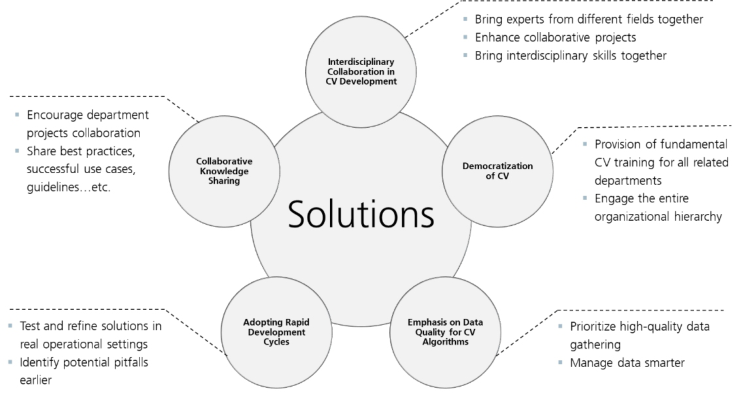
integration presents—whether they be due to technical complexities, con- cerns about data privacy, or the skills gap—require an in-depth investigation of viable solutions. Drawing insights from the broader field of Artificial Intel- ligence (AI) in manufacturing addressed by (Kutz et al., 2022; Neuhüttler et al., 2022; Neuhüttler et al., 2023), we propose, as described in Figure 1, a comprehensive set of strategies to address the current challenges.
Figure 1: Domains of human systems integration.
Interdisciplinary Collaboration in CV Development Holistic CV solutions can be produced by bringing together experts from different fields such as IT, manufacturing, data science and sustainability. Technical challenges can be addressed through collaborative projects that bring together interdisciplinary skills while ensuring the produced solutions are appropriate for use in real-world manufacturing scenarios.
Democratization of Computer Vision For CV to be successfully integrated, the entire organizational hierarchy must accept and comprehend it. In order to ensure that not only the technical team but also managerial and ground-level employees grasp the technol- ogy’s potential and workings, this democratization comprises the provision of fundamental CV training for all related departments.
Emphasis on Data Quality for CV Algorithms AI experts concur that the quality and quantity of the available data play a critical role in determining the stability and efficacy of CV models. The gathering of high-quality data must be prioritized by organizations, and they must make sure there is enough data to train reliable and generalizable CV model.
Leveraging Computer Vision for Sustainable Manufacturing 253
Adopting Rapid Development Cycles The incorporation of cutting-edge technology like Computer Vision (CV) into sustainable manufacturing requires quick development cycles, which are similar to “agile” software development approaches. They allow for:
Real-time feedback: testing and refining solutions in real operational settings allows stakeholders to gather real-time feedback.
Risk mitigation: identifying potential pitfalls and addressing challenges early on.
Stakeholder engagement and trust: Demonstrating the value of a solution early builds trust and increases organizational acceptance.
Enhanced flexibility and adaptability: keeping up with fast-paced devel- opments in CV.
However, implementing rapid cycles presents challenges with resource allocation, resistance to change, and quality assurance. Cross-functional teams, regular testing, iterative feedback mechanisms, and continuous train- ing are all advantageous for successfully implementing quick development cycles. These agile methods become more and more important as industries evolve.
Collaborative Knowledge Sharing The speed and effectiveness of execution can be increased by encourag- ing collaboration between development projects and building a professional knowledge management system for CV development. Sharing best practices, successful use cases, and guidelines may provide a road map for seamless CV integration.
FUTURE PERSPECTIVES We have examined the potentials and challenges of computer vision (CV) in sustainable manufacturing, but it is as important to look ahead and fore- cast the future of this mutually beneficial relationship. In this constantly changing environment, the combination of CV and sustainable manufac- turing not only shows potential but also signals the beginning of a new era of environmentally responsible, productive, and cutting-edge industrial processes.
Expansion of CV Technologies in Manufacturing The use of CV in sustainable manufacturing is still in its early stages. We anticipate a wider range of applications suited to specialized production pro- cesses as technology evolves. The opportunities will expand due to improved algorithms, high-speed cameras, and advanced sensors, allowing for even more detailed and efficient operation monitoring.
Integration With Other Emerging Technologies By combining CV with emerging technologies like the Internet of Things (IoT), Blockchain, and 5G, the manufacturing landscape will be completely
changed. Such a merger will make it easier to collect and analyze data in real- time, guarantee fast decision-making, and improve sustainable operations.
Customized and On-Demand Manufacturing The overproduction of commodities is one of the problems with sustain- ability. With CV providing real-time customization and quality checks, we predict a shift towards more on-demand production, decreasing waste associated with mass manufacturing and unsold goods.
Advanced Training and Augmented Reality (AR) Integration Training and skills development will be transformed by the integration of AR and CV, which can provide real-time feedback to technicians while improving their skills, ensuring products meet quality standards, reducing waste and upskilling the workforce.
CONCLUSION
Today, sustainable manufacturing is central to addressing environmental issues, and together with CVs’ transformational capabilities, it represents a unique and promising paradigm. As this review shows, CV’s applications in manufacturing are diverse, going beyond operational efficiency to fun- damentally reshape how industries approach sustainability. It is possible to use CV’s powerful combination of real-time analytics, precision quality con- trol, predictive maintenance and waste reduction to transform sustainable manufacturing from a theoretical idea into a workable, scalable reality. A comprehensive and connected manufacturing ecosystem is made possible by CV’s inherent versatility, which also allows it to be easily combined with other emerging technologies.
However, as with any transformative technology, the integration of CV into sustainable manufacturing is not without its challenges. Technical com- plexity, skills gaps and privacy issues are all potential barriers. Yet our analysis has shown that these challenges, when met with innovation and strategic foresight, can be transformed into avenues of opportunity and research.
In conclusion, there is a critical inflection point in the relationship between computer vision and sustainable manufacturing. It is the shared responsibility of academia, industry and governments to drive this discourse forward, pro- moting research, implementation and ethical considerations, even as current applications and studies have demonstrated its enormous potential. At the forefront of this technological revolution, CV and sustainable manufactur- ing are paving the way for a greener, more productive and more cutting-edge industrial future.
REFERENCES
Abidi, Mustufa Haider; Mohammed, Muneer Khan; Alkhalefah, Hisham (2022): Predictive Maintenance Planning for Industry 4.0 Using Machine Learning for Sustainable Manufacturing. In Sustainability 14 (6), p. 3387. DOI: 10.3390/su14063387
Leveraging Computer Vision for Sustainable Manufacturing 255
Ahner, Lena; Neuhüttler, Jens; Gladilov, Nicole (2022): An approach for developing and assessing sustainable business models. In: The Human Side of Ser- vice Engineering. 13th International Conference on Applied Human Factors and Ergonomics (AHFE 2022), July 24-28, 2022: AHFE International (AHFE International). Anitha, R.; Maruthi, R.; Sudha, S. (2022): Automated segregation and microbial degradation of plastic wastes: A greener solution to waste man- agement problems. In Global Transitions Proceedings 3 (1), pp. 100–103. DOI: 10.1016/j.gltp.2022.04.021. Baumung, Wjatscheslav; Baumung, Viktor (2020): Application of Machine Learning and Vision for real-time condition monitoring and acceleration of product development cycles. In Procedia Manufacturing 52, pp. 61–66. DOI: 10.1016/j.promfg.2020.11.012. Bocken, N. M. P.; Short, S. W.; Rana, P.; Evans, S. (2014): A literature and practice
review to develop sustainable business model archetypes. In Journal of Cleaner Production 65, pp. 42–56. DOI: 10.1016/j.jclepro.2013.11.039. Cao, Ruiqing; Iansiti, Marco (2022): Digital transformation, data architec- ture, and legacy systems. In Journal of Digital Economy 1 (1), pp. 1–19. DOI: 10.1016/j.jdec.2022.07.001. Charleen; Angelica, Cheryl; Purnama, Hendrik; Purnomo, Fredy (2021): Impact of Computer Vision With Deep Learning Approach in Medical Imaging Diag- nosis. In : 2021 1st International Conference on Computer Science and Artificial Intelligence (ICCSAI). 2021 1st International Conference on Computer Science and Artificial Intelligence (ICCSAI). Jakarta, Indonesia, 28.10.2021 - 28.10.2021: IEEE, pp. 37–41. Cuingnet, Remi; Ladegaillerie, Yannik; Jossent, Jérôme; Maitrot, Aude; Chedal-
Anglay, Julien; Richard, Williams et al. (2022): PortiK: A computer vision based solution for real-time automatic solid waste characterization - Application to an aluminium stream. In Waste management (New York, N. Y.) 150, pp. 267–279. DOI: 10.1016/j.wasman.2022.05.021. Dong, Zhiming; Chen, Junjie; Lu, Weisheng (2022): Computer vision to recognize construction waste compositions: A novel boundary-aware transformer (BAT) model. In Journal of environmental management 305, p. 114405. DOI: 10.1016/j.jenvman.2021.114405. Gao, Yiping; Li, Xinyu; Wang, Xi Vincent; Wang, Lihui; Gao, Liang (2022):
A Review on Recent Advances in Vision-based Defect Recognition towards Industrial Intelligence. In Journal of Manufacturing Systems 62, pp. 753–766. DOI: 10.1016/j.jmsy.2021.05.008. Haleem, Noman; Bustreo, Matteo; Del Bue, Alessio (2021): A computer vision based online quality control system for textile yarns. In Computers in Industry 133, p. 103550. DOI: 10.1016/j.compind.2021.103550. Jin, Meng; Rajesh, Mehta Dharmil; Xing, Wenting; Schniertshauer, Johannes;
Neuhüttler, Jens; Zimmermann, Felix (2023): Implementation and Validation of non-semantic Out-of-Distribution Detection on Image Data in Manufacturing, p. 6675. Kanchana, Bimsara; Peiris, Rojith; Perera, Damitha; Jayasinghe, Dulani; Kasthurirathna, Dharshana (2021): Computer Vision for Autonomous Driving. In : 2021 3rd International Conference on Advancements in Computing (ICAC). 2021 3rd International Conference on Advancements in Computing (ICAC). Colombo, Sri Lanka, 09.12.2021 - 11.12.2021: IEEE, pp. 175–180.
Kazemian, Ali; Yuan, Xiao; Davtalab, Omid; Khoshnevis, Behrokh (2019): Computer vision for real-time extrusion quality monitoring and control in robotic construction. In Automation in Construction 101, pp. 92–98. DOI: 10.1016/j.autcon.2019.01.022. Khan, Moin; Haleem, Abid; Javaid, Mohd (2023): Changes and improve- ments in Industry 5.0: A strategic approach to overcome the challenges of Industry 4.0. In Green Technologies and Sustainability 1 (2), p. 100020. DOI: 10.1016/j.grets.2023.100020. Kiel, Daniel; Müller, Julian M.; Arnold, Christian; Voigt, Kai-Ingo (2017): Sustain-
able Industrial Value Creation: Benefits and Challenges of Industry 4.0. In Int. J. Innov. Mgt. 21 (08), p. 1740015. DOI: 10.1142/S1363919617400151. Kutz, Janika; Neuhüttler, Jens; Spilski, Jan; Lachmann, Thomas (2022): Implementation of AI Technologies in manufacturing - success factors and challenges. In : The Human Side of Service Engineering. 13th International Conference on Applied Human Factors and Ergonomics (AHFE 2022), July 24–28, 2022: AHFE International (AHFE International). Li, Guoyan; Yuan, Chenxi; Kamarthi, Sagar; Moghaddam, Mohsen; Jin, Xiaoning
(2021): Data science skills and domain knowledge requirements in the man- ufacturing industry: A gap analysis. In Journal of Manufacturing Systems 60, pp. 692–706. DOI: 10.1016/j.jmsy.2021.07.007. Liu, Yuehua; Yu, Wenjin; Dillon, Tharam; Rahayu, Wenny; Li, Ming (2022): Empowering IoT Predictive Maintenance Solutions With AI: A Distributed Sys- tem for Manufacturing Plant-Wide Monitoring. In IEEE Trans. Ind. Inf. 18 (2), pp. 1345–1354. DOI: 10.1109/tii.2021.3091774. Manyika, James; Chui, Michael; Bughin, Jacques; Dobbs, Richard; Bisson, Peter;
Marrs, Alex (2013): Disruptive technologies: Advances that will transform life, business, and the global economy. Moldovan, Liviu (2019): State-of-the-art Analysis on the Knowledge and Skills Gaps on the Topic of Industry 4.0 and the Requirements for Work-based Learning. In Procedia Manufacturing 32, pp. 294–301. DOI: 10.1016/j.promfg.2019.02.217. Neuhuttler, Jens; Hermann, Sibylle; Ganz, Walter; Spath, Dieter; Mark, Riccarda
(2022): Quality Based Testing of AI-based Smart Services: The Example of Stuttgart Airport. In : 2022 Portland International Conference on Management of Engineering and Technology (PICMET). 2022 Portland International Conference on Management of Engineering and Technology (PICMET). Portland, OR, USA, 07.08.2022 - 11.08.2022: IEEE, pp. 1–10. Neuhüttler, Jens; Feike, Maximilian; Kutz, Janika; Blümel, Christian; Bienzeisler, Bernd (2023): Digital Factory Transformation from a Servitization Perspective: Fields of Action for Developing Internal Smart Services. In Sci 5 (2), p. 22. DOI: 10.3390/sci5020022. Ngan, Henry Y. T.; Pang, Grantham K. H.; Yung, Nelson H. C. (2011): Auto-
mated fabric defect detection—A review. In Image and Vision Computing 29 (7), pp. 442–458. DOI: 10.1016/j.imavis.2011.02.002. Sharma, Himanshu; Kumar, Harish; Mangla, Sachin Kumar (2023): Enablers to computer vision technology for sustainable E-waste management. In Journal of Cleaner Production 412, p. 137396. DOI: 10.1016/j.jclepro.2023.137396. Shen, Heng-Kuang; Chen, Po-Han; Chang, Luh-Maan (2013): Auto- mated steel bridge coating rust defect recognition method based on color and texture feature. In Automation in Construction 31, pp. 338–356. DOI: 10.1016/j.autcon.2012.11.003.
Leveraging Computer Vision for Sustainable Manufacturing 257
Zhou, Longfei; Zhang, Lin; Konz, Nicholas (2023): Computer Vision Techniques in Manufacturing. In IEEE Trans. Syst. Man Cybern, Syst. 53 (1), pp. 105–117. DOI: 10.1109/TSMC.2022.3166397. Zonta, Tiago; Da Costa, Cristiano André; Da Rosa Righi, Rodrigo; Lima, Miro-
mar José de; Da Trindade, Eduardo Silveira; Li, Guann Pyng (2020): Predictive maintenance in the Industry 4.0: A systematic literature review. In Computers & Industrial Engineering 150, p. 106889. DOI: 10.1016/j.cie.2020.106889.
LISTED IN THE AHFE DIGITAL BOOKSTORE CATALOGUE
Explore the complete digital volume
Application of Emerging Technologies
Read this individual research paper free through the original publisher, or explore the full digital proceedings book.
ISBN 978-1-958651-91-9
Explore this ISBN in the AHFE Bookstore ↗Listed in the July 2026 bookstore catalogue; search by ISBN to confirm current availability · Digital book purchase optional