Maximilian Feike, Jens Neuhüttler, Janika Kutz (2023). Towards A Reference Process for Developing Cognitive Service Systems. In: The Human Side of Service Engineering. AHFE Open Access, vol. 108, pp. 47–56. https://doi.org/10.54941/ahfe1003106
In recent years, digital technologies such as artificial intelligence found their way into existing services, while at the same time providing the basis for entirely new possibilities. However, our understanding of the development of services based on these technologies is still limited. Due to the high complexity, they can rarely be developed within the boundaries of a single company or on the basis of knowledge from a single discipline. Building on the relevant literature, we derive a sound understanding of cognitive service systems from existing perspectives. Following an iterative process, we conducted several interdisciplinary workshops and analysed existing development approaches, which were adapted and recombined into a process model for cognitive service development. Our work contributes to a common understanding of cognitive service systems. By introducing a reference model that addresses the specific requirements for the successful development of cognitive services, we take a first step towards a systematic and holistic development of cognitive service systems that supports companies in this complex task.
The increasing complexity of competitive environments, the emergence of artificial intelligence (AI) and the transformation from product-based to service-based business models present companies with numerous challenges. At the same time, these developments come with a wide range of opportu- nities to exploit new business areas, enter new markets or satisfy existing customer needs more effectively and efficiently. For companies, the develo- pment of so-called “cognitive services” offers a promising way to exploit these opportunities. These highly automated and intelligent services can either be stand-alone services or complement existing offerings. Depending on the area of application, they help to make internal value creation processes more efficient or offer a new value proposition for external customers.
However, the development of cognitive services also presents companies with certain challenges. Due to their intensive use of data and technology, as well as the automated adaptation of processes and value propositions, development requires knowledge and methods from more than one develo- pment discipline, e.g., service engineering, data science and IT infrastructure management (Ahner et al. 2021). Moreover, these complex services can rarely
be developed and operated within the boundaries of one company, due to lacking resources (e.g., access to data, need for IT-infrastructure), knowledge and technical infrastructure available (Neuhüttler et al. 2020a). This also leads to an increasing relevance of joint development with external stakehol- ders and a more system-oriented development process. Although the concept of cognitive service systems is not new, there is still no integrated appro- ach that takes a holistic view of their development and that of the required subcomponents.
In order to support companies with the complex task of developing cogni- tive services systematically, the aim of our paper is (1) to contribute to a common understanding of the phenomenon of cognitive service systems, (2) to introduce a reference model that addresses the specific requirements for a successful development of cognitive services by recombining approa- ches from neighbouring disciplines and (3) show how the reference model can be applied in specific development projects.
UNDERSTANDING COGNITIVE SERVICE SYSTEMS Since there are a variety of existing perspectives and adjacent or partially overlapping concepts of cognitive service systems, this chapter first presents our understanding from a developmental perspective. Smart service systems represent the overarching concept for this, which is why they are considered below.
Smart services are characterized by their ability to adapt to a specific context (Neuhüttler et al. 2019) and can be defined as databased, indi- vidually configurable bundles of intelligent products, digital services, and personally delivered services that are organized and performed via integrated service platforms. Adaptivity can either be supported by the use of artifi- cial intelligence and in particular machine learning methods, or by using classical rule-based algorithms. Emerging from the fields of service science and service engineering, the phenomenon of smart services is researched in several domains (e.g. marketing, management, and information systems) and from different perspectives (e.g., customer perspective, company perspective) (Korper et al. 2020).
The terms system and ecosystem are used at different levels in the service- related literature. As services and their associated value are created by a combination of resources accessed in an exchange with other resources, both internal and available through other exchanges (Lusch and Vargo 2006), services have a certain system character by nature. According to the service- dominant logic, in the process of value co-creation, actors integrate resources in service systems that are configured by institutional arrangements through which service ecosystems emerge endogenously (Blaschke et al. 2018; Vargo and Lusch 2016a). The concept of service systems is also often used to inte- grate service-related aspects across organizational boundaries (Spohrer et al. 2008). As the ever-increasing complexity in technology and markets necessi- tates the inter-organisational combination of resources, digital ecosystems are another phenomenon that has significantly gained in relevance, both in research and business. Along with this, new configurations for firms to
Towards a Reference Process for Developing Cognitive Service Systems 49
collaborate and combine resources have become an important part of value creation (Jacobides 2022).
Linking the characteristics of smart services to the ecosystem perspective, smart service systems include the capability of self-adaption and the requi- rement of technology incorporation. Therefore, smart services are under- stood as systems, in which data contributes significantly to the creation of value (Brogt and Strobel 2020; Lim and Maglio 2018). Furthermore, smart service systems are able to self-improve continuously (Demirkan et al. 2019). Spohrer et al. 2017 extend the concept of smart service systems by linking it to the human side of service engineering, adding connections to human values and ethical questions. As technical capabilities increase, so do the demands for responsibility. The authors argue that there is a need for better rule systems and conflict-resolution methods (Spohrer et al. 2017).
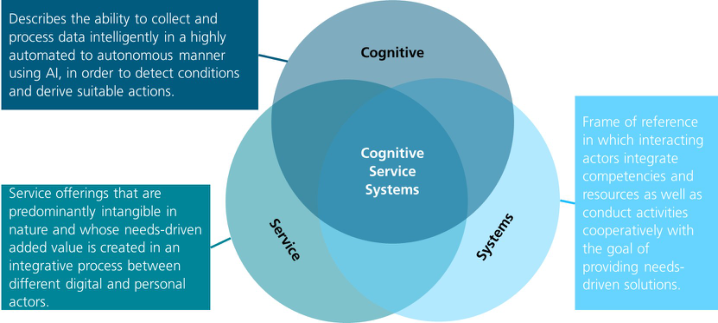
Cognitive services can be described as a subset of smart services. Smart services use data to provide situation-specific, individualized added value in an automated manner. This also applies to cognitive services, although they represent the most automated to autonomous offerings in the range of diffe- rent smart services. This is made possible by the use of cognitive technologies. In general, they rely on computational components that deliver cognition as a service, augmenting human intelligence and capabilities across the spectra of sensory perception, deduction, reasoning, learning, and knowledge (Spo- hrer & Banavar, 2015; Mele et al. 2021). Cognitive systems therefore can be described as highly automated to autonomous systems that perceive the environment, learn from experience, anticipate the outcome of events, act to pursue goals, and adapt to changing circumstances (Vernon 2021). Machine learning algorithms and AI applications, such as speech, image or face reco- gnition, predictive inference and decision making as well as generative AI, therefore build the technical core of such cognitive services (Neuhüttler et al. 2020b). According to Demirkan et al. 2019 an increasing relevance of cogni- tive assistants in the field of smart service systems can be observed. Cognitive services as a sub-category of smart services, with focus on a highly automa- ted to autonomous acquisition and processing of data and the execution of actions with the help of artificial intelligence.
Figure 1: Definition of cognitive service systems.
For the purposes of the following work, we understand cognitive servi- ces as interactively provided services that enable an automated adaptation of service processes and outcomes to specific needs through the use of AI. Figure 1 shows the central fields of action and development of cognitive service systems.
TOWARDS A REFERENCE PROCESS FOR DEVELOPING COGNITIVE SERVICE SYSTEMS Requirements of Reference Processes
The overall goal of our contribution is to develop a reference process for the holistic development of cognitive services. Reference models constitute a generic representation of a specific topic that can be adapted to a specific use case (Rosing et al. 2015). They serve to collect and structure know- ledge on this topic and can thus be used for knowledge exchange between different users and application areas. The recurring application generates empirical knowledge and enables a low-effort implementation (Frank et al. 2020). However, in order to do so, Frank et al. 2020 summarize the follo- wing requirements that they need to meet. First, a reference process strives for completeness it should comprehensively represent the phenomenon to be described. As a second requirement, a reference process needs to be of a uni- versal nature, it must be suitable for different applications and fields of use. Furthermore, reference processes must be both adaptable and reusable (Sch- lagheck 2000). Finally, a reference process has a recommendatory character (Rosemann 2003).
Since the development of cognitive services is a multidisciplinary task in a dynamic and complex environment, we assume that an appropriate refe- rence model contributes to a reduction in complexity. As there is a need for knowledge and methods from several disciplines at the same time, exi- sting, discipline-specific reference processes are reaching their limits. In other words: Since each of these disciplines has its own specific theoretical foun- dations, methods and principles, a reference process for the development of cognitive services can only fulfil the requirement for completeness if it makes use of all relevant disciplines.
Method and Approach To achieve the goal, a multi-level approach was taken with several interdisci- plinary workshops, with researchers from the disciplines of service science, innovation management, embedded information systems, data science and engineering. The first step was to establish a common understanding of cogni- tive service by conducting an initial literature review, the results of which were discussed among the participants. This was followed by an intra-disciplinary analysis of existing approaches in each of the relevant development discipli- nes. The identified models were compared with each other and the fit towards cognitive services as well as their adaptability were evaluated. Table 1 pro- vides examples of the development disciplines and approaches examined.
Towards a Reference Process for Developing Cognitive Service Systems 51
Table 1. Overview of analysed reference models.
Table available in the original PDF paper.
Discipline Reference process Process steps and activities Service Science/ Service Engineering
Task-based reference model of Smart Service Engineering (according to Meiren/Neuhüttler 2019)
1. Ideation 2. Requirement analysis 3. Conception 4. Test 5. Implementation 6. Launch Development Approach for Smart Service Engineering (according to Jussen et al. 2019)
1. Strategy development 2. Prototyping 3. Market development Development of digital service systems (according to Post et al. 2019)
1. Analysis 2. Design 3. Implementation
Information Systems
Crisp-DM (Cross-industry standard process for data mining) (according to Wirth et al. 2000)
1. Business understanding 2. Data understanding 3. Data preparation 4. Modeling 5. Evaluation 6. Development ITIL (Information Technology Infrastructure Library) (according to Axelos 2013)
1. Service Design 2. Service Transition 3. Service Operation
Ecosystem perspective
Ecosystem development Framework (according to Jacobides 2022)
1. Potential Scope of play and target choice 2. Competitive landscape & anchor analysis 3. Role of the firm & stra- tegic approach 4. Ecosystem double value proposition 5. Partnership strategy 6. Governance and enga- gement 7. Metrics of success and next steps
Subsequently, tasks that are relevant to the development of cognitive servi- ces were extracted from all considered disciplines. This step was followed by clustering and merging the identified tasks.
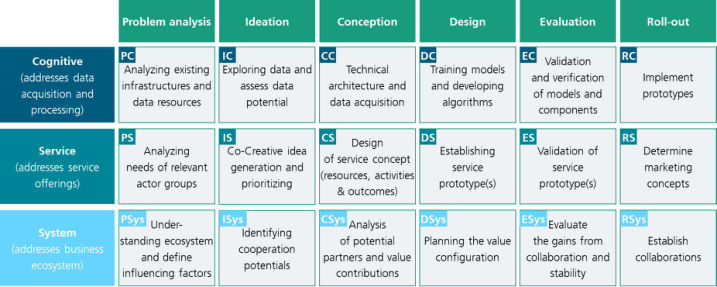
By following the method described above, a first version of a reference pro- cess consisting of 3 dimensions and 6 phases is developed (cf. Figure 2). As it is designed in a task-based manner, it explicitly does not specify a fixed order for the execution of phases or development tasks. The 3 dimensions are deri- ved from the definition stated in Figure 1 and provide the basic structure into which the identified development steps and tasks of cognitive service systems can be integrated. The division into 3 dimensions, namely cognitive, service
Figure 2: Reference process for developing cognitive service systems.
and system, ensures that it is still possible to assign the relevant tasks and activities to the original disciplines which they each represent. The chosen subdivision into the six phases - (1) problem analysis, (2) ideation, (3) conce- ption, (4) design, (5) evaluation, (6) roll-out - was achieved by abstracting and consolidating the reference models shown in Table 1. This segmentation allows the parallelisation and coordination of the relevant steps of all consi- dered disciplines. The vertical and horizontal subdivisions give rise to a total of 18 development tasks.
The 18 development tasks come with a description along the components of objectives, activities, methods, tools and results. In addition, they can be supplemented by corresponding role models and a meta-model, which concretise the process and reduce interdisciplinary complexity. For example, existing methods that are suitable for implementation can also be assigned. One example is the method for testing perceived quality by Neuhüttler et al. 2022, which can be assigned to the activity “ES”. The individual tasks are described in a non-overlapping and coherent manner, and interfaces with the other tasks are specified. This has the advantage that they can be arranged and executed in different order depending on the needs of a development project. This fundamental principle is demonstrated in the following section.
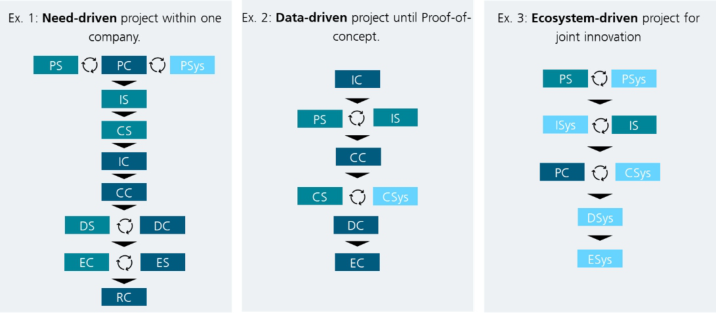
POSSIBLE APPLICATION OF THE REFERENCE PROCESS To consider both adaptability and generality as two important features of reference models, the individual activities can be arranged in different ways. This is also to ensure that the approach can be adapted to the specific needs and circumstances of different development projects and contexts. Figure 3 shows the adaptability of our approach by presenting three exemplary project approaches with different focus in terms of objectives and scope. Moreover, the modularity allows both linear and iterative structures to be represented.
Example 1 describes a needs-driven development project that is to be implemented within a company. The development project starts with the analysis of existing problems, be they on the level of cognitive technology (PC), the needs of potential customers (PS) or in an ecosystem (PSys). After
Towards a Reference Process for Developing Cognitive Service Systems 53
Figure 3: Demonstration of process adaptability with three exemplary project types.
the analysis, a co-creative ideation follows to find and evaluate ideas for a new cognitive service (IS). Selected ideas are described by a service concept (CS), whose feasibility is completed by an exploration of data (IC) as well as a technical conception (CC). Finally, the evaluation and roll-out of the implemented concepts follow.
A data-driven development project, as illustrated in example 2, could start with an in-depth exploration of existing data to identify existing needs (IC). The identified needs must be compared with an analysis of the problems of potential customers (PS) and combined into a concrete idea (IS).Based on this, the technical and service concept (CS) can first be planned with the partici- pation of various actors outside the company (CSys). This is followed by the development of a technical prototype (DC) and its verification and validation (EC).
Example 3 describes an ecosystem-driven development project, such as might be implemented by partners on an innovation campus or as part of a governmental, overarching initiative. First, potential problems of end custo- mers (PS) and of the actors in an ecosystem (PSys) are analyzed in order to evaluate ideas for a service concept (IS) and the possible potential for coope- ration (ISys). In a subsequent step, the existing technical infrastructures and data pools of the partners are examined (PC) and possible value contributi- ons to the implementation of the service idea are examined (CSys). After that, the value configuration within the ecosystem is planned (DSys) and validated (ESys).
CONCLUSION AND OUTLOOK As a result of this paper, we propose a first version of a task-based reference process for the development of cognitive service systems, based on establi- shed processes in literature, which we recombine and develop specifically for cognitive service systems. The model focuses on six main activities: problem understanding, ideation, conception, design, evaluation and roll-out. As our model is of an interdisciplinary character, every task is described for a data,
service and system-related dimension. Striving for completeness as a chara- cteristic of reference processes, we combine the three relevant sub-disciplines in one model. To ensure that our model is up to the manifold challenges and requirements of different complex projects in the field of cognitive service development, we follow a modular approach. This means that the procedure can also be adapted to the specific requirements of individual projects within its basic structure. Our work can be understood as a first step in a syste- matic and holistic development of cognitive service systems that supports companies in this complex task.
In order to meet the overarching objective, further research will be needed. First of all, the content of the 18 development activities must be designed and backed up with appropriate methods and tools to enable their application in practice. Although the reference process was designed by a group of rese- archers that possess practical experiences from development projects in all relevant disciplines, practical applicability and completeness must be demon- strated in different cognitive services development projects. Moreover, there is a need to evaluate the models’ comprehensibility and adaptability.
ACKNOWLEDGEMENT
The authors would like to thank the members of the “Service Science” wor- king group at Fraunhofer IAO for their contributions, which form the basis for this article. Our thanks go in particular to Christian Blümel, Philipp Göbels, Nina Hieber, Dharmil Mehta, Timo Stöhr and Benedikt Wohlmuth.
REFERENCES
Ahner, L., Bayrak, Y., Cleaver, I., Ge, M. L., Neuhüttler, J., & Urmetzer, F.
(2021). Impacts of Professional Education Measures on the Digital Transforma- tion in Organisations. In C. Leitner et al. (Eds.), Lecture Notes in Networks and Systems, Vol. 266, pp. 173–180. Springer International Publishing. https: //doi.org/10.1007/978-3-030-80840-2_19 Axelos. (2013). Information Technology Infrastructure Library (ITIL). Blaschke, Michael & Haki, Kazem & Aier, Stephan & Winter, Robert. (2018). Capabilities for Digital Platform Survival: Insights from a Business-to-Business Digital Platform. Brogt, Tobias and Strobel, Gero. (2020). Service Systems in the Era of the Internet of
Things: A Smart System Taxonomy., In Proceedings of the 28th European Con- ference on Information Systems (ECIS), An Online AIS Conference, June 15-17, 2020. https://aisel.aisnet.org/ecis2020_rp/178 Demirkan, Haluk; Spohrer, James C.; Badinelli, Ralph. (2019). Introduction to the Smart Service Systems: Analytics, Artificial Intelligence and Cognitive Appli- cation. Proceedings of the 52nd Hawaii International Conference on System Sciences. Frank, Maximilian; Gausemeier, Jürgen; von Widdern, Nils Henning-Cardinal;
Koldewey, Christian; Menzefricke, Jörn Steffen; Reinhold, Jannik. (2020). A reference process for the smart service business: development and practical implications. Proceedings of the ISPIM 2020). High, R. (2012). The era of cognitive systems: An inside look at IBM Watson and how it works. IBM Corporation, Redbooks, 1, 16.
Towards a Reference Process for Developing Cognitive Service Systems 55
Jacobides, M. G. (2022). How to Compete When Industries Digitize and Collide: An Ecosystem Development Framework. California Management Review, 64(3), 99–123. https://doi.org/10.1177/00081256221083352 Jussen, P., J. Kuntz, R. Senderek und B. Moser. (2019). Smart Service Enginee-
ring [online]. Procedia CIRP, 83, 384–388. ISSN 22128271. Verfügbar unter: doi: 10.1016/j.procir.2019.04.089. Korper, A. K., Purrmann, M., Heinonen, K., Kunz, W. (2020). Towards a Better Understanding of Smart Services - A Cross-Disciplinary Investigation. In: Nóvoa, H., Dr˘agoicea, M., Kühl, N. (eds) Exploring Service Science. IESS 2020. Lecture Notes in Business Information Processing, vol. 377. Springer, Cham. https://doi.org/10.1007/978-3-030-38724-2_12 Lim, C., Maglio, P. P. (2019). Clarifying the Concept of Smart Service System. In:
Maglio, P. P., Kieliszewski, C. A., Spohrer, J. C., Lyons, K., Patrício, L., Sawatani, Y. (eds) Handbook of Service Science, Volume II. Service Science: Research and Innovations in the Service Economy. Springer, Cham. https://doi.org/10.1007/978- 3-319-98512-1_16 Lusch, R. F., & Vargo, S. L. (2006). Service-dominant logic: reacti- ons, reflections and refinements. Marketing Theory, 6(3), 281–288. https://doi.org/10.1177/1470593106066781 Meiren, T. und J. Neuhüttler. (2019). Smart Services im Maschinenbau. Systematische Entwicklung digital unterstützter Dienstleistungen. wt Werkstattstechnik online, 109(7/8), 555–557. wt Werkstattstechnik online. Mele, C., Russo Spena, T., Kaartemo, V., & Marzullo, M. L. (2021). Smart nudging:
How cognitive technologies enable choice architectures for value co-creation. Journal of Business Research, 129, 949–960. https://doi.org/10.1016/j.jbusres. 2020.09.004 Neuhüttler, J., Fischer, R., Ganz, W., & Urmetzer, F. (2020a). Perceived Quality of Artificial Intelligence in Smart Service Systems: A Structured Approach. In M. Shepperd et al. (Eds.), Communications in Computer and Information Science. Quality of Information and Communications Technology (Vol. 1266, pp. 3–16). Springer International Publishing. https://doi.org/10.1007/978-3-030-58793-2_1 Neuhüttler, J., Ganz, W., Spath, D. (2019) An Integrative Quality Framew-
ork for Developing Industrial Smart Services. Service Science 11(3): 157–171. https://doi.org/10.1287/serv.2019.0242 Neuhüttler, J., Kett, H., Frings, S., Falkner, J., Ganz, W., & Urmetzer, F. (2020b).
Artificial Intelligence as Driver for Business Model Innovation in Smart Service Systems. In J. Spohrer & C. Leitner (Eds.), Advances in Intelligent Systems and Computing, Vol. 1208, pp. 212–219. https://doi.org/10.1007/978-3-030-51057- 2_30 Nonnenmacher, M. G. (1994) Informationsmodellierung unter Nutzung von Referenzmodellen: Die Nutzung von Referenzmodellen zur Implementierung industri- ebetrieblicher Informationssysteme, Frankfurt am Main, Lang. Post, Till & Heuermann, Aaron & Wiesner, Stefan & Olschweski, Detlef & Maass,
Wolfgang & Klatt, Rüdiger & Jussen, Philipp & Ragab, Sherif & Senderek, Roman & Höckmayr, Benedikt & Schulz, Thomas & Meyer, Kyrill & Heinen, Ewald & Hocken, Christian & Michalke, Simon & Lattemann, Christoph & Redlich, Beke & Schlimm, Katrin & Ziegler, Christoph & Falkus, Michael. (2019). DIN SPEC 33453:2019-09 Entwicklung digitaler Dienstleistungssysteme (Development of digital service systems). 10.31030/3085072.
Rosemann, M. (2003) ‘Preparation of Process Modeling’, in Becker, J., Kugeler, M.
and Rosemann, M. (eds) Process Management: A Guide for the Design of Business Processes, Berlin, Heidelberg, Springer, pp. 41–78. Rosing, M. V., Scheer, A.-W. and Scheel, H. V. (2015) The complete business process handbook: Body of knowledge from process modelling to BPM: Volume I [Online], Waltham. Schlagheck, B. (2000) Objektorientierte Referenzmodelle für das Prozess-und Pro-
jektcontrolling: Grundlagen-Konstruktion-Anwendungsmöglichkeiten [Online], Wiesbaden, Deutscher Universitätsverlag. Available at https://dx.doi.org/10.1007/ 978-3-663-07993-4. Spohrer, J., & Banavar, G. (2015). Cognition as a Service: An Industry Perspective.
AI Magazine, 36(4), 71–86. https://doi.org/10.1609/aimag.v36i4.2618 Spohrer, J., Bassano, C., Piciocchi, P., Siddike, M. A. K. (2017). What Makes a System Smart? Wise?. In: Ahram, T., Karwowski, W. (eds) Advances in The Human Side of Service Engineering. Advances in Intelligent Systems and Computing, vol. 494. Springer, Cham. https://doi.org/10.1007/978-3-319-41947-3_3 Spohrer, Jim & Vargo, Stephen & Caswell, Nathan & Maglio, Paul. (2008). The
Service System Is the Basic Abstraction of Service Science. Inf. Syst. E-Business Management. 7. 104. 10.1109/HICSS.2008.451. Vargo, S. L., and Lusch, R. F. 2016. “Institutions and Axioms: An Extension and Update of Service-Dominant Logic,” Journal of the Academy of marketing Science (44:1), pp. 5–23. Vernon, D. (2021). Cognitive System. In: Ikeuchi, K. (eds) Computer Vision. Springer,
Cham. https://doi.org/10.1007/978-3-030-63416-2_82 Wirth, Rüdiger and Jochen Hipp. 2000. “CRISP-DM: Towards a Standard Process Model for Data Mining.” Proceedings of the 4th international conference on the practical applications of knowledge discovery and data mining (4), pp. 29–39.
LISTED IN THE AHFE DIGITAL BOOKSTORE CATALOGUE
Explore the complete digital volume
The Human Side of Service Engineering
Read this individual research paper free through the original publisher, or explore the full digital proceedings book.
ISBN 978-1-958651-84-1
Explore this ISBN in the AHFE Bookstore ↗Listed in the July 2026 bookstore catalogue; search by ISBN to confirm current availability · Digital book purchase optional