Nina Hieber, Maximilian Feike, Veronika Prochazka (2023). Towards a co-creative approach to interactively develop digital services. In: The Human Side of Service Engineering. AHFE Open Access, vol. 108, pp. 292–301. https://doi.org/10.54941/ahfe1003131
Numerous new service innovation methods and approaches have been established in recent decades, a lot of them emphasize the early involvement of the user perspective (e.g., in design thinking). However, there is still potential for further perspectives to be integrated into the service innovation process in a structured way, in particular to innovate inter-organisational with different stakeholders in order to incorporate different competences, knowledge and perspectives. Therefore, based on a literature review and an analysis of existing approaches, our work aims to develop a unified approach that enables the co-creative development of digital services by involving all relevant stakeholders (e.g., potential users, company representatives, experts, and business partners) in all development phases. The developed approach (consisting of three phases: Co-Exploration, Co-Innovation, Co-Evaluation) provides a structured yet modular and thus adaptable methodology that maps the entire innovation process of a digital service. Our research shows that the field of service innovation and user-centred methodologies is widely discussed, but the structured involvement of additional stakeholder groups is hardly recognised.
Both, the increasingly complex competitive environment and rapid technolo- gical developments of recent years pose a number of challenges for companies and public institutions. An inter-organisational and interdisciplinary collabo- ration in order to develop innovative, efficient, and interconnected services can help to meet these challenges. A systematic review has shown that open innovation (i.e. interacting with the external environment and stake- holders in the innovation process to gain external knowledge and ideas) has a positive influence on the firm’s performance (Bigliardi et al., 2020). Numerous service innovation methods and approaches have been establi- shed over the last decades addressing some of these needs. In particular, the early inclusion of the user perspective has become popular with the rise of approaches such as design thinking (Lewrick et al., 2018) and design sprint, or co-creation. However, with the shift towards inter-organisational and interdisciplinary collaboration in the development, operation and deli- very of services, the service development process could also benefit from
Towards a Co-Creative Approach to Interactively Develop Digital Services 293
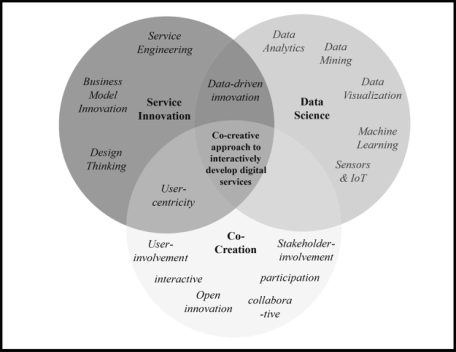
Figure 1: Combining service innovation, data science and co-creation for co-creatively developing digital services (own figure).
the early inclusion of the perspective and knowledge of external stakehol- ders and the environment. Moreover, digital technology and data analytics provide further opportunities for service development, e.g. in the discovery of trends, needs or ideas (Engel and Ebel, 2019). Thus, data analytics and the perspectives of business partners, external experts etc. should be integra- ted into the service innovation process in a structured way. Therefore, our work aims at finding an approach that enables the data-driven, co-creative development of digital services by ensuring the involvement of all relevant stakeholders. Consequently, elements and principles of existing co-creation, service innovation and data science frameworks and processes are combined (see Figure 1).
THEORETICAL BACKGROUND Co-creation originally describes the active role of consumers in joint value creation of a company, where the interaction between the consumer and company results in a value extraction (Prahalad and Ramaswamy, 2004). Co-Creation is used in new product development (Hoyer et al., 2010), (radi- cal) service innovation (Perks et al., 2012; Yu and Sangiorgi, 2018) and also in public services and social innovation (Kerber and Reindl, 2021; Verschuere et al., 2018; Voorberg et al., 2015), where co-creation is mainly used for user- involvement, developing a joint understanding and solution of a problem and in participation processes.
For service innovation different definitions can be found in the literature as shown in a review by Witell et al. (2016). According to Randhawa and Scerri (2015), it ranges from service design and development to service delivery and management and can be understood as an amalgamation of product and process innovation consisting of several dimensions: user involvement, tech- nology and service-oriented innovation, service-logic innovation and service design model. Similarly, the literature on service innovation covers several
reference processes and frameworks for service development, which often focus and reinforce user-centricity and are characterized by an iterative and modular process (Agarwal et al., 2015); e.g. design thinking (Lewrick et al., 2018; Tim Brown, 2008), service engineering (Bullinger et al., 2003; Bullinger et al., 2015; Jussen et al., 2019; Meiren and Barth, 2002) and service (innova- tion) design (Ojasalo et al., 2015; Post et al., 2019; Stickdorn and Schneider, 2014). Data can be very helpful in gaining customer insights and a deeper understanding of the service environment. In terms of data science the CRISP-DM reference model (Chapman et al., 1999) is still a standard in data mining (Schröer et al., 2021). It was developed by several companies (e.g. NCR, Daimler Chrysler AG, SPSS Inc., OHRA) as a cross-industry standard process model for data mining and covers the six phases “Busi- ness Understanding”, “Data Understanding”, “Data Preparation”, “Model- ling”, “Evaluation” and “Deployment”. Ayele (2020) adapted the CRISP- DM model for idea mining. Moreover, the CRISP-DM model was also shown to be useful in social sciences (Cazacu and Titan, 2020). The use of data and analytics in service innovation is referred to as data-driven service innovation. According to Engel and Ebel (2019), data analytics are used in service innovation in an explorative (discovering opportunities such as trends, ideas, needs), validative (monitoring the success and process) and generative way (using data as a “key resource for value proposition” (Engel and Ebel, 2019, p.7)).
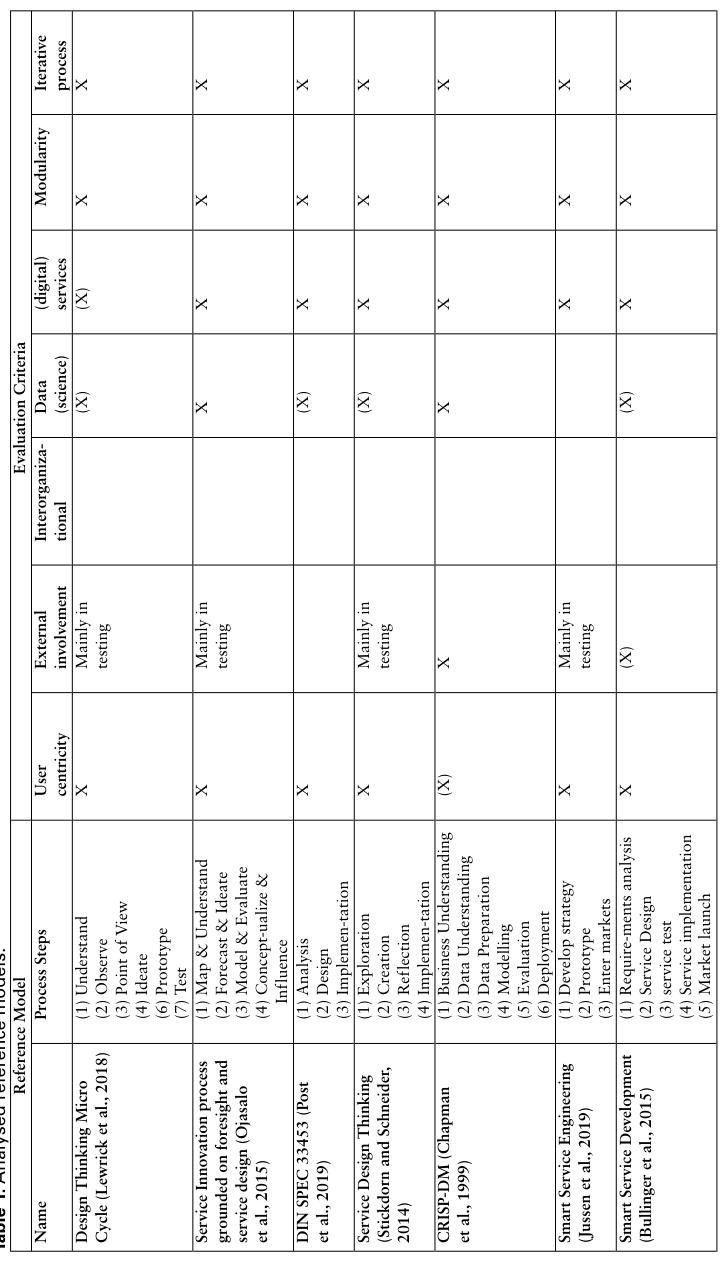
Analysis of Existing Reference Models As mentioned, several reference models in the fields of service innovation, service engineering, co-creation, and data science exist. In order to assess their suitability for our approach, which enables the co-creative, inter- organisational and interactive development of digital services, they were evaluated according to different criteria. These criteria correspond to the requirements to be addressed by our final approach, namely:
User centricity
External involvement (experts, users, business partners, company repre- sentatives)
Inter-organisational collaboration for service development
Use of data (science)
Focus on (digital) service development
Modularity of the process
Iterative process As shown in Table 1, none of the models fulfils all the requirements. In particular, with regard to inter-organizational collaboration between stake- holders from different institutions and companies within an ecosystem, the existing models do not propose a structured process. Therefore, we aim to fill this gap by combining aspects and stages of existing models and adding a process and methods for inter-organizational collaboration.
Towards a Co-Creative Approach to Interactively Develop Digital Services 295
Table 1. Analysed reference models.
METHOD
Key features of each model are combined to develop an approach for the co- creative and interactive development of digital services. In a further step, the derived approach is applied in two use cases with different technical focus and stakeholder constellations (1: service for booking a workplace in the library, 2: development of a sharing app) and evaluated for its applicability and logic.
RESULTS
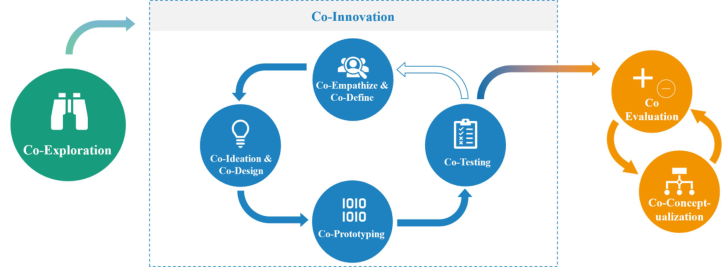
The developed approach consists of three phases: Co-Exploration, Co-Innovation (with four sub-phases) and Co-Evaluation with Co-Conceptualization (see Figure 2). These phases are carried out by hete- rogeneous, interdisciplinary teams, consisting of company representatives, external experts, business partners and potential users. In this way, an interdi- sciplinary exchange of opinions and a broad solution expertise are combined to work on viable, digital, innovative services.
In the first phase “Co-Exploration” challenges, problems and trends are jointly identified, and assessed for their suitability to be addressed by a digital service. Through extensive research, analysis of existing data and workshops, questionnaires or interviews with experts, an understanding of the design field is created, and its potential is explored. Based on the assessment, the design field and the group of people to be involved in the subsequent deve- lopment process are identified, consisting of representatives from different institutions of the ecosystem to which the design field belongs.
In the second phase, “Co-Innovation”, the service is jointly developed by a heterogeneous team consisting of developers, potential users and other sta- keholders that are related to the service. In a total of four sub-phases, the team comes together in different settings to pool individual expertise and competencies: “Co-Empathize & Co-Define” involves building a comprehensive under- standing of the target group by understanding and anticipating their needs and wishes, through evidence-based and contextual methods (e.g., surveys, observations, data analysis) and deriving personas to develop an empathy
Figure 2: Co-creative approach to interactively develop digital services (own figure).
Towards a Co-Creative Approach to Interactively Develop Digital Services 297
for potential users and the environment in which the new service might occur. “Co-Ideation & Co-Design” then uses a variety of creative and design methods (e.g., 6-3-5, brainstorming, value proposition design), data analy- tics and simulations to collaboratively generate innovative solution ideas and service concepts and compare alternative development options. In “Co- Prototyping”, the developed concept is transformed into a customer journey, a service blueprint, and a prototype. The aim is to visualize and simulate the service concept in order to examine, test and evaluate it in “Co-Testing” with selected test persons in terms of its usefulness, comprehensibility, functi- onality, and acceptance, e.g., through participant observation, surveys, or user experience tests. If necessary, the service is then improved by itera- tively repeating the sub-phases until the desired results and insights are achieved.
The third and final phase “Co-Evaluation & Co-Conceptualization” aims to evaluate the results and the concept in general, to compare implementation options and to decide whether the service should be further developed for an operational use or a scale-up. In addition, the underlying business model is elaborated. Questions include, for example: Will there be added value for the customers, the provider, and the other involved stakeholders? What might a sustainable business model look like? Is the concept scalable or transferable to other sectors? Ideally, the result is a viable, profitable service concept.
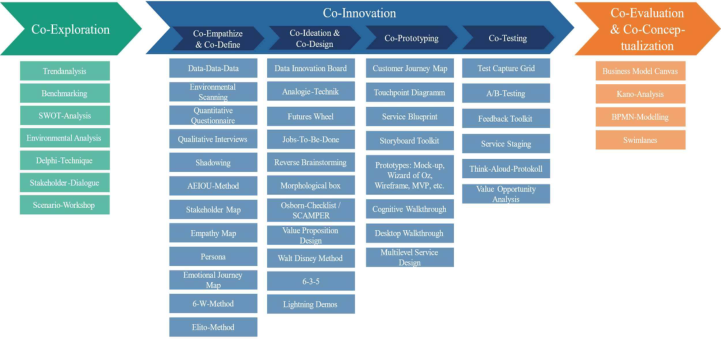
Throughout the process, various methods from data science, service engi- neering and, in particular, design thinking (see also Hehn et al., 2018) and co-creation are applied (see Figure 3 for a selection of methods). Wherever data helps to elucidate a problem, find ideas, or evaluate a new service, it is collected, analysed, and simulated, accordingly. Because of the vast diffe- rences in the nature of services, each service development requires different methods and tools (Gemser and Perks, 2015).
Figure 3: Selection of modular methods for interactively developing digital services (own figure).
Case Studies In order to test the approach for comprehensibility and applicability in practice, we applied the process in two case studies.
1. Development of a digital seat management tool for a university library 2. Development of a digital sharing platform for a university campus In both use cases the process was moderated by Fraunhofer IAO, who also decided on the methods to be used in each phase. The development team con- sisted of potential users in both use cases and representatives of the library and external developers in the first use case. While the result of the first use case was a sensor-based hardware solution combined with a web applica- tion to reserve a seat and visualize the current and predicted seat capacity, the result of the second use case was a mock-up of a smartphone application to share, offer and search for diverse items (e.g., books, tools, apartments). In line with the different outcome expectation, the length of the service deve- lopment process differed between the two use cases (use case one: 1,5 years, use case two: 3 months).
Despite the differences in team composition, duration, outcome expecta- tion and technical components, our approach was successfully applied in both use cases. The interdisciplinary composition of the participants led to innovative ideas. In particular, the “Co-Innovation” phase is well suited for co-creative and inter-organisational collaboration. The experienced gains in use case one showed that continuous support from the potential service ope- rator can provide valuable input and feedback in every phase of the service development process. However, in the “Co-Prototyping” subphase, digitally unsavvy people could only be involved in visualizing the service, not in the actual programming of it. Appropriate methods to involve all participants more fully, and easily applicable methods to promote the use of data in the service development need to be identified or developed in the future. In addi- tion, the “Co-Evaluation and Co-Conceptualization” phase was not carried out in detail, as both use cases focused on the general feasibility and were not designed for direct implementation.
DISCUSSION
Limitations and Further Research As the approach is still in its infancy, further evaluation should be undertaken to adapt the approach and modify the methods and tools used in the process. Moreover, a detailed cost-benefit analysis of the whole approach should be carried out and criteria for use cases that could particularly benefit from the process should be identified. As described above, there is still potential for improvement, especially in the Co-Prototyping phase, in order to promote the joint development between all stakeholders. In addition, insights from further use cases of other application areas are needed. So far, the approach has only been applied in a campus living lab, and mainly students and sta- keholders of this narrow living lab have been involved in the approach. In the future, the approach should be applied to existing business ecosystems in
Towards a Co-Creative Approach to Interactively Develop Digital Services 299
order to involve further and more diverse stakeholder groups and to assess whether the approach is also suitable for their interests and expectations and to verify its external validity. Furthermore, the most efficient composition of the service development team in each phase and subphase should be iden- tified, e.g. involving lead users for idea generation and ordinary users for testing (Gemser and Perks, 2015). Due to the COVID pandemic, many work- shops were conducted online, and further experience with on-site workshops is needed to evaluate this approach. The efficiency of this approach depends on the number of perspectives involved. It is therefore important to ensure a value creation and benefit for each participant to keep them involved. This should be analysed in detail in further research.
CONCLUSION
The result of our work is an approach that enables the development of digital services in a collaborative, inter-organisational and co-creative envi- ronment. Each phase is equipped with a set of methods, tailored to the specific goals and requirements. The structured but modular approach ena- bles practitioners and interdisciplinary, cross-organisational teams to jointly develop digital services in a collaborative way. Our research shows that the field of service innovation and user-centred methodologies is a widely discus- sed subject, but the structured involvement of additional stakeholder groups within an ecosystem is hardly recognized. Further research and publicati- ons are needed to build a better understanding of the different requirements and challenges of specific stakeholder groups and the ideal constellation of participants for such co-creative settings. In addition, further research is nee- ded to emphasise the technical and data-driven perspective in the co-creative development.
REFERENCES
Agarwal, R., Selen, W., Roos, G. and Green, R. (eds) (2015) The Handbook of Service Innovation, London, Springer London. Ayele, W. Y. (2020) ‘Adapting CRISP-DM for Idea Mining’, International Journal of
Advanced Computer Science and Applications, vol. 11, no. 6. Bigliardi, B., Ferraro, G., Filippelli, S. and and Galati, F. (2020) ‘The influence of open innovation on firm performance’, International Journal of Engineering Business Management, vol. 12. Bullinger, H.-J., Fähnrich, K.-P. and Meiren, T. (2003) ‘Service engineering—
methodical development of new service products’, International Journal of Production Economics, vol. 85, no. 3, pp. 275–287. Bullinger, H.-J., Meiren, T. and Nägele, R. (2015) Smart Services in Manufacturing Companies. Cazacu, M. and Titan, E. (2020) ‘Adapting CRISP-DM for Social Sciences’, BRAIN.
Broad Research in Artificial Intelligence and Neuroscience, vol. 11, 2sup1, pp. 99–106. Chapman, P., Clinton, J., Kerber, R., Khabaza, T., Reinartz, T., Shearer, C. and Wirth, R. (1999) ‘CRISP-DM 1.0: step-by-step data mining guide’ [Online]. Available at https://www.kde.cs.uni-kassel.de/wp-content/uploads/lehre/ws2012- 13/kdd/files/CRISPWP-0800.pdf.
Engel, C. and Ebel, P. (2019) ‘Data-Driven Service Innovation: A Systematic Literature Review and Development of a Research Agenda’, Proceedings of the 27th European Conference on Information Systems (ECIS) [Online]. Available at https://aisel.aisnet.org/ecis2019/. Gemser, G. and Perks, H. (2015) ‘Co-Creation with Customers: An Evolving Innova-
tion Research Field’, Journal of Product Innovation Management, vol. 32, no. 5, pp. 660–665. Hehn, J., Uebernickel, F. and Herterich, M. (2018) ‘Design Thinking Methods for Service Innovation - A Delphi Study’, PACIS 2018 Proceedings [Online]. Available at https://aisel.aisnet.org/pacis2018/126. Hoyer, W. D., Chandy, R., Dorotic, M., Krafft, M. and Singh, S. S. (2010) ‘Consumer
Cocreation in New Product Development’, Journal of Service Research, vol. 13, no. 3, pp. 283–296. Jussen, P., Kuntz, J., Senderek, R. and Moser, B. (2019) ‘Smart Service Engineering’, Procedia CIRP, vol. 83, pp. 384–388. Kerber, T. and Reindl, I. C. (2021) Co-creating Climate Smart Cities: A Practical
Guide: Developing digital solutions for and with citizens and public sector organizations [Online]. Available at https://www.smart-city-dialog.de/wp-conten t/uploads/2021/11/2020_GIZ_ICT-A_Co-Creating_Climate_Smart_Cities_Pract ical_Guide_web.pdf. Lewrick, M., Link, P. and Leifer, L. (eds) (2018) Das Design Thinking Playbook: Mit traditionellen, aktuellen und zukünftigen Erfolgsfaktoren, 2nd edn, München, Zürich, Vahlen; Versus Verlag. Meiren, T. and Barth, T. (2002) Service Engineering in Unterneh- men umsetzen: Leitfaden für die Entwicklung von Dienstleistungen [Online], Stuttgart, Fraunhofer-IRB-Verl. Available at http://vdli.de/VDLI- Dateien/Service%20Engineering%20in%20der%20Praxis.pdf. Ojasalo, K., Koskelo, M. and Nousiainen, A. K. (2015) ‘Foresight and Service Design
Boosting Dynamic Capabilities in Service Innovation’, in Agarwal, R., Selen, W., Roos, G. and Green, R. (eds) The Handbook of Service Innovation, London, Springer London, pp. 193–212. Perks, H., Edvardsson, B. and Gruber, T. (2012) ‘Co-Creation in Radical Service Innovation: A Systematic Analysis of Micro-Level Processes’, Journal of Product Innovation Management, vol.2 9, no. 9. Post, T., Heuermann, A., Wiesner, S., Oleschewski, D., Maaß, W., Klatt, R.,
Jussen, P., Ragab, S., Senderek, R., Höckmayr, B., Schulz, T., Meyer, K., Hei- nen, E., Hocken, C., Fischer, S., Lattemann, C., Redlich, B., Schlimm, K., Ziegler, C., Rechtien, C., Schröder, M., Kube, B., Pöppelbuß, J., Wiesche, M., Bartelheimer, C., Beverungen, D., Lüttenberg, H., Wolf, V., Bongers, F., Winkler, C., Schumann, J. H., Li, M. M., Brinker, J., Hagen, S., Kammler, F., Strina, G. and Ernst, Philipp, Falkus, Michael (2019) DIN SPEC 33453: Entwicklung digitaler Dienstleistungssysteme. Prahalad, C. K. and Ramaswamy, V. (2004) ‘Co-creation experiences: The next practice in value creation’, Journal of Interactive Marketing, vol. 18, no. 3, pp. 5–14. Randhawa, K. and Scerri, M. (2015) ‘Service Innovation: A Review of the Literature’,
in Agarwal, R., Selen, W., Roos, G. and Green, R. (eds) The Handbook of Service Innovation, London, Springer London, pp. 27–51. Schröer, C., Kruse, F. and Gómez, J. M. (2021) ‘A Systematic Literature Review on Applying CRISP-DM Process Model’, Procedia Computer Science, vol. 181, pp. 526–534.
Towards a Co-Creative Approach to Interactively Develop Digital Services 301
Stickdorn, M. and Schneider, J. (2014) This is service design thinking: Basic, tools, cases, Amsterdam, BIS. Tim Brown (2008) ‘Design Thinking: thinking like a designer can transform the
way you develop products, services, processes - and even strategy’, Harvard Busi- ness Review [Online]. Available at https://readings.design/PDF/Tim%20Brown, %20Design%20Thinking.pdf. Verschuere, B., Steen, T. and Brandsen, T. (2018) Co-Production and Co-Creation, Taylor & Francis. Voorberg, W. H., Bekkers, V. J. J. M. and Tummers, L. G. (2015) ‘A Systematic Review
of Co-Creation and Co-Production: Embarking on the social innovation journey’, Public Management Review, vol. 17, no. 9, pp. 1333–1357. Witell, L., Snyder, H., Gustafsson, A., Fombelle, P. and Kristensson, P. (2016) ‘Defining service innovation: A review and synthesis’, Journal of Business Research, vol. 69, no. 8, pp. 2863–2872. Yu, E. and Sangiorgi, D. (2018) ‘Service Design as an Approach to Implement the
Value Cocreation Perspective in New Service Development’, Journal of Service Research, vol. 21, no. 1, pp. 40–58.
LISTED IN THE AHFE DIGITAL BOOKSTORE CATALOGUE
Explore the complete digital volume
The Human Side of Service Engineering
Read this individual research paper free through the original publisher, or explore the full digital proceedings book.
ISBN 978-1-958651-84-1
Explore this ISBN in the AHFE Bookstore ↗Listed in the July 2026 bookstore catalogue; search by ISBN to confirm current availability · Digital book purchase optional