Thomas Meiren, Ilyas Khan (2023). New digital ways of creating value in retail. In: The Human Side of Service Engineering. AHFE Open Access, vol. 108, pp. 333–340. https://doi.org/10.54941/ahfe1003135
The COVID 19 pandemic led to a change in consumer behavior in the retail industry. While retailers were already facing increased competition from large online platforms before the Corona crisis, the pandemic has significantly accelerated this process and also introduced customer groups to online shopping that had not used it in earlier times. However, there is currently only a hesitant return to earlier shopping habits from which entire regional ecosystems - especially in rural areas and smaller towns - are now suffering. Many stores are giving up, and neighboring service providers (e.g., restaurants, culture, leisure industry) are also affected. Nevertheless, the pandemic has also shown that companies, that implemented new - often digitally supported - solutions very quickly, came through the difficult times better. For example, web shops as well as additional online and delivery services were able to mitigate the loss of sales in the stationary business.But it has to be noted, that retail is traditionally a rather less innovative industry. Expenditure on research and development, for example, is among the lowest in the entire service sector. It is not uncommon for small and medium-sized retail companies to lack a fundamental awareness of innovation and to have no corresponding processes and responsibilities defined there. The resulting deficits became obvious in the current pandemic and now leaves many companies with a dilemma: on the one hand, they notice that competitors are successful with new digital solutions, but at the same time they often have neither the competence nor the means to implement their own innovations. The knowledge about digitization as well as about the development of new solutions is simply not available in many small and medium-sized retail companies.The conference paper will present relevant digital innovations for the retail industry of the future - from interactive display boards and shop windows to digital price tags, new smart payment solutions and the use of augmented reality, artificial intelligence and service robots. Moreover, concepts and case studies will be shown how digital innovations can be successfully implemented step by step in small and medium-sized retail companies. The conference presentation will be complemented by the results of an expert survey in the retail sector.
The COVID-19 pandemic led to a change in consumer behavior in the retail industry. While retailers were already facing increased competition from large online platforms before the Corona crisis, the pandemic has significantly accelerated this process, and also introduced customer groups to online shop- ping that had not used it in earlier times (Grimmer, 2022). However, there is currently only a hesitant return to earlier shopping habits from which entire regional ecosystems - especially in rural areas and smaller towns - are now suffering. Many stores are giving up, and neighboring service providers (e.g., restaurants, culture, and leisure industry) are also affected (Hedde et al. 2021, Nanda et al. 2021). Nevertheless, the pandemic has also shown that com- panies, that implemented new - often digitally supported - solutions very quickly, came through the difficult times better (Simmons, 2021). For exam- ple, web shops as well as additional online and delivery services were able to mitigate the loss of sales in the stationary business.
But it has to be noted, that retail is traditionally a rather less innovative industry. Expenditure on research and development, for example, is among the lowest in the entire service sector (OECD 2023). It is not uncommon for small and medium-sized retail companies to lack a fundamental awareness of innovation and to have no corresponding processes and responsibilities defined there. The resulting deficits became obvious in the current pandemic and now leave many companies with a dilemma: on the one hand, they notice
that competitors are successful with new digital solutions, but at the same time they often have neither the competence nor the means to implement their own innovations. The know-ledge about digitization as well as about the development of new solutions is simply not available in many small and medium-sized retail companies (Meiren et al. 2022).
Against this background, the paper discusses new digital ways of crea- ting value in retail. It first looks at key challenges in stationary retail. It then discusses the role of digitization and presents new digital solutions for the retail sector. The paper concludes with the results of a workshop with 16 experts from practice, who evaluated the new digital solutions and formulated recommendations for small and medium-sized retail companies.
CHANGES IN VALUE CREATION The increasing importance of e-commerce is not only leading to structural change in city centers and shopping malls and to changes in the sales of stationary retail, but is also leading to changes within the traditional value chain (Hagi and Zabarauskas, 2022, Roggeveen and Sethuraman, 2020). The primary role of retailers was to help customers select products. If this was also done at an acceptable price, this was the key benefit for consumers, for whom they were also prepared to pay a little more. However, digitization and the corresponding developments mean that retailers are often no longer able to perform precisely these value-adding activities, such as procurement, pre-selection and advice, as they used to. This particularly affects the core functions of assortment and information management.
For example, price and product search engines are increasingly taking over the advisory function, recommendation engines enable customer revi- ews, social networks bundle opinions and recommendations, “infomediaries” often have greater assortment expertise, and brokers offer an infinitely large selection of products (Nanda et al. 2021). The result is the loss of the domi- nant role and unique selling propositions of traditional stationary retail. Customers no longer perceive or often even make use of many central sta- ges of the value chain, so that the willingness to pay for them continues to decline. It also becomes problematic for stationary retail when the costs of advice and service are nevertheless included in the price calculation. As a result, stationary retailers will always be significantly inferior to pure online providers in terms of competition and will lose further market share.
Up to now, the entire value creation in the purchase decision process has taken place at the retailer. However, the Internet is leading to a progressive decoupling of the previous value creation stages in stationary retail. Value creation is increasingly being distributed among different players, which con- sequently also leads to a new distribution of profits and a decrease in the depth of value creation in retail.
CHANGE IN BUYING BEHAVIOR The changes in the consumer buying process as a result of digitization and increasing online purchases will also lead to a transformation in customer
New Digital Ways of Creating Value in Retail 335
expectations of stationary retail in the future (Sayyida et al. 2021). In the typical buying process, increasing digitization is more and more blurring the boundaries between the online and offline worlds (Winters, 2021). Custo- mers are coming into contact with digital information and marketing tools during the buying process, for example during the purchase initiation phase through product recommenddations and extensive product information, or during the purchase decision phase through available customer reviews. As a result, people are becoming accustomed to the advantages and new digi- tal shopping elements, so that their absence in stationary retail can have a negative impact on the purchase decision.
These missing digital elements, which are otherwise only known from online retail, disturb many stationary customers. In a current study, 76 percent of younger respondents (“generation Z”) expect retailers to have their own website and 58 percent to have their own Internet stores. In addi- tion, 83 percent demand product availability that can be viewed online and 51 percent expect their own WLAN in the store (Kemmer et al. 2023). Other customer expectations are directed at the experience aspects of stationary retailing. Entertainment in particular is becoming increasingly important, e.g. the term “retailtainment” has been coined, a combination of “retail” and “entertainment”. The key to success here will be to offer customers a memorable shopping experience (Ibrahim, 2022). In addition to the customer’s desire for entertainment and experience, the social aspects of stationary shopping must also be taken into account. People are commu- nal creatures and like to go shopping in the company of others. Therefore, stationary shopping should additionally create spaces and places for human encounters to promote a social community experience.
In the future, stationary retail should aim to accompany customers along their buying process through an effective combination of stationary elements, such as advisory staff, and innovative, digital elements, such as self-service checkouts, across all channels and process steps (Mason and Knights, 2019). In the process, how stationary advice is provided will also change radically in the future. It will be increasingly important to meet customer expectati- ons by providing customer-oriented and targeted advice. For this purpose, the collection and use of customer data is essential in stationary retail, simi- lar to what is already happening in online retail. This will enable various targeted and personalized offer formats and consulting options to meet custo- mer demands and thus position themselves better concerning online offers (T-Systems 2022).
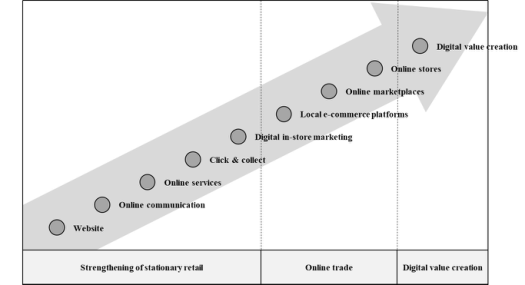
DIGITIZATION STAGES IN STATIONARY RETAIL The previous chapters have made it clear how digital technologies and appli- cations are changing value creation in retail. Figure 1 now shows various stages of digitization, both for stationary retail and its connection to the online world.
The lower levels serve to strengthen stationary retail. The aim of this is to encourage customers to visit the store. Starting with the company’s web- site, online communication can be designed for this purpose, e.g., via online
336 Meiren and Khan
Figure 1: Digitization stages in retail.
marketing and social media. Furthermore, online services such as information on frequently asked questions via chat or email functions, digital bookings of consulting appointments, or registrations for special events can also be offe- red. This also provides the opportunity to collect customer data and make exclusive offers. Other online services can include reservation and on-site collection (“click & reserve”) or online purchase and subsequent on-site col- lection (“click & collect”) of products. As the boundaries to online stores are becoming increasingly blurred here, especially in the case of click & col- lect, these services can also be assigned to the category of “multi-channel retailing”, although the primary aim of these offerings is still to encourage customers to visit the store. It is the same with digital in-store marketing. The aim is to support customers throughout the entire buying process by employing digital technologies in the store and thus to improve the statio- nary shopping experience. Conceivable examples here include support for the advisory staff by tablets, new forms of contactless payment, indoor navi- gation, or smart shopping carts and interactive shop windows that enable customer interactions outside opening hours.
In the second digitization stage, there are local e-commerce platforms, such as city apps, which support users in their search for restaurants, sights, cultu- ral offerings, and shopping opportunities, depending on their location. These not only serve as digital showcases for stationary stores, but in some cases also offer direct ordering options and delivery services. In contrast, online marketplaces and stores are limited exclusively to product sales via the Inter- net. In terms of multi-channel retailing, these can be used in addition to the stationary store as further sales channels to market and sell products.
In digital value creation, the retailer sees itself not only as a pure link between production and consumption, but also actively intervenes in pro- duct and service design. In particular, customer-specific information is used to individualize and personalize products and services.
EVALUATION OF DIGITAL SOLUTIONS FOR STATIONARY RETAIL Recently, a variety of new digital solutions have emerged that can be used in the retail business. Accelerated by the effects of the COVID 19 pandemic as
New Digital Ways of Creating Value in Retail 337
well as the megatrend of digitalization, not only large companies but incre- asingly also small and medium-sized enterprises are now interested in new digital solutions.
As part of an expert workshop, relevant digital technologies for stationary retailers were identified and evaluated, and recommendations for action were subsequently derived. The workshop took place on September 22, 2022, in Stuttgart, Germany, and was attended by 16 experts - all with at least ten years of practical experience in retail.
At the beginning, digital solutions for retail were collected and the applications listed in Table 1 were selected for further evaluation: Then, each of the digital solutions was evaluated by each expert based on the following three criteria:
Future relevance: How important will each digital solution be to the retail industry in the future?
Customer need: To what extent is there a need for each digital solution from the customer’s perspective?
Table 1. Overview of the digital solutions selected by the experts.
Table available in the original PDF paper.
Digital technologies Characterization Online communication Company profile with basic information on the Internet, own website, use of social media Internet-based sales channels
Sales on the Internet in addition to stationary business, Online marketplaces, Online stores Online services Offering additional services via the Internet, linking stationary business with online channels Digital price tags Displaying the prices of products via small digital displays, digitally controlled dynamic price adjustment Interactive displays Digital displays that enable interaction with customers via gesture control or touch screen Interactive shop windows
Digital storefronts composed of screens and other technologies such as cameras, speakers and motion sensors Digital dressing rooms Digital provision of product information in the changing room, often using the mirror as a display Tablets for the sales staff Equipping staff on the sales floor with tablets, retrieving information in direct conversation with customers Virtual Reality and Augmented Reality
Generation of interactive virtual, computer-generated environments, e.g. for product presentation or in-store navigation Service robots Service robots take over simple tasks in direct contact with customers, to relieve sales staff of routine tasks Beacon technology Beacons are small, battery-powered devices that send product information at regular intervals via Bluetooth Mobile and contactless payment
Payment is made by holding the smartphone, a wearable or a credit card at a short distance from the payment terminal Self-checkout systems Self-checkout systems enable customers to register and pay for products independently using scanners Cashierless payment systems
Product scanning and payment are fully automated, allowing customers to leave the store without a checkout process Intelligent inventory management
Use of Artificial Intelligence for trend recognition, demand planning and stock management
338 Meiren and Khan
Suitability for SME: To what extent is each digital solution suitable for small and medium-sized retail enterprises?
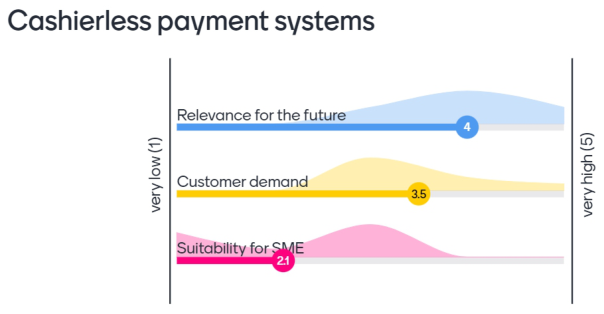
A scale of 5 from 1 (“very low”) to 5 (“very high”) was used for each of the three criteria. The evaluation was carried out individually by each participa- ting expert. The use of the Mentimeter software made it possible to present the results - in particular the mean values and distributions - immediately after the expert evaluation (see Figure 2).
Figure 2: Example of instant display of evaluation results before expert discussion.
The question of future relevance revealed that the technologies assigned to the lower digitization level (see Figure 1) are of particular importance. At the top of the list are online communication and mobile and contactless payment (each with a maximum value of 5.0), followed by online services (4.6) and Internet-based sales channels (4.1). At the bottom end are interactive store windows (2.4), interactive displays (2.3), and service robots (2.0).
With regard to the criteria of customer need, the evaluation results show a similar distribution. The experts see the highest need for mobile and conta- ctless payment (with a value of 4.9) and online communication (4.4), while interactive store windows (2.3), digital dressing rooms (2.1) and service robots (1.9) bring up the rear. The subsequent discussion among the experts also showed that the “future relevance” factor is highly linked to customer needs and expectations.
The third of the evaluation criteria used was suitability for SME. This was due to the observation that large retail companies have recently inve- sted massively in the digitization of their processes and stores and have built up corresponding personnel capacities, while small and medium-sized enter- prises often simply lack the resources for this. In line with that, the experts’ ratings are also rather low overall. Online communication achieves the high- est score of 4.5, but the following tablets for the sales staff (3.9), online services (3.8) and Internet-based sales channels (3.6) only achieve scores in the middle range. Nine of the 15 digital solutions surveyed even receive extremely low scores of less than 2.5.
New Digital Ways of Creating Value in Retail 339
RECOMMENDATIONS The evaluation was finally discussed with the experts - particularly with a view to drawing conclusions for small and medium-sized retailers. As a result, the following recommendations for action have been formulated.
1. Develop an own strategy for digitization: Retail companies are heterogeneous. While a traditional, family-run retailer may be able to score more with quality and customer orienta- tion, a young start-up has the flexibility and willingness to react quickly to trends. A large company, on the other hand, can invest larger sums and sometimes has an easier time building up the necessary personnel skills. That is why “one size fits all” approaches do not work and every company is well advised to develop its own strategy to digitization. 2. Build competencies for digital business: Technological developments and the increasing opportunities for digiti- zation have led to new qualification requirements for employees. Com- petencies that are currently available and will be required in the future should therefore be systematically collected, analyzed, documented and presented transparently to the workforce at regular intervals. The identi- fied gaps can be closed not only through new hires, but also with targeted training measures. 3. Build company networks and use them for digitization: Small and medium-sized retailers often lack the financial and human resources to implement digitization projects in the company. One way out of this is to carry out such projects jointly with other retailers and to establish collaborations with suitable external partners such as IT service providers and consulting firms. Another approach that can help is not to develop everything from scratch, but to use ready-made soluti- ons and instead focus on integrating them into the company’s business processes.
The results of the expert workshop make it clear that the innova- tion dynamic in the retail has increased significantly. The main dri- vers are the digitization of business, which has been intensified by the COVID 19 pandemic, and changes in customers’ buying behavior. A large number of new digital technologies are currently entering the mar- ket, and small and medium-sized enterprises in particular are finding it difficult to keep pace with the new developments. It is therefore impor- tant to familiarize with the new technical possibilities, develop own stra- tegies and cooperatively implement new solutions in line with customer needs.
ACKNOWLEDGMENT
The authors would like to acknowledge the Ministry of Economic Affairs, Labor and Tourism Baden-Wuerttemberg for funding this work within the Project “Handel innovativ”.
340 Meiren and Khan
REFERENCES
Grimmer L. (2022) Lessons from the COVID19 pandemic: The case of retail and consumer service firms. Journal of Retailing and Consumer Services. doi: 10.1016/j.jretconser.2022.103012. Hagi, A., Zabarauskas, J. (2022) Impact of Covid-19 on Retail Strategies Adopted
by Grocery Stores in Sweden. Jönköpping: International Business School. Hedde, B., Fabian, M.-H., Peissner, M. (2021) Zukunft des Handels – Zukunft der Städte. Cologne: IFH. Ibrahim, I. (2022) Future-Ready Retail: How to Reimagine the Customer Experie-
nce, Rebuild Retail Spaces and Reignite our Shopping Malls and Streets. London: Kogan. Kemmer, J., Schweiger, S., Taubert, J. (2023) Studie zu den Anforderungen und Erwartungen der Generation Z an den Einzelhandel. Stuttgart: Fraunhofer. Mason, T., Knights, M. (2019) Omnichannel Retail: How to build winning stores in
a digital world. London: Kogan. Meiren, T., Friedrich, M., Schiller, C. (2021) Smart Services. Stuttgart: Fraunhofer. OECD (March 31, 2023) Business enterprise R&D expenditures by industry. Website: https://stats.oecd.org. Nanda, A., Xu, Y., Zhang, F. (2021) How would the COVID-19 pandemic resh-
ape retail real estate and high streets through acceleration of E-commerce and digitalization?, Journal of Urban Management, Volume 10, No. 2, pp. 110–124. Roggeveen A. L., Sethuraman R. (2020) How the COVID-19 pandemic may change the world of retailing, Journal of Retailing, Volume 96, No. 2, pp. 169–171. Sayyida, S., Hartini, S., Gunawan, S., Husin, S. N. (2021) The Impact of the Covid-19
Pandemic on Retail Consumer Behavior, APTISI Transactions on Management (ATM), Volume 5, No. 1, pp. 79–88. Simmons, J. (2021) Retail survival through the pandemic. White Paper. London: L. E. K. T-Systems (2021) Off to the digital fast lane. Data analyses strengthen the retail
sector, Frankfurt: T-Systems International. Winters, A. (2021) Omni-Channel Retailing: An Analysis of Channel Interdependencies, Integration Services and Specific Marketing Instruments. Wiesbaden: Springer Gabler.
LISTED IN THE AHFE DIGITAL BOOKSTORE CATALOGUE
Explore the complete digital volume
The Human Side of Service Engineering
Read this individual research paper free through the original publisher, or explore the full digital proceedings book.
ISBN 978-1-958651-84-1
Explore this ISBN in the AHFE Bookstore ↗Listed in the July 2026 bookstore catalogue; search by ISBN to confirm current availability · Digital book purchase optional