Jonas Christian Dietz, Manuel Kaiser, Marc Rüger (2026). Sustainability in value creation systems: a systematic literature review and development of an integrative framework. In: Human Factors, Business Management and Society. AHFE Open Access, vol. 215, pp. 192–201. https://doi.org/10.54941/ahfe1007600
Sustainability is an impactful driver of recent business operations and is gaining increasing visibility in practice and academic discussions. The increasing interest in sustainability among organizations is driven by the growing expectations of stakeholders for environmentally and socially responsible business practices. Regulatory changes often necessitate adjustments to existing business models and value chains, leading to new compliance requirements and reporting obligations. Additionally, integrating sustainability has the potential to open new opportunities for innovation and the development of new products and customer segments, providing new economic opportunities to create value. However, the research on the influence of sustainability on value creation systems is fragmented and lacks an integrative approach to the impact on value systems. To address this gap, this study conducts a systematic literature review. The goal is to synthesize the current state and identify established and emerging research areas. The analysis incorporates a total of 44 peer-reviewed articles published between 2009 and 2024 in the Scopus database through a keyword search. The thematic synthesis shows that companies that strategically embed sustainability into their value creation systems can realize long-term benefits for the environment, society, and the economy. This systematic literature review contributes two main pieces of knowledge to the academic discourse on sustainability in value creation systems. Firstly, it highlights existing knowledge and key discussion lines that shape the discourse. Secondly, it develops an integrative framework that presents complex relationships between the triple bottom line (TBL), dynamic capabilities, and sustainability implementation in value creation systems.
In a world shaped by ecological challenges, the concept of sustainability is gaining increasing significance for all economic activity. Particularly within value creation systems (Fearne et al., 2012; Ledro et al., 2025), which form the backbone of corporate operations, the integration of sustainable practices is becoming a decisive factor for long-term success and competitiveness. This is Received February 5, 2026; Revised April 12, 2026; Accepted May 1, 2026; Available online July 20, 2026
Sustainability in Value Creation Systems: A Systematic Literature Review 193 because value creation systems include various areas of the company, such as networks, dynamic processes, strategic cooperation, resource management, and stakeholder orientation.
The relevance of the topic arises from several factors. First, sustainability has evolved into a central strategic element of corporate management (Fearne et al., 2012; Seuring & Müller, 2008; Markard et al., 2012). Today, companies face mounting expectations from consumers (Gualandris & Kalchschmidt, 2014), investors (Tun et al., 2024), and regulators (Aiguobarueghian et al., 2024) to make their business practices more environmentally friendly and socially responsible. Second, integrating sustainability into value creation systems opens new ways for innovation (Hinderer & Kuckertz, 2022), efficiency gains, and risk mitigation. Companies recognize that sustainability initiatives can lead to innovations, cost savings, and new market opportunities (Fransen, 2019). At the same time, they face new challenges arising from global trends such as climate change, digitization, and stricter regulation. Governments worldwide have introduced more stringent rules and reporting obligations related to sustainability, compelling firms to integrate these aspects into their core business strategies (Aiguobarueghian et al., 2024). Furthermore, successful sustainability initiatives increasingly involve partnerships with other organizations, including competitors, non-governmental organizations, and government agencies (Avery, 2015). Therefore, sustainability drives innovation in products, services, and business processes and is becoming an important differentiator in competitive markets (Sevak & George, 2024). In our study, we define sustainability as the holistic development of societies and businesses that aims to meet the needs of the present generation without compromising the ability of future generations to meet their own needs, by equally integrating the environmental, social, and economic dimensions. This requires resource conservation, efficiency, and the promotion of a circular economy as central goals, while reconciling economic progress with social justice and environmental protection under clear, binding frameworks based on our planet’s ecological carrying capacity (Piel, 1992; Elkington, 1997; McDonough & Braungart, 2009). This definition integrates the core elements of sustainability: long-term development and intergenerational justice, the multidimensional nature of sustainability, as well as resource conservation, while also emphasizing a systematic approach.
In summary, these approaches and perspectives show that there are many different areas of action for sustainability in organizations, their value chains and entire value creation systems. However, despite advances, an overview of the status quo, important discussion lines as well as the connection between key topics spanning organizational value creation processes is still missing. In addition, there is currently a lack of an integrative framework that links sustainability concepts with value creation systems and thus illustrates the interrelationships between them. Therefore, we conduct a systematic literature review to summarize this knowledge and identify established and new research fields of sustainability in value creation systems.
REVIEW APPROACH AND DATA SELECTION The analysis and synthesis of sustainability in value creation systems is performed through a systematic literature review (Fisch & Block, 2018; Tranfield et al., 2003). The systematic literature review is an essential
approach in expanding knowledge in a particular subject area. Its goal is not only to collect existing studies, but also to view, evaluate, and synthesize them in a comprehensive context.
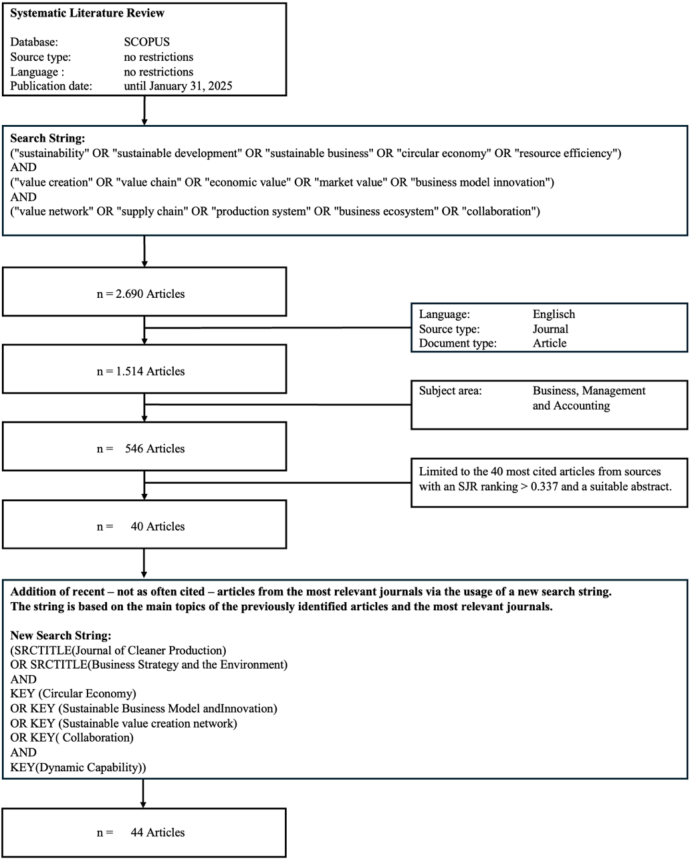
To develop the search string for the topic of sustainability in value creation systems, we summarized keywords and important concepts of the subject areas sustainability, value creation, and value creation systems. To enable a precise search, the terms within each category were linked with OR so that different synonyms and formulations could be captured. Furthermore, the categories were linked with AND to ensure that the articles found deal with sustainability, value creation, and value creation systems at the same time. As a result, we received the following search string: (sustainability OR sustainable development OR sustainable business OR circular economy OR resource efficiency) AND (value creation OR value chain OR economic value OR market value OR business model innovation) AND (value network OR supply chain OR production system OR business ecosystem OR collaboration).
In the next step, the Scopus database was used in January 2025 to query this search string. The initial search without filters yielded a total of 2,690 paper hits with a publication period of 26 years (1999–2025). Our systematic literature review focuses on papers published in academic, peer-reviewed journals in English. To meet these quality requirements, the original search in Scopus was further narrowed down using the filters Language: English, Source Type: Journal, and Publication Type: Article. This reduced the number of publications to 1,514. Subsequently, the subject area was used as inclusion criterion, and only papers from Scopus area: Business, Management and Accounting were used in the further sample. This left us with 546 articles in the sample. In the next step, we applied a quality cut-off (Kaiser & Berger, 2021) with the scientific journal ranking (SCImagojr) as filter (exclusion of all articles in the sample with SJR ≤ 0.337). This filtering reduced the number of relevant articles from 546 to 463, meaning that 83 articles were excluded by the quality cut-off. After that, the abstracts of the 463 articles were analyzed in more detail, and we focused on the 40 most cited articles in that sample. Furthermore, only those articles that contributed to answering our research topic were included in the final selection. This selection process ultimately resulted in 40 articles from 2009 up to 2023. However, a review of the identified articles reveals that no publications from the years 2024 or 2025 are included. This lack of current literature is due to the influence cut- off regarding the number of citations. Since newer articles have naturally not yet reached the number of citations required to be included in the selection, they were excluded by this selection criterion.
To expand the sample with current and relevant literature, the previously identified articles were examined for relevant recurring themes. Based on these thematic priorities, a supplementary search was then conducted, specifically looking for current publications from 2024 and 2025. This ensured that more recent scientific articles that may not yet have been cited sufficiently but are nevertheless relevant in terms of content were also included in the analysis. The analysis of recurring themes revealed that most of the articles identified deal with key concepts such as circular economy, sustainable business model innovation, sustainable value creation network, and collaboration.
Sustainability in Value Creation Systems: A Systematic Literature Review 195 In addition, supply chain sustainability was frequently discussed. However, in the further search for current articles, this topic area was combined with sustainable value creation networks, as both concepts are closely linked and address similar research questions. Although dynamic capabilities are not among the most frequently discussed topics, they were nevertheless included in the further search. The additional search yielded a total of 11 articles that matched the defined filter criteria. To ensure that only relevant articles were included in the analysis, the abstracts of these articles were analyzed in the same way as in the previous selection. Four relevant articles from 2024 were identified, three of which were published in the Journal Business Strategy and the Environment and one in the Journal of Cleaner Production. By adding these four relevant articles, the total number of publications analyzed in this work increased to 44 articles from 16 journals (see Figure 1).
Figure 1: Search process.
RESULTS OF THE SYSTEMATIC LITERATURE REVIEW: CENTRAL THEMES AND TRENDS IN THE FIELD Building on the methodology in the previous sections, this chapter aims to systematically identify content patterns and central concepts within the field of sustainability in value creation systems. The analysis of the identified literature constitutes a central component of this work and serves to develop a comprehensive understanding of the research landscape.
Systematic Evaluation of Relevant Publications For the systematic documentation and tracking of the conducted literature evaluation, a research journal was created in Microsoft Excel. This contained all relevant metadata of the identified publications, including author(s), year, title, and journal, as well as the applied method. Additionally, regional and industry-specific assignments were made, and definitions of sustainability from the respective sources were documented. A particular focus was on the analysis of the TBL dimensions (economic, ecological, social) as well as the challenges and success factors of sustainable value creation. Furthermore, best practices and the role of dynamic capabilities were recorded. This structured recording ensured the consistency and reproducibility of the analysis and allowed for the targeted identification of potential research gaps. The analysis of the 44 considered articles shows that qualitative and conceptual methods were used most frequently, both individually and in combination. Quantitative methods, on the other hand, are the least represented, indicating that the research field is more focused on exploratory and theory-building approaches. Another central aspect is the geographical scope of the studies. More than half of the articles examine more than one region, with the majority of them analyzing at least three regions.
The analyzed studies are “multidimensional” and show a strong international perspective on sustainable value creation systems. Regarding the industry-specific foci, most articles focus on energy-intensive industries such as the manufacturing and agricultural & food industries (Kiss, 2024; UNIDO, 2024). These industries are often at the center of the discussion on sustainable value creation because they have both high ecological and economic impacts. A significant result of the analysis is the multidimensionality of sustainability in the studied articles. The majority of the articles consider sustainability from the perspective of the Triple Bottom Line (TBL), with 80% of the articles including all three sustainability dimensions— ecological, social, and economic. Nevertheless, it is evident that the social aspect is the least discussed, as 20% of the articles do not consider it. Regarding dynamic capabilities, it is clear that they are mostly treated indirectly rather than explicitly. Coordination and learning are the most frequently discussed abilities, while reconfiguration is less frequently examined.
This indicates that research has so far focused more on processes for identifying and implementing sustainable innovations, while the structural and strategic adaptation of companies is less in focus. The results of the articles clarify that sustainability is often understood as a strategic transformation that must be accompanied by comprehensive organizational adaptations. Particularly innovative business models play a central role in this context,
Sustainability in Value Creation Systems: A Systematic Literature Review 197 as they enable companies to link sustainability goals with economic success. Concepts of the circular economy and Sustainable Business Model Innovation are dominant approaches in this regard. Furthermore, it is evident that cooperation and stakeholder management are essential for the implementation of sustainable processes, as companies operate in highly networked value creation systems. Another central result is that regulatory frameworks have a significant influence on the implementation of sustainable strategies, as they force companies to adapt on the one hand but can also provide supportive measures on the other. Finally, it becomes clear that technological innovations, particularly in the areas of artificial intelligence and big data, enable new approaches to sustainable transformation. Nevertheless, companies face challenges here, for example regarding the integration of new technologies into existing processes or the use of data to optimize sustainable business models. Another pattern emerges in the recurring themes and trends of the considered articles.
The circular economy is gaining increasing importance as companies develop more resource-efficient production processes. At the same time, business model innovation is seen as an essential strategy for successfully implementing sustainability, which often requires a radical rethink in existing business models. Furthermore, it is evident that the involvement of stakeholders is a decisive success factor. Companies are increasingly working with partners such as NGOs, governments, and supply chain actors to implement sustainable processes. Finally, technology is considered an enabler for sustainability, facilitating the implementation of sustainable processes, for example through the use of artificial intelligence (Pallardy, 2024; Sargiotis, 2024). Digitization and automation also facilitate this implementation but are associated with challenges, as is the use of artificial intelligence (Dubie, 2025). Despite these commonalities, differences between the studies can also be observed. While all articles emphasize the need for coordination and stakeholder management, they show different perspectives on the role of regulation. Some studies see sustainability as an entrepreneurial opportunity, while others see it primarily as a regulatory necessity. Additionally, there are industry-specific differences. While sustainability in the energy sector is seen as a strategic component of corporate alignment, it is often used as a marketing tool in the fashion industry.
DISCUSSION OF THE RESULTS AND DEVELOPMENT OF AN INTEGRATIVE FRAMEWORK The results of our systematic literature review indicate that sustainable value creation systems require a holistic consideration of economic, social, and ecological dimensions. In particular, the role of dynamic capabilities is highlighted as central to the implementation of sustainable business models. Firms that can dynamically adapt their resources and capabilities to changing environmental conditions benefit from sustainable strategies in the long term. Interorganizational networks and collaborations prove to be key factors in the successful implementation of sustainable value creation approaches. Moreover, it is shown that technological developments (Sevak & George,
2024), particularly in the areas of digitization and the circular economy, are playing an increasingly significant role in sustainable value creation.
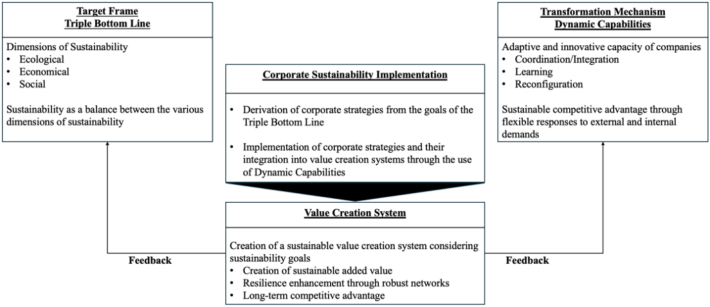
Various definitions of value creation systems and sustainability show that dynamism and adaptability are central elements of these concepts. This is closely related to the dynamic capabilities approach according to Teece et al. (1997). This approach describes a company’s ability to continuously adapt to changing environmental conditions, renew internal competencies, and shape innovation processes to achieve long-term economic success. Some definitions explicitly address the dynamic nature of sustainability and value creation. This corresponds to the idea of dynamic capabilities, which emphasize that companies must regularly reconfigure their resources and competencies to operate successfully and sustainably in the long term. Schumpeter (2003), Osterwalder & Pigneur (2013), and Allee (2000) also emphasize the importance of innovation and the dynamic processes associated with it. Schumpeter’s concept (2003) illustrates that companies must question existing structures and business models and achieve competitive advantages through continuous renewal. Osterwalder & Pigneur (2013) highlight the role of business model innovations, while Allee (2000) emphasizes that value creation is not static, but rather the result of dynamic and interactive processes within networks. Another aspect emerges from the considerations of Figueiredo & Scaraboto (2016), who address the necessary adaptation of processes and infrastructure. This is directly related to the dynamic capabilities that enable companies to transform existing structures, build new competencies, and integrate innovative technologies. These dynamic capabilities thus form the basis for value creation and sustainable development and the transformation mechanism of the integrative framework (see Figure 2). In the context of dynamic capabilities, this means that companies not only respond to change, but also actively strengthen their competitiveness through three key processes: (1) Coordination and integration: the efficient coordination and linking of existing resources to secure competitive advantages. (2) Learning: the continuous development of knowledge and skills to recognize changes early on and respond to them. (3) Reconfiguration: the flexible realignment of internal processes and resources to exploit innovation potential and adapt to new market conditions (Teece et al., 1997).
The multidimensionality of sustainability is, alongside dynamic capabilities, the second central component of the framework. Sustainability is understood not only as an ecological concept, but as an integrative model that takes several aspects into account equally. This perspective is evident in several of the definitions considered, which indicate that sustainable development always exists in a dynamic tension between economic value creation, social responsibility, and ecological sustainability. These aspects were most prominently identified by Elkington (1997) in the context of the TBL as economic, ecological, and social dimensions. Considering these findings, the TBL is the second fundamental concept used in the framework. The use of the TBL in the framework makes it possible to systematically capture the multidimensionality of sustainability and to view the various factors influencing value creation systems from a holistic perspective. By integrating ecological, social, and economic aspects, it provides a structured basis for analyzing sustainable transformation processes.
Sustainability in Value Creation Systems: A Systematic Literature Review 199 Although the analyzed studies provide valuable insights, some aspects have not been sufficiently investigated. Detailed analyses on the implementation of dynamic capabilities are largely missing. While many studies highlight the importance of dynamic capabilities, few explain how companies can actually transform their capabilities. Another research deficit is the low consideration of sustainability in service industries. Most studies focus on production and industry, while sustainability strategies in the service sector have been little studied. Moreover, there are contradictory findings and open questions, particularly regarding the economic significance of sustainability. While some studies show that sustainability can be a clear competitive factor, others argue that the associated costs are too high for companies to implement sustainable measures independently.
Figure 2: The integrative framework of sustainability in value creation systems.
To close these research gaps, future studies should improve the measurability of sustainability measures. Companies need better key performance indicators (KPIs) to systematically evaluate the impact of sustainable practices. Another important research area is the expansion of the focus on digitization. Technologies such as artificial intelligence and big data could open up new opportunities by enabling more efficient and data-driven sustainability strategies. In this context, however, it is also necessary to take a critical perspective on these technological advances and their implications for the ecological dimension of sustainability (e.g., the impact of energy requirements for AI solutions). Finally, there is potential for cross-industry comparisons. It would be relevant to investigate which industries implement sustainability most effectively and what best practices can be derived from this. The findings can be classified into the combined TBL and dynamic capabilities framework introduced in our research. While the TBL model serves as a framework for evaluating sustainable value creation systems, dynamic capabilities explain how companies can operationally implement sustainability. The abilities to coordinate and learn play a decisive role, as sustainable value creation systems are heavily dependent on internal processes and external partnerships. The reconfiguration, which deals with the structural adaptation and realignment of companies, is less strongly examined. This shows that research has so far focused primarily on the identification and implementation of sustainable
innovation processes, while questions about long-term structural adaptation and strategic transformation of companies should be further investigated.
CONCLUSION
The aim of the study was to identify the current state of research and to highlight any research gaps that require further scientific investigation. With its integrative framework, our study also provides a connection between sustainability, value creation systems, and dynamic capabilities. This framework not only elucidates the theoretical relationships between ecological, social, and economic dimensions of sustainability but also operationalizes these insights by emphasizing the role of dynamic capabilities as key mechanisms for systematically integrating sustainability into corporate value creation systems. Thus, it directly addresses the central research question by offering a structured approach to sustainable transformation that is both theoretically grounded and actionable for organizational practice. In our upcoming research, we will therefore build on the integrative framework and test it using empirical approaches with stakeholders in organizational contexts.
REFERENCES
Aiguobarueghian, I., Adanma, U. M., Ogunbiyi, E. O., Solomon, N. O. (2024). An overview of initiatives and best practices in resource management and sustainability. World Journal of Advanced Research and Reviews, 22(2), pp. 1734–1745. https:// doi.org/10.30574/wjarr.2024.22.2.1519 Allee, V. (2000). Reconfiguring the value network. Journal of Business Strategy,
21(4), 36–39. https://doi.org/10.1108/eb040103 Avery, G. C. (2015). Key corporate sustainability drivers: engaged boards and partnerships. Strategy & Leadership, 43(3), pp. 44–48. https://doi.org/10.1108/ SL-02-2015-0015 Dubie, D. (2025). Sustainability, grid demands, AI workloads will challenge data
center growth in 2025, Network World. Available at: https://www.networkworld. com/article/3806848/sustainability-grid-demands-ai-workloads-will-challenge- data-center-growth-in-2025.html. Elkington, J. (1997). Cannibals with forks: the triple bottom line of 21st century business. Oxford: Capstone Fearne, A., Garcia Martinez, M., Dent, B. (2012). Dimensions of sustainable value chains:
implications for value chain analysis. Supply Chain Management: An International Journal, 17(6), pp. 575–581. https://doi.org/10.1108/13598541211269193 Figueiredo, B., Scaraboto, D. (2016). The Systemic Creation of Value Through Circulation in Collaborative Consumer Networks. Journal of Consumer Research, 43(4), pp. 509–533. https://doi.org/10.1093/jcr/ucw038 Fisch, C., Block, J. (2018). Six tips for your (systematic) literature review in business
and management research. Management Review Quarterly, 68(2), pp. 103–106. https://doi.org/10.1007/s11301-018-0142-x Fransen, L. (2019). Political Consumerism and Corporate Strategy towards Sustainability Standard-Setting. In M. Boström, M. Micheletti, P. Oosterveer, & L. Fransen (Eds.), The Oxford Handbook of Political Consumerism (pp. 792–812). Oxford University Press. https://doi.org/10.1093/ oxfordhb/9780190629038.013.34
Sustainability in Value Creation Systems: A Systematic Literature Review 201 Gualandris, J., & Kalchschmidt, M. (2014). Customer pressure and innovativeness:
Their role in sustainable supply chain management. Journal of Purchasing and Supply Management, 20(2), 92–103. https://doi.org/10.1016/j. pursup.2014.03.001 Hinderer, S., Kuckertz, A. (2022). The bioeconomy transformation as an external enabler of sustainable entrepreneurship. Business Strategy and the Environment, 31(7), pp. 2947–2963. https://doi.org/10.1002/bse.3056 Kaiser, M., Berger, E.S.C. (2021). Trust in the investor relationship marketing of
startups: A systematic literature review and research agenda. Management Review Quarterly, 71(2), pp. 491–517. https://doi.org/10.1007/s11301-020-00191-9 Kiss, L.B. (2024). Development of Energy Consumption in Agriculture in the European Union between 2010 and 2021. Polgári szemle, 20(4–6), pp. 128–138. Ledro, C., Nosella, A., Vinelli, A. (2025). Leveraging artificial intelligence for
sustainable customer relationship management: A critical review and a conceptual framework. Journal of Cleaner Production, 535, 147142. https://doi. org/10.1016/j.jclepro.2025.147142 Markard, J., Raven, R., Truffer, B. (2012). Sustainability transitions: An emerging field of research and its prospects. Research Policy, 41(6), pp. 955–967. https:// doi.org/10.1016/j.respol.2012.02.013 McDonough, W., & Braungart, M. (2009). Cradle to cradle: Remaking the way we
make things. Vintage Books. Osterwalder, A., Pigneur, Y. (2013). Business model generation: a handbook for visionaries, game changers, and challengers. New York: John Wiley & Sons. Pallardy, C. (2024). How AI Impacts Sustainability Opportunities and Risks.
Available at: https://www.informationweek.com/sustainability/how-ai-impacts- sustainability-opportunities-and-risks. Piel, G. (1992). Agenda 21: Sustainable Development. Scientific American, 267(4), 128–128. https://doi.org/10.1038/scientificamerican1092-128 Sargiotis, D. (2024). Smart Infrastructure for Sustainable Energy Consumption:
Leveraging AI and Big Data. SSRN Electronic Journal [Preprint]. Available at: https://doi.org/10.2139/ssrn.4789747 Schumpeter, J. (2003). Theorie der wirtschaftlichen Entwicklung. In J. Backhaus (Ed.), The European Heritage in Economics and the Social Sciences. Joseph Alois Schumpeter (Vol. 1, pp. 5–59). Springer. https://doi.org/10.1007/0-306-48082- 4_2 Seuring, S., Müller, M. (2008). From a literature review to a conceptual framework
for sustainable supply chain management. Journal of Cleaner Production, 16(15), 1699–1710. https://doi.org/10.1016/j.jclepro.2008.04.020 Sevak, K. Y., George, B. (2024). The evolution of Internet of Things (IoT) research in business management: a systematic review of the literature. Journal of Internet and Digital Economics, 4(3), 242–265. https://doi.org/10.1108/JIDE-12-2023- 0026 Teece, D. J., Pisano, G., Shuen, A. (1997). Dynamic capabilities and strategic
management. Strategic Management Journal, 18(7), pp. 509–533. Tranfield, D., Denyer, D., Smart, P. (2003). Towards a Methodology for Developing Evidence-Informed Management Knowledge by Means of Systematic Review. British Journal of Management, 14(3), pp. 207–222. Tun, M. Y., Arshad, S., Sattar, S., Zafar, H., Noor, M. (2024). From Reports to
Returns. A bibliometric analysis of the investors role in shaping sustainability disclosures. International Journal of Business Reflections, 5(2), pp. 222–252. https://doi.org/10.56249/ijbr.03.01.58 UNIDO (2024). Industrial energy efficiency and climate change, UNIDO. Available at: https://www.unido.org/our-focus-safeguarding-environment-clean-energy- access-productive-use/industrial-energy-efficiency-and-climate-change.
LISTED IN THE AHFE DIGITAL BOOKSTORE CATALOGUE
Explore the complete digital volume
Human Factors, Business Management and Society
Read this individual research paper free through the original publisher, or explore the full digital proceedings book.
ISBN 978-1-964867-91-5
Explore this ISBN in the AHFE Bookstore ↗Listed in the July 2026 bookstore catalogue; search by ISBN to confirm current availability · Digital book purchase optional