Gabriela Santos, Cristina Carvalho (2022). Ergonomic Fashion Design: Sustainable Dyes. In: Advances in Ergonomics In Design, Usability & Special Populations: Part III. AHFE Open Access, vol. 20. https://doi.org/10.54941/ahfe1001318
Water waste, contamination, and fossil fuel generated energy are acknowledged issues within the textile industry. Current dyeing processes pose serious threat to the environment and human health, often associated with toxic and carcinogenic substances that are released into the environment, through effluents not conveniently treated before being discharged into natural waters. Besides print and pattern, consumers demand for basic characteristics in textiles – these must resist to agents that cause colours to fade. On the other hand, industry must provide a great range of colours and access to huge quantities of coloured substance to dye. Simultaneously, it must be cost-effective. Natural dyes are perceived as less harmful for the environment due to its biodegradable nature. Studies reveal certain natural dyes possess UVR protection properties, as well as antimicrobial and anti-inflammatory assets. Nevertheless, depending on the nature of the dye, there are many advantages and disadvantages to consider.Through an extensive study on various fields such as Biotechnology, History, Ethnography, Biology, Archaeology, amongst many others we gathered information regarding natural coloured compounds, colour sources (plants, animals and microorganisms), ancient and modern techniques of extraction and application. This study shows the evolution of dyes throughout the centuries. It also reveals that the revival of natural dyes in addiction to new cutting edge technologies such as biotechnology might allow for an industrial feasibility.
It is a challenging period for the textile industry, with the economic downturn threatening sales and a growing awareness of real social and environmental challenges, such as climate change, wars over resources and increasing consumer expectations of brands.
Textile sustainability issues are often associated with dyeing methods applied by the fashion and textile industry. The negative aspects of such practices are strongly related to the usage of non-renewable resources as well as the effluents derived from these specific finishing processes. These effluents present high levels of toxicity putting at risk the entire ecosystem.
Dye’s production and application process is crucial for the textile industry’s success. Aware of colour influence over consumers, textile and fashion industry explore this aspect in great detail, spending massive amounts of energy and money in the pursuit for the perfect colour. This is crucial so the product projects an intended message to increase sales. Fashion design would not be such a major phenomenon without dyeing development and its techniques.
Dyeing industry is currently facing great challenges. Although having many benefits, the usage of certain synthetic dyeing substances must be analysed in greater depth for a better understanding of the real risks of its application and which are the possible alternatives, if should them be replaced. Meanwhile, certain synthetic toxic dyes have been removed from market but current dyeing processes are still characterised as little sustainable. The main reason for this resides in the hazardous chemicals from textile effluents (during the finishing processes) that are not conveniently treated before discharge. These chemical substances pose great threat to human’s health and entire ecosystem by being able to easily infiltrate water treatment stations and reservoirs (Vandevivere et al 1998); they are considered harmful, toxic, carcinogenic, corrosive and irritant; some are known hormone disruptors, whilst others can affect the reproductive system. Some toxic substances do not break down when in the environment but instead build up in every living organism causing mutations (Dirty Laundry, 2011). They are considered non-safe for consumers (Clarke and Anliker, 1980) and the environment (Clarke and Steinle, 1995). Severe risks to consumers are associated with the length of time of exposure to it, oral ingestion, skin and respiratory tract susceptibility (Clarke, Steinle, 1995). Water is becoming increasingly contaminated and studies reveal that almost two tons per day of these chemicals are thrown into the environment (Anliker, 1978).
METHOD
For deeper understanding on such subjects, the methodology used in this study consists essentially on the analysis of scientific papers and books, thus, primary and secondary research. Documents include articles on many subjects in fields of knowledge as different as design, history, ethnography, anthropology, chemistry, biology, among many others; these documents were imperative for the identification of different natural coloured substances, and by crossing these different topics we were able to gather data regarding the identification of the main dye’s bio sources and provenience, extraction methods, ancient techniques, procedures of application, possible shades and dyeing evolution. This research covered developmental stages of many different civilizations and reflects upon many technologies involved in either the dyeing procedures or its evolution and enhancement.
RESULTS AND DISCUSSION
Solving some of the negative features of dyeing is not an easy task mainly because there are two important aspects that need to be considered. One is associated to the consumer’s demands; the other is related to the textile industry needs.
Besides print and pattern, consumers demand for basic characteristics in textiles: resisting to the agents that cause colour to fade, great range of colours, safety, etc. For colours to resist usage, light, perspiration and washing, dyes conferring colour to fibres must present high affinity properties allowing for a greater fastness and uniformity. On the other hand, industry needs are related to the vast range of colour shades it intends to sell and the huge quantities of dyestuff required for large scale dyeing. Dyes must, simultaneously, be economical. Currently one can find approximately two thousand different types of synthetic dyes on the market (only in the textile industry) (Zollinger, 1991). This number is justified given the requirements of industry and consumers as well as the quantity and characteristics of the fibres, which require dyes with specific features.
Due to the hazardous aspects of dyeing, the prompt response by consumers and professionals (generally brands embracing principles of slow fashion) aware of such issues is a preference for natural products, generally safer but at the same time more costly. This preference led to the gradual interest and reintroduction of natural dyes in the market. Due to their biodegradable nature, natural dyes are generally considered safer. They possess a higher level of affinity with the environment causing less impact. Depending on which natural dye, some are known to possess great colourfastness properties (applied with or without mordents), fair range of colours, protection properties against UVR (Kozlowski, Zaikov and Pudel, 2006) as well as antimicrobial (Prusty, Trupty and Das, 2010 / Singh, et al. 2004) and anti-inflammatory advantages (Hamburger, 2002). These are not without disadvantages, though.
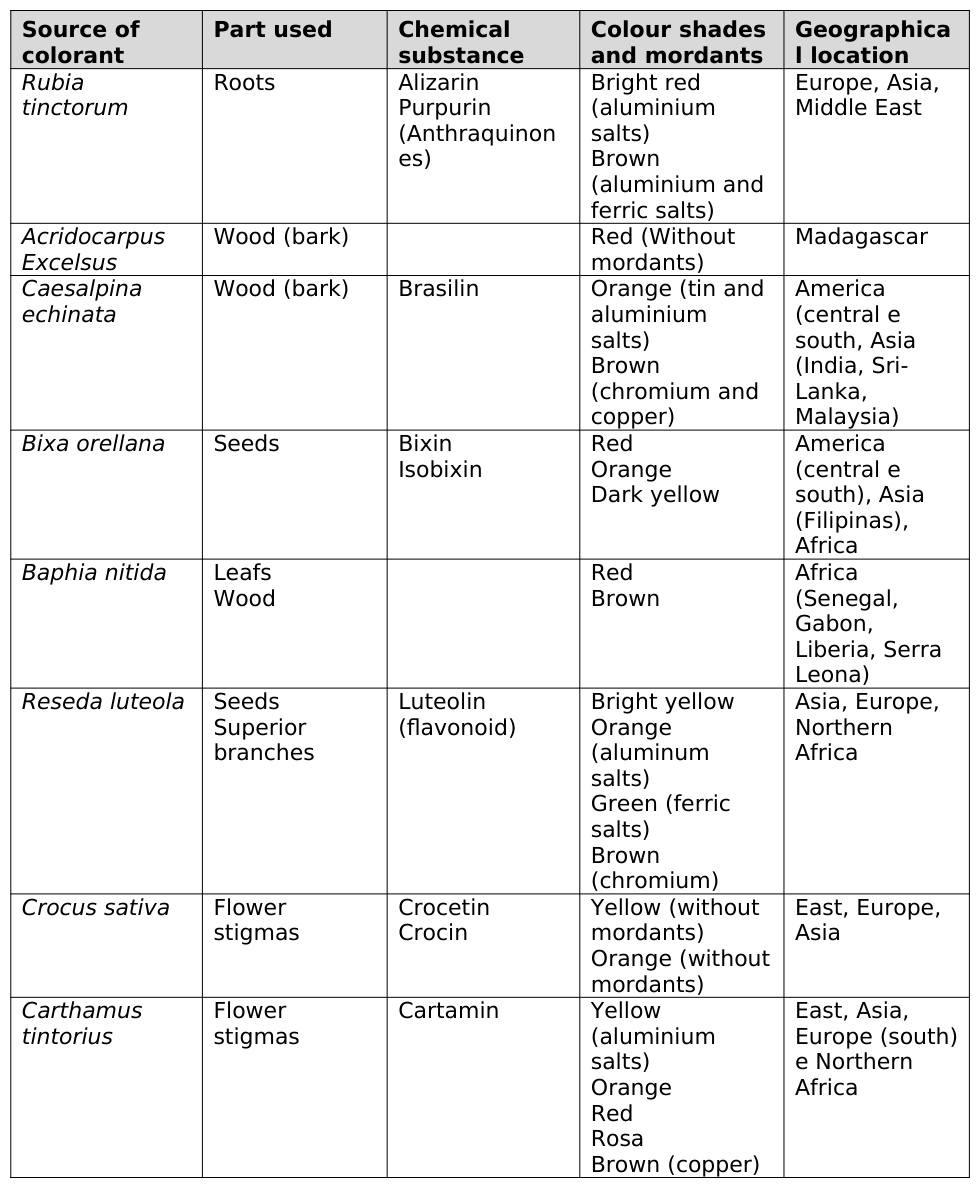
Despite the vast array of coloured compounds found in nature, reality is only a small parcel of it is used to dye (table 1). There’s an extensive amount of data that were lost at the time of the introduction of synthetic dyes in the market. Within this class of dyes, most knowledge on resources, extraction techniques and applying methods is very limited. Naturally, dyeing with natural dyes tends to be expensive due to their rather complex processes of extraction and application and the very limited amount of dyestuff provided. Within this context, it is crucial a deeper understanding on materials, dyes and fibres, and also a focus on learning more about the vast biodiversity yet to be explored. Knowledge on bio-resources is vital to push boundaries on applicable research within the sector.
Table 1: Natural coloured compounds with great dyeing potential (Santos, 2010) Source of colorant Part used Chemical substance Colour shades and mordants
Ancient Times Middle Age Modernity Indigo 4000 a.c.
Madder 3400 a.c.
Tyrian Purple
Pau-brazil Pau-campeche
Saffron 500 a.c.
Bio Dyes (Bacteria)
3000 a.c.
Weld 2000 a.c.
I V X XV XX Achiote 300 a.c.
Kermes 2000 a.c.
Cochineal
Dyed fibbers (Genetic modified) Fustic
Archil 2000 a.c.
Indian Gum 1400 a.c.
Aniline (synthetic)
Figure 1. Speculative timeline on natural dyes and its hypothetical evolution. (Santos, 2010)
Figure available in the original PDF paper.
Regarding dyeing industry, specifically, some of the alternatives consist in the use of living organisms, providing clean technologies and helping dealing with environmental issues (Ratledge and Kristiansen, 2001). Biotechnology (either classic or modern) makes use of bio-resources in order to create products for the benefit of man (Nair, 2008). This approach is not innovative though - societies always depended on biotechnology (classic or traditional) to obtain new products or substances of interest, e.g. bread, beer, natural dyes, etc. A fair amount of work is reported, particularly in the treatment of textile effluents with microbes. Ecologically, in the past decades, bacteria are most important for the restoration of a contaminated environment. This specific process of bioremediation is an economical, versatile, environment friendly and efficient treatment strategy, rapidly developing technology to degrade or detoxify chemical substances.
Additional sustainable alternatives consist in the use of fibres possessing natural colour (classic biotechnology) or modified to do so (modern biotechnology). There’s reference to various different types of silk worms producing different coloured silk fibres (Chen, Wang, Hua & Du, 2007). Another example can be analysed in the Madagascar origin Orb Weaver Spider; through the discovery of a specific arachnid producing silk fibres with such properties, a natural golden emerges in the silk cape shown in figure 2 (no dyeing process involved). This option is effective for energy and water waste, saving fibres from most of textile finishing procedures.
Figure 2. Golden cape shown at the Victoria & Albert Museum in London, 2012 (The Guardian, 2012)
Modern biotechnology (genetic engineering and synthetic biology) is a rather radical form of approach but it is standing out as a future alternative for many sustainability related issues, slowly replacing industrial or mechanical systems with a biological process. Synthetic biology is increasingly finding new ways to integrate into the everyday life, especially when combined with Art and Design. Questions arise though and, through the creation of varied projects, these fields alert for the endless possibilities of these new technologies.
Biotechnological materials are becoming very much of a trend in the past recent years. They introduce visionary strategies for improving the ecological performance of objects; with new emerging fields such as synthetic biology, sustainable issues are much promptly to be solved. It is relevant for the dyeing industry bacteria specifically engineered to produce better quality dyes (bio-dyes) (Ginsberg, 2012).
The reuse of dyeing bath or waterless dyeing techniques (to reduce waste), ultrasound techniques (to enhance the bond between dyes and fibres) and others were also considered in this study as complementary alternatives.
CONCLUSIONS
Dyeing process represent one of the main challenges for the fashion and textile sectors. Current dyeing procedures pose serious threat to the environment and human health, being classified as little sustainable. As a result, research and development strategies within this industry and fashion design are now highly focused and the challenges will force many transformations in the sector.
Both natural and synthetic dyes possess advantages and disadvantages when applied industrially. The former do not always guarantee infinite shades of colour and large quantities of material (so that they might be used in bulk), therefore natural dyeing cannot be practical in a large industrial scale. They are also expensive due to their rather complex extraction methods. Synthetic coloured compounds are related to toxic and ecological issues, which must be contained. Some authors defend that these are issues that can be circumvent by the use of sophisticated technologies such as modern biotechnology.
Natural dyeing is associated with green methods because natural compounds present a biodegradable nature and less toxicity. Some studies show that some of the natural dyes used in ancient times possess suitable fastness properties.
Additionally they are more effective protecting the skin against UVR and hold medicinal properties. Surely, natural dyes and potential biological resources need to be explored in greater depth; knowledge on resources and techniques can be allied to other technologies in order to enhance their dyeing potential. This way there’s a chance they become of important use for the textile and fashion industry (large scale), not only for slow fashion movement embracing design companies.
Currently, there are techniques that allow for the manipulation and modification of living organisms. Through genetic engineering the gene that contains the genetic code for the production of a substance of interest can be transferred to another organism (Ratledge and Kristiansen, 2001). This organism will then start to produce large quantities of the same substance even if it has never produced it before.
Modern biotechnology also ensures other alternatives for the production of potential textile dyeing colourants. Synthetic biology is another approach that offers way to engineer bacteria to produce bio-dyes that can be implemented by the fashion and textile industry. Another approach is to confer colour to the fibre at its core in the same way naturally dyed fibres, like pale colour cottons or golden spider’s silk threads appear in nature. Via modern biotechnology it is possible to confer an infinite range of colours to different types of fibres and studies refer advances for blue cotton as an appropriate approach for the creation of ecological fashion design garments. This allow for the elimination of toxic dye’s application during finishing process, reducing the incidence of ecosystem damage caused by dyeing procedures. Ethical questions are likely to be raised, though.
Biotechnology’s application in the textile and fashion design sectors suggests methods that result in less waste for the ecosystem and use less energy and water, thus, becoming an important and highly promising approach to pollution’s prevention and decline, as well as aiding biodiversity conservation and cost reduction. Plus, it means that the application of natural textile dyes can be done in bulk and is therefore feasible on an industrial scale.
Dyes derived from plants, animals or microorganisms surely have limitations. Nevertheless, studies illustrate the importance of modern biotechnology to enhance the dyeing potential of certain coloured substances or even to produce new substances of interest that better fit the need and demands of textile industry. This study shows the evolution of dyes throughout the centuries. It also reveals that the revival of natural dyes (and technical knowledge attached to it) in addiction to new cutting edge technologies such as biotechnology might allow for an industrial viability.
REFERENCES
Anliker, R. 1978. Ecotoxicology and Environmental Safety; 1, 211, chem. Abstr., 88 Bancroft, E. 2008. Experimental researches concerning the philosophy of permanent colours: and the best means of producing them, by dyeing, calico printing, etc. T. Dobson, Universidade de Harvard Chen, J. Wang, Q. Hua, Z. & Du, G. 2007. Research and application of biotechnology in textile industries in China. Enzyme and
Microbial Technology 40, 1651-1655 Clarke, E.A. & Anliker, R. 1980. Handbook of Environmental Chemistry Chemical Safety. O. Hutzinger (Ed.), Vol.3 , Springer Berlin Clarke, E.A. & Steinle, D. 1995. J.Soc. Dyes Color, 25 Collet, C. 2011. About: Biodesign. In: Home: Carole Collet. <http://www.carolecollet.com>, 11/05/2011 Department of biotechnology, Ministry of Science and Technology 2005. About Prospecting of bioresources for natural dyes. In:
<http://www.greenpeace.org/international/en/publications/reports/Dirty-Laundry/>, 02/10/2011 Fehrman, K. & Fehrman, C . 2004. Color: the secret influence. Prentice Hall Editor Fiore, D. Maier, M. Parera, S.D. Orquera, L. & Piana, E 2008. Chemical analyses of the earliest pigment residues from the uttermost part of the planet. Journal of Archaelogical Science, 35, 3047-3056 Garfield, S. 2002. Mauve: how a man invented a color that change the world. Faber & Faber. Ginsberg, A.D. 2012. About: E-chromi. In: Home: Daisyginsberg.
<http://www.greenpeace.org/international/en/campaigns/toxics/water/detox/intro/Eleven-flagship- hazardous-chemicals/> ; <http://www.greenpeace.org/international/en/multimedia/videos/Dirty-little-secret-/>, 09/07/2012 Hamburger, M. 2002. Isatis Tinctoria- From the discovery of an ancient medicinal plant towards a novel anti-inflammatory phytopharmaceutical. (Phytochemistry Rev.)
Hasseloff, J. 2012. About: Dyes. In: Home: haseloff-lab. <http://www.haseloff-lab.org> 20/06/2012 Jalil, N.A. Yunus, R.M. & Said, N.S. 2011. Environmental Colour Impact upon Human Behaviour: A Review. Procedia - Social and Behavioral Sciences 35 (2012) 54 – 62 Kozlowski, R. Zaikov, G.E. & Pudel, F. 2006. Renewable resources and plant biotechnology. Nova Publishers Nair, A.J. 2008. Introduction to Biotechnology and genetic engineering. Jones and Bartlett Publishers Prusty, A.K. Trupti Das, Nayak, A. & Das, N.B. 2010. Colourimetric analysis and antimicrobial study of natural dyes and dyed
silk. Journal of Cleaner Production 18, 1750e1756 Ratledge, C. & Kristiansen, B. 2001. Basic biotechnology. (2ª ed.), Cambridge University Press Santos, G.C. 2010. Corantes têxteis naturais: A biotecnologia da antiguidade até ao século XXI. Tese de Mestrado, Faculdade de Arquitectura – Universidade Técnica de Lisboa Shamim, S.H. & Karmakar, A. 2006. Community-based sustainable livelihoods Small-scale textile production using natural
dyes, 114-125, Prabartana, UBINIG. Singh, R. Jain, A. Panwar, S. Gupta, D. & Skhare 2005. Antimicrobial activity of some natural dyes. Dyes and Pigments 66, 99-
102. The Guardian, 2012. About: Golden silk cape spiders in pictures. In: Home: The Guardian <http://www.guardian.co.uk/artanddesign/gallery/2012/jan/23/golden-silk-cape-spiders-in-pictures?INTCMP=SRCH>, 20/01/2012 Vandevivere, P.C. Bianchi, R. Verstraete, W. 1998. Treatment and reuse of wastewater from the textile wet-processing industry:
Emerging Technologies, Journal Chemistry Technology Biotechnology, 72 (4): 289-302 Vankar, P.S. Shanker, R. Dixit, S. Mahanta, D. & Tiwari, S.C. 2008. Sonicator dyeing of modified cotton, wool and silk with Mahonia napaulensis DC. And identification of the colorant in Mahonia. Industrial crops and products 27, 371-379. Zollinger, H. (1991): Color Chemistry, 3ª ed, NY, V.C.H. Publishing
LISTED IN THE AHFE DIGITAL BOOKSTORE CATALOGUE
Explore the complete digital volume
Advances in Ergonomics In Design, Usability & Special Populations: Part III
Read this individual research paper free through the original publisher, or explore the full digital proceedings book.
ISBN 978-1-4951-2108-1
Explore this ISBN in the AHFE Bookstore ↗Listed in the July 2026 bookstore catalogue; search by ISBN to confirm current availability · Digital book purchase optional