Carla Costa Pereira, Isabella Carvalho, Cristina Carvalho (2024). Colouring Kombucha Biofilm. In: Human Systems Engineering and Design (IHSED2024): Future Trends and Applications. AHFE Open Access, vol. 158, pp. 372–378. https://doi.org/10.54941/ahfe1005560
1 CIAUD, Research Centre for Architecture, Urbanism and Design, Lisbon School of Architecture, Universidade de Lisboa, Rua sá Nogueira, Polo Universitário do Alto da Ajuda, 1349–063 Lisboa, Portugal ↗
2 Faculdade de Arquitectura, Universidade de Lisboa, Lisboa, Portugal ↗
Guided by the principles of sustainability, we believe that the development of biomaterials offers the most promising solution for the textile and clothing industries. They present a potential path towards a closed-loop system, where waste from one process becomes raw material for another.Our research explores the potential of bacterial cellulose, particularly kombucha biofilms, as a primary source of material, as these biofilms offer unique advantages: they are renewable, biodegradable, and have inherent strength and flexibility.This study is motivated by the potential of natural dyeing in these biofilms and its application in fashion design. It begins with a comprehensive review of the existing literature on the use of kombucha in clothing, followed by the current limitations and opportunities of the experimental procedures carried out at BioLab Lisboa. What we learned about dyeing during the biofilm fermentation process was useful for continuing the research we are now talking about into the type of dyeing that happens in biofilm after it dries.During the process, we will analyse and discuss the results and conclusions on the potential of biofilms dyed in primary colours. Our goal is to not only address current difficulties, but also fully explore the possibilities of using kombucha biofilms in fashion design.
The textile industry is a major contributor to environmental pollution, as evidenced by the works of numerous authors, including Azevedo (2010), Morais (2013), Barauna & Renck (2021), and Duarte (2021). Despite the well-documented issue of chemical pollutants released during fabrication and dyeing processes, the industry continues to face challenges in reducing production demands driven by fashion trends (Raspanti, 2020).
Biomaterials offer a promising avenue for creating a more sustainable fashion industry, as demonstrated by studies from Santos et al. (2019), Primiani et al. (2018), and Freeman et al. (2016). While these studies highlight the potential environmental benefits of biological materials, there remains a significant opportunity to explore their aesthetic possibilities.
To fully realise the potential of biomaterials in fashion, it is crucial to experiment with natural dyes and their application to specific biomaterials, such as cellulose biofilm produced through the kombucha process.
STATE OF THE ART Contrary to the notion that biomaterials are a sustainable solution by default (as suggested by Lee in Natsai et al., 2019), the development of biofilm for clothing emerged primarily from the exploration of microbial fiber applications. The process is inherently sustainable, requiring minimal energy and resources while producing no waste (Natsai et al., 2019).
Various authors interpret the concept of biomaterial differently. We adopt Barauna & Renck’s (2021, p. 193) definition for this research, characterizing biomaterials as substances with a non-specific biological association. These authors’ focus on the intersection of kombucha and fashion, a unique perspective in the field, led us to choose this definition.
Scarpitti & Valsecchi (2023) and Raspanti (2019) differentiate between crafted and grown biomaterials based on their origin and production process. Crafted biomaterials, such as bioplastics or fish leather, are laboratory- developed composites designed to resist degradation. Grown biomaterials, including spider silk, laboratory-grown leather, and kombucha biofilm (Barauna & Renck, 2021; Raspanti, 2019), develop organically over time and may require controlled environments.
We classify materials that blend characteristics of both animal and synthetic leathers under the term “bio-leather”. This distinction is crucial for understanding the unique properties and applications of these novel materials (Raspanti, 2023).
Kombucha biofilm has emerged as a versatile material in design and innovation. Several designers, including Lionne van Deursen, whose focus is experimental research, and Surzhana Radnaeva, whose ReGrow project explored sustainability in biofilm applications, have incorporated kombucha biofilm into their fashion creations. Ivan Hunga Garcia further expands the material’s potential by integrating it into designs that interact with nature.
Beyond the fashion industry, kombucha biofilm’s applications are diverse. Researchers have explored its potential in fields such as food packaging, tissue engineering, electronic batteries, and healthcare (Priyadharshini et al., 2022).
THE KOMBUCHA BIOFILM Local conditions and desired outcomes influence the multifaceted process of SCOBY cultivation for kombucha production. While different recipes exist, as exemplified by Lee (2011), who utilises green tea and vinegar, the core principles remain consistent. Other common ingredients include black tea or beer (Grushkin, 2015). The cultivation process typically begins with preparing a sweetened tea solution. We then incubate this mixture and the SCOBY at a controlled temperature of 23
to 27
Celsius. We harvest, clean, and dry the biofilm for further use once it reaches the desired size and thickness.
The tea solution’s specific composition has an impact on SCOBY growth and biofilm characteristics. Caffeine, present in tea, stimulates bacterial cellulose synthesis. Vinegar regulates pH levels between 2.5 and 3.5, essential for optimal SCOBY development. Sugar provides the necessary carbon and nitrogen sources for growth. Ethanol naturally produced during fermentation or optionally added, can accelerate the process (Priyadharshini et al., 2022).
THE COLORING For this study, we focus on readily available Portuguese plant-based dyes, including flowers, vegetables, legumes, and stems, to investigate primary colours like blue, yellow, and magenta.
Natural dyes, derived from plant or animal sources through physical or biochemical reactions (Azevedo, 2010), have a rich historical tapestry. Chemically synthesised dyes largely replaced the widely used natural dyes in ancient civilizations due to their superior colourfastness.
Vankar (2000) categorises natural dyes based on origin (plants, animals, by-products, chemical synthesis, DNA transfer), chemical structure, application method, and colour. According to Dean (2010), they are further classified into substantive, vat, and adjective dyes based on their application processes. Substantive dyes, rich in tannins (e.g., nuts, green tea), bind directly to fibers. Vat dyes, like indigo, require a chemical process to become water- soluble and develop colour upon oxygen exposure. Adjective dyes, the most common type, require a mordant for color fixation.
JM (2016) explored the potential of caffeine sources (green tea, black tea, coffee) to accelerate bacterial cellulose synthesis and produce coloured biofilms using extracts from various plants. However, the results were inconsistent, influenced by sucrose and caffeine concentrations.
EXPERIMENTS We conducted the experiments between February and April 2024, with the primary goal of dyeing the dried biofilm with natural dyes. For these experiments, the BioLab Lisboa laboratory provided a controlled environment.
To standardise the processes, all biofilms were produced using a standard initial recipe (described previously) with the same ingredients, differing only in the dye used. We dried all the biofilms on a standard plastic surface to potentially achieve a uniform texture.
We could use the dye baths prepared with the natural dyes for multiple biofilms, thereby conserving resources (Deurr, 2010). The literature review indicated that the tannins present in tea during the kombucha fermentation process are effective mordants for fixing colour to cellulose fibres, so we decided not to add any mordanting processes.
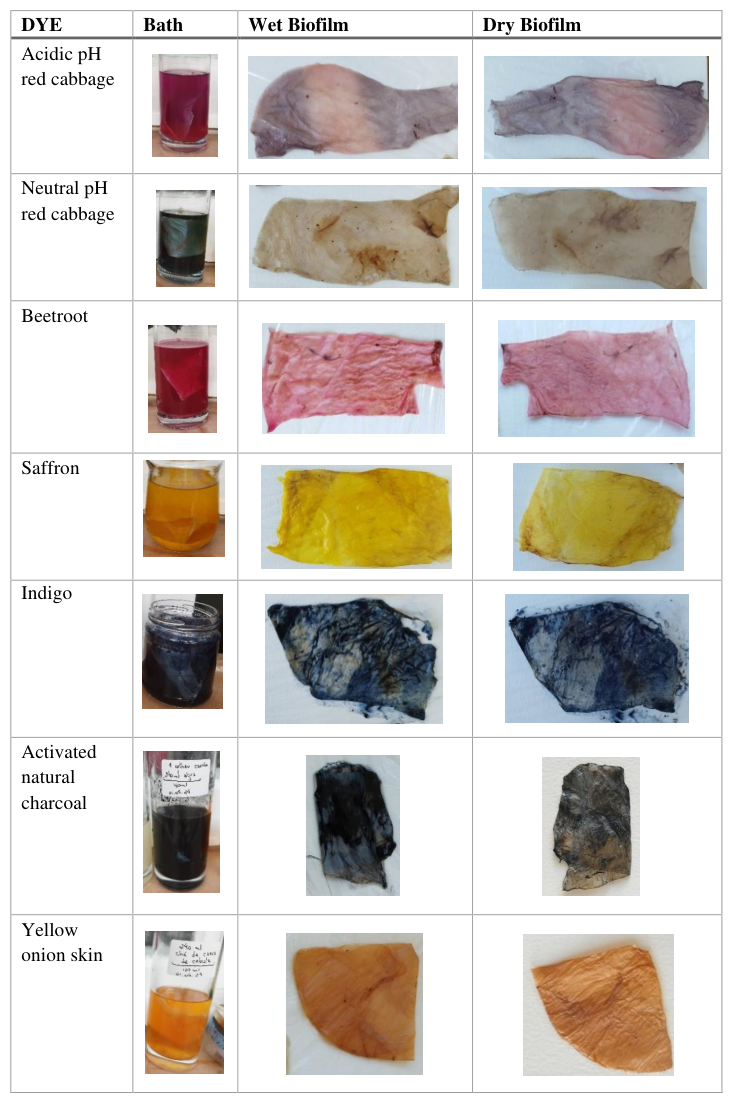
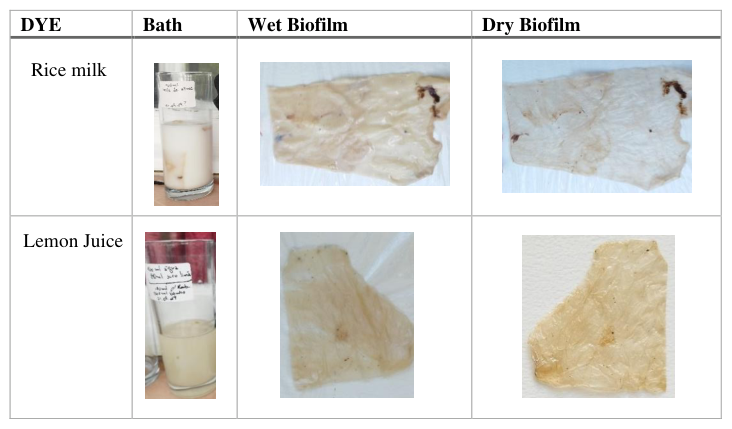
The experiments involved submerging the biofilms, after washing with neutral pH soap and complete drying, into the following dye baths: indigo, saffron, neutral pH red cabbage, acidic pH red cabbage, beetroot, onion peel, and activated charcoal (Table 1). We also submerged the biofilms in two bleaching baths, rice milk and lemon juice, in addition to these dye baths (Table 2).
Colouring Kombucha Biofilm 375
Table 1. Biofilms submerging into colourful dye baths (indigo, saffron, red cabbage, beetroot, onion and activated charcoal).Table 2. Biofilms submerging in two bleaching baths, rice milk and lemon juice.
We added the biofilm only when the dye bath was completely dry, without any additional treatment. We removed them after seven days of immersion and dried them again.
RESULTS
The colors obtained through this process were notable for their saturation and uniformity. For example, the onion dye yielded the most successful results, with the final dried biofilm exhibiting a colour very close to that of the initial dye. Despite the positive results, the red cabbage dyes, at both acidity levels, produced a dull color that differed from those previously obtained with the same baths.
After drying the biofilm and impregnating it with the rice milk bleaching agent, the dyeing tests revealed a whiter biofilm than the original one. However, this is not yet a conclusive result regarding its use as a natural bleach for kombucha biofilm. Lemon juice, on the other hand, did not yield favorable results.
Several challenges hinder the potential for widespread application of kombucha biofilm. While the material exhibits promising properties, its susceptibility to water damage and environmental factors necessitates further research and development.
Hildebrandt et al. (2021) have shown that it is possible to improve the water resistance of biofilms by applying wax treatments. However, it should be noted that this research is still in its early phases. Furthermore, the biofilm’s susceptibility to deterioration in high humidity, together with its colour alteration due to ageing (Trebbi, n.d.), adds further complexity to its practical use. In order to achieve large-scale production and integration into everyday life, it is imperative that we find strong and effective solutions to these issues.
Colouring Kombucha Biofilm 377
ACKNOWLEDGMENT
This work is supported by CIAUD Research Center of Architecture Urbanism and Design and by FCT Project No. 68924 GRANT NUMBER: T590517690-00082967. Foundation for Science and Technology.
CONCLUSION
This study demonstrates the possibility of using natural dyes to colour dried kombucha biofilm. However, there are still unresolved concerns that present an opportunity for further investigation.
To summarise, there is a continued requirement to enhance and expand research on biomaterials, particularly in colouring kombucha biofilm. According to Hildebrandt et al. (2021), the potential of using biomaterials in the fashion business to generate a substantial beneficial effect is uncertain. We need to wait and see if this is a groundbreaking development or just another material to explore. As a result, there is a promising future for exploring and examining biofilm applications.
REFERENCES
Azevedo, J. J. R. (2010). Poluição pela Indústria Têxtil. Revista Brasileira de Meio Ambiente, 1(1), 1–12. Barauna, D., & Renck, G. E. (2021). Sustentabilidade na cadeia da moda e o
design de biomateriais têxteis. Repositorio.ufsc.br. https://repositorio.ufsc.br/ha ndle/123456789/228981. Dean, J. (2010). Wild color: The complete guide to making and using natural dyes.
Watson-Guptill Publications. Duarte, A. R. D. S. (2021). Design têxtil e moda: Tingimento através de microrganismos. Universidade de Lisboa (Portugal), ProQuest Dissertations Publishing. https://www.proquest.com/openview/9adf84176f639c67c6e920c65b 674e95/1?pq-origsite=gscholar&cbl=2026366&diss=y Duerr, S. (2010). The handbook of natural plant dyes: Personalize your craft with organic colors from acorns, blackberries, coffee, and other everyday ingredients. Timber Press. Freeman, C. E., Gillon, F., James, M., French, T., & Ward, J. (2016). Production
of microbial leather from culled sweet potato sugars via kombucha culture. International Textile and Apparel Association Annual Conference Proceedings, 73(1). https://www.iastatedigitalpress.com/itaa/article/id/3090/ Grushkin, Daniel (2015). Meet woman who wants growing clothing in a lab. Popular Science. https://www.popsci.com/meet-woman-who-wants-growing-clothing-lab Hildebrandt, J., Thrän, D., & Bezama, A. (2021). The circularity of potential bio-
textile production routes: Comparing life cycle impacts of bio-based materials used within the manufacturing of selected leather substitutes. Journal of Cleaner Production, 287, 125470. https://doi.org/10.1016/j.jclepro.2020.125470 JM. (2016). Maschabiohack. Wordpress. https://maschabiohack.wordpress.com/ Lee, S. (2011). Grow your own clothes. TED. https://www.ted.com/talks/suzanne_le e_grow_your_own_clothes
Morais, C. C. C. P. (2013). A sustentabilidade no design de vestuário. Universidade Técnica de Lisboa, Faculdade de Arquitectura. https://www.repository.utl.pt/bits tream/10400.5/6927/1/TeseFinal_CarlaMorais.pdf Natsai, C., Ginsberg, A. D., Lee, S., Agapakis, C., Vilutis, J. (2019). Design with
science. Journal of Design and Science. https://jods.mitpress.mit.edu/ Priyadharshini, T., Nageshwari, K., Vimaladhasan, S., Parag Prakash, S., & Balasubramanian, P. (2022). Machine learning prediction of SCOBY cellulose yield from Kombucha tea fermentation. Bioresource Technology Reports, 18, 101027. https://doi.org/10.1016/j.biteb.2022.101027 Primiani, C. N., Mumtahanah, M., & Ardhi, W. (2018). Kombucha fermentation
test used for various types of herbal teas. In Journal of Physics: Conference Series. IOP Publishing. https://iopscience.iop.org/article/10.1088/1742-6596/ 1025/1/012073/meta Raspanti, C. (2019). Biofabricating materials. Class Textile Academy: https://class.te xtile-academy.org/classes/2019-20/week05A/ Raspanti, C. (2020). BioChromes. Class Textile Academy: FabricAcademy. https:
//class.textile-academy.org/classes/2020-21/week04/ Santos, V. M. C., Degrave, W., Flemming, L., Rocha, J. R., Gonçalves, E. T., & Mello, Y. (2019). A Utilização de novas tecnologias na moda - Aplicação de tecido orgânicos fabricados a partir de Kombucha na confecção de bolsas e acessórios da moda. Repositorio.ufsc.br. https://repositorio.ufsc.br/handle/123456789/24488 Scarpitti, C., & Valsecchi, F. (2023). For a Coexistence with the More-Than-
Human: Making Biomaterials from a Philosophical Perspective. Sustainability, 15(6), 5464–5464. https://doi.org/10.3390/su15065464 Trebbi, L. (n.d.). Evolving matter: Future of materials and design in biofabrication era. Site.google. Acessado em fevereiro 7, 2024. https://sites.google.com/uniroma 1.it/evolvingmatter Vankar, P. S. (2000). Chemistry of natural dyes. Resonance, 5(10), 73–80. https:
//doi.org/10.1007/bf02836844
LISTED IN THE AHFE DIGITAL BOOKSTORE CATALOGUE
Explore the complete digital volume
Human Systems Engineering and Design (IHSED2024): Future Trends and Applications
Read this individual research paper free through the original publisher, or explore the full digital proceedings book.
ISBN 978-1-964867-34-2
Explore this ISBN in the AHFE Bookstore ↗Listed in the July 2026 bookstore catalogue; search by ISBN to confirm current availability · Digital book purchase optional