Claudia Mont’Alvãoa, Soyun Kimb (2022). A Cross-Cultural Comparison of Safety Beliefs about Products and Warnings: Brazil vs. United States. In: Advances in Ergonomics In Design, Usability & Special Populations: Part III. AHFE Open Access, vol. 20. https://doi.org/10.54941/ahfe1001299
Concerns about safety have generated considerable research on warnings in recent years. A number of factors that influence warning effectiveness have been investigated. One factor is perceived hazard, which is a belief about how dangerous a product, environment or activity may be. The purpose of the present study was to conduct a cross-cultural investigation between the beliefs and attitudes about the safety of consumer products, the roles of product manufacturers and government in product safety, and aspects regarding warnings by participants in Brazil and in the United States (U.S.). A total of 282 individuals (including college students and adult volunteers) were recruited from these two countries. Participants in both countries believed that government would act to protect them by recalling or banning unsafe products and that manufacturers are more concerned with profits than safety. U.S. participants believed that the products in the U.S. were safer at a level that was significantly higher than what Brazilians believed about their products. Interestingly Brazilians reported that they read warnings more than the U.S. participants reported but Brazilian participants believed their warning labels were of poorer quality than what the U.S. participants reported. Other results show additional differences between the two populations. The results are discussed in terms of acknowledging that cultural background can affect safety-related beliefs.
Concern about the safety has prompted a growing body of human factors research on safety communications and in particular on warnings. During the past several decades, a number of factors that influence warnings have been examined including design factors such as signal words and non-design factors such as cost of compliance. According to warning researchers, an important factor in whether individuals will look for and read warnings is their a priori beliefs about hazards (e.g., Laughery and Wogalter, 1997; Laughery and Wogalter, 2006). The more dangerous a product or environment is perceived to be, the more responsive individuals will be to warnings (Wogalter, Brelsford, Desaulniers, and Laughery, 1991; Wogalter, Brems, and Martin, 1993). Many studies showed that perceived hazard was related to the likelihood of looking for and reading warnings (Godfrey et al, 1983; LaRue and Cohen, 1987; Leonard, Ponsi, et al., 1989; Wogalter, Brelsford, et al., 1991). Perceived hazard or risk is a relevant and interrelated factor with people’s beliefs and attitudes. The Communication-Human Information Processing (C-HIP) model (see Wogalter, 2006) is a framework that describes several stages of processing within Ergonomics In Design, Usability & Special Populations III the receiver necessary for warning effectiveness. According to the C-HIP model, warning compliance depends, in part, on people’s current beliefs and attitudes. A mismatch between people’s beliefs about the extent of hazard relative to the actual extent of hazard can affect and may block compliance behavior. If the warning message does not concur with the receiver’s beliefs, then for a warning to be successful the receiver’s beliefs or attitudes need to be altered appropriately (by salient persuasive messages) to enable further processing that results in behavioral compliance (Wogalter, 2006). In other words, beliefs and attitudes associated with products or environments influence whether or not people would process warning. Beliefs about hazards are known to differ between experts and novices (Fisher, 1991; Slovic, Fischoff, and Lichtenstein, 1979; Tonn, Travis, Goeltz, and Phillip, 1990; Riley, 2006 and between individuals and groups (Smith-Jackson and Essuman-Johnson, 2002).
As globalization has given rise to international trade and transfer of information technologies, it is important to understand characteristics of populations as receivers of warnings. Sometimes western-centric methods employed in safety communication research do not emphasize the importance of culture (Smith-Jackson and Wogalter, 2000). According to a sociological perspective, culture can be defined as a collection of values, experiences, beliefs, attitudes, (Smith-Jackson et al., 2002) and behavior patterns shared by a group (Berry, Poortinga, Segall, & Dasen, 1992). Unfortunately, there have been relatively few studies on cultural differences in warning processing (Lesch, Rau, Zhao, and Liu, 2009). However, there are a few studies have examined perceived hazard to various design components or factors in warnings such as color and signal words between population groups. For example, Smith- Jackson and Wogalter (2000) and Wogalter Frederick, Herrera, and Magurno (1997) showed differences in hazard connotation for colors between Spanish and English language users. Other studies have found similarities and differences beween Chinese and U.S. participants (Lesch, Rau, Zhao, and Liu, 2009; Yu, Chan, and Salvendy, 2004.
Issues regarding cultural differences in hazard perception has become important in world-wide trade of products. Moreover it is particularly important in countries that are experiencing economic growth and which do not have well-established regulations and standards for warnings (Lesch et al., 2009). For example, Brazil is experiencing relatively rapid economic growth and large consumer market due to increased international trade. Regarding to consumer products, Brazilian’s law was established in 1990 but despite the law, products that do not comply with the law can often be found in the consumer market. For industrial products, manufacturers are required to provide health and safety instructions for users, and provide information on the hazards and risks of the product (BRASIL, 1990). Despite these laws being over two decades old, many Brazilian consumers are not aware of their rights. The National Brazilian Institute of Metrology, Quality and Technology – INMETRO - certify products’ safety. Due the global market, INMETRO tests several foreign products and certifies them before they are sold in the Brazilian market. But even with having gained approval by INMETRO, many products do not provide the necessary safety information as required by law (INMETRO, 2013).
The purpose of the present study was to investigate people’s existing beliefs and attitudes towards consumer products or environments. While a substantial body of research has been conducted regarding factors that influence warning effectiveness, relatively few studies have examined on people’s existing overall beliefs towards products that they may have or use (Kim and Wogalter, 2011). The purpose of this study was to make cross-cultural comparisons (Brazil vs. U.S) on safety beliefs. Because of Brazilian consumers’ low understandability about their own rights when they purchase products, there have been relatively few cases in which consumers initiate lawsuits against companies regarding injury claims. To improve this relation between consumers and products, a government office in each Brazilian state (PROCON) has been established to provide assistance to consumers in this regard. PROCON helps consumers to decide if they can prosecute a product manufacturer due to faulty product instructions in which a consumer was injured. Moreover, Brazil has over 14 million people (9.7% of total population) that are illiterate. For this group of consumers, PROCON offices are fundamental to help them to understand and fight for their rights. Compared to the U.S., a developed country with a large body consumer protection-related laws including product-liability case law, U.S. consumers may have different perceptions than Brazilians. If so, beliefs about consumer product safety, the roles of manufacturers and government, and the quality of warnings should show difference between persons from these countries.
METHOD
Participants A total of 282 individuals (112 males, 170 females) participated. Average age was 35 years (SD = 14.4).
Participants were recruited from two countries, United States and Brazil. Both populations were comprised of undergraduate students and adults volunteers. The U.S. data is also described in Kim and Wogalter (2011).
United States A total of 128 participants (51 males and 77 females) were recruited (M = 32.6 years; SD = 15). Samples from two population pools were collected: 40% were undergraduate students from North Carolina State University (M = 23 years; SD = 5.2) and 60% were nonstudent adult volunteers from central North Carolina (M = 40 years; SD = 15.3).
Brazil A total of 154 participants (M = 36.8 years; SD = 13.9) were recruited from Rio de Janeiro city, Brazil. They were interviewed from diverse places including schools, malls, train stations, universities, and other public places. Participants were mostly workers and students.
Materials and Procedure Questionnaires were administered in the U.S. and Brazil. For U.S. population, the questions were part of a larger questionnaire concerning various beliefs about safety and consumer products. Participants were presented with 11 statements relating to issues associated with consumer product safety including the role of manufacturers and government and some aspects associated with warnings. The statements are listed in Table 1. Participants were asked to rate how much they agree with each of the statements by giving a rating on a 9-point scale with the even numbered scale points labeled with the following anchors: (0) definitely do not agree; (2) do not agree; (4) somewhat agree; (6) agree; and (8) definitely agree. In the present article, only 7 of the statements are used to match same questions administered to Brazilian participants. Two orders of the statements were used; one was a randomized order and the other was the reverse of the randomized order. For use in Brazil, the statements were translated and administered in Portuguese. A 5-point scale was used with the sequence numbered scale points labeled with the following anchors: (1) definitely do not agree; (2) do not agree; (3) somewhat agree; (4) agree; and (5) definitely agree.
RESULTS
Scale Equalization Because the ratings were done on different scales between countries, a procedure to equalize them was performed. The 5-point ratings collected in Brazil were transformed to the U.S. scale. To do so, ‘9/5’ was multiplied to each rating score of 5-point scale and then ‘1’ was subtracted because the starting number of 5 point scale was 1.
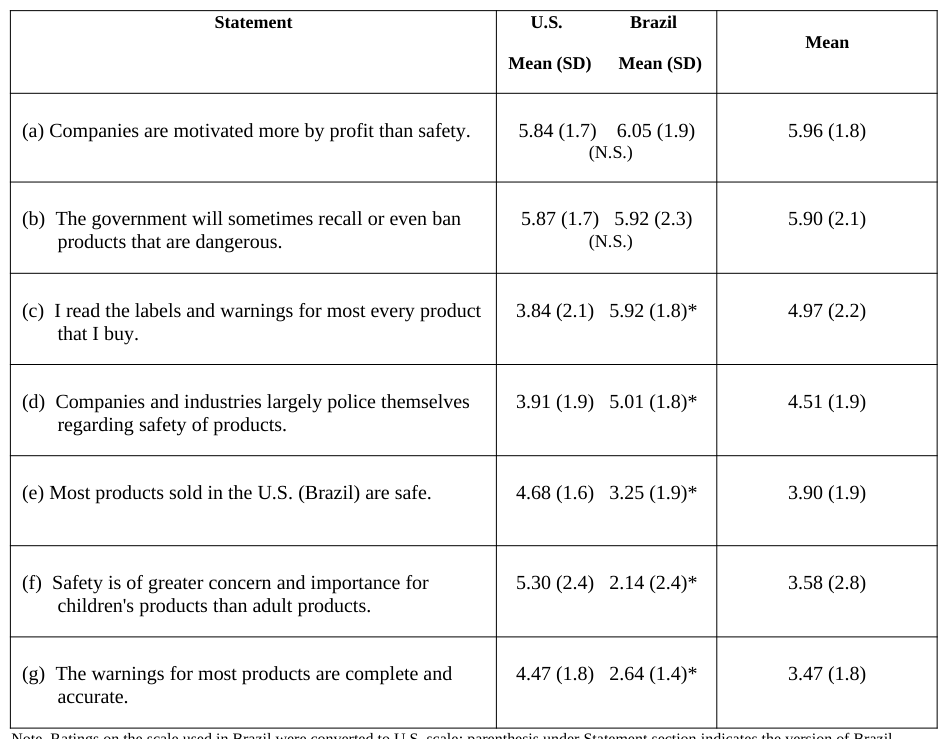
Agreement with Statements Concerning Safety of Consumer Products A 2 (country group: U.S. vs. Brazil) X 7 (statement) mixed model analysis of variance revealed that there was a significant main effect for country, F (1, 280) = 17.8, p < .001; U.S. (M = 4.8) showed, in general, higher ratings than Brazil (M = 4.4). There was a significant main effect for Statements, F (6, 1680) = 77.7, p <.001. The statements that garnered the highest levels of agreement were: (a) companies are motivated more by profit than safety; (b) the government will sometimes recall or even ban products that are dangerous, which was followed by (c) I read the labels and warnings for most every product that I buy. The lowest agreement ratings were given to the statement that (g) the warnings for most products are complete and accurate. Other low ratings were for the statements: (e) most products sold in the U.S. (Brazil) are safe; (f) safety is of greater concern and importance for children's products than adult products; and (d) Companies and industries largely police themselves regarding safety of products. Tukey’s Honestly Significant Difference (HSD) test set at p = .05 was found equal to .5. This value can be used to compare means. Any mean difference greater than this value is statistically significant. There also was a significant interaction effect between country and Statements, F (6, 1680) = 65.3, p <.001. Post hoc comparisons between the two countries for statements showed significant differences for the last five statements in Table 1.
Table 1: Means agreement (and standard deviations) of statements concerning safety beliefs in descending order (based on grand mean). Higher numbers indicate greater agreement.
Note. Ratings on the scale used in Brazil were converted to U.S. scale; parenthesis under Statement section indicates the version of Brazil questionnaire. (N.S.) indicates Not Significant difference between countries whereas * denotes significant difference.
There was no significant difference between the first two statements in Table 1 which showed the highest agreement for both countries: (a) “Companies are motivated more by profit than safety” and (b) “The government will sometimes recall or even ban products that are dangerous.” The remainder of the statements showed significant differences in ratings between countries. Brazil participants gave higher ratings of agreement than U.S. participants for (c) “I read the labels and warnings for most every product that I buy” and (d) “Companies and industries largely police themselves regarding safety of products.” U.S. participants gave ratings of higher agreement to the statement (e) “Most products sold in the U.S. (or Brazil) are safe” than their Brazilian counterparts. Brazilians gave relatively low agreement ratings to the statements (f) “Safety is of greater concern and importance for children's products than adult products” and (g) “The warnings for most products are complete and accurate” whereas U.S. respondents showed a moderate level of agreement to them.
DISCUSSION
The present study examined perception on safety of consumer products and attitudes towards companies or government’s role concerning safety. Participants in both countries showed high agreement with the statements: (a) companies are motivated more by profit than safety and (b) the government will sometimes recall or even ban products that are dangerous. This suggests that both groups perceive that government plays an important role about safety and were skeptical about roles of companies or industries concerning safety.
Several statements had different results between countries. U.S. population showed relatively higher agreement with the statement that most products sold in the U.S. are somewhat safe than those in Brazil population. It seems that U.S. population has beliefs that products sold in the U.S. are safe in general. This result is supported by an earlier study that U.S. respondents gave their ratings between “safe” and “very safe” regarding the question asking how safe they believed consumer products to be in general in the U.S. (Kim and Wogalter, 2011). On the other hand, Brazilians gave relatively lower ratings on the question between do not agree and somewhat agree. The U.S participants were skeptical about the roles of companies or industries regarding safety. Brazilians negatively perceived the safety concerning products sold in the Brazil but they appeared to have positive beliefs regarding the safety of companies and industries and government’s role about safety. This could also be interpreted as Brazilian consumers perceiving that the government is not doing much policing on consumer products sold in Brazil. Additional research would be necessary to better pinpoint the cause of these results.
With respect to warning labels, U.S. respondents somewhat agreed with the statement that warnings for most products are complete and accurate but had lower agreement with the statement that they read the labels and warnings for most every products that they buy. Conversely, Brazil participants did not agree that the warnings are complete and accurate but they read the labels and warnings for most every product. Thus U.S. respondents appear to have positive beliefs regarding the safety of U.S. products and their warnings but report that they are less likely to read them. On the other hand, Brazilians report that they read warning labels but they have a negative belief about the quality of warnings on their consumer products. If they do read them this could be a help in becoming aware of their poor quality.
While the U.S. participants reported some agreement that companies and industries largely regulate themselves on product safety, Brazilians believed that companies took a larger role in policing consumer product safety. Perhaps Brazilians are more concerned or wary about safety of products that they buy than U.S. participants. However, this concern is apparently different for children’s products. Brazilians reported low agreement to the statement saying that safety is of greater concern and importance for children's products than adult products, whereas U.S. participants showed higher concern. It is not clear why this is the case, given children are vulnerable to hazards in both countries. It would be interesting to determine if this result can be replicated and also whether it is a belief more likely to be found in developing versus developed countries.
There was limitation in this study that scales used were not exactly the same between countries; the U.S. questionnaire used 9 point scale from 0 to 8 being definitely do not agree to definitely agree respectively whereas Brazil questionnaire used 5 point scale from 1 to 5 being definitely disagree to definitely agree. Although Brazil’s scales were converted to U.S. to equalize systematically, it could affect how participants used the scale in each country. These results ought to be replicated to determine the reliability of the findings between the two populations.
In this study, people’s beliefs concerning several specific safety-related statements about products, governments and industries’ role in safety policy were examined. According to the C-HIP model, “beliefs and attitudes” is important stage of processing for successful and effective warning. By knowing what people believe (Riley, 2006; Smith- Jackson, 2002), it could aid in making successful safety communications. If people believe that a product is safer than it really is then they will be less likely to look for or read a warning for that product or environment. In cases where there may be a mismatch and if so, then warnings need to be highly conspicuous and give persuasive statements to change beliefs so that they concur with actual extent of the hazard.
REFERENCES
Brasil. (1990) Ministério da Justiça. Código de Defesa do Consumidor. Lei n. 8.078, de 11 de setembro de 1990. Fisher, A. (1991). Risk communication challenges. Risk Analysis, 11(2), 173-179. Godfrey, S.S., Allender, L., Laughery, K. R., & Smith, V. (1983). Warning messages: Will the consumer bother to look? In Proceedings of the Human Factors Society 27th Annual Meeting (pp. 950-954). Santa Monica, CA: Human Factors Society. INMETRO (2013). Ministério do Desenvolvimento, Indústria e Comércio Exterior. Kim, S., Wogalter, M. S. (2012) Most Natural and Propane (LP) Gas Service Users Report Not Having Electronic Gas Detectors.
Proceedings of the 56th HFES Annual Meeting, 666 – 670. Kim, S., Wogalter, M. S., & Taylor, J. R. I. (2011). Safety beliefs about consumer products. Proceedings of the Human Factors and Ergonomics Society 55th Annual Meeting, 55, 1778-1782. Laughery, K.R., Wogalter, M.S. (1997). Warnings and risk perception. In: Salvendy, G. (Ed.), Handbook of Human Factors and
Ergonomics, 2nd Edition. Wiley, New York, pp. 1175–1197. Laughery, K. R., & Wogalter, M. S. (2006). Designing effective warnings: Current status and new directions. In R. Williges (ed.)
HFE Reviews, Vol. 2. (pp. 241-271), Santa Monica, CA: Human Factors and Ergonomics Society. Leonard, D. C., Ponsi, K. A., Silver, N. C., & Wogalter, M. S. (1989). Pest-control products: Reading warnings and purchasing intentions. In Proceedings of the Human Factors Society33rd Annual Meeting (pp. 436–440). Santa Monica, CA: Human Factors and Ergonomics Society. Lesch, M. F., Rau, P. P., Zhao, Z., & Liu, C. (2009). A cross-cultural comparison of perceived hazard in response to warning
components and configurations: US vs. China. Applied Ergonomics, 40, 953-961. Riley, D. M. (2006). Beliefs, attitudes, and motivation (Chap. 21). In M. S. Wogalter (Ed.) Handbook of Warnings (pp. 289-300).
Mahwah, NJ: Lawrence Erlbaum Associates. Slovic, P., Fischoff, B., & Lichtenstein, S. (1979, April). Rating the risks. Environment, 21(3), 14-20, 36-39. Smith-Jackson, T. L. & Essuman-Johnson A. (2002). Cultural ergonomics in Ghana, West Africa; A descriptive survey of industry and trade workers’ interpretations of safety symbols. International Journal of Occupational Safety and Ergonomics, 8, 37-50. Smith-Jackson, T. L., & Wogalter, M. S. (2000). Applying cultural ergonomics/human factors to safety information research.
Proceedings of the IEA 2000/HFES 2000 Congress. 6-150-6-153. Tonn, B. E., Travis, C. B., Goeltz, R., & Phillip, R. H. (1990). Knowledge-based representations of risk beliefs. Risk Analysis, 10(1), 169-184. Wogalter. M. S. (2006). Communication-human information model (C-HIP) model (Chap. 5). In M. S. Wogalter (Ed.) Handbook
of Warnings (pp. 51-61). Mahwah, NJ: Lawrence Erlbaum Associates. Wogalter, M.S., Brelsford, J. W., Desaulniers, D.R., & Laughery, K.R. (1991). Consumer product warnings: The role of hazard perception. Journal of Safety Research, 22, 71-82. Wogalter, M. S., Brems, D. J., & Martin, E. G. (1993). Risk perception of common consumer products: Judgments of accident
frequency and precautionary intent. Journal of Safety Research, 24, 97-106. Yu, R., Chan, Chan, A.H.S., & Salvendy, G., (2004). Chinese perceptions of implied hazard for signal words and surround shapes. Human Factors and Ergonomics in Manufacturing, 14, 69–80.
LISTED IN THE AHFE DIGITAL BOOKSTORE CATALOGUE
Explore the complete digital volume
Advances in Ergonomics In Design, Usability & Special Populations: Part III
Read this individual research paper free through the original publisher, or explore the full digital proceedings book.
ISBN 978-1-4951-2108-1
Explore this ISBN in the AHFE Bookstore ↗Listed in the July 2026 bookstore catalogue; search by ISBN to confirm current availability · Digital book purchase optional