Thomas Meiren, Christian Schiller (2022). Development of new sustainable services. In: The Human Side of Service Engineering. AHFE Open Access, vol. 62, pp. 295–301. https://doi.org/10.54941/ahfe1002570
Sustainability is one of the most frequently discussed topics of our time. Although the idea of a sustainable economy was already addressed in the context of forestry in the 15th century and may therefore appear to be have a long tradition, the need for action - for example due to political or public demands - is stronger today than ever in many sectors of the economy. Although a growing number of companies are endeavoring to make their products and services more environmentally compatible, concepts for sustainability have hardly been implemented comprehensively in business practice to date.However, the guiding principle of sustainable design is already known in the product world and appears to be established to a certain extent, but it opens up more or less "new territory" in the sense of systematic research and development for new services. On the one hand, interesting economic and ecological opportunities for companies can be found in this area; on the other hand, there are also uncertainties associated with it, mainly due to the lack of knowledge about sustainable services.In particular, ecological sustainability has so far been discussed strongly against the background of energy production (shutdown of coal-fired power plants, use of renewable energies, etc.), energy-intensive industries (chemicals, steel production, etc.) and energy-consuming private areas of life (heating, mobility, etc.). However, the importance for the service economy is often underestimated. Particularly with regard to the design of processes (e.g. "online instead of on-site"), the consumption of resources (e.g. use of sustainable mobility solutions) and the development of new ecologically sustainable service offerings, considerable opportunities lies hidden here.Companies that want to put their ideas for ecologically sustainable services into practice often face two fundamental challenges. First, their corporate structures and processes are not designed for the efficient development and market positioning of new services. In many cases, the difficulties start with the fact that the development processes are not clearly defined, i.e. there is a lack of clear descriptions of the tasks, the methods to be used and the personnel requirements needed. Secondly, competencies with regard to the ecological sustainability of services are missing. In particular, there is a lack of knowledge on how to systematically develop sustainability into services.In the conference presentation, a reference model for the development of new ecologically sustainable services will be presented. In addition to a configurable development process, the model includes integrated methods and tools for various sustainability aspects. The reference model is complemented by recommendations for its organizational and personnel implementation.
SUSTAINABILITY OF SERVICES Sustainability is one of the most frequently discussed topics of our time. Alth- ough the idea of a sustainable economy was already addressed in the context of forestry in the 15th century and may therefore appear to have a long tradi- tion, the need for action - for example due to political or public demands - is stronger today than ever in many sectors of the economy. Although a growing number of companies are endeavoring to make their products and services more environmentally compatible (KPMG 2020), concepts for sustainability have hardly been implemented comprehensively in business practice to date (BSR/GlobeScan 2019, Davis-Peccoud et al. 2018).
However, the guiding principle of sustainable design is already known in the product world and appears to be established to a certain extent (Desai and Mital 2021, Su 2020), but it opens up more or less “new territory” in the sense of systematic research and development for new services. On the one hand, interesting economic and ecological opportunities for companies can be found in this area; on the other hand, there are also uncertainties associated with it, mainly due to the lack of knowledge about sustainable services (van Riel 2021).
In particular, ecological sustainability has so far been discussed stron- gly against the background of energy production (shutdown of coal-fired power plants, use of renewable energies, etc.), energy-intensive industries (chemicals, steel production, etc.) and energy-consuming private areas of life (heating, mobility, etc.). However, the importance for the service economy
is often underestimated. Particularly with regard to the design of proces- ses (e.g. “online instead of on-site”), the consumption of resources (e.g. use of sustainable mobility solutions) and the development of new ecologically sustainable service offerings, considerable opportunities lies hidden here.
Companies that want to put their ideas for ecologically sustainable servi- ces into practice often face two fundamental challenges. First, their corporate structures and processes are not designed for the efficient development and market positioning of new services. In many cases, the difficulties start with the fact that the development processes are not clearly defined, i.e. there is a lack of clear descriptions of the tasks, the methods to be used and the person- nel requirements needed (Meiren et al. 2021). Secondly, competencies with regard to the ecological sustainability are missing (Sassen et al. 2021). In particular, there is a lack of knowledge on how to systematically develop sustainability into services.
SERVICE RESEARCH AND SUSTAINABILITY Research on the sustainability of services is gaining more and more impor- tance (Journal of Service Research 2022). A particular problem with sustai- nable services can be seen in the perception of economic success through sustainable production and service offerings. In production research, it is postulated that it should be “profit not in spite of, but through sustainabi- lity” - the same applies in principle to service research (Haanaes et al. 2013, Lamberth and Meiren 2012). There are also practical examples of service providers (e.g. in the field of logistics or tourism) who see themselves as successful precisely because they anchor and implement sustainability goals in their corporate philosophy. In this context, strategies and solutions must be sought for all other service sectors in order to be able to exploit the greatest possible potential for the environment, people and the economy.
A different view of services, one that seeks less to view products and servi- ces separately from one another and more to integrate them - in the sense of total solutions or even product-service systems - is obtained if one lea- ves the product- and technology-centered view and takes the market need as a starting point when considering them. Against the background of the product-service-system view, the so-called “eco-efficient services” (Hockerts 2017) exist in service-focused sustainability research, which can appear once as product-complementary and once as product-replacement. This is comple- mented by the view that services also have a corresponding share of resource consumption and emissions due to their large share in the economy and the associated high product and technology use (Lamberth and Meiren 2012).
In the development and design of sustainable services, the focus should be on the natural environment, people and their subsequent generations, and the positive contribution to the economy (DIN SPEC 35201). What is new is that this type of service no longer only addresses customers and the short-term satisfaction of their needs or the satisfaction of their require- ments, but at the same time takes a long-term perspective, i.e. the needs of society, in particular of subsequent generations, are also taken into account. From an economic perspective, added value is created at the same time when
Development of New Sustainable Services 297
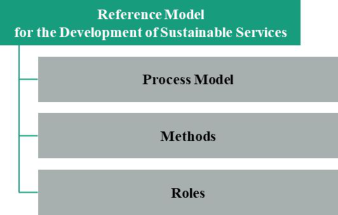
Figure 1: Components of the reference model.
resource- or process-related expenditures are reduced by sustainable services (e.g., through higher process or energy efficiency), or when revenues incre- ase as a result of sustainable services (e.g., through greater customer benefits such as satisfying the need to “do something good”).
In the product sector, the occupation with sustainability is more adva- nced than in the service sector (McKinsey 2021). Green product strategies are supported here by various certifications and standards (e.g. Greenhouse Gas Protocol, GRI Standards), and so-called “eco labels” are in use (e.g. EU Ecolabel). Services, however, are of great importance from an economic per- spective. Accordingly, service processes also contribute a considerable share to resource consumption and emissions. Certifications and labels to define “green standards” could therefore help to create reliability, comparability and transparency on “ecological footprints” of services. Another example in the context of standards is the so-called “EMAS” (Eco-Management and Audit Scheme). This is a certification according to the environmental mana- gement standard ISO 14001, with which companies can voluntarily commit to environmental management and an environmental audit (EMAS 2022).
REFERENCE MODEL In order to be able to implement strategic considerations for sustainable servi- ces, it is necessary to have a suitable set of tools in the operational area as well. For the creation of a new offering of ecologically sustainable services, this means in practice that suitable processes and methods for the develo- pment of such services must also be available. In the following, a reference model is presented that can be used to develop ecologically sustainable servi- ces (see Figure 1). This helps to structure the development, to collect and reuse existing knowledge, and to avoid mistakes from previous projects.
The core element of the reference model is what is known as the process model. This takes the form of a detailed description of the entire development process for services and the tasks to be conducted.
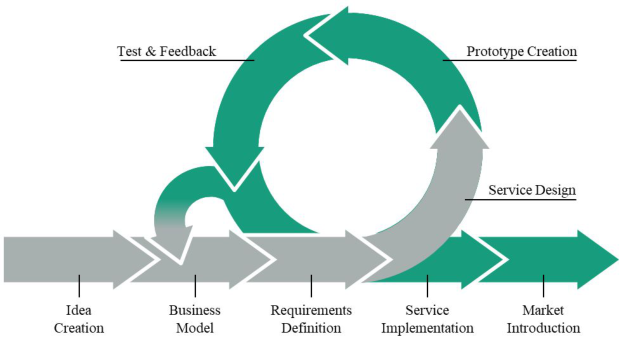
A semi-agile process model was chosen for the development of ecologically sustainable services (see Figure 2). The reason for this is that, on the one hand, it should be possible to develop different types of services as flexibly as possible. On the other hand, checks and controls are necessary to verify the definition and achievement of ecological goals.
298 Meiren and Schiller
Figure 2: Process model for new service development.
The process model begins with the Idea Creation phase, in which, for example, ideas for ecologically sustainable services are sought and speci- fied with the help of design thinking approaches. A business model is then developed for promising ideas, which includes ecological aspects as well as economic aspects. Subsequently, requirements for the new service are deter- mined and, in particular, detailed ecological specifications for the subsequent service development are derived. In the next agile development steps, concepts for the service are developed, prototypes are created and tested, and feedback from important stakeholders is obtained - and this continues until the spe- cified (ecological) goals and requirements are met. If necessary, the business model also has to be adjusted again. However, if the specifications can be met, approval is given for the subsequent implementation and market launch of the new service.
Although the process model forms the ‘backbone’ of the entire process, it does not describe in detail how the tasks are to be accomplished. Practitio- ners, in particular, would have difficulty at this point not knowing exactly what to do in order to successfully complete a task. For example, if a task such as the analysis of market and customer requirements seems obvious, the question still remains as to how exactly it should be carried out and which methods are available. The second level of the service engineering reference framework addresses precisely this challenge and provides a set of methods, templates and tools.
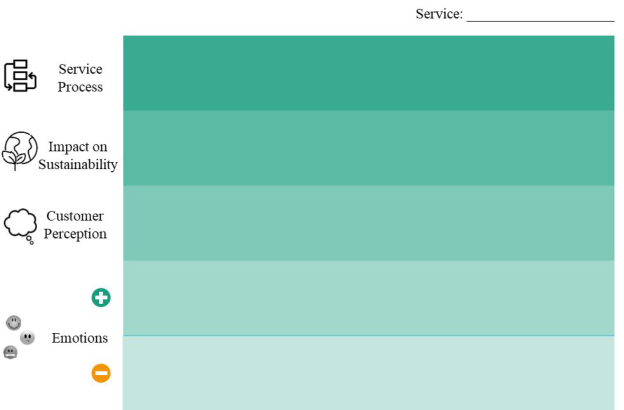
In addition to the many existing methods of service design and service engi- neering, the development of ecologically sustainable services requires special - adapted or even new - methods for taking sustainability aspects into account. Figure 3 shows a selected example of this. With the Service Empathy Board, it is possible to analyze individual activities in the service process both in terms of their ecological impact and the emotional reactions of customers.
The third level of the reference model consists of so-called roles. Here, organizational responsibilities are defined for specific tasks in the develo- pment process. A role can take on one or more tasks and be performed by
Development of New Sustainable Services 299
Figure 3: Adaptation of methods using the example of Service Empathy Board (Lamberth-Cocca and Meiren, 2017).
one or more persons at the same time. With a view to the development of ecologically sustainable services, it is advisable to define separate roles for this purpose - such as a “sustainability manager” or a “green service owner” - in order to lend emphasis to the topic.
OUTLOOK The topic of sustainability is on everyone’s lips and has gained increased attention in society in recent years. However, this is primarily in the area of goods production and information technology. The service sector is often not in the focus, but due to its size it offers considerable potential and should the- refore be the subject of “green” promotional activities. Although individual, promising approaches can be identified, there is a lack of integrated approa- ches with which complete service offerings can be designed sustainably across all types of services.
If service providers are already concerned with environmental sustainabi- lity, it is usually at the strategic level. In many cases, management has reco- gnized that sustainability is an important topic for corporate development. However, there are typically deficits in the operational implementation. The presented reference model is a first step to include ecological aspects in the development of ecologically sustainable services. It shows how development processes, methods and responsibilities must interlock in order to ultimately be economically and ecologically successful.
Sustainability is difficult to “prescribe”. In order to be successful in implementation and credible to their own customers, it is also particularly important for companies that employees and managers support the transfor- mation process - sustainability should not just be sold, but actively lived in the company, so to speak. Accompanying measures are needed to raise awareness
300 Meiren and Schiller
and build up the skills of everyone involved with the aim of creating a cor- porate culture that reconciles economy and ecology and thus secures the company’s long-term competitiveness.
ACKNOWLEDGMENT
The authors would like to acknowledge the Ministry of Economic Affairs, Labour and Tourism Baden-Wuerttemberg for funding this work within the Competence Center Smart Services.
REFERENCES
BSR/GlobeScan (2019): The State of Sustainable Business 2019. Results of the 11th Annual Survey of Sustainable Business Leaders. BSR and GlobeScan. Davis-Peccoud, J., Seemann, A., Jongeneel, M., Martins, F. (2018): Transforming
Business for a Sustainable Economy. Boston: Bain & Company. Desai, A., Mital, A. (2021): Sustainable Product Design and Development. Boca Raton: CRC Press. DIN SPEC 35201 (2015): Referenzmodell für die Entwicklung nachhaltiger Dien-
stleistungen. Berlin: Beuth. EMAS (March 1, 2022), The EU Eco-Management and Audit Scheme, Website: https://ec.europa.eu/environment/emas/. European Commission (March 1, 2022), EU Ecolabel, Website: https://europa.eu/youreurope/business/product-requirements/labels- markings/ecolabel/index_en.htm. GRI Global Reporting Initiative (March 1, 2022): The global standards for sustai-
nability reporting, Website: www.globalreporting.org. Haanaes, K., Michael, D., Jurgens, J., Subramanian, R. (2013): “Making Sustainability Profitable”, Harvard Business Review, Volume 91, No. 3. Hockerts, K. (2017), “Innovation of Eco-Efficient Services”, in: Charter, M.,
Polonsky, M.J. (eds.) Greener Marketing, London: Routledge. ISO 14001 (2015): Environmental management systems – Requirements with guidance for use. ISO 14001:2015. Journal of Service Research (2022), Special Issue on Sustainable Service, Call for
Paper. KPMG (2020): The time has come. The KPMG Survey of Sustainability Reporting
2020. KPMG International. Lamberth-Cocca, S., Meiren, T. (2017), “Service Empathy Board: A Method for the Agile Development of Mobility as a Service”, proceedings of the EVS30 Inter- national Battery, Hybrid and Fuel Cell Electric Vehicle Symposium. Stuttgart. Lamberth, S., Meiren, T. (2012), Green Services. Studie zu Trends und Perspektiven
nachhaltiger Dienstleistungsangebote. Stuttgart: Fraunhofer. McKinsey & Company (2021): How companies capture the value of sustainability: Survey findings. McKinsey Global Publishing. Meiren, T., Friedrich, M., Schiller, C. (2021), Smart Services. Mit digital unterstützten
Dienstleistungen in die Zukunft, Study, Stuttgart: Fraunhofer. Sassen, R., Azizi, L., Bien, C., Braun, V. (2021): Stand nachhaltigen Wirtschaftens in Deutschland. Berlin: Rat für Nachhaltige Entwicklung. Su, D. (2020): Sustainable Product Development. Tools, Methods and Examples.
Cham: Springer Nature.
Development of New Sustainable Services 301
Van Riel, A.C.R., Andreassen, T., Lervik-Olsen, L., Zhang, L., Mithas, S., Heinonen, K. (2021): “A customer-centric five actor model for sustainability and service innovation”, Journal of Business Research, Volume 136, November 2021. World Resources Institute, WBCSD (March 1, 2022), Green House Gas Protocol,
Website: https://ghgprotocol.org/.
LISTED IN THE AHFE DIGITAL BOOKSTORE CATALOGUE
Explore the complete digital volume
The Human Side of Service Engineering
Read this individual research paper free through the original publisher, or explore the full digital proceedings book.
ISBN 978-1-958651-38-4
Explore this ISBN in the AHFE Bookstore ↗Listed in the July 2026 bookstore catalogue; search by ISBN to confirm current availability · Digital book purchase optional