Christian Schiller, Michaela Friedrich, Simon Buchart (2022). Dissemination of smart product-service systems in the corporate world. In: The Human Side of Service Engineering. AHFE Open Access, vol. 62, pp. 279–285. https://doi.org/10.54941/ahfe1002568
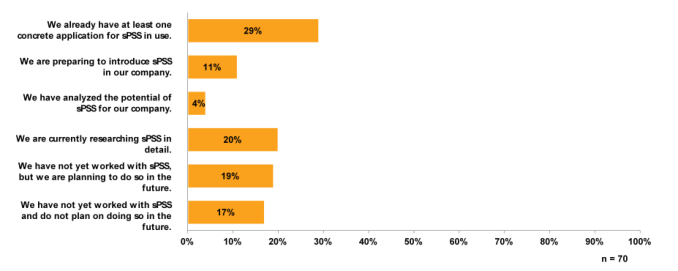
In the corporate world, the focus continues to be on technical innovations in particular. However, with the ever more widespread development of data-based and intelligent ("smart") systems, in which products and services are increasingly interlinked, this way of thinking quickly reaches its limits. The focus here is more on customer benefits, which form the basis for future innovations. Accordingly, the importance of integrated development of smart product-service systems (sPSS) is also increasingly coming into focus.To find out the extent to which products and services are already being developed in an integrated manner and what concrete support needs exist with regard to this topic in practice, Fraunhofer IAO conducted a broad survey among German companies. The survey was conducted in the summer of 2021, with 71 companies taking part. In terms of company size, there was a relatively even distribution. 56 percent of the companies surveyed had a workforce of up to 249 employees, while the remaining 44 percent had 250 or more employees. Across all company sizes, 59 percent assigned themselves to the secondary sector and 41 percent to the tertiary sector. Some interesting findings were derived from the survey. It is apparent that the development focus in the companies surveyed is increasingly moving away from product development toward service and system development. Despite this development, many companies still do not have defined development processes for the latter. Thus, there is a considerable need for research and transfer for service and systems research. It should be noted that most companies would rather see a dovetailing of classic product and service development approaches than the introduction of completely new and previously unknown models and processes.Another interesting finding from the survey is that an astonishing number of companies are already addressing the issue of sPSS. 29 percent of the survey participants even already have an sPSS application in use. Only 17 percent state that they have not yet addressed the issue and are not planning to do so in the near future. The remaining 54 percent lie between these two poles in terms of their experience with sPSS. Another striking aspect from the survey is the broad overall need for support that the companies surveyed identify for themselves in the development of sPSS. Of the ten items asked about the need for support, four had an approval rate above 40 percent and seven still above 30 percent. This supports the following hypotheses: on the one hand, that many companies are already dealing with the topic of sPSS. On the other hand, that there has been little concrete experience with the topic in practice. Overall, the survey shows that the topic of smart product service systems is receiving increasing attention in German companies. However, it also shows that there is still little concrete experience and that many companies are currently looking for external knowledge and expertise. The paper will go into more detail on the study results and show if there are differences between the surveyed companies, e.g. depending on company size, sector or previous orientation.
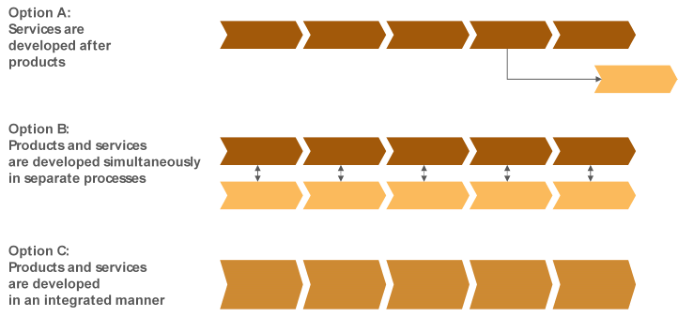
The phenomenon of increasing complementarity between services and physi- cal products has been under discussion in science and business since the early 1990s at the latest (Engelhardt et al., 1993). Physical products were being increasingly complemented by various services as a means of boosting custo- mer satisfaction as well as remaining competitive when compared with other companies. Even today, services are still being developed in a fairly ad-hoc way and are only added to the overall company offers after product deve- lopment is complete (see Figure 1). Some companies are already developing products and services simultaneously. In most cases, this involves the use of structured coordination phases between the respective development proces- ses. Either way, the term “bundles” of products and services is more accurate than “integrated systems”.
However, as of the late 2000s and early 2010s, increasing research efforts have focused on integrating product and service development processes (Spath et al., 2012). The aim is to reach a solution that adds value for both customers and providers when combined as a system. As a result, signifi- cant benefits are created for all involved through the structured addition of services to traditional physical products.
Yet from the later half of the 2010s, the advancement of digitalization has presented growing potential for products to be developed into cyber-physical
Figure 1: Different approaches to product-service system development. (Source: Spath/Meiren, zfbf 2012).
systems that are able to communicate with both other products and the inter- net (Abramovici et al., 2018). This will create entirely fresh potential for the provision of data-based and intelligent (“smart”) services (Freitag and Häm- merle, 2021). These resulting systems comprising of networked products and smart services are also known as smart product-service systems (sPSS). A distinctive feature of sPSS is their customer-oriented approach to solutions in order to generate genuine added value for users (Maleki et al., 2018). Fur- thermore, they display a high level of complexity, dynamism, and intricacy (Kuhlenkötter et al., 2017).
Nevertheless, how can we quantify motives, challenges, or even support requirements as well as any other relevant aspects when developing sPSS in German industry? To find an answer to this, 71 German companies were surveyed and analyzed as part of a research project. This publication pre- sents key findings from this survey. The results are intended to provide small and medium-sized enterprises (SMEs) with some guidance in the extensive topic of sPSS and give them an insight into how they can develop into system providers.
Study Design The study is based on a wide-ranging quantitative survey of companies in Germany. The survey questions were based on the development of services and products, e.g., what the current and future development priorities are, whether existing development priorities already exist, and how much time the development process requires. These were followed by questions concerning the development of smart product-service systems in particular, for example, how much experience the surveyed companies already have, which digital technologies they consider important, what motivates them to work on smart product-service systems, and where they encounter challenges or need sup- port. The survey was rounded off by general questions about the company, such as the number of employees and the industry it belongs to.
Dissemination of Smart Product-Service Systems in the Corporate World 281
The survey’s main target groups were companies that mainly focus on products and offer accompanying services (e.g., mechanical and plant engine- ering) as well as service providers that use a substantial amount of technology (e.g., telecommunications). Particular attention was paid to business-related service providers (“business-to-business”).
In total, 71 companies successfully completed the online questionnaire. The majority of the respondents (approximately three-fifths) belong to the secondary sector (manufacturing industry). All the remaining companies belong to the tertiary sector (services). In order to evaluate the size of the companies, the participants were classified according to their number of employees. 28 percent of the responding companies are classified as small companies with up to 49 employees. A further 28 percent of the partici- pating companies are medium-sized companies with up to 249 employees. Large companies with 250 to 2,499 employees account for 21 percent of the total, while the final 22 percent are comprised of companies with more than 2,500 employees. Small and medium-sized enterprises with up to 249 emplo- yees were grouped together. This corresponds to the European Commission’s definition of SMEs. For the purpose of identifying the most successful com- panies among the respondents, answers given regarding the development of key company figures — number of employees, sales and profit — were used as the starting point. The surveyed companies were asked to comment on how they had developed over the last three years in comparison with their own industry. Cluster analysis revealed three groups of companies based on the responses to this question: The first group reports largely positive key figures (“very successful companies”), the second group posts average key figures (“successful companies”) and the third group of companies presents more negative key figures (“less successful companies”). Altogether, the first group comprises 16 companies, the second group 30 companies and the third group 19 companies.
RESULTS
A selection of results from the survey can be found below. This publication looks at the prevalence of sPSS in business, the existence of defined develo- pment processes in the companies surveyed, as well as the challenges faced, support requirements and motives for addressing the topic.
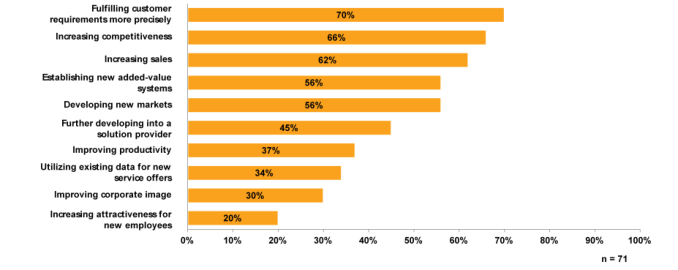
According to the respondents, one of the primary motives is to optimally fulfill customer requirements as well as to increase competitiveness and sales (see figure 2). Developing new added-value systems, exploring new markets or wanting to move towards becoming a solution provider only play an average role. One third of all companies surveyed still wish to use sPSS to improve productivity, harness existing data to develop new service offers, or improve the company’s image. Enhancing their appeal to new employees was only a key incentive for a minority of the survey participants.
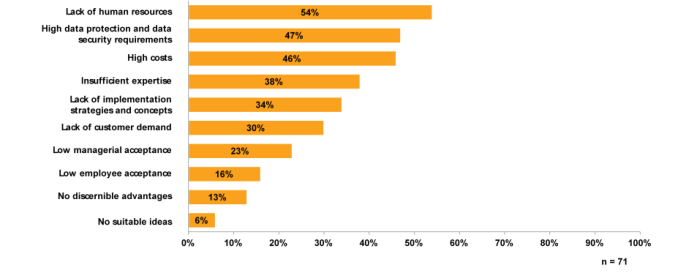
On top of their own incentives for engaging with sPSS, the companies were also asked about any potential challenges (see figure 3). Their main challenges include a lack of human resources, data protection and data security requi- rements as well as high costs. Compared with their motives, however, the
Figure 2: Motivation behind the use of smart product-service systems.Figure 3: Challenges in developing smart product-service systems.
responses show that companies perceive these challenges as less significant. This doesn’t change when comparing companies of different sizes. The only challenges identified by large companies were data privacy and data security, as well as acceptance among employees and managers. When it comes to the success of the company, it becomes apparent that very successful companies identify substantially larger challenges in the areas of data privacy and data security than less successful companies. In contrast, less successful companies identified significantly greater challenges in terms of lack of human resources when compared with the very successful companies.
When developing smart product-service systems, respondents noted the need for support primarily with regard to providing suitable methods and interlinking product and service development, which is then closely followed by business model design and data and information management. There is also demand for support when it comes to the design of defined development processes and software. Yet on the whole, the overall support requirements are not considered to be too great.
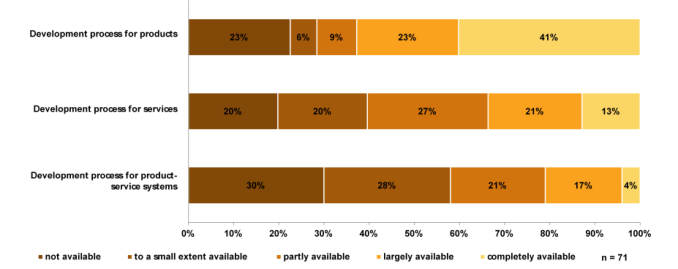
The existence and relevance of defined development processes for produ- cts, services and product-service systems is frequently discussed in scientific circles. 64 percent of the companies surveyed stated that defined development processes for products are either largely or wholly in place (see figure 4). However, only 34 percent of respondents say the same for the development
Dissemination of Smart Product-Service Systems in the Corporate World 283
Figure 4: Distribution of defined development processes among the surveyed companies.
of services, and only 21 percent for the development of product-service systems. In other words, there is considerable ground to be made up here. This applies in particular to the change in development focus towards services and product-service systems outlined in the previous question.
Companies that have defined development processes generally have greater motivation to work with smart product-service systems. At the same time, they are less likely to encounter challenges and require less support. What is particularly interesting is that very successful companies are far more likely to have defined development processes, or at the very least approaches to them, for product development, service development and product-service system development than the other companies. The same trend can also be seen when comparing successful and less successful companies.
As for the use of smart product-service systems (sPSS), 40 percent of the surveyed companies are either preparing to use them or are already using an application for sPSS (see figure 5). On the other hand, nearly the same percentage, that is 36 percent, have never worked with sPSS before. Over half of them plan on using sPSS, leaving only 17 percent of all respondents stating that they do not intend to use it in the future. Almost a quarter of all companies surveyed fall somewhere between these two extremes and either state that they are analyzing the potential of sPSS or that they are currently researching the subject in detail. Larger companies are more likely to have already introduced sPSS than SMEs. It is much rarer for large companies to indicate that they have not yet dealt with sPSS. It is a similar situation when looking at the different sectors: Industrial sector companies are more likely to already be using smart product-service systems than those in the service sector. Very successful companies are by far the most likely to currently be using sPSS.
Companies that have previous experience with sPSS tend to be distinctly more motivated to work with sPSS, particularly with a view of using exi- sting data to develop new service offerings, increase their competitiveness, fulfill customer requirements in a more tailored way and implement new added-value systems. Those companies lacking any practical sPSS experie- nce are more likely to face greater challenges more often. More specifically,
Figure 5: Experience with smart product-service systems.
they regard inadequate strategies and concepts as well as a lack of human resources as more of a challenge than companies with previous experience. Meanwhile, experienced companies consider data protection, data security and costs to be a greater challenge than inexperienced companies.
Companies with previous experience in sPSS are somewhat more likely to need support, although not with regard to all issues. This may be explai- ned by the fact that these companies are able to more accurately evaluate their support needs due to their experience. When it comes to interlinking product and service development, implementing intelligent components and integrating customers, experienced companies claim to require considerably more support. Yet where business models are concerned, less experienced companies, in contrast, see a slightly higher need for support.
CONCLUSION
Defining development processes is key to the successful development and introduction of smart product-service systems. The survey revealed that very successful companies and successful companies are far more likely to have somewhat defined development processes than less successful companies. These companies also exhibit a greater motivation in tackling this issue. Fur- thermore, they tend to face considerably fewer challenges and estimate a lower support requirement than companies that currently do not have any defined development processes in place.
The study confirmed that there is a direct link between corporate success and experience with the use of product-service system. However, there is no clear information about the exact direction of this correlation, therefore it is possible that companies that are more successful are much more likely to be involved with smart product-service systems and that companies that use smart product-service systems are also more successful because of this. Despite this, this correlation should still be taken into consideration, in part due to the high expectations attached to introducing smart product-service systems, and the fact that companies with previous experience also value smart product-service systems at a much higher level. As a result, these com- panies can draw their motivation from the fact that they have a better chance
Dissemination of Smart Product-Service Systems in the Corporate World 285
of meeting customer expectations and increasing their competitiveness and sales.
According to the results of the study, companies in the service sector appear to find implementing smart product-service systems particularly challenging. Product sector companies are much more likely to already be using smart product-service systems. Service providers apparently find it much more dif- ficult to gain the required skills or product expertise needed to do this. Developing product-service systems calls for an interdisciplinary approach. Therefore, developing a wide range of expertise is a wise move in order to meet the interdisciplinary challenges. This can take place by means of cooperative ventures, the use of consulting services, the further training of employees, or the establishment of new, specialized organizational units.
ACKNOWLEDGMENT
This article was written as part of the project ≫Integriertes Design smarter Produkt-Service-Systeme in KMU (bi.smart)≪. This research and develo- pment project is funded by the German Federal Ministry of Education and Research (BMBF) within the “Innovations for Tomorrow’s Production, Servi- ces, and Work” Program (funding number 02J19B042) and implemented by the Project Management Agency Karlsruhe (PTKA). The authors are responsible for the content of this publication.
REFERENCES Abramovici, M. (Hrsg.) (2018), Engineering smarter Produkte und Services, Plattform Industrie 4.0 Studie, acatech – Deutsche Akademie der Technikwissenschaf- ten, München.Booher, H.R., Minninger, J. (2003) “Human systems integration in army systems acquisition”, in: Handbook of human systems integration, Booher, Harold (Ed.). pp. 663–698. Dumitrescu, R., Albers, A., Riedel, O., Stark, R., Gausemeier, J. (Hrsg.) (2021), Engi-
neering in Deutschland – Status quo in Wirtschaft und Wissenschaft. Ein Beitrag zum Advanced Systems Engineering, Fraunhofer IEM, Paderborn. Folds, Dennis. Gardner, Douglas and Deal, Steve. (2008). Building Up to the Human Systems Integration Demonstration, INCOSE INSIGHT Volume 11 No. 2. Engelhardt, W.H., Kleinaltenkamp, M., Reckenfelderbäumer, M. (1993), Leistungsbündel als Absatzobjekte. Zeitschrift für Betriebswirtschaftliche Forschung, 45 (1993) 5, S. 394–426. Freitag, M., Hämmerle, O. (2021), Die Entwicklung von Smart Services im
Maschinen- und Anlagenbau: Ein Leitfaden. Fraunhofer IAO, Stuttgart. Kuhlenkötter, B., Wilkens, U., Bender, B., Abramovici, M., Süße, T., Göbel, J., Herzog, M., Hypki, A., Lenkenhoff, K.(2017), New Perspectives for Generating Smart PSS Solutions – Life Cycle, Methodologies and Transformation. Procedia CIRP, 64, S. 217-222, https://doi.org/10.1016/j.procir.2017.03.036. Maleki, E., Belkadi, F., Bernard, A. (2018), A Metamodel for Product-Service System
based on Systems Engineering approach. Procedia CIRP, 73, S. 39-44, https://doi. org/10.1016/j.procir.2018.04.016. Spath, D., Meiren, T., Münster, M. (2012), F&E-Management für Lösungsanbieter. In: Fleig, G.: Integration von Produkt und Service. Auf dem Weg zum Lösungsanbieter: Handelsblatt Verlagsgruppe, Düsseldorf, S. 73–87.
LISTED IN THE AHFE DIGITAL BOOKSTORE CATALOGUE
Explore the complete digital volume
The Human Side of Service Engineering
Read this individual research paper free through the original publisher, or explore the full digital proceedings book.
ISBN 978-1-958651-38-4
Explore this ISBN in the AHFE Bookstore ↗Listed in the July 2026 bookstore catalogue; search by ISBN to confirm current availability · Digital book purchase optional