Katharina Schulze, Michaela Friedrich (2025). Green Advantage: Key Differentiators in Business Sustainability. In: Human Factors, Business Management and Society. AHFE Open Access, vol. 176, pp. 26–33. https://doi.org/10.54941/ahfe1006300
More and more companies are recognizing that they have a responsibility to the environment but can also gain a competitive advantage through environmental sustainability. This is due to the fact because many customers prefer products that are advertised as climate-neutral, fairly traded or sustainable. In addition, companies are constantly faced with new regulatory requirements that need to be complied with. Environmental sustainability is also playing an increasingly important role in politics. Companies are required to tap into real potential to achieve sustainability effects and act economically at the same time. This requires them to formulate clear sustainability goals, incorporate these into their corporate objectives and the services they offer. While environmental sustainability is becoming increasingly recognized in the product sector, the service industry and small and medium-sized enterprises (SMEs) in particular are lagging behind in incorporating environmentally sustainable services into their portfolio. As part of a publicly funded project, the Smart Services Competence Center, the research team conducted a survey among 99 companies in Baden-Württemberg, Germany in summer 2024 to gain insights into their concepts of environmental sustainability. To what extent are environmentally sustainable measures already established in these companies? What motivates firms to become more sustainable and where do they see obstacles? Based on the company survey conducted, this conference paper will present what practices differentiate successful companies from less successful ones when it comes to environmental sustainability. For the classification into the success categories, the respondents answered three questions in the online questionnaire on the development of the following key figures over the period from 2021 to 2023: Number of employees, profit and turnover. Using a hierarchical cluster analysis, the respondents were divided into three groups based on their response behavior to the three questions mentioned: 35 respondents form the group of successful companies, another 35 respondents form the group of less successful companies. The remaining respondents fell between these two groups and thus form a group of moderately successful companies. These are not considered further, only the first two groups are compared.The data shows that successful companies use processes for measuring and evaluating sustainability more frequently and already offer their customers environmentally sustainable services more often. Further analyses are carried out to find out in which other aspects the successful companies differ from the less successful ones: What measures have they already implemented? What motivates them to deal with environmental sustainability?The survey responses show that SMEs are lagging behind large companies when it comes to environmental sustainability. The paper therefore examines what recommendations for action can be derived for SMEs from the knowledge gained, particularly from the successful companies.
More and more companies are recognizing their responsibility to the environment in order to meet a wide range of political and economic requirements (Crome et al., 2023). Though they also acknowledge the potential competitive advantage they might gain by meeting society’s growing need for sustainability, especially among the younger generation. Be it that young professionals want to have a positive impact on the world in their private lives as well as at work, or the growing interest of customers in whether companies take accountability for the environment and pursue transparent sustainability strategies (Pavlik, 2024; Crome et al., 2023).
Sustainability is certainly not limited to environmental aspects but can rather be described by the triple bottom line, containing ecological, social and governmental aspects (Schrettle et al., 2014). However, as this paper focusses on the first of the three, further mentioning of the term ‘sustainability’ in this paper refers to environmental issues.
The Competence Center Smart Services, which is an initiative funded by the Baden-Württember Ministry of Economic Affiars, Labor and Tourism, conducted a survey on these topics in 2024. In May 2025, detailed findings of this study have been published (Friedrich et al., 2025). This study confirms that companies are aware of these sustainability preferences, as complying with customer expectations was ranked as the major motivation to implement sustainable measures across all firms. Although the external conditions and requirements are assessed similarly by all surveyed companies and the motivational drivers are the same in most cases, differences between
Green Advantage: Key Differentiators in Business Sustainability 27
successful and less successful companies can be seen in the implementation of and approach to sustainability in the companies’ strategies.
The study shows that successful companies use methods for measuring and evaluating sustainability more frequently and already offer their customers environmentally sustainable services more often than less successful ones. As small and medium enterprises (SMEs) make up around 90% of businesses in the global economy, the importance of SME sustainability cannot be overstated (Kannan & Gambetta, 2025). However, the study also highlights that SMEs are lagging behind large companies when it comes to addressing environmental sustainability. Thus, the authors assume that the knowledge gained on what successful companies do differently regarding sustainability might be of use for SMEs struggling with implementing sustainable products and services.
The authors therefore attempt to work out what differentiates successful and less successful companies in terms of sustainability strategies. Recommendations for action will then be formulated to help companies meet customer expectations regarding sustainability and at the same time operate as successfully as possible on the market.
LITERATURE REVIEW
In order to be able to classify the results of the survey, it is worth taking a look at the literature published to date. The relationship between sustainability activities and corporate performance is often considered in this context. However, definitions of such performance differ in the various publications.
In a 2021 McKinsey study, respondents were optimistic that sustainability programs will create value for their company in the future. Around 40 percent of respondents stated that they expect introduced sustainability programs to generate modest or significant value over the next five years (Granskog et al., 2021). Generally, research regarding the link between sustainability efforts and the success of companies varies in its findings. While studies focusing on success as financial performance on the stock market mostly observed a positive relationship, those putting their focus on a consumer’s willingness to pay were not able to back those findings, suggesting that consumers show no real preference for sustainable products regarding their willingness to pay (Schrettle et al., 2014). However, several studies indicate that consumers value ecologically conscious products and thus majorly influence supply (Hristov & Chirico, 2019; Rabadán et al., 2019; Frank et al., 2024). Customer satisfaction generally arises from the correspondence between the perceived performance and the previously generated expectations of a target state. It is assumed, that the ecological transformation of value creation will increasingly influence these expectations in the future through ecological aspects (Kieffer-Radwan & Horn, 2024).
Technology and technological development, as well as capabilities can influence a firm’s knowledge base and thus have an influence on a firm’s sustainability approaches (Rabadán et al., 2019). Whether or not companies engage in sustainability practices is further influenced by its past decisions. Firms who have already invested in similar fields in the past and thus have
28 Schulze and Friedrich
already gained competences, are more willing to repeat that in the future compared to those not familiar with the investments in those areas (Schrettle et al., 2014).
Viewing sustainability as an opportunity rather than a threat to a firm’s future performance majorly influences how progressively a company acts regarding its sustainability initiatives (Schrettle et al., 2014). Schrettle et al. (2014) further mentioned the importance of a first mover advantage when analyzing the impact of a firm’s sustainability efforts and their impacts on its performance. By being the first one to implement a successful sustainability initiative in a specific market, a firm can gain a (temporary) competitive advantage and thus push its competitors to follow (Schrettle et al., 2014; Rabadán et al., 2019). Cost reductions through so-called eco-innovations and therefore reductions in energy and other resource demands are another way sustainable products and services positively impact a firm’s financial performance. This aspect may be further strengthened when taking subsidies and access to ‘green funds’ into account (Rabadán et al., 2019).
While many firms have implemented some sort of sustainable management system, these are oftentimes separate from the main corporate strategy. This inadequate link between strategy and sustainability efforts makes it difficult to recognize the actual connection and involvement of environmental initiatives in a company’s financial performance. To purposefully integrate sustainability into the company strategy, careful selection of KPIs is necessary. The selection of relevant KPIs allows for measurement of project outcomes which in turn are directly correlated with a firm’s goals and thus performance (Hristov & Chirico, 2019).
The measurability and transparency of sustainability are also becoming increasingly relevant for companies when it comes to investment decisions. While large companies are obliged by various legal regulations to publish ESG information, SMEs are hardly affected by this, which can be detrimental to investments (Ozkan et al., 2023). Sustainability reports from SMEs are currently voluntary or have so far only been required when reporting obligations are ‘passed on’. This means, for example, when SMEs work as suppliers for large companies or banks who require such information from them for their own reporting (Ortiz-Martínez et al., 2023). It can therefore be assumed that transparent sustainability reporting can also have an influence on the success of a company with regard to investors, as it is already part of loan negotiations, especially for companies with high annual turnovers (Abel-Koch, 2022). But it is not only new developments in reporting that lead to new initiatives. More than 80% of companies already recognize successes through holistic sustainability concepts or feel disadvantages if they do not address these issues (Kieffer-Radwan & Horn, 2024).
A major focus in the literature thus far has been the perspective of how sustainability and its reporting can positively influence companies’ performances. However not many looked at it from the other direction aiming to analyze if and how successful companies differ in their approach to implementing green services.
Green Advantage: Key Differentiators in Business Sustainability 29
METHODOLOGY
The study is based on a quantitative survey of companies in Germany, particularly in Baden-Württemberg. It was conducted as part of the “Smart Services Competence Center” initiative funded by the state of Baden- Württemberg. Four steps were required to conduct the study:
- development of the questionnaire - selection of the target group - collection of the data - analyzing and processing the results.
The questionnaire was developed based on extensive content research and analysis as well as discussions between the project partners on the topic of ecological sustainability in services. Experience from previous comparable project work and company surveys from the past was drawn on in the process. The target group was deliberately not limited to specific sectors, as environmental sustainability in services is relevant to practically all sectors. Specialists and managers from large companies and small and medium-sized enterprises were contacted in two large mailings. In addition, the link to the survey was publicized via social media, Chamber of Industry and Commerce and Chamber of Crafts newsletters and in the networks of the participating partners. To collect the data, interested companies were provided with a link to the survey. The corresponding questionnaire was created using the LimeSurvey® software and could be completed online. The questions were answered anonymously. The results were analyzed and processed using the statistical software IBM® SPSS® Statistics 26. The online survey was conducted in the second half of 2024. A total of 99 people completed the questionnaire in a usable form.
At just over two thirds, most of the responding companies belong to the tertiary sector (services). The remaining companies come from the secondary sector (manufacturing, including construction). To assess company size, the participating companies were classified according to their number of employees. Companies with up to 249 employees were grouped together as small and medium-sized enterprises. This corresponds to the European Commission’s definition of SMEs. This accounts for 81 percent of the companies surveyed. The remaining companies therefore represent large companies with 250 or more employees. This corresponds to 19 percent of companies.
An interesting aspect of the study is the question of whether and where exactly there are concrete differences between successful and less successful companies. To filter out the successful companies among the responding companies, the question of the development of important company key figures - number of employees, turnover and profit - was analyzed. Here, the companies surveyed were able to indicate how they had developed over the last three years in comparison to their own sector. With the help of a cluster analysis, the answers to this question revealed a group of companies with largely positive key figures (“successful companies”) as well as a group of companies with rather negative or neutral key figures (“less
30 Schulze and Friedrich
successful companies”). Both groups comprise 35 companies each. A further 22 companies lie in the midfield between the companies defined as successful and less successful and are ignored in the following observations, so that only the two groups that differ more strongly from each other are compared.
FINDINGS A major difference between the two groups is shown by the fact that 29% of the less successful companies state that they have not yet dealt with ecologically sustainable services at all. In the group of successful companies, this proportion is less than half of that at 14%. Similarly, almost twice as many successful companies are in the process of exploring the potential of green services for their company than those in the other group. This shows the fundamental differences in previous experience and openness to the topic of sustainability between the two groups.
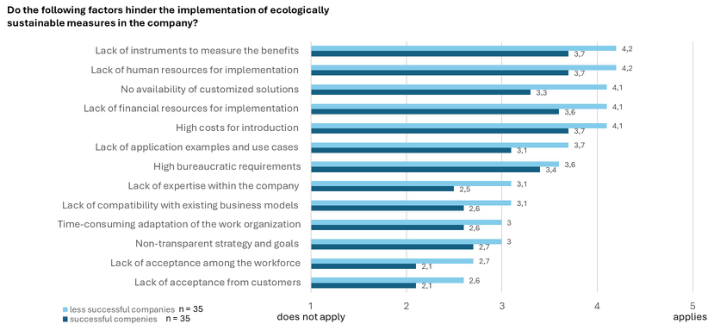
When looking at the data, it is striking that 80% of the companies classified as successful use tools to measure, evaluate and design environmental sustainability. This proportion is only 69% for the less successful. Interestingly, less successful companies rate the lack of tools to measure the benefits of sustainability higher than the successful ones when asked which factors hinder the implementation of environmentally sustainable measures in companies. Even though successful companies still rate the relevance of this item highly, there appears to be a considerable knowledge gap between the two groups, resulting in SMEs making less use of the relevant tools.
The importance of company specific KPIs to keep track of positive and negative sustainability project goals has been highlighted in previous literature. To be able to link ecological strategy to company performance, KPIs that correlate with the overall firm’s strategy, can effectively represent the value creation process and above all those that are comprehensible and comparable have been suggested (Hristov & Chirico, 2019). Generally, the obstacles are ranked similarly by both groups, however, the rating itself is
Green Advantage: Key Differentiators in Business Sustainability 31
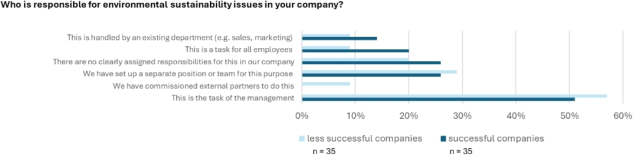
slightly higher for the less successful companies, making it clear that they generally perceive the hurdles to be higher. This is also reflected in the answers to the question as to whether companies already offer ecologically sustainable services. Sustainable services in this survey were defined as services that trigger increased sustainability on the customer side, be it through reduced resource consumption, reuse of resources or other aspects. 31% of the companies classified as successful answer this question with “yes” while only 23% of the less successful firms responded positively to this question. Even though sustainability is the responsibility of the management for most respondents in both groups of companies (just over 50%), the results show that, at 26%, successful companies are significantly more likely to have set up a dedicated position or team for sustainability. In comparison, only 9% of less successful companies have created such explicit responsibilities.
In line with our findings, a McKinsey survey from 2021 found that the management of companies stating they have made profit from their sustainability programs in the past five years, made sustainability a priority in their company strategy (Granskog et al., 2021).
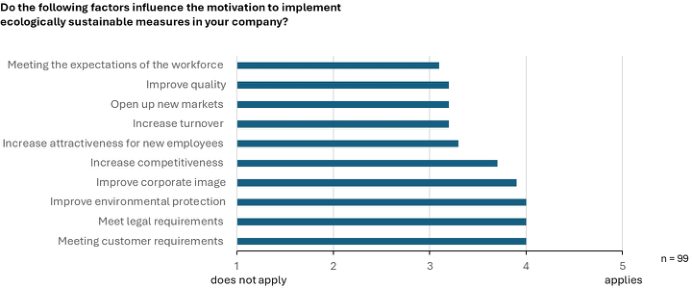
However, there is hardly any difference in the motivation for sustainable measures. Both groups surveyed, put the fulfilment of customer requirements ahead of legal requirements. This makes it clear that the external conditions and requirements are perceived similarly by both groups.
Figure 3: Motivation in general (own presentation).
32 Schulze and Friedrich
CONCLUSION AND RECOMMENDATIONS FOR ACTION Studies have shown that a sustainable strategy can have a positive impact on business performance, particularly in terms of reputation and cost savings through increased efficiency of resources used (Hristov & Chirico, 2019). Successful companies are increasingly concerned with measuring and evaluating sustainability in their own company. This not only makes it easier to keep an eye on targets and developments, but also to make sustainability efforts visible to customers and potential investors. This allows the company to tap into a clientele that is increasingly concerned with the topic, and important investor funds can be generated.
Therefore, companies such as SMEs that thus far struggle to implement sustainability initiatives should establish specific KPIs linked to their individual sustainability goals and overall company strategy in order to keep track of such targets. Especially SMEs are encouraged to explore implementing sustainable services to profit from competitive advantage. As there seems to be a major knowledge gap regarding measurement and implementation tools within the less successful group, SMEs are advised to overcome this gap by seeking external support in this area, if this knowledge is not available within the organization. Additional training and resources should be provided to keep everyone in the loop.
Based on the results of our study, major differences between the two groups were found in who is taking responsibility for sustainability practices in a country. While resource limitations might make it difficult for SMEs to implement explicit teams, it might be useful to set up staff units that put their focus on this topic and help keep the management up to date on recent developments. This can also help with acceptance within the workforce.
ACKNOWLEDGMENT
The authors would like to acknowledge the partners involved in the Smart Service Competence Center, as well as the Baden-Württemberg Ministry of Economic Affairs, Labor and Tourism.
REFERENCES
Abel-Koch, J. (2022). ‘Unternehmensbefragung 2022: Finanzierungsklima erholt sich von der Corona-Krise – Nachhaltigkeit gewinnt an Bedeutung’. KfW Bankengruppe. Crome, C., Meyer-Hollatz, T., Oberländer, A. M., Graf-Drasch, V., Urbach, N.,
Hinsen, S., (2023). Digital und nachhaltig die Zukunft sichern: Wie Unternehmen die Twin Transformation meistern können., Ernst & Young GmbH. Frank, L., Neef, N. E. and Otto, S. (2024) ‘Nachhaltige Dienstleistungen aus Kundensicht – Das Zusammenwirken von Verhaltenskosten und Nachhaltigkeitsmotivationen’, in: Sustainable Service Management Band 1: Nachhaltigkeit aus Sicht von Kunden und Mitarbeitern, Bruhn, M., Hadwich, K (Ed.). pp. 123–144. Friedrich, M., Schiller, C., Said, C., Stern, E., Glaudinger, I., Guhl, J., Fulde, T.
(2025). Green Services-Welchen Stellenwert hat ökologische Nachhaltigkeit im Unternehmen?, Fraunhofer IAO. doi:10.24406/publica-4571.
Green Advantage: Key Differentiators in Business Sustainability 33
Granskog, A., Hannon, E., Hieronimus, S., Klaeyle, M., Winkle, A. (2021).
Sustainability Practice How companies capture the value of sustainability: Survey findings., McKinsey Global Publishing. Hristov, I. and Chirico, A. (2019) ‘The role of Sustainability Key Performance Indicators (KPIs) in Implementing Sustainable Strategies’, Sustainability, 11(20). doi: 10.3390/su11205742. Kannan, S. and Gambetta, N. (2025) ‘Technology-driven sustainability in small
and medium-sized enterprises: A systematic literature review’, Journal of Small Business Strategy, 35(1), pp. 129–157. doi: 10.53703/001c.126636. Kieffer-Radwan, S. and Horn, A. (2024) ‘Green Services für Kundenzufriedenheit in der Kreislaufwirtschaft’, in: Sustainable Service Management Band 1: Nachhaltigkeit aus Sicht von Kunden und Mitarbeitern, Bruhn, M., Hadwich, K (Ed.). pp. 213–235. Ortiz-Martínez, E., Marín-Hernández, S. and Santos-Jaén, J.-M. (2023) ‘Sustainability, corporate social responsibility, non-financial reporting and company performance: Relationships and mediating effects in Spanish small and medium sized enterprises’, Sustainable Production and Consumption, 35, pp. 349–364. doi: 10.1016/j.spc.2022.11.015. Ozkan, S., Romagnoli, S. and Rossi, P. (2023) ‘A novel approach to rating SMEs’
environmental performance: Bridging the ESG gap’, Ecological Indicators, 157. doi: 10.1016/j.ecolind.2023.111151. Pawlik, V. (2024) Relevanz von Nachhaltigkeit als Kaufkriterium 2021, Statista.
Available at: https://de.statista.com/statistik/daten/studie/1285879/umfrage/ nachhaltigkeit-als-kaufkriterium/ (Accessed: 07 February 2025). Rabadán, A., González-Moreno, Á. and Sáez-Martínez, F. J. (2019) ‘Improving firms’ performance and sustainability: The case of eco-innovation in the Agri-Food Industry’, Sustainability, 11(20). doi: 10.3390/su11205590. Schrettle, S. et al. (2014) ‘Turning sustainability into action: Explaining firms’
sustainability efforts and their impact on firm performance’, International Journal of Production Economics, 147, pp. 73–84. doi: 10.1016/j.ijpe.2013.02.030.
LISTED IN THE AHFE DIGITAL BOOKSTORE CATALOGUE
Explore the complete digital volume
Human Factors, Business Management and Society
Read this individual research paper free through the original publisher, or explore the full digital proceedings book.
ISBN 978-1-964867-52-6
Explore this ISBN in the AHFE Bookstore ↗Listed in the July 2026 bookstore catalogue; search by ISBN to confirm current availability · Digital book purchase optional